Download high-resolution image
Listen to a clip from the audiobook
audio play button
0:00
0:00

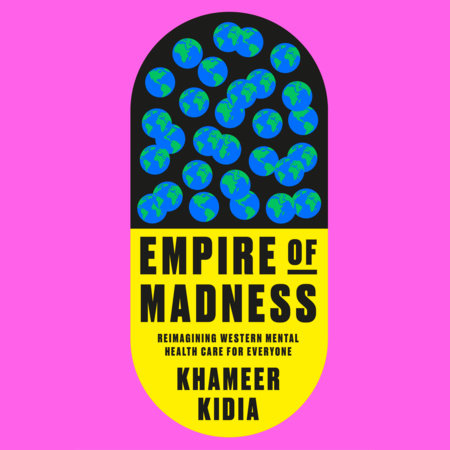
Empire of Madness

Reimagining Western Mental Health Care for Everyone

Listen to a clip from the audiobook
audio play button
0:00
0:00
An urgent rethinking of the Western approach to mental health, which treats the symptoms rather than the exploitative systems causing our distress—by a Rhodes Scholar and Harvard Medical School physician-anthropologist—offering lessons from the rest of the world.

What if the mainstay of mental health care involved cancelling onerous debt, giving poor people free housing, and paying reparations to the descendants of slavery and colonialism? In Empire of Madness, Dr. Khameer Kidia re-evaluates the Western approach to mental health, which medicates symptoms instead of changing the structures that harm the human psyche. A physician and researcher whose own family suffers from the psychological effects of colonialism, Kidia highlights the limitations of the Western mental health model by reporting from the front lines of mental health crises at home, in the clinic, and during a decade of fieldwork.

Clear-eyed and openhearted, Kidia asks the nuanced questions unaddressed by our current mental health model: How do history, culture, and politics shape mental distress? Are hoarding and burnout medical diagnoses or social problems? Why are schizophrenia outcomes sometimes better in poor countries without antipsychotics? Can a traditional healer treat mental illness better than a Western-trained clinician? For those living in poverty, can cash replace pills?

With rigorous research, cutting analysis, and illuminating prose, Kidia invites us to reimagine mental health as a global idea where our wellbeing is mutual and everyone’s voice—patients, caregivers, and healthcare workers alike—matters.
Chapter 1

Nervous Breakdowns

Harare, Zimbabwe, 2020

Chief Complaint: “I’m having a nervous breakdown.”

History of Present Illness: Sixty-­eight-­year-­old Zimbabwean-­Indian female with a history of depression and anxiety presents with suicidal ideation and a “nervous breakdown.”

The patient is a pleasant lady accompanied by her son, a physician. She says that about three months ago her small business became insolvent because of the pandemic's impact on the Zimbabwean economy. “It all came as a shock,” she explained. “Our sales figures were terrible. We were in the red for months.”

Since the onset of the stressor, the patient’s mental health has gradually deteriorated. At first, she was stressed and fearful. She was worried about what was going to happen to the business; she had recurring thoughts that she might lose every­thing. “I was so scared,” she says. She believes she is having a “nervous breakdown,” which she describes as prolonged periods (weeks to months) of paralytic mental distress during which she is unable to fully function. She mostly stays in bed, except for running a few errands each day. She has had several such nervous breakdowns over the course of her life, beginning as a teenager.

She is currently experiencing passive suicidality: wishing she wasn’t around any longer but with no active plan to take her life. She has limited access to guns or other lethal means. Recently, she had a biopsy for uterine cancer and, while awaiting the results, told her son that she would decline chemotherapy should the biopsy turn out to be malignant. Fortunately, the tumor was benign.

Sometimes, about once or twice a year, the patient has periods of very high energy when she regains her desire to live and experiences elated mood. Her son explains that during these periods she is more likely to start fights, sever important social ties with friends or family members, and make rash financial decisions.

Financial worries, in general, seem to affect the patient’s mood dramatically. When she is in debt or her bank balance is low, she develops severe, often crippling anxiety. Most of the time, the patient has some kind of financial concern on her mind, often related to wealth inheritance. She explains that her biggest stressor right now is deciding how to write up her will and how she will continue to afford to pay the house expenses and grocery bills now that her small business had to close.

Her primary social support comes from her children. She subscribes to the Indian customs of multigenerational family living and care. She also has a high care burden and suffers from caregiver fatigue. She has a history of childhood trauma and has had one prior mental health hospitalization. Her medication trials include sulpiride, fluoxetine, sertraline, mirtazapine, quetiapine, lamotrigine, bromazepam, and lorazepam. She is currently stable on sulpiride and lamotrigine.

I have been shaped by my mother’s experience with mental distress. When I was growing up, no one really understood what was going on with her. We could tell she was suffering, and we knew she was getting antidepressants from our GP, but we didn’t know where her nervous breakdowns came from or what to do about them. Most of the time, we did nothing, and eventually—sometimes after months—­she would spontaneously improve.

My mother’s aura dictated my childhood. When she was on edge, disappointed, grieving, irate, annoyed, calm, or elated, her mood would diffuse throughout our home and press up against me until I either let it in and shared it or fought against it, stirring up conflict. This experience with intersubjectivity taught me, at an early age, that our emotional lives don’t exist in a vacuum. It was perhaps the most important lesson I would learn about mental well-­being, but it is one that I have forgotten and had to relearn many times in my efforts to understand where mental distress comes from and what to do about it.

Over the last decade, in both Zimbabwe and the United States, caring for and studying patients with mental distress like my mother’s, I’ve been taken by surprise again and again. I was surprised, for instance, to learn in medical school that there is no official diagnosis of “nervous breakdown,” which I had grown up believing was the most severe form of mental collapse that could befall a person. Instead, nervous breakdowns, for which there are web pages from the Mayo Clinic, Cleveland Clinic, and WebMD, exist in Western culture as a social diagnosis. Nervous breakdowns occur when the demands of society are just too much for the sufferer, who must temporarily hit the pause button and recover from the stress of it all. Perhaps the closest term in psychiatry would be “acute stress disorder.”   But acute stress disorder occurs in response to a traumatic exposure, and it can last only one month; any longer and it becomes known as PTSD. Sometimes my mother’s nervous breakdowns persisted for months on end.

How we decide in medicine what is or is not a real psychiatric diagnosis is dependent largely on the Diagnostic and Statistical Manual of Mental Disorders (DSM). Since its inception in 1952, the DSM has been updated multiple times, the number of mental diagnoses growing dramatically each time. But these updates are less rooted in science and more determined by political pressure of pharmaceutical and insurance companies and contemporary opinions of what constitutes “disorder” among the individuals on the DSM committee, who have been mostly white, male, American psychiatrists. For example, in 2013, hoarding, which was listed as a symptom of obsessive-­compulsive personality disorder in DSM-­IV, became a separate diagnosis of “hoarding disorder” in DSM-­5, treatable with selective serotonin reuptake inhibitors (SSRIs). Even when research is used to justify a category, as we are now doing for “burnout,” which by some estimates affects up to 55 percent of Americans, the decision about what types of data to collect is itself political and subject to bias. This is why we have so few data on the health of women or sexual and gender minorities, because the white men who run academic institutions simply do not value this type of research.

Despite being taught in medical school that nervous breakdowns aren’t “real,” I still rather like the term. It is, after all, what my mother calls her own mental distress. And since the terms we use to describe mental distress are socially determined, I see no reason to force another term (“bipolar disorder,” “major depression”) on my mother. Moreover, as a physician, I like that nervous breakdowns are both symptomatic and therapeutic. Imagine if, when you are overwhelmed with the demands of society, you could, for a discrete period, hit the pause button and stop tending to your responsibilities in life so that you had a moment to disconnect, breathe, and pick up the broken pieces of your psyche. More of a nervous break than breakdown. This is what Jerry Useem argues for in his 2021 Atlantic essay “Bring Back the Nervous Breakdown,” written at a point in America’s history when everyone was on edge about the pandemic and the world’s polarized politics.

Many non-­Western cultures have their own version of nervous breakdowns. Nervios, a common expression in many Latin American cultures, “occur in response to stressful social events and are commentaries on a social world out of control,” writes a team of researchers including the cross-cultural psychiatrist Roberto Lewis-­Fernández, who helped lead the cultural approach used in DSM-­5. The related phenomenon ataque de nervios is an “acute, dramatic episode which occurs as the result of a major stressful event, particularly in the family sphere . . . the whole episode is relatively brief, with a rapid return to the pre-­ataque state.”

Anthropologists call these expressions—­“nervous breakdown,” “burn­out,” ataque de nervios—idioms of distress:6 cultural ways of articulating suffering. Other examples are khyâl (wind attacks) among traumatized Cambodian refugees, dhiki (stress or agony) in Kenya, and tensan (tension) in North India. Idioms of distress remind us that suffering, not our response to it, is universal. How we make meaning of physical or emotional suffering is shaped by our culture and our context. The problem with Western medicine is that it cherry-­picks the responses it believes are appropriate and delegitimizes the rest.
© The Light Committee
Khameer Kidia is a writer, physician, and anthropologist at Harvard Medical School and University of Zimbabwe. A Rhodes Scholar and 2023 New America Fellow, Kidia has worked on global mental health research, practice, and advocacy for the last decade. His writing has been published in New England Journal of Medicine, Lancet Psychiatry, The New York Times, Slate, Yale Review, and Los Angeles Review of Books. Born in Zimbabwe, Kidia lives between Harare and Washington, D.C. View titles by Khameer Kidia
Empire of Madness argues that the solution to our mental health crisis is not more psychiatry, but more justice. Khameer Kidia makes the powerful case that what we diagnose as individual illness is often a rational response to structural violence. This is an essential, paradigm-shifting book.”—Anne Boyer, Pulitzer Prize winning author of The Undying

“Kidia unfolds one brilliant revelation after another, deftly moving between incisive social and geopolitical analysis of what Western medicine calls ‘mental illness’ and personal experience, as a child-of-empire-turned-Western-educated physician. Empire of Madness is required reading for anyone who seeks to improve health care, as well as anyone who wishes to better understand their own mental distress.”—Grace M. Cho, author of National Book Award Finalist, Tastes Like War

“[A] bold debut treatise from physician Kidia . . . Kidia incisively reveals how the Western mental healthcare system simplifies the complexities of emotional suffering to the detriment of patients and doctors. It’s an impassioned plea to rethink what it means to feel well.”Publishers Weekly, starred review

“Deeply researched . . . An ambitious take on the diagnosis and treatment of mental health issues viewed through a cross-cultural lens.”Kirkus Reviews

“This book is going to change many lives. Using thorough research, heart-wrenching introspection, and above all, compassion . . . here is a bold vision of another way to approach mental health, one that does a lot less harm and a lot more healing. Just read it, you will thank me later.”—Mona Chalabi, Pulitzer Prize winning data journalist

“Moving nimbly between the Global North and Global South, Kidia unpacks why we are faced with a global mental health crisis and what we can do to fix it. Meticulously researched and compassionately written, Empire of Madness is an urgently needed update to the Western mental health canon, bringing the rest of the world into view.”—Dixon Chibanda, professor of psychiatry and global mental health, London School of Hygiene and Tropical Medicine, and author of The Friendship Bench

“In Empire of Madness, Khameer Kidia does something rare and necessary: traces the roots of Western psychiatry back through colonial violence and family memory. This book challenges readers to see how deeply empire shapes not just who receives care, but how we understand mental suffering itself. A vital intervention that asks whether the tools we’ve inherited can ever truly heal us.”—Esmé Weijun Wang, author of The Collected Schizophrenias

“Boldly interrogating his own complicity in the system he critiques, Kidia brings a fresh, radical, and essential voice that reimagines the possibilities for global health care—and for a more compassionate world.”—Albert Samaha, author of Concepcion: An Immigrant Family’s Fate

“Blending vivid personal storytelling with history, anthropology, and medicine, Empire of Madness provocatively exposes the quicksand of a biomedical approach to mental health problems. Kidia highlights the importance of culture and context and prescribes the powerful antidotes of community action and social reform. A must-read for everyone interested in a refreshing, even radical, perspective on mental health.”—Vikram Patel, Paul Farmer Professor and Chair of Global Health and Social Medicine, Harvard Medical School

About

An urgent rethinking of the Western approach to mental health, which treats the symptoms rather than the exploitative systems causing our distress—by a Rhodes Scholar and Harvard Medical School physician-anthropologist—offering lessons from the rest of the world.

What if the mainstay of mental health care involved cancelling onerous debt, giving poor people free housing, and paying reparations to the descendants of slavery and colonialism? In Empire of Madness, Dr. Khameer Kidia re-evaluates the Western approach to mental health, which medicates symptoms instead of changing the structures that harm the human psyche. A physician and researcher whose own family suffers from the psychological effects of colonialism, Kidia highlights the limitations of the Western mental health model by reporting from the front lines of mental health crises at home, in the clinic, and during a decade of fieldwork.

Clear-eyed and openhearted, Kidia asks the nuanced questions unaddressed by our current mental health model: How do history, culture, and politics shape mental distress? Are hoarding and burnout medical diagnoses or social problems? Why are schizophrenia outcomes sometimes better in poor countries without antipsychotics? Can a traditional healer treat mental illness better than a Western-trained clinician? For those living in poverty, can cash replace pills?

With rigorous research, cutting analysis, and illuminating prose, Kidia invites us to reimagine mental health as a global idea where our wellbeing is mutual and everyone’s voice—patients, caregivers, and healthcare workers alike—matters.

Excerpt

Chapter 1

Nervous Breakdowns

Harare, Zimbabwe, 2020

Chief Complaint: “I’m having a nervous breakdown.”

History of Present Illness: Sixty-­eight-­year-­old Zimbabwean-­Indian female with a history of depression and anxiety presents with suicidal ideation and a “nervous breakdown.”

The patient is a pleasant lady accompanied by her son, a physician. She says that about three months ago her small business became insolvent because of the pandemic's impact on the Zimbabwean economy. “It all came as a shock,” she explained. “Our sales figures were terrible. We were in the red for months.”

Since the onset of the stressor, the patient’s mental health has gradually deteriorated. At first, she was stressed and fearful. She was worried about what was going to happen to the business; she had recurring thoughts that she might lose every­thing. “I was so scared,” she says. She believes she is having a “nervous breakdown,” which she describes as prolonged periods (weeks to months) of paralytic mental distress during which she is unable to fully function. She mostly stays in bed, except for running a few errands each day. She has had several such nervous breakdowns over the course of her life, beginning as a teenager.

She is currently experiencing passive suicidality: wishing she wasn’t around any longer but with no active plan to take her life. She has limited access to guns or other lethal means. Recently, she had a biopsy for uterine cancer and, while awaiting the results, told her son that she would decline chemotherapy should the biopsy turn out to be malignant. Fortunately, the tumor was benign.

Sometimes, about once or twice a year, the patient has periods of very high energy when she regains her desire to live and experiences elated mood. Her son explains that during these periods she is more likely to start fights, sever important social ties with friends or family members, and make rash financial decisions.

Financial worries, in general, seem to affect the patient’s mood dramatically. When she is in debt or her bank balance is low, she develops severe, often crippling anxiety. Most of the time, the patient has some kind of financial concern on her mind, often related to wealth inheritance. She explains that her biggest stressor right now is deciding how to write up her will and how she will continue to afford to pay the house expenses and grocery bills now that her small business had to close.

Her primary social support comes from her children. She subscribes to the Indian customs of multigenerational family living and care. She also has a high care burden and suffers from caregiver fatigue. She has a history of childhood trauma and has had one prior mental health hospitalization. Her medication trials include sulpiride, fluoxetine, sertraline, mirtazapine, quetiapine, lamotrigine, bromazepam, and lorazepam. She is currently stable on sulpiride and lamotrigine.

I have been shaped by my mother’s experience with mental distress. When I was growing up, no one really understood what was going on with her. We could tell she was suffering, and we knew she was getting antidepressants from our GP, but we didn’t know where her nervous breakdowns came from or what to do about them. Most of the time, we did nothing, and eventually—sometimes after months—­she would spontaneously improve.

My mother’s aura dictated my childhood. When she was on edge, disappointed, grieving, irate, annoyed, calm, or elated, her mood would diffuse throughout our home and press up against me until I either let it in and shared it or fought against it, stirring up conflict. This experience with intersubjectivity taught me, at an early age, that our emotional lives don’t exist in a vacuum. It was perhaps the most important lesson I would learn about mental well-­being, but it is one that I have forgotten and had to relearn many times in my efforts to understand where mental distress comes from and what to do about it.

Over the last decade, in both Zimbabwe and the United States, caring for and studying patients with mental distress like my mother’s, I’ve been taken by surprise again and again. I was surprised, for instance, to learn in medical school that there is no official diagnosis of “nervous breakdown,” which I had grown up believing was the most severe form of mental collapse that could befall a person. Instead, nervous breakdowns, for which there are web pages from the Mayo Clinic, Cleveland Clinic, and WebMD, exist in Western culture as a social diagnosis. Nervous breakdowns occur when the demands of society are just too much for the sufferer, who must temporarily hit the pause button and recover from the stress of it all. Perhaps the closest term in psychiatry would be “acute stress disorder.”   But acute stress disorder occurs in response to a traumatic exposure, and it can last only one month; any longer and it becomes known as PTSD. Sometimes my mother’s nervous breakdowns persisted for months on end.

How we decide in medicine what is or is not a real psychiatric diagnosis is dependent largely on the Diagnostic and Statistical Manual of Mental Disorders (DSM). Since its inception in 1952, the DSM has been updated multiple times, the number of mental diagnoses growing dramatically each time. But these updates are less rooted in science and more determined by political pressure of pharmaceutical and insurance companies and contemporary opinions of what constitutes “disorder” among the individuals on the DSM committee, who have been mostly white, male, American psychiatrists. For example, in 2013, hoarding, which was listed as a symptom of obsessive-­compulsive personality disorder in DSM-­IV, became a separate diagnosis of “hoarding disorder” in DSM-­5, treatable with selective serotonin reuptake inhibitors (SSRIs). Even when research is used to justify a category, as we are now doing for “burnout,” which by some estimates affects up to 55 percent of Americans, the decision about what types of data to collect is itself political and subject to bias. This is why we have so few data on the health of women or sexual and gender minorities, because the white men who run academic institutions simply do not value this type of research.

Despite being taught in medical school that nervous breakdowns aren’t “real,” I still rather like the term. It is, after all, what my mother calls her own mental distress. And since the terms we use to describe mental distress are socially determined, I see no reason to force another term (“bipolar disorder,” “major depression”) on my mother. Moreover, as a physician, I like that nervous breakdowns are both symptomatic and therapeutic. Imagine if, when you are overwhelmed with the demands of society, you could, for a discrete period, hit the pause button and stop tending to your responsibilities in life so that you had a moment to disconnect, breathe, and pick up the broken pieces of your psyche. More of a nervous break than breakdown. This is what Jerry Useem argues for in his 2021 Atlantic essay “Bring Back the Nervous Breakdown,” written at a point in America’s history when everyone was on edge about the pandemic and the world’s polarized politics.

Many non-­Western cultures have their own version of nervous breakdowns. Nervios, a common expression in many Latin American cultures, “occur in response to stressful social events and are commentaries on a social world out of control,” writes a team of researchers including the cross-cultural psychiatrist Roberto Lewis-­Fernández, who helped lead the cultural approach used in DSM-­5. The related phenomenon ataque de nervios is an “acute, dramatic episode which occurs as the result of a major stressful event, particularly in the family sphere . . . the whole episode is relatively brief, with a rapid return to the pre-­ataque state.”

Anthropologists call these expressions—­“nervous breakdown,” “burn­out,” ataque de nervios—idioms of distress:6 cultural ways of articulating suffering. Other examples are khyâl (wind attacks) among traumatized Cambodian refugees, dhiki (stress or agony) in Kenya, and tensan (tension) in North India. Idioms of distress remind us that suffering, not our response to it, is universal. How we make meaning of physical or emotional suffering is shaped by our culture and our context. The problem with Western medicine is that it cherry-­picks the responses it believes are appropriate and delegitimizes the rest.

Author

© The Light Committee
Khameer Kidia is a writer, physician, and anthropologist at Harvard Medical School and University of Zimbabwe. A Rhodes Scholar and 2023 New America Fellow, Kidia has worked on global mental health research, practice, and advocacy for the last decade. His writing has been published in New England Journal of Medicine, Lancet Psychiatry, The New York Times, Slate, Yale Review, and Los Angeles Review of Books. Born in Zimbabwe, Kidia lives between Harare and Washington, D.C. View titles by Khameer Kidia

Praise

Empire of Madness argues that the solution to our mental health crisis is not more psychiatry, but more justice. Khameer Kidia makes the powerful case that what we diagnose as individual illness is often a rational response to structural violence. This is an essential, paradigm-shifting book.”—Anne Boyer, Pulitzer Prize winning author of The Undying

“Kidia unfolds one brilliant revelation after another, deftly moving between incisive social and geopolitical analysis of what Western medicine calls ‘mental illness’ and personal experience, as a child-of-empire-turned-Western-educated physician. Empire of Madness is required reading for anyone who seeks to improve health care, as well as anyone who wishes to better understand their own mental distress.”—Grace M. Cho, author of National Book Award Finalist, Tastes Like War

“[A] bold debut treatise from physician Kidia . . . Kidia incisively reveals how the Western mental healthcare system simplifies the complexities of emotional suffering to the detriment of patients and doctors. It’s an impassioned plea to rethink what it means to feel well.”Publishers Weekly, starred review

“Deeply researched . . . An ambitious take on the diagnosis and treatment of mental health issues viewed through a cross-cultural lens.”Kirkus Reviews

“This book is going to change many lives. Using thorough research, heart-wrenching introspection, and above all, compassion . . . here is a bold vision of another way to approach mental health, one that does a lot less harm and a lot more healing. Just read it, you will thank me later.”—Mona Chalabi, Pulitzer Prize winning data journalist

“Moving nimbly between the Global North and Global South, Kidia unpacks why we are faced with a global mental health crisis and what we can do to fix it. Meticulously researched and compassionately written, Empire of Madness is an urgently needed update to the Western mental health canon, bringing the rest of the world into view.”—Dixon Chibanda, professor of psychiatry and global mental health, London School of Hygiene and Tropical Medicine, and author of The Friendship Bench

“In Empire of Madness, Khameer Kidia does something rare and necessary: traces the roots of Western psychiatry back through colonial violence and family memory. This book challenges readers to see how deeply empire shapes not just who receives care, but how we understand mental suffering itself. A vital intervention that asks whether the tools we’ve inherited can ever truly heal us.”—Esmé Weijun Wang, author of The Collected Schizophrenias

“Boldly interrogating his own complicity in the system he critiques, Kidia brings a fresh, radical, and essential voice that reimagines the possibilities for global health care—and for a more compassionate world.”—Albert Samaha, author of Concepcion: An Immigrant Family’s Fate

“Blending vivid personal storytelling with history, anthropology, and medicine, Empire of Madness provocatively exposes the quicksand of a biomedical approach to mental health problems. Kidia highlights the importance of culture and context and prescribes the powerful antidotes of community action and social reform. A must-read for everyone interested in a refreshing, even radical, perspective on mental health.”—Vikram Patel, Paul Farmer Professor and Chair of Global Health and Social Medicine, Harvard Medical School