Lucky's Home for Lost and Hungry Dogs

Author Deborah Hopkinson On Tour
A brave pup navigates the streets of Victorian London in search of a loving home in this rollicking adventure inspired by the true story of England’s first animal shelter.

Lucky the dog and her brother Winston are born into a wealthy Victorian home, but they are not purebred poodles like their show-winning mother. When the owners realize their lack of pedigree, the pups are cast out on the snowy streets to fend for themselves. It’s a dangerous world for two small pups, and when Winston is scooped up by a dog napper, Lucky  is left all alone!  

Thankfully, brave Lucky has a few tricks up her sleeve. She can read, for one thing. And she makes fast friends among her fellow strays.
With the help of a regal wolfhound, a wise old spaniel, a quick-witted cat, and two giant dogs who live with the storyteller Charles Dickens, Lucky hatches a plan to rescue Winston and help all the lost and hungry dogs of London find a place to call home.

From the award-winning author of The Great Trouble, this rollicking adventure inspired by England’'s first animal shelter will win over dog-loving hearts of any age.
1

We Are Born

To begin at the beginning, we were born. Obviously. Otherwise there wouldn't be much of a story, would there?

I love stories. I like hearing stories and telling them too. And I saw everything that happened in this tale with my own eyes.

Well, except for being born. My eyes weren't even open yet. But one day by the hearth in the kitchen, Peg told us all about it.

"It was a stormy Friday night," the housemaid said. Peg planted a kiss on my nose. "You were born at the first stroke of midnight." She tweaked my little brother's ear. "Winston, you arrived as Big Ben's last chime faded away."

I could imagine it. Thunder crashing. Wind whistling. Mist swirling at the windows. Candles casting giant shadows on the walls. Then the exciting part: us!

"My gran told me that those born on a Friday at midnight have special gifts," Peg said.

"Gifts?" Winston perked up. "What gifts? I want a gift."

Oh, Winston!

Except it wasn't any kind of gift you'd want. "Gran said you might be able to see goblins, ghosts, and spirits," Peg said. Then she frowned. "But Gran also told me those born at that witching hour could sometimes turn out to be unlucky. Yet how can that be? You're healthy and beautiful, like your mum. You have brave and gallant hearts."

Peg sighed. "The world can be a cold, hard place. But you have what everyone needs and deserves: a warm fire, good food and friends, and a kind and loving home."

She hugged me closer. "And that's why we call you Lucky."

2

We Look Around

When we first opened our eyes, we saw our mum. Our soft, warm mum. Everyone called her "Darling." She was darling to us too. It was a cozy time, the three of us cuddled together.

We had full tummies and lots of love. Cook and Emmy bustled about, filling the Mudstones' big kitchen with delicious smells. Peg was always dashing in and out. So was Henry, who served as both stable boy and messenger for Mr. and Mrs. Mudstone.

Yet no matter how busy they were, all the servants (except for Mr. Heep, the coachman) stopped to congratulate Mum and give us hugs and tickles.

I thought it would always be like this. Then one morning, Mrs. Mudstone appeared in the doorway. "Darling, it's time," she called. "Come along."

"Don't go, Mum," I cried. Winston whined.

"Now, there's no need to make a fuss, dears." Mum got up, leaving behind a cold, empty space.

After that, Mum went off with Mrs. Mudstone more and more. Once, when I was whimpering, Peg enfolded me in her arms. "Don't cry, Lucky. It's autumn now, a busy time for Mrs. Mudstone and your mum. They have friends to see and shows to attend."

Sometimes Peg let us watch Mrs. Mudstone and Mum prance off in a cloud of ribbons, rustling silks, and flowery perfume. Winston and I would rush down the hall to the front door. "Mummy, take me!" Winston begged.

Mum shook her elegant head. "Maybe when you're older, pet." I couldn't wait to grow up and ride in a carriage. Maybe I'd wear a fancy pink bow on my head, just like Mum.

Peg held us up so we could watch as the carriage rumbled away. Winston only stopped crying when he saw Roland and Rupert step out, their sleek chestnut coats glimmering. Clop! Clop! Clop!

Winston loved the horses, so Henry started bringing my little brother to the stable with him whenever visitors arrived. That way, Winston wouldn't cry when Mum was summoned to the parlor to sit by Mrs. Mudstone's side.

I stayed in the kitchen alone then. Though, sometimes Peg brought me along when she cleaned Mr. Mudstone's library. She polished the furniture with beeswax until it shone, and carefully dusted the great globe that sat on a side table.

Whenever Peg spun the globe, I twirled round and round (but I never could catch my tail). "I like maps too, Lucky," Peg told me. "Now, this globe shows the whole world. Other maps are small and detailed. Maps can help us find our way, even if it's just to a street in another part of London."

It took Peg a long time to clean the library. The room was lined with tall shelves packed with books. Peg had to climb a special ladder to dust them all. I whined a little to see her up so high on those steep steps. But Peg didn't mind. She loved books. She said books were a way to learn about the world, even if she never left London.

"The King's Library in the British Museum has sixty thousand books, full of stories and ideas and knowledge from all over the world. Imagine that!" Peg told me. "When I visited, I felt so inspired, I stopped at a bookshop on the way home to buy a book for myself.

"Then I saw a little primer and bought it instead." Peg smiled to herself. "That's the day I began teaching Henry to read."

I knew that primer. Most evenings, after chores were done and if Henry wasn't needed to drive the carriage, Peg and Henry sat at the kitchen table poring over it.

During lessons, Winston dozed on Henry's lap. Winston loved Henry, who smelled like horses and hay and Cook's ginger biscuits. I sat on Peg's lap, resting my chin on the table to see better. Peg smelled like hard work and soap and lavender.

"This primer includes lots of examples with pictures to help you learn," Peg told Henry. "See, for the letter D we have 'dog,' and also 'deer,' 'donkey,' and 'duck.' "

Deer. Donkey. Duck. I leaned forward and wagged my tail. I wondered if I'd ever meet these creatures someday, right here in London.

Henry read slowly. "D-o-g spells dog."

"Oh, you're getting it, Henry," Peg declared, clapping her hands in delight.

Before long, I began to get it too. I learned that letters were a way to show sounds. And sounds came together to make words. Of course, I already knew lots of words, like "good dog" and "bad puppy." I knew "sit," "lie down," "stay," and "outside." Henry was even teaching us "heel."

I'd also figured out that words were like smells: They told stories about the world. When I sniffed Henry's clothes, I knew he'd been grooming Rupert and Roland. I knew it was laundry day when Peg and Emmy brought out the lye soap scented with rose water.

But though I was trying hard, I hadn't actually read any words yet. So whenever Mum was gone and Winston was with Henry in the stable, I fetched the little book from its place on the shelf and brought it to our basket to study.

It wasn't that easy to use my nose to turn the pages. But by holding one page down with my paw, I could do it. My favorite things to look at were pictures of animals. (B is for "badger," and also b is for "bunny.") I loved the pages that showed everyday objects, things I could see right in the kitchen. (P is for "pot," and also p is for "plate.")

One day, Peg came in. She saw me and stopped short. She turned to Emmy, who was whisking eggs. "Emmy, if I didn't know better, I'd think Lucky was trying to read that book."

"It wouldn't surprise me." Emmy grinned. "The other day I misplaced my recipe notebook and found it in her basket."

Then Peg and Emmy looked at one another and giggled. "What are we saying?" Peg shook her head. "Dogs can't read. We must be working too hard, Em."

Peg came over and took the primer. "Books aren't for chewing, Lucky, dear."

I already knew that. Obviously.

3

I Make an
Astonishing Discovery

One day, I sat by the library door and watched as Peg built up the fire for Mr. Mudstone, who was sitting behind his large wooden desk. She scooped me up as she started to leave.

"Oh, Peg," Mr. Mudstone called. He held out a small booklet. "Here's last week's issue of Mr. Dickens's magazine. The servants might enjoy it. It has the start of his new novel in it."

"Thank you so much, sir. I'll share it with the others tonight," said Peg. "We love Mr. Dickens, especially after seeing him perform scenes from A Christmas Carol last year. He made the story come alive!"

Peg walked over and took the magazine. She bobbed such a deep curtsy that she almost dropped me. I yelped in surprise.

Mr. Mudstone frowned. "Do keep those little things under control, Peg."

"Yes, sir. Sorry, sir." Peg bobbed again and began to scurry away.

We were almost out the door when Mr. Mudstone barked, "Hold on a minute!"

Mr. Mudstone charged over, eyes bulging. He stuck his pudgy face so close, I could smell his stinky cigar breath. I whined.

"How did this happen?" Mr. Mudstone demanded. "I never noticed it before. Now that I get a good look, I see there's been a dreadful mistake."

Was he talking about me? Was I a mistake? A dreadful mistake?

I snuggled closer to Peg, tucking my nose under her arm. She curtsied again and mumbled, "I'm sure I don't know, sir."

Peg hurried off, closing the door quietly behind her. In the hallway, she took a deep breath. "Don't worry, Lucky. Nothing bad will happen."

Nothing bad. I wanted to believe Peg, so I put Mr. Mudstone's words out of my mind.

I forgot about him for another reason too. Because as we made our way back down to the kitchen, something wonderful happened.

Something that turned out to be important for this tale.

Peg was holding me and carrying the magazine. It was right in front of my face as we bounced along. "I can't wait to begin this new story," Peg said. "Stories are like lights in the dark days of winter. They bring us comfort, just as friends do."

As Peg chattered away, I stared at the magazine's cover. And at that moment, the pieces started sliding together, like one of Jimmy Mudstone's wooden puzzles (which Winston and I were definitely not allowed to chew).

At the top of the page, in big letters, I saw:

All the Year Round

A Weekly Journal

That last word was a little hard. Did the "jour" sound like "hour"? Then I remembered Peg telling Henry that sometimes ou made a different sound, more like an e. I tried that: "jer-nal." Now it made sense! A journal was a magazine.

Just below that line, I read these words: Conducted by Charles Dickens. And then: Saturday, December 1, 1860. Oh, this was the date! I knew that because Cook had a pretty calendar on the kitchen wall with the name of each month on it.

Wait! What was happening? Was I actually reading? I was! I wriggled like an eel and planted wet, slobbery kisses all over Peg's face, and her ear too. (Ears are my favorite things to kiss.)

"That tickles!" Peg giggled. "Are you trying to tell me you're hungry, Lucky? I'm sure Cook and Emmy will have something scrumptious for your tea."

I love to eat. But I wasn't excited about food. I couldn't wait to follow along while Peg read the new story to our friends in the kitchen.

Except it didn't happen exactly like that.
© Deborah Hopkinson
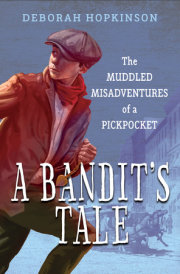
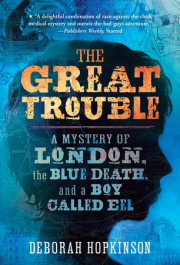
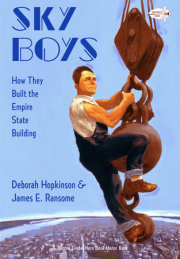
Deborah Hopkinson is the author of award-winning books for children and teens including Sky Boys, The Great Trouble, A Bandit's Tale, and A Letter to My Teacher. She visits schools across the country and lives in Oregon. View titles by Deborah Hopkinson

About

A brave pup navigates the streets of Victorian London in search of a loving home in this rollicking adventure inspired by the true story of England’s first animal shelter.

Lucky the dog and her brother Winston are born into a wealthy Victorian home, but they are not purebred poodles like their show-winning mother. When the owners realize their lack of pedigree, the pups are cast out on the snowy streets to fend for themselves. It’s a dangerous world for two small pups, and when Winston is scooped up by a dog napper, Lucky  is left all alone!  

Thankfully, brave Lucky has a few tricks up her sleeve. She can read, for one thing. And she makes fast friends among her fellow strays.
With the help of a regal wolfhound, a wise old spaniel, a quick-witted cat, and two giant dogs who live with the storyteller Charles Dickens, Lucky hatches a plan to rescue Winston and help all the lost and hungry dogs of London find a place to call home.

From the award-winning author of The Great Trouble, this rollicking adventure inspired by England’'s first animal shelter will win over dog-loving hearts of any age.

Excerpt

1

We Are Born

To begin at the beginning, we were born. Obviously. Otherwise there wouldn't be much of a story, would there?

I love stories. I like hearing stories and telling them too. And I saw everything that happened in this tale with my own eyes.

Well, except for being born. My eyes weren't even open yet. But one day by the hearth in the kitchen, Peg told us all about it.

"It was a stormy Friday night," the housemaid said. Peg planted a kiss on my nose. "You were born at the first stroke of midnight." She tweaked my little brother's ear. "Winston, you arrived as Big Ben's last chime faded away."

I could imagine it. Thunder crashing. Wind whistling. Mist swirling at the windows. Candles casting giant shadows on the walls. Then the exciting part: us!

"My gran told me that those born on a Friday at midnight have special gifts," Peg said.

"Gifts?" Winston perked up. "What gifts? I want a gift."

Oh, Winston!

Except it wasn't any kind of gift you'd want. "Gran said you might be able to see goblins, ghosts, and spirits," Peg said. Then she frowned. "But Gran also told me those born at that witching hour could sometimes turn out to be unlucky. Yet how can that be? You're healthy and beautiful, like your mum. You have brave and gallant hearts."

Peg sighed. "The world can be a cold, hard place. But you have what everyone needs and deserves: a warm fire, good food and friends, and a kind and loving home."

She hugged me closer. "And that's why we call you Lucky."

2

We Look Around

When we first opened our eyes, we saw our mum. Our soft, warm mum. Everyone called her "Darling." She was darling to us too. It was a cozy time, the three of us cuddled together.

We had full tummies and lots of love. Cook and Emmy bustled about, filling the Mudstones' big kitchen with delicious smells. Peg was always dashing in and out. So was Henry, who served as both stable boy and messenger for Mr. and Mrs. Mudstone.

Yet no matter how busy they were, all the servants (except for Mr. Heep, the coachman) stopped to congratulate Mum and give us hugs and tickles.

I thought it would always be like this. Then one morning, Mrs. Mudstone appeared in the doorway. "Darling, it's time," she called. "Come along."

"Don't go, Mum," I cried. Winston whined.

"Now, there's no need to make a fuss, dears." Mum got up, leaving behind a cold, empty space.

After that, Mum went off with Mrs. Mudstone more and more. Once, when I was whimpering, Peg enfolded me in her arms. "Don't cry, Lucky. It's autumn now, a busy time for Mrs. Mudstone and your mum. They have friends to see and shows to attend."

Sometimes Peg let us watch Mrs. Mudstone and Mum prance off in a cloud of ribbons, rustling silks, and flowery perfume. Winston and I would rush down the hall to the front door. "Mummy, take me!" Winston begged.

Mum shook her elegant head. "Maybe when you're older, pet." I couldn't wait to grow up and ride in a carriage. Maybe I'd wear a fancy pink bow on my head, just like Mum.

Peg held us up so we could watch as the carriage rumbled away. Winston only stopped crying when he saw Roland and Rupert step out, their sleek chestnut coats glimmering. Clop! Clop! Clop!

Winston loved the horses, so Henry started bringing my little brother to the stable with him whenever visitors arrived. That way, Winston wouldn't cry when Mum was summoned to the parlor to sit by Mrs. Mudstone's side.

I stayed in the kitchen alone then. Though, sometimes Peg brought me along when she cleaned Mr. Mudstone's library. She polished the furniture with beeswax until it shone, and carefully dusted the great globe that sat on a side table.

Whenever Peg spun the globe, I twirled round and round (but I never could catch my tail). "I like maps too, Lucky," Peg told me. "Now, this globe shows the whole world. Other maps are small and detailed. Maps can help us find our way, even if it's just to a street in another part of London."

It took Peg a long time to clean the library. The room was lined with tall shelves packed with books. Peg had to climb a special ladder to dust them all. I whined a little to see her up so high on those steep steps. But Peg didn't mind. She loved books. She said books were a way to learn about the world, even if she never left London.

"The King's Library in the British Museum has sixty thousand books, full of stories and ideas and knowledge from all over the world. Imagine that!" Peg told me. "When I visited, I felt so inspired, I stopped at a bookshop on the way home to buy a book for myself.

"Then I saw a little primer and bought it instead." Peg smiled to herself. "That's the day I began teaching Henry to read."

I knew that primer. Most evenings, after chores were done and if Henry wasn't needed to drive the carriage, Peg and Henry sat at the kitchen table poring over it.

During lessons, Winston dozed on Henry's lap. Winston loved Henry, who smelled like horses and hay and Cook's ginger biscuits. I sat on Peg's lap, resting my chin on the table to see better. Peg smelled like hard work and soap and lavender.

"This primer includes lots of examples with pictures to help you learn," Peg told Henry. "See, for the letter D we have 'dog,' and also 'deer,' 'donkey,' and 'duck.' "

Deer. Donkey. Duck. I leaned forward and wagged my tail. I wondered if I'd ever meet these creatures someday, right here in London.

Henry read slowly. "D-o-g spells dog."

"Oh, you're getting it, Henry," Peg declared, clapping her hands in delight.

Before long, I began to get it too. I learned that letters were a way to show sounds. And sounds came together to make words. Of course, I already knew lots of words, like "good dog" and "bad puppy." I knew "sit," "lie down," "stay," and "outside." Henry was even teaching us "heel."

I'd also figured out that words were like smells: They told stories about the world. When I sniffed Henry's clothes, I knew he'd been grooming Rupert and Roland. I knew it was laundry day when Peg and Emmy brought out the lye soap scented with rose water.

But though I was trying hard, I hadn't actually read any words yet. So whenever Mum was gone and Winston was with Henry in the stable, I fetched the little book from its place on the shelf and brought it to our basket to study.

It wasn't that easy to use my nose to turn the pages. But by holding one page down with my paw, I could do it. My favorite things to look at were pictures of animals. (B is for "badger," and also b is for "bunny.") I loved the pages that showed everyday objects, things I could see right in the kitchen. (P is for "pot," and also p is for "plate.")

One day, Peg came in. She saw me and stopped short. She turned to Emmy, who was whisking eggs. "Emmy, if I didn't know better, I'd think Lucky was trying to read that book."

"It wouldn't surprise me." Emmy grinned. "The other day I misplaced my recipe notebook and found it in her basket."

Then Peg and Emmy looked at one another and giggled. "What are we saying?" Peg shook her head. "Dogs can't read. We must be working too hard, Em."

Peg came over and took the primer. "Books aren't for chewing, Lucky, dear."

I already knew that. Obviously.

3

I Make an
Astonishing Discovery

One day, I sat by the library door and watched as Peg built up the fire for Mr. Mudstone, who was sitting behind his large wooden desk. She scooped me up as she started to leave.

"Oh, Peg," Mr. Mudstone called. He held out a small booklet. "Here's last week's issue of Mr. Dickens's magazine. The servants might enjoy it. It has the start of his new novel in it."

"Thank you so much, sir. I'll share it with the others tonight," said Peg. "We love Mr. Dickens, especially after seeing him perform scenes from A Christmas Carol last year. He made the story come alive!"

Peg walked over and took the magazine. She bobbed such a deep curtsy that she almost dropped me. I yelped in surprise.

Mr. Mudstone frowned. "Do keep those little things under control, Peg."

"Yes, sir. Sorry, sir." Peg bobbed again and began to scurry away.

We were almost out the door when Mr. Mudstone barked, "Hold on a minute!"

Mr. Mudstone charged over, eyes bulging. He stuck his pudgy face so close, I could smell his stinky cigar breath. I whined.

"How did this happen?" Mr. Mudstone demanded. "I never noticed it before. Now that I get a good look, I see there's been a dreadful mistake."

Was he talking about me? Was I a mistake? A dreadful mistake?

I snuggled closer to Peg, tucking my nose under her arm. She curtsied again and mumbled, "I'm sure I don't know, sir."

Peg hurried off, closing the door quietly behind her. In the hallway, she took a deep breath. "Don't worry, Lucky. Nothing bad will happen."

Nothing bad. I wanted to believe Peg, so I put Mr. Mudstone's words out of my mind.

I forgot about him for another reason too. Because as we made our way back down to the kitchen, something wonderful happened.

Something that turned out to be important for this tale.

Peg was holding me and carrying the magazine. It was right in front of my face as we bounced along. "I can't wait to begin this new story," Peg said. "Stories are like lights in the dark days of winter. They bring us comfort, just as friends do."

As Peg chattered away, I stared at the magazine's cover. And at that moment, the pieces started sliding together, like one of Jimmy Mudstone's wooden puzzles (which Winston and I were definitely not allowed to chew).

At the top of the page, in big letters, I saw:

All the Year Round

A Weekly Journal

That last word was a little hard. Did the "jour" sound like "hour"? Then I remembered Peg telling Henry that sometimes ou made a different sound, more like an e. I tried that: "jer-nal." Now it made sense! A journal was a magazine.

Just below that line, I read these words: Conducted by Charles Dickens. And then: Saturday, December 1, 1860. Oh, this was the date! I knew that because Cook had a pretty calendar on the kitchen wall with the name of each month on it.

Wait! What was happening? Was I actually reading? I was! I wriggled like an eel and planted wet, slobbery kisses all over Peg's face, and her ear too. (Ears are my favorite things to kiss.)

"That tickles!" Peg giggled. "Are you trying to tell me you're hungry, Lucky? I'm sure Cook and Emmy will have something scrumptious for your tea."

I love to eat. But I wasn't excited about food. I couldn't wait to follow along while Peg read the new story to our friends in the kitchen.

Except it didn't happen exactly like that.

Author

© Deborah Hopkinson
Deborah Hopkinson is the author of award-winning books for children and teens including Sky Boys, The Great Trouble, A Bandit's Tale, and A Letter to My Teacher. She visits schools across the country and lives in Oregon. View titles by Deborah Hopkinson