Download high-resolution image
Listen to a clip from the audiobook
audio play button
0:00
0:00

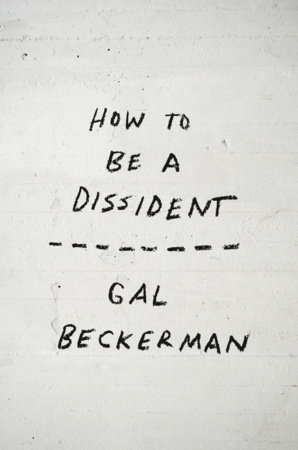
How to Be a Dissident

Listen to a clip from the audiobook
audio play button
0:00
0:00
An invigorating guide to fighting back—part philosophy, part history, and part manual for living with integrity in an age of conformity and authoritarian drift

How do we push back in a world where political leaders wield fear and intimidation? Where digital technology dehumanizes and flattens us? We need role models, and in this engaging book, acclaimed writer Gal Beckerman goes looking for them. Drawing on the stories of dissidents from around the globe and across time, from Socrates to Ai Weiwei, and thinkers like Hannah Arendt and Iris Murdoch, Beckerman reveals the defining characteristics these extraordinary figures share, a set of attributes and practices for anyone navigating the pressures of modern tyranny.

Structured around ten qualities—among them, Be Pessimistic, Be Funny, Be Reckless, and Be Immortal—this illuminating, surprising book blends intellectual history, biography, and cultural criticism. It charts a dissident’s journey from the solitary moment of recognizing the truth, through the risks of speaking it, to the legacy that can outlast a life. What makes dissidents tick? And how might we change when we encounter them?

Urgent and inspiring, Beckerman’s book shows that dissidence is a human capacity we can all cultivate, a refusal to betray one’s inner voice, no matter the cost. In a polarized America and a world sliding toward authoritarianism, we need dissidents—not only the jailed and martyred, but also those of us who face small daily compromises of conscience. How to Be a Dissident lights the way.
Chapter 1

Be Alone

Face the discomfort and fear.

1

Aleksandr Solzhenitsyn could easily be the patron saint of dissidents. The Soviet writer was a prisoner of the Gulag for nearly a decade until Stalin’s death in 1953. After he was released, he eventually published a two-­thousand-­page tome that exposed not just the vast penal system he had known but every aspect of his society that was endemically deceitful, corrupt, and cruel. In his prophetic prime, with his long wispy beard and mournful eyes, each word he uttered clanged with total moral certainty. He was austere and demanding. His parting advice to his fellow Soviet citizens when he was exiled in 1974 was as simple as it was impossible to follow: Don’t ever lie.

So I was surprised to discover that this same man was once considered a candidate for recruitment by the NKVD, the precursor to the KGB. He had no desire to sit apart. In his twenties, he rose to the rank of captain in the Red Army and led troops into battle in World War II. “We loved marches,” he wrote. When he entered the army as an officer, he felt the “happiness of simplification,” of being “a military man and not having to think things through; the happiness of being immersed in the life everyone else lived.”

What he’s expressing is shocking to hear only because it’s coming from one of the twentieth century’s most famous and uncompromising dissidents: He wanted to conform and was happy when he was able to. This is where we need to start.

2

This desire to conform sits deep in the psyche. Just how deep can be seen in the troubled sleep of liberal-­minded Germans in the 1930s. A journalist named Charlotte Beradt wrote down the dreams of her friends and neighbors in Berlin as the Nazis consolidated power, and if I thought my own nightmare was alarming, it is child’s play compared to these surreal visions. A bedside lamp listens in on conversations. A stove speaks, disclosing secrets. A man holds a Hitler salute until his spine literally snaps.

But the most telling of the dreams in her collection are those that express not so much the pressures of the new, oppressive reality as the comfort that could come from bending to it. These were fantasies of conformity.

A business school student dreams she’s on a train where a group of passengers are singing political songs. Annoyed, she keeps moving seats. But then she has a thought: “Maybe if you’re singing along it isn’t so silly, so I sang along.” An older man dreams he is at the movies when Hermann Göring, Hitler’s second-­in-­command, shows up wearing a brown leather vest and firing arrows from a crossbow. At first, the man laughs at the ridiculous get-­up. But then he looks down and sees he’s wearing the same outfit. A housewife dreams that she is kicked out of her friend’s home for criticizing people who perform the Hitler salute. When she boards a bus to leave, she faces the silently staring passengers, extends her arm, and says, “Heil Hitler!”

One of Beradt’s subjects offered just a single sentence: “I dreamed I said: ‘I don’t have to always say No anymore.’ ”

These people are not Nazi supporters. Even in their sleep they start off mocking the salutes, the songs, the uniforms, all of it. But a deeper wish reveals itself, to be released from responsibility. Analyzing these dreams led Beradt to one, unsettling conclusion: “Freedom is a burden, unfreedom comes as a relief.”

3

The question of why the chanting, goose-­stepping, flag-­waving crowd exerted so great a pull on millions of Germans became a kind of obsession for the intellectual class in the two decades that immediately followed World War II. The philosophers of the Frankfurt School even developed what they called an “F-scale” to measure a person’s fascistic tendencies, as if this could be determined as easily as sticking a thermometer in someone’s mouth. In 1961, a now-­famous experiment got people to deliver electric shocks to strangers just by ordering them to do so. Ten years later, another study turned college students into sadistic prison guards overnight.

Much of this postwar theorizing about human nature was, unsurprisingly, carried out by European Jews like Hannah Arendt, who, having just barely escaped with their lives, were desperate to understand what the hell had happened to their societies. But after all the experiments and the thinking, could it actually all boil down to what Beradt discerned in those dreams?

Conformity comes very naturally to humans. This is how our species has survived for so long, because we tend to work well together. Within our tribes, we know how to tamp down objections and nagging questions. Conforming may sound like a pejorative way to put it, but it’s what’s required if a society is to find some level of stability and well-­being.

Our lemming-­like mentality is more than a subtle tendency. It’s pretty extreme. The psychologist Solomon Asch performed the classic experiment on conformity in the early 1950s. A group of people were shown a page with a line, and then three other lines. They were asked which of the three matched the length of the original one. The answer was blind­ingly obvious, and at first everyone responded correctly. But then a majority of the group—­who were actually actors secretly planted by Asch—­changed their answer to a wrong one. Immediately, a third of the unsuspecting real participants changed their answers as well, disregarding what their own eyes told them (“I didn’t want to look stupid,” one of them said afterward—­someone whose parents apparently had never demanded to know what he would do if all his friends jumped off a bridge). This experiment has been replicated many times over the decades and always produces the same result: 33 to 38 percent of people are willing to abandon their sense of reality in order to align with others. One version in 2023 even offered money as an incentive for sticking with the correct answer; it made little difference.

Neuroscientists, also curious about the conforming brain, carried out the same test with people in MRI machines. They found that in those who changed their answers, the spatial awareness areas of their brains lit up, suggesting they were straining to see (or unsee, or re-­see) the world in a way that would allow them to easily fit in with the majority. And, even more startling, in the brains of the resisters—­those who stuck with their original answers—­an entirely different region started to glow: the amygdala, normally triggered by anxiety and emotional conflict. The brain, it seems, wants what it wants, which is to conform.

4

At an instinctual level, we get this. In his 1960 book Crowds and Power, the writer Elias Canetti points to an intriguing paradox. People generally do not like to be touched by a stranger—­a vestige, perhaps, of early human existence, when being surprised by an animal or an enemy was often bad news. But in a crowd, he writes, “man can become free of this fear.” The observation is unusual, but it, too, rings true. Canetti points out that in a crowd, all the distinctions and hierarchies collapse. You are equal with everyone else and your individuality evaporates. “In that density, where there is scarcely any space between, and body presses against body, each man is as near the other as he is to himself; and an immense feeling of relief ensues,” he writes. “It is for the sake of this blessed moment, when no one is greater or better than another, that people become a crowd.”

Personally, I’ve always felt both entranced and repulsed by crowds, and it’s hard for me to tell when I’ll have one reaction or another, which itself mystifies me. If you’ve ever been at a mass protest, you might know what I mean, the way it can transform from the ecstasy of people chanting together—­what the sociologist Émile Durkheim called “collective effervescence”—­to suddenly feeling like you’re drowning. This must be what happens when you are standing right on the border between two strong competing impulses: the overwhelming human desire to become one with others and the need to assert yourself in all your individuality. In those moments, what I feel is panic. I start searching for a side street, a way to escape, even if I don’t quite know where I’m going yet.
© © Beowulf Sheehan
Gal Beckerman is a staff writer at The Atlantic and the author of The Quiet Before: On the Unexpected Origins of Radical Ideas, a New York Times notable book, and When They Come for Us, We’ll Be Gone: The Epic Struggle to Save Soviet Jewry, which won the Sami Rohr Prize. His writing has appeared in The New York Times, The Washington Post, and many other publications. He has a PhD from Columbia University and lives in Brooklyn, New York. View titles by Gal Beckerman
“One way to change the world is to be yourself. This is harder than it sounds. Gal Beckerman, one of our most thoughtful commentators on the soul of politics, appealingly invites us to learn from those more courageous than ourselves. Along the way we learn some history that we should know and find ourselves by the end not only instructed but wiser.”—Timothy Snyder, author of On Tyranny

“Urgent, wise, and immensely compelling, Gal Beckerman’s How to Be a Dissident illuminates an inspiring gallery of history’s independent thinkers, their lives both reassurance and exhortation in these challenging times. Everyone should read this book.”—Claire Messud, author of The Emperor’s Children

“A sharp, cogent analysis of what dissidents really do to fight repressive regimes, with essential advice for anyone who wants to join them.”—Anne Applebaum, author of Autocracy, Inc.

“A beautiful, profound book, rich in examples. It helped me to think more clearly, to feel heartened, and to focus on what is most important—all of which feels essential in these times.”—Sarah Bakewell, author of How to Live

“A Rules for Radicals for our time . . . [and] a well-reasoned set of prescriptions for building a better future.”—Kirkus Reviews, starred review

About

An invigorating guide to fighting back—part philosophy, part history, and part manual for living with integrity in an age of conformity and authoritarian drift

How do we push back in a world where political leaders wield fear and intimidation? Where digital technology dehumanizes and flattens us? We need role models, and in this engaging book, acclaimed writer Gal Beckerman goes looking for them. Drawing on the stories of dissidents from around the globe and across time, from Socrates to Ai Weiwei, and thinkers like Hannah Arendt and Iris Murdoch, Beckerman reveals the defining characteristics these extraordinary figures share, a set of attributes and practices for anyone navigating the pressures of modern tyranny.

Structured around ten qualities—among them, Be Pessimistic, Be Funny, Be Reckless, and Be Immortal—this illuminating, surprising book blends intellectual history, biography, and cultural criticism. It charts a dissident’s journey from the solitary moment of recognizing the truth, through the risks of speaking it, to the legacy that can outlast a life. What makes dissidents tick? And how might we change when we encounter them?

Urgent and inspiring, Beckerman’s book shows that dissidence is a human capacity we can all cultivate, a refusal to betray one’s inner voice, no matter the cost. In a polarized America and a world sliding toward authoritarianism, we need dissidents—not only the jailed and martyred, but also those of us who face small daily compromises of conscience. How to Be a Dissident lights the way.

Excerpt

Chapter 1

Be Alone

Face the discomfort and fear.

1

Aleksandr Solzhenitsyn could easily be the patron saint of dissidents. The Soviet writer was a prisoner of the Gulag for nearly a decade until Stalin’s death in 1953. After he was released, he eventually published a two-­thousand-­page tome that exposed not just the vast penal system he had known but every aspect of his society that was endemically deceitful, corrupt, and cruel. In his prophetic prime, with his long wispy beard and mournful eyes, each word he uttered clanged with total moral certainty. He was austere and demanding. His parting advice to his fellow Soviet citizens when he was exiled in 1974 was as simple as it was impossible to follow: Don’t ever lie.

So I was surprised to discover that this same man was once considered a candidate for recruitment by the NKVD, the precursor to the KGB. He had no desire to sit apart. In his twenties, he rose to the rank of captain in the Red Army and led troops into battle in World War II. “We loved marches,” he wrote. When he entered the army as an officer, he felt the “happiness of simplification,” of being “a military man and not having to think things through; the happiness of being immersed in the life everyone else lived.”

What he’s expressing is shocking to hear only because it’s coming from one of the twentieth century’s most famous and uncompromising dissidents: He wanted to conform and was happy when he was able to. This is where we need to start.

2

This desire to conform sits deep in the psyche. Just how deep can be seen in the troubled sleep of liberal-­minded Germans in the 1930s. A journalist named Charlotte Beradt wrote down the dreams of her friends and neighbors in Berlin as the Nazis consolidated power, and if I thought my own nightmare was alarming, it is child’s play compared to these surreal visions. A bedside lamp listens in on conversations. A stove speaks, disclosing secrets. A man holds a Hitler salute until his spine literally snaps.

But the most telling of the dreams in her collection are those that express not so much the pressures of the new, oppressive reality as the comfort that could come from bending to it. These were fantasies of conformity.

A business school student dreams she’s on a train where a group of passengers are singing political songs. Annoyed, she keeps moving seats. But then she has a thought: “Maybe if you’re singing along it isn’t so silly, so I sang along.” An older man dreams he is at the movies when Hermann Göring, Hitler’s second-­in-­command, shows up wearing a brown leather vest and firing arrows from a crossbow. At first, the man laughs at the ridiculous get-­up. But then he looks down and sees he’s wearing the same outfit. A housewife dreams that she is kicked out of her friend’s home for criticizing people who perform the Hitler salute. When she boards a bus to leave, she faces the silently staring passengers, extends her arm, and says, “Heil Hitler!”

One of Beradt’s subjects offered just a single sentence: “I dreamed I said: ‘I don’t have to always say No anymore.’ ”

These people are not Nazi supporters. Even in their sleep they start off mocking the salutes, the songs, the uniforms, all of it. But a deeper wish reveals itself, to be released from responsibility. Analyzing these dreams led Beradt to one, unsettling conclusion: “Freedom is a burden, unfreedom comes as a relief.”

3

The question of why the chanting, goose-­stepping, flag-­waving crowd exerted so great a pull on millions of Germans became a kind of obsession for the intellectual class in the two decades that immediately followed World War II. The philosophers of the Frankfurt School even developed what they called an “F-scale” to measure a person’s fascistic tendencies, as if this could be determined as easily as sticking a thermometer in someone’s mouth. In 1961, a now-­famous experiment got people to deliver electric shocks to strangers just by ordering them to do so. Ten years later, another study turned college students into sadistic prison guards overnight.

Much of this postwar theorizing about human nature was, unsurprisingly, carried out by European Jews like Hannah Arendt, who, having just barely escaped with their lives, were desperate to understand what the hell had happened to their societies. But after all the experiments and the thinking, could it actually all boil down to what Beradt discerned in those dreams?

Conformity comes very naturally to humans. This is how our species has survived for so long, because we tend to work well together. Within our tribes, we know how to tamp down objections and nagging questions. Conforming may sound like a pejorative way to put it, but it’s what’s required if a society is to find some level of stability and well-­being.

Our lemming-­like mentality is more than a subtle tendency. It’s pretty extreme. The psychologist Solomon Asch performed the classic experiment on conformity in the early 1950s. A group of people were shown a page with a line, and then three other lines. They were asked which of the three matched the length of the original one. The answer was blind­ingly obvious, and at first everyone responded correctly. But then a majority of the group—­who were actually actors secretly planted by Asch—­changed their answer to a wrong one. Immediately, a third of the unsuspecting real participants changed their answers as well, disregarding what their own eyes told them (“I didn’t want to look stupid,” one of them said afterward—­someone whose parents apparently had never demanded to know what he would do if all his friends jumped off a bridge). This experiment has been replicated many times over the decades and always produces the same result: 33 to 38 percent of people are willing to abandon their sense of reality in order to align with others. One version in 2023 even offered money as an incentive for sticking with the correct answer; it made little difference.

Neuroscientists, also curious about the conforming brain, carried out the same test with people in MRI machines. They found that in those who changed their answers, the spatial awareness areas of their brains lit up, suggesting they were straining to see (or unsee, or re-­see) the world in a way that would allow them to easily fit in with the majority. And, even more startling, in the brains of the resisters—­those who stuck with their original answers—­an entirely different region started to glow: the amygdala, normally triggered by anxiety and emotional conflict. The brain, it seems, wants what it wants, which is to conform.

4

At an instinctual level, we get this. In his 1960 book Crowds and Power, the writer Elias Canetti points to an intriguing paradox. People generally do not like to be touched by a stranger—­a vestige, perhaps, of early human existence, when being surprised by an animal or an enemy was often bad news. But in a crowd, he writes, “man can become free of this fear.” The observation is unusual, but it, too, rings true. Canetti points out that in a crowd, all the distinctions and hierarchies collapse. You are equal with everyone else and your individuality evaporates. “In that density, where there is scarcely any space between, and body presses against body, each man is as near the other as he is to himself; and an immense feeling of relief ensues,” he writes. “It is for the sake of this blessed moment, when no one is greater or better than another, that people become a crowd.”

Personally, I’ve always felt both entranced and repulsed by crowds, and it’s hard for me to tell when I’ll have one reaction or another, which itself mystifies me. If you’ve ever been at a mass protest, you might know what I mean, the way it can transform from the ecstasy of people chanting together—­what the sociologist Émile Durkheim called “collective effervescence”—­to suddenly feeling like you’re drowning. This must be what happens when you are standing right on the border between two strong competing impulses: the overwhelming human desire to become one with others and the need to assert yourself in all your individuality. In those moments, what I feel is panic. I start searching for a side street, a way to escape, even if I don’t quite know where I’m going yet.

Author

© © Beowulf Sheehan
Gal Beckerman is a staff writer at The Atlantic and the author of The Quiet Before: On the Unexpected Origins of Radical Ideas, a New York Times notable book, and When They Come for Us, We’ll Be Gone: The Epic Struggle to Save Soviet Jewry, which won the Sami Rohr Prize. His writing has appeared in The New York Times, The Washington Post, and many other publications. He has a PhD from Columbia University and lives in Brooklyn, New York. View titles by Gal Beckerman

Praise

“One way to change the world is to be yourself. This is harder than it sounds. Gal Beckerman, one of our most thoughtful commentators on the soul of politics, appealingly invites us to learn from those more courageous than ourselves. Along the way we learn some history that we should know and find ourselves by the end not only instructed but wiser.”—Timothy Snyder, author of On Tyranny

“Urgent, wise, and immensely compelling, Gal Beckerman’s How to Be a Dissident illuminates an inspiring gallery of history’s independent thinkers, their lives both reassurance and exhortation in these challenging times. Everyone should read this book.”—Claire Messud, author of The Emperor’s Children

“A sharp, cogent analysis of what dissidents really do to fight repressive regimes, with essential advice for anyone who wants to join them.”—Anne Applebaum, author of Autocracy, Inc.

“A beautiful, profound book, rich in examples. It helped me to think more clearly, to feel heartened, and to focus on what is most important—all of which feels essential in these times.”—Sarah Bakewell, author of How to Live

“A Rules for Radicals for our time . . . [and] a well-reasoned set of prescriptions for building a better future.”—Kirkus Reviews, starred review