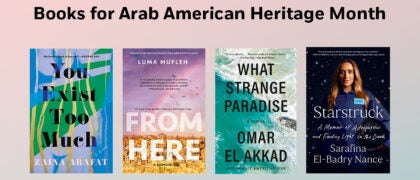
Books for Arab American Heritage Month
In honor of Arab American Heritage Month in April, we are sharing books by Arab and Arab American authors that share their culture, history, and personal lives.


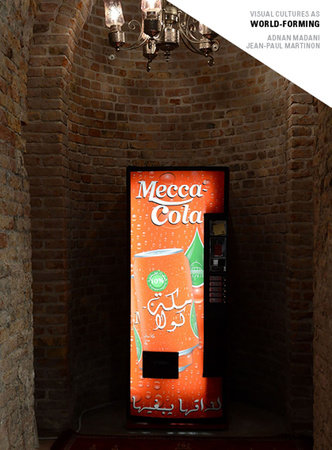
How does the world form itself? How does it create itself as a world? And how do we understand the role of the visual in this regard? Most responses to these questions within cultural theory and visual culture refer to the rise of globalization, thus highlighting the acceleration of exchanges, the proliferation of information and communication devices, and the multiplication of globally circulated goods and images that characterize the world we live in. Visual Cultures as World Forming takes a different approach by focusing on the taking place of the world, a creative act that knows no economic return.
This taking place does not lead to more proliferation of goods, additional financial exchanges, further communications, or an increase in the distribution of visual material, but leads to the continued “worlding” of the world. This approach is predominantly, but not exclusively, inspired by the work of Jean-Luc Nancy. Through a reading of his work and of some of his contemporaries both inside and outside of the Western canon, Madani and Martinon attempt to expose how the world—and the world of visual culture in particular—creates itself and the ways in which each one of us is embodying this creation without economy.
Copublished with Goldsmiths, University of London
How does the world form itself? How does it create itself as a world? And how do we understand the role of the visual in this regard? Most responses to these questions within cultural theory and visual culture refer to the rise of globalization, thus highlighting the acceleration of exchanges, the proliferation of information and communication devices, and the multiplication of globally circulated goods and images that characterize the world we live in. Visual Cultures as World Forming takes a different approach by focusing on the taking place of the world, a creative act that knows no economic return.
This taking place does not lead to more proliferation of goods, additional financial exchanges, further communications, or an increase in the distribution of visual material, but leads to the continued “worlding” of the world. This approach is predominantly, but not exclusively, inspired by the work of Jean-Luc Nancy. Through a reading of his work and of some of his contemporaries both inside and outside of the Western canon, Madani and Martinon attempt to expose how the world—and the world of visual culture in particular—creates itself and the ways in which each one of us is embodying this creation without economy.
Copublished with Goldsmiths, University of London
In honor of Arab American Heritage Month in April, we are sharing books by Arab and Arab American authors that share their culture, history, and personal lives.
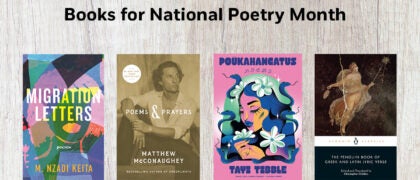
For National Poetry Month in April, we are sharing poetry collections and books about poetry by authors who have their own stories to tell. These poets delve into history, reimagine the present, examine poetry itself—from traditional poems many know and love to poems and voices that are new and original.