
Books for Arab American Heritage Month
In honor of Arab American Heritage Month in April, we are sharing books by Arab and Arab American authors that share their culture, history, and personal lives.


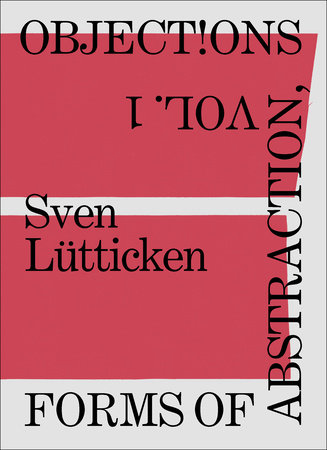
Forms of Abstraction engages with abstraction not as a formal option in art, or as an airy theoretical speculation, but as an operational force that has redesigned our world, and continues to do so. What Alfred Sohn-Rethel has called the “real abstraction” of value-form molds the world, and does so in conjunction with the real abstractions of the law and of technoscience.
In this first volume, Objections, Sven Lütticken takes his cue from the Latin root of object, obiectum—which refers to something put before the subject, something thrown in one's way—pursuing this sense of the object as obstacle or obstruction, and of the artwork as an aesthetic and political objection. Lütticken sees artists engaging with materiality and value, with subatomic particles and radiation as well as with the objectification of human and nonhuman organisms. Along the way, we encounter theoretical objects such as the fetish, the plaster cast, the patented bacteria, the buried radioactive container, and the contemporary artwork itself. Lütticken analyzes contemporary art as a set of aesthetic practices revolving around problematic and questionable objects that can act as productive objections.
Among the artists discussed are Agency, Kader Attia, Stanley Brouwn, Antje Ehmann and Harun Farocki, Andrea Fraser, Hans Haacke, Carsten Höller and Rosemarie Trockel, Natascha Sadr Haghighian, Sean Snyder, and Jonas Staal.
Forms of Abstraction engages with abstraction not as a formal option in art, or as an airy theoretical speculation, but as an operational force that has redesigned our world, and continues to do so. What Alfred Sohn-Rethel has called the “real abstraction” of value-form molds the world, and does so in conjunction with the real abstractions of the law and of technoscience.
In this first volume, Objections, Sven Lütticken takes his cue from the Latin root of object, obiectum—which refers to something put before the subject, something thrown in one's way—pursuing this sense of the object as obstacle or obstruction, and of the artwork as an aesthetic and political objection. Lütticken sees artists engaging with materiality and value, with subatomic particles and radiation as well as with the objectification of human and nonhuman organisms. Along the way, we encounter theoretical objects such as the fetish, the plaster cast, the patented bacteria, the buried radioactive container, and the contemporary artwork itself. Lütticken analyzes contemporary art as a set of aesthetic practices revolving around problematic and questionable objects that can act as productive objections.
Among the artists discussed are Agency, Kader Attia, Stanley Brouwn, Antje Ehmann and Harun Farocki, Andrea Fraser, Hans Haacke, Carsten Höller and Rosemarie Trockel, Natascha Sadr Haghighian, Sean Snyder, and Jonas Staal.
In honor of Arab American Heritage Month in April, we are sharing books by Arab and Arab American authors that share their culture, history, and personal lives.
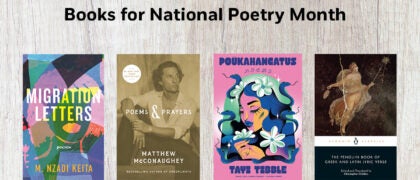
For National Poetry Month in April, we are sharing poetry collections and books about poetry by authors who have their own stories to tell. These poets delve into history, reimagine the present, examine poetry itself—from traditional poems many know and love to poems and voices that are new and original.