Books for Jewish American Heritage Month
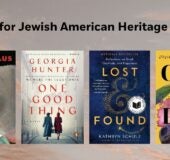
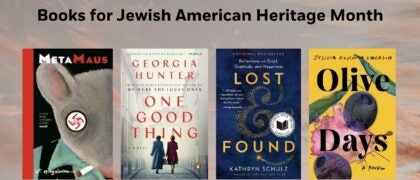
In celebration of Jewish American Heritage Month in May, we are sharing books by authors who share their individual stories, experiences, and lives. Find our full collection of books here.


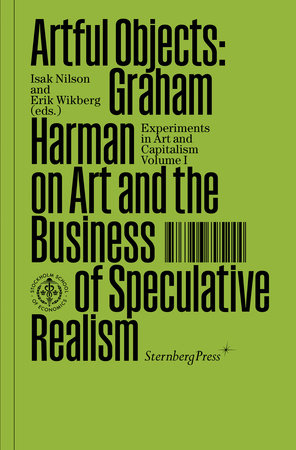
Can objects be traumatized? How does the commercial value of an art object relate to its aesthetic qualities? How do objects interact? These are some of the questions addressed by Graham Harman, the originator of object-oriented philosophy and a central figure of the Speculative Realism school of thought in contemporary philosophy. This book includes Graham Harman's lecture “What Is an Object?” delivered at Moderna Museet in Stockholm, on the occasion of the exhibition “Sculpture after Sculpture,” with Jeff Koons, Charles Ray, and Katharina Fritsch—artists, who have expanded the notion of the object in art and society at large.
In his lecture, Harman gives a thorough exposition of the object from an ontological standpoint and puts forward a concept of the object that goes beyond reductionist orientations. He declares a philosophical approach bringing philosophy and the arts closely together, where objects are impenetrable to direct knowledge and paraphrase and instead must be approached obliquely and indirectly. The publication also includes a symposium in which thirteen questions to Graham Harman—among and in relation to the thirteen sculptures of the show—that were posed about the implications of object oriented philosophy for art, business administration, and philosophy.
Contributors
Graham Harman, Daniel Birnbaum, Lars Strannegård, Sven-Olov Wallenstein, Pierre Guillet de Monthoux, Marcia Cavalcante, Jo Widoff, Sigrid Sandström, Michael Dahlén, Emma Stenström, Jenny Lanz, Ebba Sjögren, Isak Nilson, Erik Wikberg
Copublished with the Stockholm School of Economics
Can objects be traumatized? How does the commercial value of an art object relate to its aesthetic qualities? How do objects interact? These are some of the questions addressed by Graham Harman, the originator of object-oriented philosophy and a central figure of the Speculative Realism school of thought in contemporary philosophy. This book includes Graham Harman's lecture “What Is an Object?” delivered at Moderna Museet in Stockholm, on the occasion of the exhibition “Sculpture after Sculpture,” with Jeff Koons, Charles Ray, and Katharina Fritsch—artists, who have expanded the notion of the object in art and society at large.
In his lecture, Harman gives a thorough exposition of the object from an ontological standpoint and puts forward a concept of the object that goes beyond reductionist orientations. He declares a philosophical approach bringing philosophy and the arts closely together, where objects are impenetrable to direct knowledge and paraphrase and instead must be approached obliquely and indirectly. The publication also includes a symposium in which thirteen questions to Graham Harman—among and in relation to the thirteen sculptures of the show—that were posed about the implications of object oriented philosophy for art, business administration, and philosophy.
Contributors
Graham Harman, Daniel Birnbaum, Lars Strannegård, Sven-Olov Wallenstein, Pierre Guillet de Monthoux, Marcia Cavalcante, Jo Widoff, Sigrid Sandström, Michael Dahlén, Emma Stenström, Jenny Lanz, Ebba Sjögren, Isak Nilson, Erik Wikberg
Copublished with the Stockholm School of Economics
In celebration of Jewish American Heritage Month in May, we are sharing books by authors who share their individual stories, experiences, and lives. Find our full collection of books here.
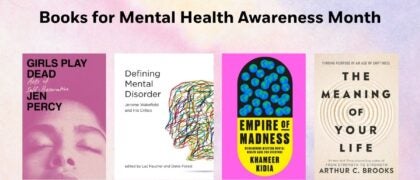
For Mental Health Awareness Month in May, we are sharing books to educate and raise awareness about mental health and the various factors that may affect it, and to provide tools and resources for student wellness. Find our full collection of titles here.
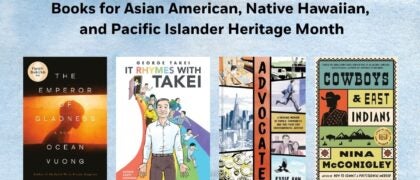
Each May, we honor the stories, histories, and cultures of Asian Americans, Native Hawaiians, and Pacific Islanders. Below is a selection of acclaimed fiction and nonfiction books by AANHPI creators to share with your students this month and throughout the year. Find our full collection of titles for Higher Education here.