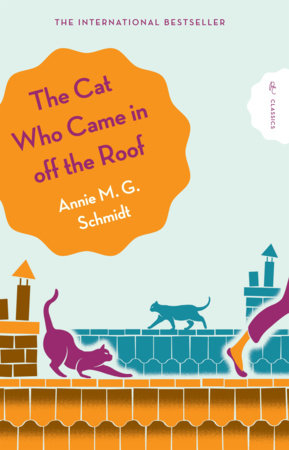
The Cat Who Came in Off the Roof

Translated by David Colmer
Paperback
$15.95 US
On sale Oct 06, 2026 | 160 Pages | 9781782694946

See Additional Formats
A WORLDWIDE CLASSIC: The beloved, hilarious tale of felines and friendship, from the queen of Dutch children's literature.

“A charming, refreshing, and funny treat.”  — Kirkus, Starred Review


One of the best-known classics from beloved Dutch children’s author Annie M.G. Schmidt, The Cat Who Came in Off the Roof spins a charming and whimsical tale of friendship and adventure. Tibble is a timid reporter on the verge of losing his job. He only ever writes about cats, not the hard news his paper wants, and because of this he’s about to be fired.

Minou is a young woman who has moved into Tibble's flat. She hates dogs, likes rooftops, loves the fishmonger, and happens to have been, until very recently, a cat.

With her feline friends listening out for all the local human news, is Minou the answer to all Tibble's problems-or just the beginning of them? Together they begin to uncover the real scoops about the local community, exposing secrets that Tibble’s newspaper never dared report!

The Cat Who Came in Off the Roof is a hilarious, charming story of cats, dogs, and learning to dare. Widely celebrated, it has been translated into 32 languages and its film adaptation remains the biggest Dutch children’s movie of all time. This gorgeous, repackaged paperback presents a perfect collectible classics edition for young and old readers alike.
No News Anywhere 7
A Stray Cat 15
The Tatter Cat 25
The Cat Press Agency 33
Tibble’s Secretary 41
The Neighbourhood 51
“Your Sister Came By” 57
Mr Smith’s Reception 65
The Head Doctor 73
Cats Aren’t Witnesses 83
The Pump Cat and the Metropole Cat 91
The Tatter Cat’s Babies 97
Tibble is Writing! 107
Far Too Many Cats 115
The Cat Through the Ages 123
The Editorial Cat 133
A Cat Again? 139
The Ginger Sister 145
Carlo this Time 153
"Tibble! Where’s Tibble? Has anyone seen Tibble? The boss wants to talk to him. Where’s he got to? Tibble!!
Tibble had heard them all right. But he’d slipped down out of sight. And now he was crouched behind his desk trembling and thinking, I don’t want to talk to the boss, I’m too scared. I know exactly what’s going to happen. He’s going to fire me.
“Ah, Tibble! There you are!” Oh, no. They’d spotted him.
“The boss wants to see you straight away.”
He couldn’t get out of it now. He had no choice but to walk down the corridor with his head hanging and stop at the door marked Editor.
He knocked. A voice said, “Yes.”
When Tibble went in, his boss was on the phone. He pointed at an empty chair and carried on with his conversation.
Tibble sat down and waited.
This was in the building of the Killenthorn Courier, the newspaper Tibble worked for. Writing articles.
“So, Tibble,” the Editor said as he hung up the phone. “There’s something important we need to discuss.”
Here it comes, thought Tibble.
“These articles you write… They’re quite good. Sometimes, even very good.”
Tibble smiled. Maybe it wasn’t going to be too bad, after all.
“But…”
Tibble waited patiently. Of course, there had to be a “but”.
Otherwise he wouldn’t be sitting here.
“But… There’s never any news in them. I’ve told you so many times. Your articles are always about cats.”
Tibble was quiet for a moment. It was true. He was a real cat lover. He knew all the local cats. He even had one himself.
“But yesterday I wrote an article that didn’t even mention cats,” he said. “It was about spring.”
“Exactly,” his boss said. “It was about spring. About the little leaves reappearing on the trees. Is that news?”
“Er… they were new leaves,” Tibble said.
His boss sighed. “Listen carefully, Tibble,” he said. “I like you. You’re a nice guy and you can string a story together. But we’re working on a newspaper here. And a newspaper has to provide news. It has to tell people things they don’t know.”
“But it’s already full of news,” Tibble said. “Wars and stuff like that. And murders. I thought people would like to read about cats and leaves for a change.”
“I’m afraid not, Tibble. Don’t get me wrong, you don’t need to write about murders or bank robberies. But a small town like ours is full of little news stories. You just have to find them. I’ve told you again and again, you’re too shy. You have to approach people. You have to ask questions. But you’re always too scared. Apparently you only ever associate with cats.”
Again Tibble remained silent, because it was true. He was shy. And if you work for a newspaper, you can’t afford to be shy. If you want to find out about things other people don’t know about, you have to march right up to strangers. You have to be brave enough to barge in on a government minister, even if he’s having a bath. And then you have to ask fearlessly, “Where were you last night?”
A good newspaperman does things like that. But not Tibble. “Well,” the Editor said, “I’ll give you one last chance. From now on, write articles with news in them. I want the first one on my desk tomorrow morning. And after that, I want to see two or three a week. And if you can’t manage it… ”
Tibble understood perfectly. If he didn’t come up with something, he’d lose his job.
“Goodbye, Tibble.” “Goodbye, sir.”
And now he was walking down the street. Light rain was falling and everything looked grey. Tibble was taking his time. He was looking around and keeping his eyes peeled and his ears open. But there was no news anywhere. He couldn’t see anything new, there was nothing he didn’t already know about.
He saw cars. Parked cars and cars driving down the street. There were a few pedestrians and the occasional cat. But he wasn’t allowed to write about cats any more. In the end he was so tired he sat down on a bench in Green Square, under a tree where it was still dry.
There was already somebody else sitting on the bench and now Tibble saw who it was. It was his old teacher from school, Mr Smith.
“Look who we have here,” said Mr Smith. “What a nice surprise, bumping into you like this. I’ve heard you’ve got a job with the Courier. I was always sure you’d end up at a newspaper. It’s going fabulously, I suppose.”
Tibble swallowed uncomfortably and said, “I’m settling in.” “You always wrote such wonderful compositions at school,”
Mr Smith said. “I knew you’d go far. Yes, you’re an excellent writer.”
“Can’t you tell me something I don’t know?” Tibble asked. Mr Smith was quite insulted. “Has it gone to your head already?” he asked. “I tell you how well you write and you ask me to tell you something you don’t know… that’s not very nice of you.”
“Oh, I didn’t mean it like that,” Tibble cried, blushing. He was about to explain what he had meant, but before he got a chance there was the sound of furious barking close by. They both looked up. A big German Shepherd was racing after something, but they couldn’t quite make out what that something was. It disappeared between two parked cars and the dog rushed after it. The very next instant there was a wild rustling in the tall elm tree near the cars.
“A cat,” Mr Smith said. “A cat’s been treed.”
“Was it a cat?” Tibble asked. “It was big. And it kind of fluttered a little. It looked more like a large bird. A stork or something like that.”
“Storks don’t run,” Mr Smith said.
“No, but it definitely fluttered. And cats don’t flutter.” They went over to have a look.
The dog was standing under the tree and still barking furi- ously.
They tried to see what exactly was up there between all those branches, but the cat was completely hidden. If it was a cat.
“Mars! Here, boy!” Someone was calling the dog. “Mars, here!”
A man appeared with a lead. He clicked the lead onto the dog’s collar and started pulling.
Grrr… ” said Mars, holding his four legs stiff as the man dragged him away over the road. Tibble and Mr Smith kept peering up for a moment. And now they saw something very high up among the new leaves.
A leg. A leg in a stylish stocking with a shiny, high-heeled shoe on the foot.
“Heavens,” said Mr Smith, “it’s a lady.”
“It can’t be,” Tibble said. “That high up? How’d she get up there so quickly?”
Now a face appeared too. A frightened face with big scared eyes and masses of red hair.
“Is it gone?” she called.
“It’s gone! Come on down!” Tibble called back. “I’m too scared,” she moaned. “It’s so far down.”
Tibble looked around. There was a van parked close by.
Cautiously, he climbed up onto the roof of the van and reached out as far as he could with one hand. The woman crawled out slowly to the end of her branch, then lowered herself down onto another and grabbed Tibble’s hand.
And now she turned out to be tremendously agile. In one easy leap she was on the roof of the van and a second hop took her down to the street.
“I dropped my case,” she said. “Have you seen it anywhere round here?”
It was lying in the gutter. Mr Smith picked it up for her. “Here,” he said. “Your clothes are all messed up too.”
She brushed the dirt and leaves off her skirt and jacket and said, “It was such a big dog… I can’t help it, I just have to get up into a tree when I see a dog coming. Thanks very much for your help.”
Tibble suddenly remembered his article and realized he should stop her to ask a few questions… This was definitely something unusual he could write about.
But he hesitated a little too long. He was too shy again. And off she went with that small case of hers.
“What a peculiar young woman,” Mr Smith said. “She was like a cat.”
“Yes,” said Tibble. “She was just like a cat.”
They watched her walk off. She went round a corner.
I can still catch up with her, thought Tibble. He left Mr Smith behind without saying goodbye and raced down the narrow street he’d seen her take. There she was. He’d ask her, “Excuse me, but I was wondering if you could tell me why you’re so scared of dogs and how you’re able to climb trees so fast… ”
But suddenly he couldn’t see her any more.
Annie M.G. Schmidt (1911-95) was regarded as the Queen of Dutch Children's Literature and her books have been an essential part of every Dutch childhood for the last fifty years. She trained as a librarian but burst onto the literary scene when the newspaper she was working for discovered her gift for children's verse. Having won numerous awards during her lifetime, including the 1989 Hans Christian Andersen Award, Schmidt is now included in the Canon of Dutch History taught to all Dutch schoolchildren, alongside Spinoza, Anne Frank and Vincent van Gogh.

David Colmer has won several international awards for his translations of Dutch and Flemish novels, poetry and children's books. He has translated much of Annie M.G. Schmidt's work.

About

A WORLDWIDE CLASSIC: The beloved, hilarious tale of felines and friendship, from the queen of Dutch children's literature.

“A charming, refreshing, and funny treat.”  — Kirkus, Starred Review


One of the best-known classics from beloved Dutch children’s author Annie M.G. Schmidt, The Cat Who Came in Off the Roof spins a charming and whimsical tale of friendship and adventure. Tibble is a timid reporter on the verge of losing his job. He only ever writes about cats, not the hard news his paper wants, and because of this he’s about to be fired.

Minou is a young woman who has moved into Tibble's flat. She hates dogs, likes rooftops, loves the fishmonger, and happens to have been, until very recently, a cat.

With her feline friends listening out for all the local human news, is Minou the answer to all Tibble's problems-or just the beginning of them? Together they begin to uncover the real scoops about the local community, exposing secrets that Tibble’s newspaper never dared report!

The Cat Who Came in Off the Roof is a hilarious, charming story of cats, dogs, and learning to dare. Widely celebrated, it has been translated into 32 languages and its film adaptation remains the biggest Dutch children’s movie of all time. This gorgeous, repackaged paperback presents a perfect collectible classics edition for young and old readers alike.

Table of Contents

No News Anywhere 7
A Stray Cat 15
The Tatter Cat 25
The Cat Press Agency 33
Tibble’s Secretary 41
The Neighbourhood 51
“Your Sister Came By” 57
Mr Smith’s Reception 65
The Head Doctor 73
Cats Aren’t Witnesses 83
The Pump Cat and the Metropole Cat 91
The Tatter Cat’s Babies 97
Tibble is Writing! 107
Far Too Many Cats 115
The Cat Through the Ages 123
The Editorial Cat 133
A Cat Again? 139
The Ginger Sister 145
Carlo this Time 153

Excerpt

"Tibble! Where’s Tibble? Has anyone seen Tibble? The boss wants to talk to him. Where’s he got to? Tibble!!
Tibble had heard them all right. But he’d slipped down out of sight. And now he was crouched behind his desk trembling and thinking, I don’t want to talk to the boss, I’m too scared. I know exactly what’s going to happen. He’s going to fire me.
“Ah, Tibble! There you are!” Oh, no. They’d spotted him.
“The boss wants to see you straight away.”
He couldn’t get out of it now. He had no choice but to walk down the corridor with his head hanging and stop at the door marked Editor.
He knocked. A voice said, “Yes.”
When Tibble went in, his boss was on the phone. He pointed at an empty chair and carried on with his conversation.
Tibble sat down and waited.
This was in the building of the Killenthorn Courier, the newspaper Tibble worked for. Writing articles.
“So, Tibble,” the Editor said as he hung up the phone. “There’s something important we need to discuss.”
Here it comes, thought Tibble.
“These articles you write… They’re quite good. Sometimes, even very good.”
Tibble smiled. Maybe it wasn’t going to be too bad, after all.
“But…”
Tibble waited patiently. Of course, there had to be a “but”.
Otherwise he wouldn’t be sitting here.
“But… There’s never any news in them. I’ve told you so many times. Your articles are always about cats.”
Tibble was quiet for a moment. It was true. He was a real cat lover. He knew all the local cats. He even had one himself.
“But yesterday I wrote an article that didn’t even mention cats,” he said. “It was about spring.”
“Exactly,” his boss said. “It was about spring. About the little leaves reappearing on the trees. Is that news?”
“Er… they were new leaves,” Tibble said.
His boss sighed. “Listen carefully, Tibble,” he said. “I like you. You’re a nice guy and you can string a story together. But we’re working on a newspaper here. And a newspaper has to provide news. It has to tell people things they don’t know.”
“But it’s already full of news,” Tibble said. “Wars and stuff like that. And murders. I thought people would like to read about cats and leaves for a change.”
“I’m afraid not, Tibble. Don’t get me wrong, you don’t need to write about murders or bank robberies. But a small town like ours is full of little news stories. You just have to find them. I’ve told you again and again, you’re too shy. You have to approach people. You have to ask questions. But you’re always too scared. Apparently you only ever associate with cats.”
Again Tibble remained silent, because it was true. He was shy. And if you work for a newspaper, you can’t afford to be shy. If you want to find out about things other people don’t know about, you have to march right up to strangers. You have to be brave enough to barge in on a government minister, even if he’s having a bath. And then you have to ask fearlessly, “Where were you last night?”
A good newspaperman does things like that. But not Tibble. “Well,” the Editor said, “I’ll give you one last chance. From now on, write articles with news in them. I want the first one on my desk tomorrow morning. And after that, I want to see two or three a week. And if you can’t manage it… ”
Tibble understood perfectly. If he didn’t come up with something, he’d lose his job.
“Goodbye, Tibble.” “Goodbye, sir.”
And now he was walking down the street. Light rain was falling and everything looked grey. Tibble was taking his time. He was looking around and keeping his eyes peeled and his ears open. But there was no news anywhere. He couldn’t see anything new, there was nothing he didn’t already know about.
He saw cars. Parked cars and cars driving down the street. There were a few pedestrians and the occasional cat. But he wasn’t allowed to write about cats any more. In the end he was so tired he sat down on a bench in Green Square, under a tree where it was still dry.
There was already somebody else sitting on the bench and now Tibble saw who it was. It was his old teacher from school, Mr Smith.
“Look who we have here,” said Mr Smith. “What a nice surprise, bumping into you like this. I’ve heard you’ve got a job with the Courier. I was always sure you’d end up at a newspaper. It’s going fabulously, I suppose.”
Tibble swallowed uncomfortably and said, “I’m settling in.” “You always wrote such wonderful compositions at school,”
Mr Smith said. “I knew you’d go far. Yes, you’re an excellent writer.”
“Can’t you tell me something I don’t know?” Tibble asked. Mr Smith was quite insulted. “Has it gone to your head already?” he asked. “I tell you how well you write and you ask me to tell you something you don’t know… that’s not very nice of you.”
“Oh, I didn’t mean it like that,” Tibble cried, blushing. He was about to explain what he had meant, but before he got a chance there was the sound of furious barking close by. They both looked up. A big German Shepherd was racing after something, but they couldn’t quite make out what that something was. It disappeared between two parked cars and the dog rushed after it. The very next instant there was a wild rustling in the tall elm tree near the cars.
“A cat,” Mr Smith said. “A cat’s been treed.”
“Was it a cat?” Tibble asked. “It was big. And it kind of fluttered a little. It looked more like a large bird. A stork or something like that.”
“Storks don’t run,” Mr Smith said.
“No, but it definitely fluttered. And cats don’t flutter.” They went over to have a look.
The dog was standing under the tree and still barking furi- ously.
They tried to see what exactly was up there between all those branches, but the cat was completely hidden. If it was a cat.
“Mars! Here, boy!” Someone was calling the dog. “Mars, here!”
A man appeared with a lead. He clicked the lead onto the dog’s collar and started pulling.
Grrr… ” said Mars, holding his four legs stiff as the man dragged him away over the road. Tibble and Mr Smith kept peering up for a moment. And now they saw something very high up among the new leaves.
A leg. A leg in a stylish stocking with a shiny, high-heeled shoe on the foot.
“Heavens,” said Mr Smith, “it’s a lady.”
“It can’t be,” Tibble said. “That high up? How’d she get up there so quickly?”
Now a face appeared too. A frightened face with big scared eyes and masses of red hair.
“Is it gone?” she called.
“It’s gone! Come on down!” Tibble called back. “I’m too scared,” she moaned. “It’s so far down.”
Tibble looked around. There was a van parked close by.
Cautiously, he climbed up onto the roof of the van and reached out as far as he could with one hand. The woman crawled out slowly to the end of her branch, then lowered herself down onto another and grabbed Tibble’s hand.
And now she turned out to be tremendously agile. In one easy leap she was on the roof of the van and a second hop took her down to the street.
“I dropped my case,” she said. “Have you seen it anywhere round here?”
It was lying in the gutter. Mr Smith picked it up for her. “Here,” he said. “Your clothes are all messed up too.”
She brushed the dirt and leaves off her skirt and jacket and said, “It was such a big dog… I can’t help it, I just have to get up into a tree when I see a dog coming. Thanks very much for your help.”
Tibble suddenly remembered his article and realized he should stop her to ask a few questions… This was definitely something unusual he could write about.
But he hesitated a little too long. He was too shy again. And off she went with that small case of hers.
“What a peculiar young woman,” Mr Smith said. “She was like a cat.”
“Yes,” said Tibble. “She was just like a cat.”
They watched her walk off. She went round a corner.
I can still catch up with her, thought Tibble. He left Mr Smith behind without saying goodbye and raced down the narrow street he’d seen her take. There she was. He’d ask her, “Excuse me, but I was wondering if you could tell me why you’re so scared of dogs and how you’re able to climb trees so fast… ”
But suddenly he couldn’t see her any more.

Author

Annie M.G. Schmidt (1911-95) was regarded as the Queen of Dutch Children's Literature and her books have been an essential part of every Dutch childhood for the last fifty years. She trained as a librarian but burst onto the literary scene when the newspaper she was working for discovered her gift for children's verse. Having won numerous awards during her lifetime, including the 1989 Hans Christian Andersen Award, Schmidt is now included in the Canon of Dutch History taught to all Dutch schoolchildren, alongside Spinoza, Anne Frank and Vincent van Gogh.

David Colmer has won several international awards for his translations of Dutch and Flemish novels, poetry and children's books. He has translated much of Annie M.G. Schmidt's work.