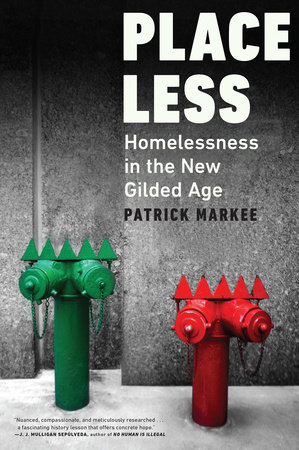
Placeless

Homelessness in the New Gilded Age

Author Patrick Markee On Tour
Look inside
Hardcover
$31.99 US
On sale Dec 02, 2025 | 352 Pages | 9781685891671

See Additional Formats
In the tradition of Matthew Desmond's Evicted, a longtime housing activist presents a vivid and myth-breaking account of why homelessness endures in contemporary America...

Millions of people are affected by homelessness, but media pundits and politicians see homelessness as a social work problem, or a matter of personal pathology, or some peculiar subspecies of urban poverty.

Informed by the author’s own front-line experiences from more than two decades working as an advocate for homeless people in New York City and his work with housing activists across the country. Placeless: Homelessness in the New Gilded Age presents an alternative and innovative, wide-angle view of homelessness and displacement in New York and elsewhere.

A tour of the geography of homelessness in New York City, where some 100,000 people a night sleep in the city’s shelter system, Markee visits certain city landmarks where homeless New Yorkers struggle to survive:

  • armories once built to quarter militias who put down worker uprisings
  • a train tunnel underneath Riverside Park
  • a grim intake center where infants, children, and families were forced to sleep on office floors
  • a former psychiatric wing of Bellevue Hospital now sheltering hundreds of homeless men each night
  • a Manhattan park surrounded by luxury condos where the police routinely harassed homeless street-dwellers

Blending historical analysis, urban theory, and the latest policy research, Markee considers homelessness in America as a tragic yet inevitable consequence of economic shifts inaugurated in the Reagan era, worsening inequality and housing affordability, systemic racism, and neoliberal government policies.

At a moment where tabloids and politicians use homelessness as an excuse to whip up fear, Placeless is a powerful and moving account of a social problem whose solution is entirely possible.
Introduction: Places and Spaces
The Train Tunnel: Pathologizing Homelessness
The Lower East Side and Tompkins Square Park: The Origins of Modern Mass Homelessness
Madison Square Park: Criminalizing Homelessness
The South Bronx: The Backlash Era
Bedford-Stuyvesant: Record Homelessness in the Luxury City
The EAU: Systemic Racism and Homelessness
Bellevue: Mental Illness and Homelessness
City Hall: Ideology and Homelessness
Armories: Labor and Homelessness
Three-Quarter Houses: “Permanent Housing” and Homelessness
Washington, DC, and Beyond: Urban America and Homelessness
Neighborhoods and Homelessness: Mass Displacement and Homelessness
Conclusion: Placeless
The New Gilded Age

It was an era marked by rampant inequality and urban poverty. Industrial tycoons owned more than half the nation’s wealth, wielded monopoly power, and corrupted the political system. Municipal leaders deployed militias and police on behalf of moneyed elites, brutally suppressing the revolts of restive laborers. A white backlash, often violent, grew amid even minimal signs of Black progress. Immigrants flooded into teeming cities, crowding tenements while landlords demanded ever higher rents. Underlying it all, massive shifts were transforming an economy in which manufacturing and industry prevailed.

This was the first Gilded Age of the late nineteenth century, and its echoes and reverberations have grown louder and more insistent over a century later. Unaccountably, we’ve arrived at another Gilded Age, but this one brought with it something new—a decades-long crisis of mass homelessness.

With this book, I’ve set out to explore the phenomenon of modern mass homelessness in our New Gilded Age, an era defined, like its late nineteenth-century namesake, by exploding inequality and seismic shifts in the economic and urban landscape. In these pages, I have attempted to offer a wide view of mass homelessness and displacement informed by historical analysis, urban theory, the latest policy research, and my own frontline experiences from more than two decades working as a homeless advocate. In short, I have tried to show that modern homelessness is both antecedent and symptom of the neoliberal era—and that far from being yet another urban malady, it has been instead a harbinger of wider forms of displacement in this New Gilded Age.

Too many accounts of homelessness have treated it as a special case—a social work problem, a matter of personal pathology and dysfunction, or some peculiar subspecies of urban poverty. Worse still, homelessness has too often been portrayed as an intractable problem that will “always be with us.” I’ve chosen instead to consider modern homelessness as the inevitable consequence of structural shifts in the capitalist economy, worsening inequality, systemic racism, and neoliberal government policies. What emerged was a loss of place—not only the loss of home and shelter, but also the loss of identity and security, as well as community and a role in our economic and civic life. I’ve then analyzed how the historical and economic forces of this unequal era accelerated the widening problem of displacement, with homelessness being only the most visible and tragic symptom.

In tracing the history of mass homelessness, I’ve also relied on the experiences of countless homeless people whom I have met over the years—people who struggled against overwhelming odds, facing government hostility and harassment, to survive day after day and ultimately escape homelessness and find a home. In this book, I’ve tried to tell some of their stories—above all, to show that the enormity of the crisis was, in the end, about real individuals.

Writing about modern mass homelessness, I knew I could never do justice to those who have lived through the crisis, nor those lost to it. So I’ve chosen to root the story in some historical, visible urban landmarks—places that offered refuge to homeless people but were also sites of displacement. In one chapter, I examine the harsh crackdowns on homeless people in Madison Square Park, part of the ruthless and racist policing tactics that helped fuel the lucrative hypergentrification of the surrounding neighborhood. In another chapter, I tell the story of the threatened eviction of dozens of homeless people from a train tunnel beneath Riverside Park, and how politicians, the news media, and others sought to pathologize the tunnel dwellers as well as other homeless people. In a later chapter, I explore the history of armories, the vast, fortresslike buildings used to shelter tens of thousands of homeless New Yorkers, many of whom were low-wage laborers—the same armories that were built in the first Gilded Age to quarter militias deployed by wealthy elites to suppress worker uprisings.

Modern homelessness was also a consequence of harsh, deliberate policies crafted and implemented by a series of New York mayors and public officials, and by their counterparts in DC and nationwide. It was impossible to understand the modern homelessness crisis in places like Boston, San Diego, Austin, and Washington, DC, without grappling with the history of the crisis in the nation’s largest city. I’ve therefore tried to show how the recent history of New York’s experience with homelessness and displacement could both explain the national phenomenon and illuminate the debate about how to handle the crisis.

Modern Mass Homelessness

While homelessness has existed in various ways throughout American history, the past century has seen just two extended periods of mass displacement: the Great Depression of the 1930s and the contemporary period of modern mass homelessness, which began in the late 1970s and has not ended after more than four decades. Historians have estimated that, on any given night during the worst years of the 1930s, there were well over a million homeless Americans, and millions of people experienced homelessness annually. The mass homelessness of the Great Depression, when the nation’s total population was about a third of what it became in the early twenty-first century, was undoubtedly more acute on a night-to-night basis than in the modern era. But it was also of far shorter duration, lasting for only a decade or so.

It has become nearly impossible to reckon with the scale of modern mass homelessness. In 2024, the federal government estimated that some 771,000 people experienced homelessness on a single night—that is, they slept in shelters, on the streets, or in other public spaces. This estimate was almost certainly an undercount, and it obscured the fact that, over the course of a year, as many as 3.5 million different people actually experienced homelessness. These measures also overlooked the much larger “hidden homeless” population of people living in doubled-up arrangements or severely overcrowded dwellings. One study found that, during the same period, there were 3.7 million people living in doubled-up housing—meaning that, by the 2020s, more than two in every hundred people in the United States was without a stable home.

The scale of the modern homelessness crisis in New York, the nation’s largest city, was almost harder to fathom. By the year 2025, more than 130,000 people were homeless each night in New York City, an astounding figure, and the highest ever recorded in the forty-plus years of modern mass homelessness. This was five times greater than the size of the nightly homeless population at the beginning of the twenty-first century, and eleven times larger than that in the early 1980s, during the first years of the modern crisis.

The large majority of New York City’s homeless population slept in shelters, thanks to legal “right to shelter” protections. Among the 130,000 people homeless in New York City each night, around three-quarters of those in shelters were in families, including some forty-five thousand children. Thousands more individuals slept rough each night on the streets, in the subway system, in parks, or in other outdoor places. Because of the legacy of systemic racism and inequality, Black and Latino New Yorkers made up nearly 90 percent of the homeless population, despite constituting only half of New York City’s total population. Indeed, according to a 2015 research study I wrote, one in every seventeen Black children in New York City had experienced homelessness over the course of a single year.

New York City’s “hidden homeless” population—the growing number of New York households forced to double up with relatives or friends or to live in severely overcrowded or illegal dwellings—was even larger. One stark sign of this invisible homeless population was that, over the course of the 2023–24 school year, more than 146,000 students in the New York public school system—a remarkable one in every eight students—had experienced homelessness. Researchers and advocates estimated that well over two hundred thousand people made up the hidden homeless population. This meant that, a quarter of the way through the twenty-first century, as many as four in every hundred New Yorkers lacked a stable home on any given night.

Musical Chairs

How did the modern homelessness crisis evolve, and why has it persisted for so long? The most elegant illustration I ever heard of the dynamics of modern homelessness was found, oddly enough, in a children’s game—musical chairs. In each round of the game, a chair was removed before the next began. Children would walk in a circle around the chairs, and, when the music stopped playing, the players would race to sit down in the remaining chairs. Each chair, in the metaphor, was an affordable home—or, as happened in the era of modern mass homelessness, one of the thousands of affordable or government-assisted apartments that were removed each year. And the rounds would continue, of course, as more chairs—or more housing units—were taken away.

So, who got the remaining chairs? Well, as I remembered it from my childhood, the winners were the bigger, stronger, and more ruthless kids. The weaker kids got pushed out of the game and wound up chairless. In the homelessness scenario, the poorest and “weakest” people were the ones pushed aside. Those who most swiftly lost their homes included people living with disabilities, the unemployed, poor families, individuals struggling with mental illness, and women fleeing domestic violence. Over time, as new rounds of the game began and the music started up and then was silenced again, the number of homeless people continued to grow.

It was a neat metaphor that helped show the problem wasn’t the players—it was the force removing the chairs. In this book, I’ve attempted to work out how and why the chairs—or, rather, the homes—were taken away, and what economic and political forces were responsible. I’ve also tried to show what happened to those who were removed and displaced, who became part of a growing surplus population of discarded people. Finally, I’ve attempted to illustrate how homelessness was only one way that displacement became so widespread in the New Gilded Age.

The Train Tunnel: Pathologizing Homelessness

The train tunnel ran for fifty city blocks, nearly three miles, under Manhattan streets and parkland. It stretched along the island’s far west side, near the Hudson River, from West 72nd Street uptown to West 122nd Street in West Harlem. It was one of those rare New York City places that made one feel both inside and utterly outside the city, as if, for a few moments, a visitor who’d ventured far enough into its recesses could convince themselves that they’d fled the chaos and noise of the city without ever leaving.

The first time I walked deep into the tunnel, one autumn afternoon in 1995, I felt myself steadily, step by step, wrapped in darkness. The pallid October sunlight from the southern entrance faded, and I could feel my pupils dilating to capture the available light, allowing me to glimpse the grime-streaked concrete walls, the graffiti, and the railroad tracks with their battered wooden ties. I was instantly aware of the descending silence, as if the volume knob on an old stereo were turning down the usual background thrum and clatter of New York City.

But then, gradually, imperceptibly, other sounds intruded: rats skittering on the gravel and rails, water dripping from the two-story-high tunnel ceiling or a ventilation grate, the echo of someone shouting from the tunnel mouth behind me. And, all at once, I was reminded that the dark, muted tunnel was merely another manufactured creation in the thoroughly artificial environment of New York City—and, most startling of all, one that became, for many years, a last-resort home for dozens of desperate New Yorkers seeking refuge.

In the mid-1990s, I spent several months helping to resettle the last of several dozen homeless people soon to be expelled from a train tunnel on the west side of Manhattan. Beginning in October 1995, I trekked a few days each month to a derelict lot not far from the Hudson River. There a once-disused rail line disappeared into a vast tunnel that stretched northwards under Riverside Park, surfaced in West Harlem, and continued on to Albany and points upstate.

During those few chilly months in a changing, embattled New York City—where Mayor Rudy Giuliani’s brutal, racist, and overtly antihomeless policies were being hailed by many elites as having “saved” New York—I met some remarkable people who’d managed to survive some unimaginably trying circumstances. Even more, I came to learn some crucial lessons about the enduring, and pernicious, myths surrounding homelessness in the New Gilded Age.
© Alan Chin
Patrick Markee was the Deputy Executive Director for Advocacy of the Coalition for the Homeless, New York’s premier homeless advocacy organization, and a member of the board of directors of the National Coalition for the Homeless. He has authored numerous research studies on homelessness and housing policy, and has written for The Nation and The New York Times Book Review. He lives in New York City. View titles by Patrick Markee

About

In the tradition of Matthew Desmond's Evicted, a longtime housing activist presents a vivid and myth-breaking account of why homelessness endures in contemporary America...

Millions of people are affected by homelessness, but media pundits and politicians see homelessness as a social work problem, or a matter of personal pathology, or some peculiar subspecies of urban poverty.

Informed by the author’s own front-line experiences from more than two decades working as an advocate for homeless people in New York City and his work with housing activists across the country. Placeless: Homelessness in the New Gilded Age presents an alternative and innovative, wide-angle view of homelessness and displacement in New York and elsewhere.

A tour of the geography of homelessness in New York City, where some 100,000 people a night sleep in the city’s shelter system, Markee visits certain city landmarks where homeless New Yorkers struggle to survive:

  • armories once built to quarter militias who put down worker uprisings
  • a train tunnel underneath Riverside Park
  • a grim intake center where infants, children, and families were forced to sleep on office floors
  • a former psychiatric wing of Bellevue Hospital now sheltering hundreds of homeless men each night
  • a Manhattan park surrounded by luxury condos where the police routinely harassed homeless street-dwellers

Blending historical analysis, urban theory, and the latest policy research, Markee considers homelessness in America as a tragic yet inevitable consequence of economic shifts inaugurated in the Reagan era, worsening inequality and housing affordability, systemic racism, and neoliberal government policies.

At a moment where tabloids and politicians use homelessness as an excuse to whip up fear, Placeless is a powerful and moving account of a social problem whose solution is entirely possible.

Table of Contents

Introduction: Places and Spaces
The Train Tunnel: Pathologizing Homelessness
The Lower East Side and Tompkins Square Park: The Origins of Modern Mass Homelessness
Madison Square Park: Criminalizing Homelessness
The South Bronx: The Backlash Era
Bedford-Stuyvesant: Record Homelessness in the Luxury City
The EAU: Systemic Racism and Homelessness
Bellevue: Mental Illness and Homelessness
City Hall: Ideology and Homelessness
Armories: Labor and Homelessness
Three-Quarter Houses: “Permanent Housing” and Homelessness
Washington, DC, and Beyond: Urban America and Homelessness
Neighborhoods and Homelessness: Mass Displacement and Homelessness
Conclusion: Placeless

Excerpt

The New Gilded Age

It was an era marked by rampant inequality and urban poverty. Industrial tycoons owned more than half the nation’s wealth, wielded monopoly power, and corrupted the political system. Municipal leaders deployed militias and police on behalf of moneyed elites, brutally suppressing the revolts of restive laborers. A white backlash, often violent, grew amid even minimal signs of Black progress. Immigrants flooded into teeming cities, crowding tenements while landlords demanded ever higher rents. Underlying it all, massive shifts were transforming an economy in which manufacturing and industry prevailed.

This was the first Gilded Age of the late nineteenth century, and its echoes and reverberations have grown louder and more insistent over a century later. Unaccountably, we’ve arrived at another Gilded Age, but this one brought with it something new—a decades-long crisis of mass homelessness.

With this book, I’ve set out to explore the phenomenon of modern mass homelessness in our New Gilded Age, an era defined, like its late nineteenth-century namesake, by exploding inequality and seismic shifts in the economic and urban landscape. In these pages, I have attempted to offer a wide view of mass homelessness and displacement informed by historical analysis, urban theory, the latest policy research, and my own frontline experiences from more than two decades working as a homeless advocate. In short, I have tried to show that modern homelessness is both antecedent and symptom of the neoliberal era—and that far from being yet another urban malady, it has been instead a harbinger of wider forms of displacement in this New Gilded Age.

Too many accounts of homelessness have treated it as a special case—a social work problem, a matter of personal pathology and dysfunction, or some peculiar subspecies of urban poverty. Worse still, homelessness has too often been portrayed as an intractable problem that will “always be with us.” I’ve chosen instead to consider modern homelessness as the inevitable consequence of structural shifts in the capitalist economy, worsening inequality, systemic racism, and neoliberal government policies. What emerged was a loss of place—not only the loss of home and shelter, but also the loss of identity and security, as well as community and a role in our economic and civic life. I’ve then analyzed how the historical and economic forces of this unequal era accelerated the widening problem of displacement, with homelessness being only the most visible and tragic symptom.

In tracing the history of mass homelessness, I’ve also relied on the experiences of countless homeless people whom I have met over the years—people who struggled against overwhelming odds, facing government hostility and harassment, to survive day after day and ultimately escape homelessness and find a home. In this book, I’ve tried to tell some of their stories—above all, to show that the enormity of the crisis was, in the end, about real individuals.

Writing about modern mass homelessness, I knew I could never do justice to those who have lived through the crisis, nor those lost to it. So I’ve chosen to root the story in some historical, visible urban landmarks—places that offered refuge to homeless people but were also sites of displacement. In one chapter, I examine the harsh crackdowns on homeless people in Madison Square Park, part of the ruthless and racist policing tactics that helped fuel the lucrative hypergentrification of the surrounding neighborhood. In another chapter, I tell the story of the threatened eviction of dozens of homeless people from a train tunnel beneath Riverside Park, and how politicians, the news media, and others sought to pathologize the tunnel dwellers as well as other homeless people. In a later chapter, I explore the history of armories, the vast, fortresslike buildings used to shelter tens of thousands of homeless New Yorkers, many of whom were low-wage laborers—the same armories that were built in the first Gilded Age to quarter militias deployed by wealthy elites to suppress worker uprisings.

Modern homelessness was also a consequence of harsh, deliberate policies crafted and implemented by a series of New York mayors and public officials, and by their counterparts in DC and nationwide. It was impossible to understand the modern homelessness crisis in places like Boston, San Diego, Austin, and Washington, DC, without grappling with the history of the crisis in the nation’s largest city. I’ve therefore tried to show how the recent history of New York’s experience with homelessness and displacement could both explain the national phenomenon and illuminate the debate about how to handle the crisis.

Modern Mass Homelessness

While homelessness has existed in various ways throughout American history, the past century has seen just two extended periods of mass displacement: the Great Depression of the 1930s and the contemporary period of modern mass homelessness, which began in the late 1970s and has not ended after more than four decades. Historians have estimated that, on any given night during the worst years of the 1930s, there were well over a million homeless Americans, and millions of people experienced homelessness annually. The mass homelessness of the Great Depression, when the nation’s total population was about a third of what it became in the early twenty-first century, was undoubtedly more acute on a night-to-night basis than in the modern era. But it was also of far shorter duration, lasting for only a decade or so.

It has become nearly impossible to reckon with the scale of modern mass homelessness. In 2024, the federal government estimated that some 771,000 people experienced homelessness on a single night—that is, they slept in shelters, on the streets, or in other public spaces. This estimate was almost certainly an undercount, and it obscured the fact that, over the course of a year, as many as 3.5 million different people actually experienced homelessness. These measures also overlooked the much larger “hidden homeless” population of people living in doubled-up arrangements or severely overcrowded dwellings. One study found that, during the same period, there were 3.7 million people living in doubled-up housing—meaning that, by the 2020s, more than two in every hundred people in the United States was without a stable home.

The scale of the modern homelessness crisis in New York, the nation’s largest city, was almost harder to fathom. By the year 2025, more than 130,000 people were homeless each night in New York City, an astounding figure, and the highest ever recorded in the forty-plus years of modern mass homelessness. This was five times greater than the size of the nightly homeless population at the beginning of the twenty-first century, and eleven times larger than that in the early 1980s, during the first years of the modern crisis.

The large majority of New York City’s homeless population slept in shelters, thanks to legal “right to shelter” protections. Among the 130,000 people homeless in New York City each night, around three-quarters of those in shelters were in families, including some forty-five thousand children. Thousands more individuals slept rough each night on the streets, in the subway system, in parks, or in other outdoor places. Because of the legacy of systemic racism and inequality, Black and Latino New Yorkers made up nearly 90 percent of the homeless population, despite constituting only half of New York City’s total population. Indeed, according to a 2015 research study I wrote, one in every seventeen Black children in New York City had experienced homelessness over the course of a single year.

New York City’s “hidden homeless” population—the growing number of New York households forced to double up with relatives or friends or to live in severely overcrowded or illegal dwellings—was even larger. One stark sign of this invisible homeless population was that, over the course of the 2023–24 school year, more than 146,000 students in the New York public school system—a remarkable one in every eight students—had experienced homelessness. Researchers and advocates estimated that well over two hundred thousand people made up the hidden homeless population. This meant that, a quarter of the way through the twenty-first century, as many as four in every hundred New Yorkers lacked a stable home on any given night.

Musical Chairs

How did the modern homelessness crisis evolve, and why has it persisted for so long? The most elegant illustration I ever heard of the dynamics of modern homelessness was found, oddly enough, in a children’s game—musical chairs. In each round of the game, a chair was removed before the next began. Children would walk in a circle around the chairs, and, when the music stopped playing, the players would race to sit down in the remaining chairs. Each chair, in the metaphor, was an affordable home—or, as happened in the era of modern mass homelessness, one of the thousands of affordable or government-assisted apartments that were removed each year. And the rounds would continue, of course, as more chairs—or more housing units—were taken away.

So, who got the remaining chairs? Well, as I remembered it from my childhood, the winners were the bigger, stronger, and more ruthless kids. The weaker kids got pushed out of the game and wound up chairless. In the homelessness scenario, the poorest and “weakest” people were the ones pushed aside. Those who most swiftly lost their homes included people living with disabilities, the unemployed, poor families, individuals struggling with mental illness, and women fleeing domestic violence. Over time, as new rounds of the game began and the music started up and then was silenced again, the number of homeless people continued to grow.

It was a neat metaphor that helped show the problem wasn’t the players—it was the force removing the chairs. In this book, I’ve attempted to work out how and why the chairs—or, rather, the homes—were taken away, and what economic and political forces were responsible. I’ve also tried to show what happened to those who were removed and displaced, who became part of a growing surplus population of discarded people. Finally, I’ve attempted to illustrate how homelessness was only one way that displacement became so widespread in the New Gilded Age.

The Train Tunnel: Pathologizing Homelessness

The train tunnel ran for fifty city blocks, nearly three miles, under Manhattan streets and parkland. It stretched along the island’s far west side, near the Hudson River, from West 72nd Street uptown to West 122nd Street in West Harlem. It was one of those rare New York City places that made one feel both inside and utterly outside the city, as if, for a few moments, a visitor who’d ventured far enough into its recesses could convince themselves that they’d fled the chaos and noise of the city without ever leaving.

The first time I walked deep into the tunnel, one autumn afternoon in 1995, I felt myself steadily, step by step, wrapped in darkness. The pallid October sunlight from the southern entrance faded, and I could feel my pupils dilating to capture the available light, allowing me to glimpse the grime-streaked concrete walls, the graffiti, and the railroad tracks with their battered wooden ties. I was instantly aware of the descending silence, as if the volume knob on an old stereo were turning down the usual background thrum and clatter of New York City.

But then, gradually, imperceptibly, other sounds intruded: rats skittering on the gravel and rails, water dripping from the two-story-high tunnel ceiling or a ventilation grate, the echo of someone shouting from the tunnel mouth behind me. And, all at once, I was reminded that the dark, muted tunnel was merely another manufactured creation in the thoroughly artificial environment of New York City—and, most startling of all, one that became, for many years, a last-resort home for dozens of desperate New Yorkers seeking refuge.

In the mid-1990s, I spent several months helping to resettle the last of several dozen homeless people soon to be expelled from a train tunnel on the west side of Manhattan. Beginning in October 1995, I trekked a few days each month to a derelict lot not far from the Hudson River. There a once-disused rail line disappeared into a vast tunnel that stretched northwards under Riverside Park, surfaced in West Harlem, and continued on to Albany and points upstate.

During those few chilly months in a changing, embattled New York City—where Mayor Rudy Giuliani’s brutal, racist, and overtly antihomeless policies were being hailed by many elites as having “saved” New York—I met some remarkable people who’d managed to survive some unimaginably trying circumstances. Even more, I came to learn some crucial lessons about the enduring, and pernicious, myths surrounding homelessness in the New Gilded Age.

Author

© Alan Chin
Patrick Markee was the Deputy Executive Director for Advocacy of the Coalition for the Homeless, New York’s premier homeless advocacy organization, and a member of the board of directors of the National Coalition for the Homeless. He has authored numerous research studies on homelessness and housing policy, and has written for The Nation and The New York Times Book Review. He lives in New York City. View titles by Patrick Markee