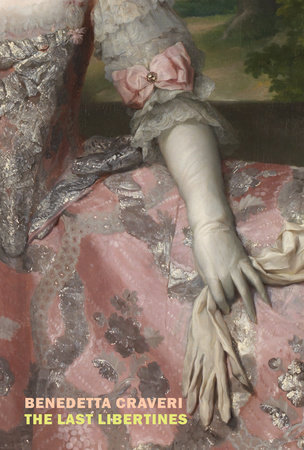

The Last Libertines

Translated by Aaron Kerner
Ebook
On sale Oct 20, 2020 | 616 Pages | 9781681373416

See Additional Formats
This “rich . . . highly enjoyable portrait of an extraordinary moment in French history” introduces us to 7 dazzling aristocrats who rose and fell during the French Revolution (Guardian).

Benedetta Craveri reveals the history of the Libertine generation “whose youth coincided with the French monarchy’s final moment of grace—a moment when . . . a style of life based on privilege and the spirit of caste might acknowledge the widespread demand for change, and . . . reconcile itself with Enlightenment ideals of justice, tolerance, and citizenship.”
 
Here we meet 7 characters who Craveri singles out not only for their “romantic character” but also for “the keenness with which they experienced this crisis . . . of the ancien régime, of which they themselves were the emblem.”
 
• Duc de Lauzun
• Vicomte de Ségur
• Duc de Brissac
• Comte de Narbonne
• Chevalier de Boufflers
• Comte de Ségur
• Comte de Vaudreuil
 
These men were at once “irreducible individualists” and true “sons of the Enlightenment”—all of them ambitious to play their part in bringing around the great changes that were in the air. But when the French Revolution came, they found themselves condemned to poverty, exile, and in some cases execution.
 
Telling the parallel lives of these dazzling but little-remembered historical figures, Craveri brings the past to life, powerfully dramatizing a turbulent time that was at once the last act of a now-vanished world and the first act of our own.
Benedetta Craveri is currently a professor of French literature at the University Suor Orsola Benincasa, Naples. She is a corresponding member of Accademia dei Lincei and contributes to The New York Review of Books and to the cultural pages of the Italian newspaper La Repubblica. Her books include Madame du Deffand and Her World, Mistresses and Queens, and The Age of Conversation (available from New York Review Books). She is married to a French diplomat and in 2017 was awarded the Prix mondial Cino Del Duca by l’Institut de France.

Aaron Kerner is a translator, editor, and teacher who lives in Boston.
“Fanning out far beyond the individual stories of her protagonists, Craveri describes in fascinating detail France’s war against the British in America, the high politics and alliances of the European courts and the fashion for all things English that swept through Paris in the 1780s... Craveri’s use of the archives and prodigious amount of printed material is extremely impressive...There is little she does not touch on and she has a gift for bringing scenes alive....With these seven characters, Craveri has painted a rich, scholarly, highly enjoyable portrait of an extraordinary moment in French history.”
—Caroline Moorehead, The Guardian

. . . . The Last Libertines provides a warmer picture of Craveri’s flawed but engaging subjects. Among its great charms are the quality and quantity of its gossipy anecdotes and the colorful portraits of its many incidental characters, including Joseph de Sabran who, running out of cannonballs in a naval battle against the British, packed his last gun with his table silver and blasted away. Throughout, Craveri quotes from her subjects’ witty writings—evidence of extraordinarily agile and imaginative minds, and largely representative of their class. This, along with their battle-tested courage leads one to wonder the question never really addressed by Craveri: how could men like them have lost to men like Saint-Just?”  
—James F. Penrose, New Criterion

“The sheer energy of these seven aristocrats is astounding. . . . In the end, we can’t help admiring these extraordinary people . . . they adhere to an aristocratic code of honour es exacting as any religiously-inspired ethic — but much more stylish.” 
—Ivan Hewett, The Daily Telegraph

The Last Libertines is a composite picture, brilliantly written, of the young aristocrats who lived through the last days of the French monarchy, subscribed both to loyalty to the throne and to Enlightenment ideals of equality, and sometimes survived the Terror to move into the Napoleonic period. Like us they had to go through these difficult transitions, in their case with elegance and extraordinary gaiety.”
—Edmund White

The Last Libertines is an elegant tale of intrigue—amorous and political. Through the lives of seven aristocrats, Benedetta Craveri convincingly explores the ideals of libertinism as a link between the ancient regime and the new world order that followed.”
—Cathleen Schine

“A beautiful subject of reflection on the end of a world too perfect in its essence to find the ways of its future.”
Culture-Tops

About

This “rich . . . highly enjoyable portrait of an extraordinary moment in French history” introduces us to 7 dazzling aristocrats who rose and fell during the French Revolution (Guardian).

Benedetta Craveri reveals the history of the Libertine generation “whose youth coincided with the French monarchy’s final moment of grace—a moment when . . . a style of life based on privilege and the spirit of caste might acknowledge the widespread demand for change, and . . . reconcile itself with Enlightenment ideals of justice, tolerance, and citizenship.”
 
Here we meet 7 characters who Craveri singles out not only for their “romantic character” but also for “the keenness with which they experienced this crisis . . . of the ancien régime, of which they themselves were the emblem.”
 
• Duc de Lauzun
• Vicomte de Ségur
• Duc de Brissac
• Comte de Narbonne
• Chevalier de Boufflers
• Comte de Ségur
• Comte de Vaudreuil
 
These men were at once “irreducible individualists” and true “sons of the Enlightenment”—all of them ambitious to play their part in bringing around the great changes that were in the air. But when the French Revolution came, they found themselves condemned to poverty, exile, and in some cases execution.
 
Telling the parallel lives of these dazzling but little-remembered historical figures, Craveri brings the past to life, powerfully dramatizing a turbulent time that was at once the last act of a now-vanished world and the first act of our own.

Author

Benedetta Craveri is currently a professor of French literature at the University Suor Orsola Benincasa, Naples. She is a corresponding member of Accademia dei Lincei and contributes to The New York Review of Books and to the cultural pages of the Italian newspaper La Repubblica. Her books include Madame du Deffand and Her World, Mistresses and Queens, and The Age of Conversation (available from New York Review Books). She is married to a French diplomat and in 2017 was awarded the Prix mondial Cino Del Duca by l’Institut de France.

Aaron Kerner is a translator, editor, and teacher who lives in Boston.

Praise

“Fanning out far beyond the individual stories of her protagonists, Craveri describes in fascinating detail France’s war against the British in America, the high politics and alliances of the European courts and the fashion for all things English that swept through Paris in the 1780s... Craveri’s use of the archives and prodigious amount of printed material is extremely impressive...There is little she does not touch on and she has a gift for bringing scenes alive....With these seven characters, Craveri has painted a rich, scholarly, highly enjoyable portrait of an extraordinary moment in French history.”
—Caroline Moorehead, The Guardian

. . . . The Last Libertines provides a warmer picture of Craveri’s flawed but engaging subjects. Among its great charms are the quality and quantity of its gossipy anecdotes and the colorful portraits of its many incidental characters, including Joseph de Sabran who, running out of cannonballs in a naval battle against the British, packed his last gun with his table silver and blasted away. Throughout, Craveri quotes from her subjects’ witty writings—evidence of extraordinarily agile and imaginative minds, and largely representative of their class. This, along with their battle-tested courage leads one to wonder the question never really addressed by Craveri: how could men like them have lost to men like Saint-Just?”  
—James F. Penrose, New Criterion

“The sheer energy of these seven aristocrats is astounding. . . . In the end, we can’t help admiring these extraordinary people . . . they adhere to an aristocratic code of honour es exacting as any religiously-inspired ethic — but much more stylish.” 
—Ivan Hewett, The Daily Telegraph

The Last Libertines is a composite picture, brilliantly written, of the young aristocrats who lived through the last days of the French monarchy, subscribed both to loyalty to the throne and to Enlightenment ideals of equality, and sometimes survived the Terror to move into the Napoleonic period. Like us they had to go through these difficult transitions, in their case with elegance and extraordinary gaiety.”
—Edmund White

The Last Libertines is an elegant tale of intrigue—amorous and political. Through the lives of seven aristocrats, Benedetta Craveri convincingly explores the ideals of libertinism as a link between the ancient regime and the new world order that followed.”
—Cathleen Schine

“A beautiful subject of reflection on the end of a world too perfect in its essence to find the ways of its future.”
Culture-Tops