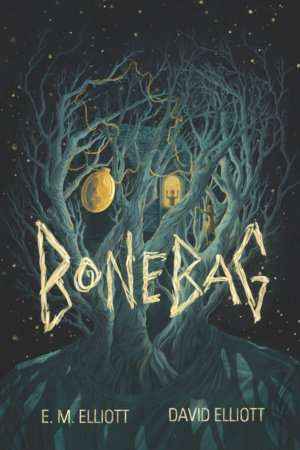
In this riveting middle-grade fantasy, New York Times bestselling author David Elliott and E.M. Elliott tell the story of a forest-dwelling boy forced to confront the mysteries of his life.

Trapped in a dark forest with his cold-hearted parents, Bonebag leads a cruel and isolated existence. However, he feels deep in his bones that things weren’t always this way: he has known happiness before. Why does it feel like it was in a past life? 

When Bonebag discovers a locket that burns him to the touch, and a ghostly girl beckons him into the deep woods, he must grapple with the riddle of where he came from and how he came to be. Only then can he begin to rewrite his fate. 

From New York Times bestselling author David Elliott and his son, E.M. Elliott, this powerful middle-grade fantasy will take readers on a quest that tackles the mystery of belonging with high-octane twists and turns along the way.
1

They hadn’t eaten for two weeks.
Not that he blamed them. The foul-smelling, rancid mush, a concoction Modor called foddish, had been served at every meal he could remember. The only variation was the amount of grit he would hear grinding between the bottom of his spoon and the glaze of the bowl. Occasionally he would discover a tiny fist of gristle in the foddish, or a bone the size of a twig. When he was sure he wouldn’t be seen, he lifted his eyes from the table to watch the empty wooden spoon slowly ascend to Faeder’s lips and then lower to the full bowl.
Weren’t his parents hungry? He knew better than to ask. They had proven to him—and on more than one occasion—that they were fierce believers that children should be seen and not heard.
Faeder looked up from his bowl.
Bonebag diverted his own gaze to a smudge of dirt on his left wrist.
He could feel Faeder’s eyes on him.
When he could stand it no longer, he looked up but trained his attention on the corner behind Faeder where an ill-made broom, untouched for as long as he could remember, provided an anchor for the webs of yellow and black spiders that made their home there. With its crooked, thorny handle and brittle, loosely bound head, the broom was hardly better than the effort of an untrained child.
Faeder told Bonebag he was a broom maker. But as far as the boy knew, the man had never traveled to sell his wares. And no one had ever come to the clearing in the Scura min Scurse, the great forest that surrounded the crumbling cottage the boy called home. Not a single person. Not once. Not ever. Bonebag knew it didn’t add up, and he knew better than to ask why.
But if Faeder presented the boy with unanswered questions, Modor’s behavior perplexed him even more. The only thing he knew for certain was that the lumbering woman was not like other mothers. Or at least not like the only other mother he knew about, a woman called Marmee. If Marmee was a good example, it seemed to him that mothers were supposed to love their children. What he felt from Modor was not love. But it was not the opposite of love either. It was as if she were expecting something from him and was impatient to receive it.
He had read about Marmee in the Tatters, hi name for the scattered confusion of brittle pages he had discovered under his mattress in the loft. There were many such pages. Stained. Torn at the edges. Yellowed with age. Some with pictures. Some without. Most single. But some, loosely bound. His favorite recounted the adventures of a boy named Davie Balfour, whose wicked uncle caused him to be kidnapped and later shipwrecked on the rugged coast of some faraway land. Marmee’s story and the one about the shipwrecked boy seemed to be parts of much longer tales, but enough of Marmee’s was there for him to understand that she was a loving mother. She laughed when her daughters—there were only daughters in the family—were happy and wept when they were sad. Marmee was as different from Modor as violets were from the sumac that grew rampant in the Scura min Scurse.
Modor slammed a fist on the table.
“Eat!” she barked.
He took a bite and swallowed without tasting. It was best to do as she said, even if his thoughts were elsewhere.
As they were now.
He’d spotted a moonthing under the table. A beauty, too. At least twice as big as any of the others. But how to get it without Modor catching him? Or worse, Faeder.
He’d asked about these discs only once, the first time he found one balanced on the bottom rung of the ladder that led to his loft. It had been a day last week.
“Bonebag is like the cat,” Faeder had said in response.
Bonebag. The only name his parents had ever called him.
“Cat?” he’d asked. “What cat?”
“That curious one,” Faeder said.
The bruise on his thin shoulder was still visible.
Since that day, he’d found more of the strange, silver discs he’d named moonthings, smaller than the one under his chair, but made of the same hard, translucent material. This new one would make number twelve.
Keeping his upper body still, he inched his right foot forward. He was hoping to cover the moonthing with the sole of his broken sandal and silently draw it to him. Then he would invent a reason to bend down, hide the treasure in the palm of his hand, and shove it into the pocket of his ragged trousers. Maybe he would pretend to drop his spoon. But that would be risking a hard slap. Or worse. No. Better if he acted like he was brushing away one of the cockroaches that skittered about as if they were the rightful residents.
Both his parents’ eyes were on him now.
He stared straight ahead, his own eyes devoid of expression, his mouth relaxed in a straight line, the mask that experience had taught him was the safest to adopt whenever he was in their presence. He snailed his foot forward. Until . . . there! He could feel it—the moonthing, its hard edges curled slightly upward under his toes. Now all he had to do was—
Suddenly, Faeder slammed his fist on the table. The bowls jumped. His foot shot back under his stool. Faeder glared. But the boy needn’t have worried. It was only the signal that the meal was over.
The moonthing lay where it was.

2 His heart still pounding, he stood up, collected the bowls and carried them outside to the wash station. He set the bowls down in the dirt and primed the pump, working the handle until the rusty water reached the surface. The water was cold, coming from dark caverns far beneath the earth. Even on the warmest days, it caused him to shiver.
As he scraped the foddish from the bowls, he thought of the moonthings. What were they? Where had they come from?
Riddles. His life was filled with them. Faeder and his broom. Modor’s cold indifference. The moonthings. But there was one riddle in particular that puzzled him more than any of the others: he knew what it meant to be happy. Knew it in his very bones. It was like the memory of a friend he had never met. Or the shadow of an object he had never seen. How, he wondered, could he be familiar with something he himself had never experienced?
This was a question that plagued him, as persistent as the mosquitoes that swarmed in the Scura min Scurse. Even more mysterious were the images that came to him each time he asked it, images and sensations that felt as real as the sinking cottage walls.
These images appeared in his mind’s eye, always in the same order. First, the image of two beasts, horned creatures he had no name for. But from their colossal size, he knew they were possessed of incredible power. Huge and unmoving. Carved from the hardest stone. He had touched those magnificent animals once. He was sure of it. But how could that be? In all his years, he had never left the confines of the Scura.
Next came a heavy, six-paneled door painted in a vibrant, eye-popping red. With its golden doorknob engraved in a brilliant sunburst, it was a door so out of place in the Scura that he sometimes wondered how his imagination had produced it.
Often, the sight of this door was followed by the most fleeting of the three impressions. A sweet fragrance so short-lived that sometimes Bonebag wasn’t entirely sure he’d experienced it at all. The instant its delicate scent registered in his nostrils, it was gone. In the rare hours when he wasn’t doing chores, he’d made it his business to search every inch of the clearing, hoping to find the flower that was its source. But so far, no luck.
The strange, horned beasts, the red door, the mysterious fragrance bewildered him. They seemed to belong to another time, another place. That was impossible, of course. But no use thinking about all that now. The moonthing still lay under the table.
He set the bowls in the sun to dry and looked behind him through the open door and into the cottage. His parents had not moved. He watched their chests rise and fall. They were asleep. Or something that mimicked sleep. But their eyes were wide open.
When they were in this state, as they increasingly were, they did not respond when he spoke to them or on those rare occasions when he was brave enough to touch them. It was as if they were trapped in a state of suspension, like moths just before they free themselves from the husk of a cocoon.
This was his chance. Holding his breath, he slipped out of his sandals and crept back into the cottage. He stole through the room, the floorboards squeaking like fearful mice. He avoided looking at Modor and Faeder, afraid he would lose his nerve if he met their glazed, unseeing eyes.
When he reached the table, he crouched down and snatched the moonthing, sliding it into his pocket in one quick motion. His lungs ached from holding his breath. He exhaled and felt himself shrink as the air escaped. He wished he could keep shrinking. Like the girl Alice in one of his favorite pages from the Tatters. But this wasn’t the Tatters. This was his life.
Slowly, he lifted his head and peeked over the tabletop.
Modor blinked.
Bonebag ran.
He did not stop running until he reached the patch of dainty purple flowers that marked his destination—a hollow log lying just inside the forest. These small, unscented blossoms, their petals tipped with white, circled the log, blooming and withering at irregular intervals without regard to season or temperature. He’d discovered the log—a moss-encrusted trunk that had fallen in one of the violent storms that plagued the Scura—shortly after he’d found the first moonthing. Like a squirrel storing acorns, he’d hidden every precious silvery disc he’d found in its rotting body. This one would join the others.
On his knees now, Bonebag reached into the log, the soft, damp wood crumbling whenever his hand brushed against it. His elbow disappeared, then his upper arm. Where was it? His shoulder was now pressed against the edge of the log, and he still hadn’t found the ragged shirt he’d wrapped the moonthings in.
Finally, his fingers closed around what he’d been searching for. But wait! What was that? His knuckles had brushed something else. Something soft, hidden deeper in the hollow log. He pulled the moonthings from their hiding place and then eased his hand back into the darkness.
Seconds later, he rolled off his knees and sat cross-legged in the sparse grass punctuated by the nameless purple flowers. In his lap lay a knotted ball of white fabric. It was another in a strange assortment of tattered clothing he’d found over the years.
He had discovered the first—a shirt with a softly rounded collar—snagged in the low-hanging branches of a tree just inside the Scura. Several months later, he found what had once been an elaborately ruffled dress trapped in a tangle of tall nettles. The hat with the cloth-covered button he had uncovered near the cottage when the sun caught its short bill jutting up from a pile of soft dirt.
Stained and filthy, disintegrated and torn, each of these had been subject to the ravages of the Scura’s savage weather. Though they differed in style and design, they held one thing in common: Judging from their size, they had once belonged to children, children of just about the same age he was now.
Using the palm of his hand, he carefully untangled this latest find—a smock. One of the Scura’s burrowing creatures must have dragged it into the log hoping to incorporate it into its nest.
He ran his fingertips over the worn fabric. To whom had this dress belonged? Where was she now? According to Modor and Faeder, the Scura was filled with savage creatures, creatures who hated the light and whose sole purpose was to bring pain to those they encountered. Had the girl met her fate in the gnashing teeth of these monsters?
With his attention on the forest, his fingers strayed from the fraying hem, stopping only when they brushed against a small circular object in one of the pockets. He yanked his hand away. His fingertips throbbed where they had brushed the object’s hard surface.
Once, during a winter rain, he’d spent all day outside chopping wood. When he’d finally been allowed back inside, his fingers curled into his palms, the heat radiating from the fireplace had hurt so badly that he’d had to fight back tears. But this . . . this was worse. The pain seemed to go deeper, all the way into his very bones.
And somehow, deeper still.
His stomach roiled. He bent over, thinking for a moment that he might be sick. But then, as immediately as it had struck him, the pain vanished. He stood up straight as he flexed his fingers. Whatever was in the smock’s pocket had done this to him. But how? He picked the dress up by its hem, lifting it until it hung upside down.
The mysterious object slipped out of the pocket. He laid the smock down and carefully parted the grass where it had fallen. A golden locket lay open, its delicate chain curled through the weeds like a snake. The frame held a picture of a young woman, her head thrown back in laughter, one arm hugging the bright-eyed infant in her lap. Most striking, though, was the girl with a tangle of jet-black hair who rested her chin on the woman’s shoulder.
There was something about the girl that was familiar. Even comforting. The tilt of her head? The light in her eyes? Did she bear a resemblance to one of the illustrations in the Tatters? No, he didn’t think so. He’d looked at the pictures so often he could see each one perfectly in his mind. Not one reminded him of the girl. And yet the stubborn feeling lingered.
He dropped to his knees. His hand closed around the chain, and he lifted the locket, letting it dangle in front of him.
Without warning, every fiber of his body began to throb, every nerve, every muscle. Even his bones ached. With the pain came a heavy sadness, as thick and firmly planted against his skin as the moss that grew over the log. Though only a few moments before, he had been filled with excitement and curiosity, he was now consumed by wave after wave of sorrow.
The Scura min Scurse grew closer. The trees tilted sharply toward him, threatening to tear their roots from the ground and come crashing down on him. The gray light of the forest faded to an ever-darker shade, like stone after a heavy rain. His heart began to race. Warm beads of perspiration broke out on his forehead and upper lip.
He felt the chain slip from his fingers.
Then the world went blank.
E. M. Elliott studied film and creative writing at Sarah Lawrence College and Media Studies at The New School in New York. He previously worked as a script reader for two production houses in Los Angeles, and currently lives in Philadelphia with his wife, dog, and cat. This is his first book. View titles by E. M. Elliott
© David Elliott
David Elliott lives in New Hampshire with his wife and a Dandie Dinmont terrier. David is the author of the New York Times Best Seller And Here's to You! illustrated by Randy Cecil; a trio of poetry books about animals illustrated by Holly Meade (On the Farm, In the Sea, and the ALSC Notable Book for Children In the Wild); and the brilliantly funny Finn Throws a Fit illustrated by Timothy Basil Ering; as well as many other picture books and middle-grade novels. davidelliottbooks.com. View titles by David Elliott

About

In this riveting middle-grade fantasy, New York Times bestselling author David Elliott and E.M. Elliott tell the story of a forest-dwelling boy forced to confront the mysteries of his life.

Trapped in a dark forest with his cold-hearted parents, Bonebag leads a cruel and isolated existence. However, he feels deep in his bones that things weren’t always this way: he has known happiness before. Why does it feel like it was in a past life? 

When Bonebag discovers a locket that burns him to the touch, and a ghostly girl beckons him into the deep woods, he must grapple with the riddle of where he came from and how he came to be. Only then can he begin to rewrite his fate. 

From New York Times bestselling author David Elliott and his son, E.M. Elliott, this powerful middle-grade fantasy will take readers on a quest that tackles the mystery of belonging with high-octane twists and turns along the way.

Excerpt

1

They hadn’t eaten for two weeks.
Not that he blamed them. The foul-smelling, rancid mush, a concoction Modor called foddish, had been served at every meal he could remember. The only variation was the amount of grit he would hear grinding between the bottom of his spoon and the glaze of the bowl. Occasionally he would discover a tiny fist of gristle in the foddish, or a bone the size of a twig. When he was sure he wouldn’t be seen, he lifted his eyes from the table to watch the empty wooden spoon slowly ascend to Faeder’s lips and then lower to the full bowl.
Weren’t his parents hungry? He knew better than to ask. They had proven to him—and on more than one occasion—that they were fierce believers that children should be seen and not heard.
Faeder looked up from his bowl.
Bonebag diverted his own gaze to a smudge of dirt on his left wrist.
He could feel Faeder’s eyes on him.
When he could stand it no longer, he looked up but trained his attention on the corner behind Faeder where an ill-made broom, untouched for as long as he could remember, provided an anchor for the webs of yellow and black spiders that made their home there. With its crooked, thorny handle and brittle, loosely bound head, the broom was hardly better than the effort of an untrained child.
Faeder told Bonebag he was a broom maker. But as far as the boy knew, the man had never traveled to sell his wares. And no one had ever come to the clearing in the Scura min Scurse, the great forest that surrounded the crumbling cottage the boy called home. Not a single person. Not once. Not ever. Bonebag knew it didn’t add up, and he knew better than to ask why.
But if Faeder presented the boy with unanswered questions, Modor’s behavior perplexed him even more. The only thing he knew for certain was that the lumbering woman was not like other mothers. Or at least not like the only other mother he knew about, a woman called Marmee. If Marmee was a good example, it seemed to him that mothers were supposed to love their children. What he felt from Modor was not love. But it was not the opposite of love either. It was as if she were expecting something from him and was impatient to receive it.
He had read about Marmee in the Tatters, hi name for the scattered confusion of brittle pages he had discovered under his mattress in the loft. There were many such pages. Stained. Torn at the edges. Yellowed with age. Some with pictures. Some without. Most single. But some, loosely bound. His favorite recounted the adventures of a boy named Davie Balfour, whose wicked uncle caused him to be kidnapped and later shipwrecked on the rugged coast of some faraway land. Marmee’s story and the one about the shipwrecked boy seemed to be parts of much longer tales, but enough of Marmee’s was there for him to understand that she was a loving mother. She laughed when her daughters—there were only daughters in the family—were happy and wept when they were sad. Marmee was as different from Modor as violets were from the sumac that grew rampant in the Scura min Scurse.
Modor slammed a fist on the table.
“Eat!” she barked.
He took a bite and swallowed without tasting. It was best to do as she said, even if his thoughts were elsewhere.
As they were now.
He’d spotted a moonthing under the table. A beauty, too. At least twice as big as any of the others. But how to get it without Modor catching him? Or worse, Faeder.
He’d asked about these discs only once, the first time he found one balanced on the bottom rung of the ladder that led to his loft. It had been a day last week.
“Bonebag is like the cat,” Faeder had said in response.
Bonebag. The only name his parents had ever called him.
“Cat?” he’d asked. “What cat?”
“That curious one,” Faeder said.
The bruise on his thin shoulder was still visible.
Since that day, he’d found more of the strange, silver discs he’d named moonthings, smaller than the one under his chair, but made of the same hard, translucent material. This new one would make number twelve.
Keeping his upper body still, he inched his right foot forward. He was hoping to cover the moonthing with the sole of his broken sandal and silently draw it to him. Then he would invent a reason to bend down, hide the treasure in the palm of his hand, and shove it into the pocket of his ragged trousers. Maybe he would pretend to drop his spoon. But that would be risking a hard slap. Or worse. No. Better if he acted like he was brushing away one of the cockroaches that skittered about as if they were the rightful residents.
Both his parents’ eyes were on him now.
He stared straight ahead, his own eyes devoid of expression, his mouth relaxed in a straight line, the mask that experience had taught him was the safest to adopt whenever he was in their presence. He snailed his foot forward. Until . . . there! He could feel it—the moonthing, its hard edges curled slightly upward under his toes. Now all he had to do was—
Suddenly, Faeder slammed his fist on the table. The bowls jumped. His foot shot back under his stool. Faeder glared. But the boy needn’t have worried. It was only the signal that the meal was over.
The moonthing lay where it was.

2 His heart still pounding, he stood up, collected the bowls and carried them outside to the wash station. He set the bowls down in the dirt and primed the pump, working the handle until the rusty water reached the surface. The water was cold, coming from dark caverns far beneath the earth. Even on the warmest days, it caused him to shiver.
As he scraped the foddish from the bowls, he thought of the moonthings. What were they? Where had they come from?
Riddles. His life was filled with them. Faeder and his broom. Modor’s cold indifference. The moonthings. But there was one riddle in particular that puzzled him more than any of the others: he knew what it meant to be happy. Knew it in his very bones. It was like the memory of a friend he had never met. Or the shadow of an object he had never seen. How, he wondered, could he be familiar with something he himself had never experienced?
This was a question that plagued him, as persistent as the mosquitoes that swarmed in the Scura min Scurse. Even more mysterious were the images that came to him each time he asked it, images and sensations that felt as real as the sinking cottage walls.
These images appeared in his mind’s eye, always in the same order. First, the image of two beasts, horned creatures he had no name for. But from their colossal size, he knew they were possessed of incredible power. Huge and unmoving. Carved from the hardest stone. He had touched those magnificent animals once. He was sure of it. But how could that be? In all his years, he had never left the confines of the Scura.
Next came a heavy, six-paneled door painted in a vibrant, eye-popping red. With its golden doorknob engraved in a brilliant sunburst, it was a door so out of place in the Scura that he sometimes wondered how his imagination had produced it.
Often, the sight of this door was followed by the most fleeting of the three impressions. A sweet fragrance so short-lived that sometimes Bonebag wasn’t entirely sure he’d experienced it at all. The instant its delicate scent registered in his nostrils, it was gone. In the rare hours when he wasn’t doing chores, he’d made it his business to search every inch of the clearing, hoping to find the flower that was its source. But so far, no luck.
The strange, horned beasts, the red door, the mysterious fragrance bewildered him. They seemed to belong to another time, another place. That was impossible, of course. But no use thinking about all that now. The moonthing still lay under the table.
He set the bowls in the sun to dry and looked behind him through the open door and into the cottage. His parents had not moved. He watched their chests rise and fall. They were asleep. Or something that mimicked sleep. But their eyes were wide open.
When they were in this state, as they increasingly were, they did not respond when he spoke to them or on those rare occasions when he was brave enough to touch them. It was as if they were trapped in a state of suspension, like moths just before they free themselves from the husk of a cocoon.
This was his chance. Holding his breath, he slipped out of his sandals and crept back into the cottage. He stole through the room, the floorboards squeaking like fearful mice. He avoided looking at Modor and Faeder, afraid he would lose his nerve if he met their glazed, unseeing eyes.
When he reached the table, he crouched down and snatched the moonthing, sliding it into his pocket in one quick motion. His lungs ached from holding his breath. He exhaled and felt himself shrink as the air escaped. He wished he could keep shrinking. Like the girl Alice in one of his favorite pages from the Tatters. But this wasn’t the Tatters. This was his life.
Slowly, he lifted his head and peeked over the tabletop.
Modor blinked.
Bonebag ran.
He did not stop running until he reached the patch of dainty purple flowers that marked his destination—a hollow log lying just inside the forest. These small, unscented blossoms, their petals tipped with white, circled the log, blooming and withering at irregular intervals without regard to season or temperature. He’d discovered the log—a moss-encrusted trunk that had fallen in one of the violent storms that plagued the Scura—shortly after he’d found the first moonthing. Like a squirrel storing acorns, he’d hidden every precious silvery disc he’d found in its rotting body. This one would join the others.
On his knees now, Bonebag reached into the log, the soft, damp wood crumbling whenever his hand brushed against it. His elbow disappeared, then his upper arm. Where was it? His shoulder was now pressed against the edge of the log, and he still hadn’t found the ragged shirt he’d wrapped the moonthings in.
Finally, his fingers closed around what he’d been searching for. But wait! What was that? His knuckles had brushed something else. Something soft, hidden deeper in the hollow log. He pulled the moonthings from their hiding place and then eased his hand back into the darkness.
Seconds later, he rolled off his knees and sat cross-legged in the sparse grass punctuated by the nameless purple flowers. In his lap lay a knotted ball of white fabric. It was another in a strange assortment of tattered clothing he’d found over the years.
He had discovered the first—a shirt with a softly rounded collar—snagged in the low-hanging branches of a tree just inside the Scura. Several months later, he found what had once been an elaborately ruffled dress trapped in a tangle of tall nettles. The hat with the cloth-covered button he had uncovered near the cottage when the sun caught its short bill jutting up from a pile of soft dirt.
Stained and filthy, disintegrated and torn, each of these had been subject to the ravages of the Scura’s savage weather. Though they differed in style and design, they held one thing in common: Judging from their size, they had once belonged to children, children of just about the same age he was now.
Using the palm of his hand, he carefully untangled this latest find—a smock. One of the Scura’s burrowing creatures must have dragged it into the log hoping to incorporate it into its nest.
He ran his fingertips over the worn fabric. To whom had this dress belonged? Where was she now? According to Modor and Faeder, the Scura was filled with savage creatures, creatures who hated the light and whose sole purpose was to bring pain to those they encountered. Had the girl met her fate in the gnashing teeth of these monsters?
With his attention on the forest, his fingers strayed from the fraying hem, stopping only when they brushed against a small circular object in one of the pockets. He yanked his hand away. His fingertips throbbed where they had brushed the object’s hard surface.
Once, during a winter rain, he’d spent all day outside chopping wood. When he’d finally been allowed back inside, his fingers curled into his palms, the heat radiating from the fireplace had hurt so badly that he’d had to fight back tears. But this . . . this was worse. The pain seemed to go deeper, all the way into his very bones.
And somehow, deeper still.
His stomach roiled. He bent over, thinking for a moment that he might be sick. But then, as immediately as it had struck him, the pain vanished. He stood up straight as he flexed his fingers. Whatever was in the smock’s pocket had done this to him. But how? He picked the dress up by its hem, lifting it until it hung upside down.
The mysterious object slipped out of the pocket. He laid the smock down and carefully parted the grass where it had fallen. A golden locket lay open, its delicate chain curled through the weeds like a snake. The frame held a picture of a young woman, her head thrown back in laughter, one arm hugging the bright-eyed infant in her lap. Most striking, though, was the girl with a tangle of jet-black hair who rested her chin on the woman’s shoulder.
There was something about the girl that was familiar. Even comforting. The tilt of her head? The light in her eyes? Did she bear a resemblance to one of the illustrations in the Tatters? No, he didn’t think so. He’d looked at the pictures so often he could see each one perfectly in his mind. Not one reminded him of the girl. And yet the stubborn feeling lingered.
He dropped to his knees. His hand closed around the chain, and he lifted the locket, letting it dangle in front of him.
Without warning, every fiber of his body began to throb, every nerve, every muscle. Even his bones ached. With the pain came a heavy sadness, as thick and firmly planted against his skin as the moss that grew over the log. Though only a few moments before, he had been filled with excitement and curiosity, he was now consumed by wave after wave of sorrow.
The Scura min Scurse grew closer. The trees tilted sharply toward him, threatening to tear their roots from the ground and come crashing down on him. The gray light of the forest faded to an ever-darker shade, like stone after a heavy rain. His heart began to race. Warm beads of perspiration broke out on his forehead and upper lip.
He felt the chain slip from his fingers.
Then the world went blank.

Author

E. M. Elliott studied film and creative writing at Sarah Lawrence College and Media Studies at The New School in New York. He previously worked as a script reader for two production houses in Los Angeles, and currently lives in Philadelphia with his wife, dog, and cat. This is his first book. View titles by E. M. Elliott
© David Elliott
David Elliott lives in New Hampshire with his wife and a Dandie Dinmont terrier. David is the author of the New York Times Best Seller And Here's to You! illustrated by Randy Cecil; a trio of poetry books about animals illustrated by Holly Meade (On the Farm, In the Sea, and the ALSC Notable Book for Children In the Wild); and the brilliantly funny Finn Throws a Fit illustrated by Timothy Basil Ering; as well as many other picture books and middle-grade novels. davidelliottbooks.com. View titles by David Elliott