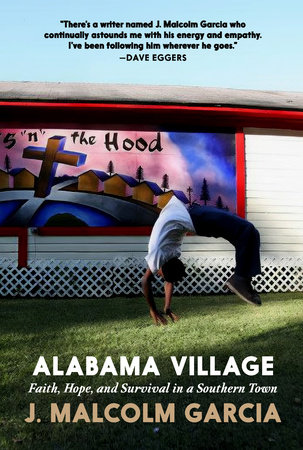
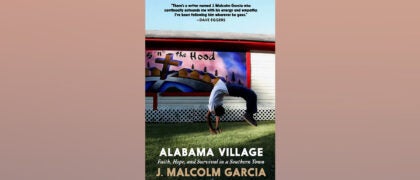
From the celebrated writer J. Malcolm Garcia, a narrative nonfiction account of a forgotten Alabama neighborhood through intimate, tender, and gritty profiles of its people as they navigate immense loss and an unassailable determination to overcome their circumstances.

"J. Malcolm Garcia [channels] the empathetic ear of Studs Terkel and the investigative skills of the best literary journalists." —Beth Taylor, author of The Plain Language of Love and Loss


In Alabama Village, an impoverished and often violent neighborhood south of Mobile, the children no longer flinch at the eruption of gunshots. To them, it’s just another day.  In this community, few things last—the loss of life is relentless, and relief efforts come and go. But John and Dolores Eads, a devout Christian couple who established Light of the Village church, stay. They spread their mission: lead with love, faith, and consistency—and don’t condemn or judge. 

In interlacing chapters, award-winning journalist J. Malcolm Garcia follows the lives of the Alabama Village community and the kids who grew up at Light of the Village church. Da’Cino Dees saw his first shooting at eight years old and now works at Light of the Village; Aaron “Billy Boy” Amison has been dreaming about dead people since he was little and has been in and out of jail since he was fourteen; Jesenda Brown hopes to escape poverty by starting her own cleaning business; and although Corey “Bigg Man” Davis has accrued exuberant wealth from unknown sources, his personality is marked by his kindhearted generosity.

These striking, raw, and humanizing portraits, among others, showcase the Village and its people, in all its devastation and resilient determination. Alabama Village is an ode to communities and the individual narratives that make them whole.
Overture

December 2020. A friend calls and tells me about a feature story he saw on PBS about this neighborhood called Alabama Village. It is one of the most violent places in the country, the broadcast said. The show compared its strife to the civil war in Syria. When I lived in Illinois, people called Chicago Chiraq, because of its astronomical homicide rate—as many as forty shootings on some weekends. But that was Chicago. It was hard to believe that an obscure neighborhood in an equally obscure small Southern town would in its own way be as bad as Chicago, let alone the Syrian civil war.

I search the internet for more information. Prichard, a predominantly Black city of 19,322, according to the 2020 census, is among the poorest in Alabama, with a median household income of just over $36,000 and more than 30 percent of its population below the poverty level.

Prichard was incorporated in 1925, about five miles south of Mobile, and industrial development fueled growth in the city in the decades that followed. The community of Alabama Village was a war housing project within Prichard developed in 1942 for shipbuilders working in and around Mobile. Single-story homes, similar in appearance to enlisted housing on a military base, lined its streets, which were named after Alabama counties.

Following the war, the residences became available for private purchase; many of the workers from the nearby paper mills and shipyards bought homes here, and the white population in Prichard soared to about forty-seven thousand by 1960. Alabama Village thrived as a typical blue-collar community, offering permanent homes for many low-income families throughout the 1950s and ’60s.

Property values began falling in the 1980s and crime began to rise, changes that coincided with white flight and the rise to power of Black politicians. By the 1990s, there were only a handful of families who owned and physically lived in their homes in the Village. Many property owners rented out their houses. Over time, however, collecting rent became difficult, and in some cases dangerous. Unable to sell, many landlords chose to abandon their property. The majority of them made their residences available for government-subsidized housing. Prichard suffered from declining tax revenues as businesses closed or moved. Between 1970 and 2014, the population declined 48 percent. The city’s finances were depleted to such a point that in 2012, according to the New York Times, Prichard became the first municipality in the United States to stop making pension payments to retired city workers.

Crime continued to grow. In 2008, Prichard was listed as the eighth most dangerous city in the United States. The city’s violent crime rate from 2001 to 2008 was higher than the state and national levels. From 2009 to 2012, the violent crime rate increased to 400 percent of the state and national rates. In 2013, the city of Chickasaw, which shares a border with Prichard, erected barricades across Iroquois Street, which used to link The Avenues, a working-class Chickasaw neighborhood, with Alabama Village.

Political corruption added to these problems. In 2019, former Prichard City Clerk Kim Green was accused of stealing more than $400,000 while working for the cities of Creola and Prichard. Prosecutors put Prichard’s loss at $158,449. Mayor Jimmie Gardner said the city was blindsided by her guilty plea.

One year later, a judge sentenced James A. Blackman, a former chief of staff of Gardner’s, for pocketing about $200,000 from Prichard between January and December 2017.

Predictably, city services suffered from neglect. Fire protection has been hobbled by low and undependable water pressure. In 2018, 93 percent of Prichard’s fire hydrants failed an inspection. The Alabama Department of Environmental Management describes Prichard’s water lines as being in dire need of repair.

With so many problems facing Prichard, the Village’s predicaments festered. About forty-two families live in the Village today. City services barely exist. In the Village, about a million gallons of water once supplied to homes and businesses drains out of decaying pipes every year. The few remaining streets flood for days after a heavy rain because of the drinking water that collects in the storm sewers.

The Village may not be Syria, but its desolation and violence shocked me. I had been a social worker for fourteen years helping homeless people in San Francisco’s Tenderloin district. They turned empty buildings into crash pads and crack houses. The hovels I had seen made me nauseous, but what I saw in the Village was on a scale beyond anything I’d ever experienced.

I made the jump into journalism at forty and devoted myself to covering families like my former homeless clients, people who live well below the news radar, and if in the unlikely or unfortunate event they become noteworthy, are generally viewed with disdain. The residents of the Village fell into that category.

I wonder about John and Dolores Eads. What is their motivation? As a social worker, I worked with religious people and found they did not stick around long when their prayers went unanswered. Too often they suggested the homeless men and women I worked with didn’t have faith. John and Dolores, however, had stuck with it for twenty years. Surely, they’ve suffered disappointment. Surely, some of their prayers have gone unanswered. But they stayed. They had to be more than do-good Jesus people.

I call John on a Wednesday morning. Totally cool, he says when I tell him I want to write about the Village. I give him a little of my social services background, how my agency had to endure state budget battles and budget cuts. That’s screwed, he says. Sounds like it sucked. Total crap. We don’t accept government funding. He does not ask if I’m saved, as have other Christians I’ve met. He doesn’t go there. I’m a stranger on the phone interested in his work. Nothing more, nothing less.

He explains that he and Dolores do not restrict themselves to a denomination. When they started Light of the Village, John wondered if he should study theology but a pastor at a Baptist church he attended in Mobile dissuaded him. For what God has called on you to do, do you think the kids care about a degree? No, John said. That settled it. John considers himself a layperson who practices his faith. If someone had to put a finger on it, he would say that he and Dolores are evangelicals. They take the Bible and go verse by verse, story by story, allowing it to speak for itself. They do not push it. They do not cram it. Anyone can come to the ministry. It offers free afterschool programs, meals, and Bible study. Faith or lack of it has no bearing on who can participate.

I’m not selling a product, John tells me.

If I want to visit the Village, I’m more than welcome. He suggests people I should meet, including a guy he calls “Bigg Man.” He’s deep in the street but has good insight, John says. We’ve known him for years.

A magazine editor I know is enthusiastic about a story on the Village so in late February 2021, I throw my duffel bag into my car and leave my San Diego home for Alabama
Literary investigative reporter J. Malcolm Garcia was a social worker and director of a homeless services agency, where he assisted unhoused people in San Francisco for fourteen years before he made the jump into journalism in 1997. His books include The Khaarijee: A Chronicle of Friendship and War in Kabul (2009); What Wars Leave Behind (2014); Without A Country: The Untold Story of America's Deported Veterans (2017); and Riding through Katrina with the Red Baron's Ghost (2018), as well as three books from Seven Stories Press: The Fruit of All My Grief: Lives in the Shadows of the American Dream (2018); Most Dangerous, Most Unmerciful: Stories from Afghanistan (2022); and Out of the Rain: A Novel (2024). In June 2025, Out of the Rain was longlisted for the 2025 Mark Twain American Voice in Literature Award. Garcia’s work has been anthologized in Best American Travel Writing, Best American Nonrequired Reading, and Best American Essays, and he is a recipient of the Studs Terkel Prize and the Sigma Delta Chi Award for a series on burn pits and how they affected American service men and women in Iraq and Afghanistan. Garcia is the nephew of celebrated Puerto Rican actor José Ferrer, winner of the inaugural Academy Award for Best Actor in a Leading Role as Cyrano in the film Cyrano de Bergerac, and the grandson of Rafael Ferrer (1885-1951), an esteemed essayist and lawyer. Garcia has been a regular contributor to Guernica, Salon, and the Virginia Quarterly Review, among others. He lives in the San Diego area.

About

From the celebrated writer J. Malcolm Garcia, a narrative nonfiction account of a forgotten Alabama neighborhood through intimate, tender, and gritty profiles of its people as they navigate immense loss and an unassailable determination to overcome their circumstances.

"J. Malcolm Garcia [channels] the empathetic ear of Studs Terkel and the investigative skills of the best literary journalists." —Beth Taylor, author of The Plain Language of Love and Loss


In Alabama Village, an impoverished and often violent neighborhood south of Mobile, the children no longer flinch at the eruption of gunshots. To them, it’s just another day.  In this community, few things last—the loss of life is relentless, and relief efforts come and go. But John and Dolores Eads, a devout Christian couple who established Light of the Village church, stay. They spread their mission: lead with love, faith, and consistency—and don’t condemn or judge. 

In interlacing chapters, award-winning journalist J. Malcolm Garcia follows the lives of the Alabama Village community and the kids who grew up at Light of the Village church. Da’Cino Dees saw his first shooting at eight years old and now works at Light of the Village; Aaron “Billy Boy” Amison has been dreaming about dead people since he was little and has been in and out of jail since he was fourteen; Jesenda Brown hopes to escape poverty by starting her own cleaning business; and although Corey “Bigg Man” Davis has accrued exuberant wealth from unknown sources, his personality is marked by his kindhearted generosity.

These striking, raw, and humanizing portraits, among others, showcase the Village and its people, in all its devastation and resilient determination. Alabama Village is an ode to communities and the individual narratives that make them whole.

Excerpt

Overture

December 2020. A friend calls and tells me about a feature story he saw on PBS about this neighborhood called Alabama Village. It is one of the most violent places in the country, the broadcast said. The show compared its strife to the civil war in Syria. When I lived in Illinois, people called Chicago Chiraq, because of its astronomical homicide rate—as many as forty shootings on some weekends. But that was Chicago. It was hard to believe that an obscure neighborhood in an equally obscure small Southern town would in its own way be as bad as Chicago, let alone the Syrian civil war.

I search the internet for more information. Prichard, a predominantly Black city of 19,322, according to the 2020 census, is among the poorest in Alabama, with a median household income of just over $36,000 and more than 30 percent of its population below the poverty level.

Prichard was incorporated in 1925, about five miles south of Mobile, and industrial development fueled growth in the city in the decades that followed. The community of Alabama Village was a war housing project within Prichard developed in 1942 for shipbuilders working in and around Mobile. Single-story homes, similar in appearance to enlisted housing on a military base, lined its streets, which were named after Alabama counties.

Following the war, the residences became available for private purchase; many of the workers from the nearby paper mills and shipyards bought homes here, and the white population in Prichard soared to about forty-seven thousand by 1960. Alabama Village thrived as a typical blue-collar community, offering permanent homes for many low-income families throughout the 1950s and ’60s.

Property values began falling in the 1980s and crime began to rise, changes that coincided with white flight and the rise to power of Black politicians. By the 1990s, there were only a handful of families who owned and physically lived in their homes in the Village. Many property owners rented out their houses. Over time, however, collecting rent became difficult, and in some cases dangerous. Unable to sell, many landlords chose to abandon their property. The majority of them made their residences available for government-subsidized housing. Prichard suffered from declining tax revenues as businesses closed or moved. Between 1970 and 2014, the population declined 48 percent. The city’s finances were depleted to such a point that in 2012, according to the New York Times, Prichard became the first municipality in the United States to stop making pension payments to retired city workers.

Crime continued to grow. In 2008, Prichard was listed as the eighth most dangerous city in the United States. The city’s violent crime rate from 2001 to 2008 was higher than the state and national levels. From 2009 to 2012, the violent crime rate increased to 400 percent of the state and national rates. In 2013, the city of Chickasaw, which shares a border with Prichard, erected barricades across Iroquois Street, which used to link The Avenues, a working-class Chickasaw neighborhood, with Alabama Village.

Political corruption added to these problems. In 2019, former Prichard City Clerk Kim Green was accused of stealing more than $400,000 while working for the cities of Creola and Prichard. Prosecutors put Prichard’s loss at $158,449. Mayor Jimmie Gardner said the city was blindsided by her guilty plea.

One year later, a judge sentenced James A. Blackman, a former chief of staff of Gardner’s, for pocketing about $200,000 from Prichard between January and December 2017.

Predictably, city services suffered from neglect. Fire protection has been hobbled by low and undependable water pressure. In 2018, 93 percent of Prichard’s fire hydrants failed an inspection. The Alabama Department of Environmental Management describes Prichard’s water lines as being in dire need of repair.

With so many problems facing Prichard, the Village’s predicaments festered. About forty-two families live in the Village today. City services barely exist. In the Village, about a million gallons of water once supplied to homes and businesses drains out of decaying pipes every year. The few remaining streets flood for days after a heavy rain because of the drinking water that collects in the storm sewers.

The Village may not be Syria, but its desolation and violence shocked me. I had been a social worker for fourteen years helping homeless people in San Francisco’s Tenderloin district. They turned empty buildings into crash pads and crack houses. The hovels I had seen made me nauseous, but what I saw in the Village was on a scale beyond anything I’d ever experienced.

I made the jump into journalism at forty and devoted myself to covering families like my former homeless clients, people who live well below the news radar, and if in the unlikely or unfortunate event they become noteworthy, are generally viewed with disdain. The residents of the Village fell into that category.

I wonder about John and Dolores Eads. What is their motivation? As a social worker, I worked with religious people and found they did not stick around long when their prayers went unanswered. Too often they suggested the homeless men and women I worked with didn’t have faith. John and Dolores, however, had stuck with it for twenty years. Surely, they’ve suffered disappointment. Surely, some of their prayers have gone unanswered. But they stayed. They had to be more than do-good Jesus people.

I call John on a Wednesday morning. Totally cool, he says when I tell him I want to write about the Village. I give him a little of my social services background, how my agency had to endure state budget battles and budget cuts. That’s screwed, he says. Sounds like it sucked. Total crap. We don’t accept government funding. He does not ask if I’m saved, as have other Christians I’ve met. He doesn’t go there. I’m a stranger on the phone interested in his work. Nothing more, nothing less.

He explains that he and Dolores do not restrict themselves to a denomination. When they started Light of the Village, John wondered if he should study theology but a pastor at a Baptist church he attended in Mobile dissuaded him. For what God has called on you to do, do you think the kids care about a degree? No, John said. That settled it. John considers himself a layperson who practices his faith. If someone had to put a finger on it, he would say that he and Dolores are evangelicals. They take the Bible and go verse by verse, story by story, allowing it to speak for itself. They do not push it. They do not cram it. Anyone can come to the ministry. It offers free afterschool programs, meals, and Bible study. Faith or lack of it has no bearing on who can participate.

I’m not selling a product, John tells me.

If I want to visit the Village, I’m more than welcome. He suggests people I should meet, including a guy he calls “Bigg Man.” He’s deep in the street but has good insight, John says. We’ve known him for years.

A magazine editor I know is enthusiastic about a story on the Village so in late February 2021, I throw my duffel bag into my car and leave my San Diego home for Alabama

Author

Literary investigative reporter J. Malcolm Garcia was a social worker and director of a homeless services agency, where he assisted unhoused people in San Francisco for fourteen years before he made the jump into journalism in 1997. His books include The Khaarijee: A Chronicle of Friendship and War in Kabul (2009); What Wars Leave Behind (2014); Without A Country: The Untold Story of America's Deported Veterans (2017); and Riding through Katrina with the Red Baron's Ghost (2018), as well as three books from Seven Stories Press: The Fruit of All My Grief: Lives in the Shadows of the American Dream (2018); Most Dangerous, Most Unmerciful: Stories from Afghanistan (2022); and Out of the Rain: A Novel (2024). In June 2025, Out of the Rain was longlisted for the 2025 Mark Twain American Voice in Literature Award. Garcia’s work has been anthologized in Best American Travel Writing, Best American Nonrequired Reading, and Best American Essays, and he is a recipient of the Studs Terkel Prize and the Sigma Delta Chi Award for a series on burn pits and how they affected American service men and women in Iraq and Afghanistan. Garcia is the nephew of celebrated Puerto Rican actor José Ferrer, winner of the inaugural Academy Award for Best Actor in a Leading Role as Cyrano in the film Cyrano de Bergerac, and the grandson of Rafael Ferrer (1885-1951), an esteemed essayist and lawyer. Garcia has been a regular contributor to Guernica, Salon, and the Virginia Quarterly Review, among others. He lives in the San Diego area.

FROM THE PAGE: An excerpt from J. Malcolm Garcia’s Alabama Village

From the celebrated writer J. Malcolm Garcia, a narrative nonfiction account of a forgotten Alabama neighborhood through intimate, tender, and gritty profiles of its people as they navigate immense loss and an unassailable determination to overcome their circumstances.   Overture December 2020. A friend calls and tells me about a feature story he saw on PBS about

Read more