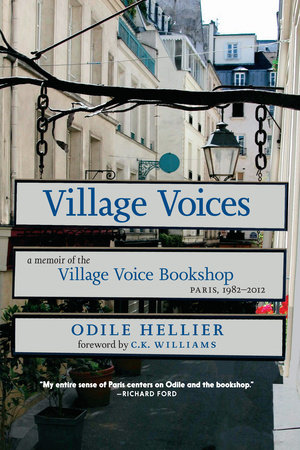
A celebration of the legacy of the Village Voice bookshop in Paris, founded by Odile Hellier in 1982—a hub of social life and a refuge for artists, writers, and anglophone literary life for over three decades until it closed in 2012.

“My entire sense of Paris centers on Odile and the bookshop.” —Richard Ford

"For literature lovers, it’s a feast." —Publishers Weekly
­


In July of 1982, on a quiet boulevard just off the bustling Boulevard Saint-German, Odile Hellier opened the Village Voice Bookshop. Over the next three decades, the blue-shuttered shop would become one of the most famous English-language bookstores in Paris—a vivacious hub for artists, writers, and a haven for anglophone literary life. After the its closing, Odile found herself with hundreds of tapes of various talks given at the bookshop by the greatest artists of their generation.

These voices from the past were the spontaneous exchanges of literary and cultural icons such as Susan Sontag, Margaret Atwood, Don DeLillo, Allen Ginsberg, Toni Morrison, Michael Ondaatje, Jim Harrison, Barry Gifford, Adrienne Rich, David Sedaris, Amy Tan, Edmund White, Art Spiegelman, and Stephen Spender, all of whom were drawn to Odile’s tiny bookstore on Rue Princesse. This carefully curated historical archive is an enduring conversation across time, and a memoir of one woman’s beloved store.

“… when you squeezed into the narrow event space on the Voice’s upper floor, French and international book lovers mingled with Parisian editors and publishers, shared a glass of wine, a new discovery, a heretical opinion, and took the conversation outside to the sidewalk of the Rue Princesse, for another shared pleasure: an unguilty cigarette.” — Livia Manera, The New Yorker

“A stroll from rue de l’Odéon, Les Deux Magots or the Luxembourg Gardens, the hanging sign reads Village Voice: Anglo-American Bookshop. The narrow door and window frames are painted Greek island blue… Lingering a while in front of the window display, you’ll want to dive inside, into an ocean of story.” —Hazel Rowley, Bookforum
Foreword
 
Prologue
 
Introduction
 
PART ONE - “Paris, Paris, Above All, Paris”
1 - It Takes a Village: A Time and a Place
 
2 - The Lost and Found Generation: Paris Was a Woman
Noël Riley Fitch, Shari Benstock, Joan Schenkar
 
3 - The Third Wave of American Expatriates and the Small Presses
John Strand, Kathy Acker, Edward Limono, Ricardo Mosner, Carol Pratl, David Applefield, Jim Haynes

4 - Black American in Paris: Updating the Myth “Remember Me”: The Legacies of James
Baldwin and Richard Wright
Gordon Heath, Julia Wright, Ernest Gaine, James Emanuel, Jake Lamar
 
5 - Emergence of a Literary Force: To Each Writer Their Own Paris
Diane Johnson, Steven Barclay, David Downie, David Sedaris, Edmund White
The Cultural Divide
Diane Johnson, Adam Gopnik, Edmund White
 
6 - From Home to Paris and Elsewhere: Irish Writers at the Village Voice Bookshop
Tributes to James Joyce and Samuel Beckett
Zeljko Ivanjek, John Calder, Anne Atik
Living in Words to Tell the World
Harry Chifton and Deirdre Madden
 
7 - Varieties of Exile: Two Canadian Parisian
Nancy Huston, Mavis Gallant
 
8 - Dark Times: An Anglo-American Focus on the Vichy Regime
Raymond Federman, Carmen Callil, Alan Riding, Alice Kaplan on Louis Guilloux
Intermezzo: One Decade Ends,
A New One Begin
 
PART TWO - A Literary Journey Across the United States
 
9 - An Era of Hope Leading to Disillusionment
Julian Beck, Judith Malina, Allen Ginsberg, Jayne Cortez, Andrei Voznesensky, Kazuko Shiraishi, Lawrence Ferlinghetti, Hubert Selby Jr., William H. Gass, William Gaddis, Don DeLillo
 
10 - Bright Lights and Twilights
Jay McInerney, Jerome Charyn, Richard Price, James Ellroy
 
11 - Highways and Byways
Barry Gifford, David Payne, John Biguenet, Terry Tempest Williams
 
12 - Spectacular Sceneries, Ordinary Lives: American Writers Reel in the French Imagination
Jim Harrison, Raymond Carver, Jonathan Raban, Richard Ford, Russell Banks
 
13 - Four Remarkable Women Breaking from Convention
Hazel Rowley, Grace Paley, Adrienne Rich, Susan Sontag
 
14 - Native American Renaissance: Storytelling as Repossession
James Welch, Louise Erdrich, Sherman Alexie, David Treuer
 
15 - “Me and you . . . we need some kind of tomorrow.” Open Wounds in African American Literature
Jake Lamar, John Edgar Wideman, Paule Marshall, Barbara Chase-Riboud, Jayne Cortez, Sapphire, Toni Morrison
 
16 - Shadow Lands: The Here and There in American Stories of Exile
André Aciman, Amy Tan, Jamaica Kincaid, Dinaw Mengestu, Junot Díaz, Azar Nafisi
 
17 - Memories of Silenced Lives
The Holocaust: Naming the Inexpressible
Gwen Edelman, Gitta Sereny, Cynthia Ozick, Art Spiegelman, Nicole Krauss, Daniel Mendelsohn
Intermezzo: The Twenty-First Century is Upon Us
Adam Zagajewski, Jacques Derrida
 
PART THREE - Rounding Out Shakespeare’s Stage: Commonwealth Literatures
 
18 - Expanding Horizons: British Literature in Pursuit of Renewal
David Lodge, Antonia Byatt
 
19 - In the Footsteps of Salman Rushdie: Life Stories from the Indian Subcontinent
Hanif Kureishi, Abha Dawesar, Tarun Tejpal
 
20 - Reshaping South Africa: Moving Forward and Out of Apartheid
Denis Hirson, Breyten Breytenbach, Mandla Langa, Damon Galgut
 
21 - Australian Narratives: As Wide and Varied as the Country
Peter Carey, Tim Winton, Julia Leigh
 
22 - Multilayered English Canadian Voices: Lingering Memories of Europe
Margaret Atwood, Jane Urquhart, Michael Ondaatje
 
PART FOUR - Closing Ceremonies
 
23 - The Center Holds: Our Circle of Poets
Stephen Spender, Harry Mathews, Marilyn Hacker, Margo Berdeshevsky, Marie Ponsot, Kathleen Spivack, C.K. Williams, Ellen Hinsey, William S. Merwin
 
Epilogue
 
Acknowledgments
 
Notes
 
Index
I was forty years old when I opened the Village Voice Bookshop in July 1982. Oddly enough, at no moment in my previous careers did I consider selling books as a plausible profession. This surprising leap of faith would undoubtedly put me out on a limb once again. But hadn’t I always listened to my instincts and taken the road not traveled when it came to choosing one direction over another in my earlier adult life? What mattered to me was the feeling that I was going forward, even tentatively, just out of reach of some elusive, ever-beckoning elsewhere.

In the immediate postwar years, children’s books were rare, yet there were plenty of stories floating around, and I enjoyed eavesdropping on adult conversations that intrigued me and teased my imagination. Recalling my early childhood, I see myself and my younger brother exploring our large garden in Nancy, my mother’s native city, or running through fields and farmlands during our summers in Brittany.

I was nine years old when we moved from Nancy to Saint-Brieuc, settling permanently in this small but lively port city on the northern coast of Brittany. We lived two steps away from our public high school, named after the author Ernest Renan, also close to the picturesque cemetery overlooking two valleys and the sea in the distance where Albert Camus’s father was buried. He was not even a year old when his father was killed in 1914 at the start of the First World War. Forty years later, accompanied by his friend, the writer Louis Guilloux, a native of our city, Camus visited his father’s grave. In his posthumously published last novel, Le premier homme, the author recalls how shaken he was at discovering his father’s birth date inscribed on his tombstone, realizing that the man lying in this grave was younger than his own son.

Mostly attracted to nature and outdoor activities as a child, I turned to music and dance in my adolescence, but it was books that truly filled my life. I never sought out stories written primarily for a young adult audience; rather, I was fond of documentaries shown in our ciné-club, and I dreamed about exotic ways of journeying in the real world. In my quest to live a life more intense than my own and even become another person, I read the books we had at home, mainly twentieth-century contemporary French authors. Among my favorites: Alain-Fournier’s Le grand Meaulnes, Marguerite Yourcenar’s Memoirs of Hadrian, Vercors’s The Silence of the Sea, and Rilke’s Letters to a Young Poet. Jean-Paul Sartre’s La nausée put a name on what I felt to be my own existential malaise while Simone de Beauvoir’s autobiographical writings strengthened my resolve to be free, independent, and travel the world.

One day during my last year of high school, I had an unlikely encounter with a woman named Natacha that changed the course of my studies and the future I had envisioned. Born in Russia, Natacha had grown up amid the circles of the Russian immigration in Paris in the twenties and thirties. Perhaps intrigued by my curiosity, she offered to teach me her native tongue.
The Russian language was totally alien to me and not even taught in our public high school; however, as ancient Greek was part of my lycée curriculum, the Russian alphabet already seemed fairly familiar. On Saturday afternoons, I would walk across town to get to her place, excited by the prospect of learning her language by reading excerpts from Russian classics she had carefully chosen for our session. She would receive me in her living room gloriously walled in by shelves of books by Pushkin, Gogol, and the like, and we would sit at her table facing the bow window with a cup of hot tea, ready to dive into another world. Encouraged by her and the promise of the unknown, I decided to take up advanced Russian studies at the University of Rennes. Our Saturday afternoon ritual continued, and before long, I was speaking Natacha’s language.
In 1962, Solzhenitsyn’s One Day in the Life of Ivan Denisovich was published in the literary review Novy Mir—the first hint of Stalin’s gulags in postwar Soviet literature. It was a breakthrough moment that generated hope for a further easing of censorship. Khrushchev’s relative relaxation of repressive measures had made it possible for Natacha to trace family members left behind in Moscow more than thirty years beforehand. They became a surrogate family for me when I was completing my junior year abroad at the Moscow State University (1964–1965), inviting me to spend my weekends with them, a rare opportunity for a foreign student to experience their daily life from the inside.

Yet hardly a month after my arrival, Khrushchev was overthrown by Brezhnev, who immediately halted the attempts of his predecessor to open up the country. Repression of writers resumed with even greater intensity. This was not good news even at my modest level as before l left for Moscow, my professor of Russian literature had entrusted me with a letter for his friend, the writer Andrei Sinyavsky, to be delivered to him in person.

In January 1965, unable to reach him by phone for an appointment, I showed up at his door and was told the author “would not be available for a while.” Aware of his satirical critiques of Soviet society, I understood what this cryptic message really meant: Khrushchev’s Thaw was definitely over. Only when I was back in France would I learn about the trials of Andrei Sinyavsky and other writers of his generation, including the poet Joseph Brodsky. All of them had been sentenced to labor camps during my own stay in Moscow.

In 1966, now certified as a teacher, I taught Russian in Paris and Vannes. Yet the stagnation, repression, and nuclear threats of the Soviet Union during this ongoing Cold War period did little to encourage French students to embrace its language. Two years later, in August 1968, Soviet tanks invaded Prague. I found myself comparing this offensive with the 1940 brutal Nazi occupation of France. A year afterwards, I resigned my tenured position as a lycée teacher of Russian studies.
My experiences in the Soviet Union had only deepened my understanding of the complexities of the Cold War with its ever-growing tensions. Just as strongly, it had awakened in me a new interest in world affairs. I enrolled at the École des Hautes Études Commerciales that, back in the 1960s, trained translators and interpreters for international organizations. I was now looking at world events from a different angle, and given this new professional challenge, I decided that the time had come for me to discover the United States, the reigning world power and major rival of the Soviet Union.

In the fall of 1969, at the height of the Vietnam anti-war demonstrations, racial and feminist protests, and the recent landing of the first man on the moon, the eyes of the world were turned toward the US. In due time I left Paris for the university city of Amherst in Massachusetts where I had secured a small job, one of several to follow in the States.
It was, however, my Greyhound bus trips that led me to discover the diversity of this wide country. I took in breathtaking natural scenery from the East Coast shores to the stunning bays of California. But it was the scenes of desolation I stumbled on that marked me most, calling up passages from Richard Wright in Twelve Million Black Voices written thirty years earlier. One of these encounters took place just outside Baton Rouge, Louisiana.

Straying from city limits, and quite by chance, I ran into a group of impassive Black men sitting on cinder blocks in front of a row of shacks. They seemed to be staring into a void; suddenly, a big, tough white guy with a rifle on his shoulder appeared out of nowhere. Shouting loud threats at me, he started to chase me away.

Such a foray into the heart of the country only increased my interest in racial justice, inspiring me to translate one of Michael Thelwell’s stories, “Fish Are Jumping an’ the Cotton Is High: Notes from the Mississippi Delta” (The Massachusetts Review, 1966). It describes a trip to the heart of “Dixieland” in the mid-sixties that revealed the huge gaps between the stark realities of the lives of disenfranchised Black peoples and the lingering image of the mythologized “Old South.” I sent my unsolicited French translation to Sartre’s review Les Temps Modernes, which published my work in 1971.

During this same period, a friend of mine, a French social worker versed in the successful methodology of the community activist Saul Alinsky (later a model for the young Barack Obama) asked me if I would help him translate Alinsky’s Rules for Radicals. Our Manuel de l’animateur social that included Jean Gouriou’s preface about his Chicago/Alinsky experience would come out with Éditions du Seuil in 1976.

As planned, I went back to France at the end of 1970 to complete the second and last year of business school. Then, out of the blue, I received an invitation to work as a translator for the major Algerian oil and gas company Sonatrach that had just opened an office in Washington, D.C. Its director was none other than the scholar who had led the Frantz Fanon seminar I had attended at U. Mass in Amherst. He had also been the first ambassador of independent Algeria to Washington, but, following his country’s diplomatic break with the US over a political disagreement, had stayed on in the capital to continue to work out a rapprochement between the two countries.

Algeria had an enormous potential of natural resources waiting to be fully developed, but in 1971 its relations with France were at their lowest. Sonatrach turned to North America to set up a working commercial and industrial collaboration: Algeria would sell the US its liquefied natural gas while the latter’s highly experienced industrial companies would participate in Sonatrach’s ambitious, large-scale development projects. I immediately accepted the unexpected but attractive offer this promising company held out to me, not unaware that Algeria was now enjoying leadership status among other aspiring developing countries. In fact, the seventies proved to be years of intense activity between our Sonatrach office and its host country. Riding the headwinds of international politics, the Algerian company had managed to set up a working partnership with the US. By the end of 1979, having met our original goals, Sonatrach closed its D.C. office.
The previous year, a family tragedy had awakened in me memories of childhood events I had been able to hold at a distance all this time abroad. Now, I was ready to go back home where I felt I was needed. Strangely enough, once there, these flashbacks continued to haunt me, including one in particular from my early years.

On August 3, 1944, I had just turned two in the small town of Corlay in the heart of rural Brittany. I clearly remember lying on the floor face down, squeezed between my elder sister and my baby brother. My mother was stretched out on top of us, her arms enfolding all three children. At eye level I could just about make out the sunbeams filtering through the shutters being hit by stray bullets coming from the fight outside between local Resistance fighters and occupying German soldiers. All of a sudden, there was a walloping bang at the door, and precipitously my mother stood up. I have no memory of what came next. Some time later, I was told that my grandmother Françoise had died that morning, but I must have been three or so before I began to grasp what had actually happened.

On that fatal day in August, after breaking through a Resistance defense line, a Gestapo division operating in the region forced two villagers to reveal the names of active partisans. Under death threats, they indicated the road to my grandmother’s café-restaurant called À la Descente des Courses (“Where the Races Meet”), a friendly gathering point for fans of Corlay’s famous horse races.

In fact, this much beloved woman had not hesitated to turn its basement into the clandestine meeting place of our nearby Resistance members. When the two hostages were brought there they blurted out, “C’est là que ça se passe” (“This is the place”). By noon, the Nazi soldiers had stormed and shelled the café.

Fighting in an area close by, my father did not arrive in time. When he did manage to get there, he had to face the utter chaos of the fierce battle that had just occurred. He was to discover two bodies on the café floor: those of his mother and her young friend, the pregnant wife of a fellow Resistance fighter. They were lying in a pool of blood, their faces riddled with bullets. The German officer who had ordered the assault was likewise dead. In an effort to check his identity papers, my father searched through the breast pocket of his uniform. There, he found the photo of a wife and child. At such a moment, he must have felt despair, but also a good measure of guilt. Be that as it may, he vowed to go and visit the officer’s family in Germany once the war was over. Three months later, my father was blown up on a land mine at la Pointe de la Varde (Saint-Malo). He never accomplished this journey.

These two dramatic events have always stayed with me, but buried inside. Yet I was never able to articulate how the loss of my father had actually shaped my values in life, including my deep and continued love of books.

One day, years later, in the middle of an interview I was giving, I had a vision of books burning in the middle of the street. This image jolted my mind as I immediately understood that these books set afire by the Gestapo had belonged to my father. Straight away I remembered my mother’s description to me of this very auto-da-fé in Strasbourg. This startling reminder would bring me face to face with the reality that my starting up a bookshop was not at all a random decision.
Rather, it was a way of bringing a luminous quality to the darkened piles of books once brutally tossed into the street. I could thus continue my silent dialogue with the father I had never known.

Throughout my thirty years at the Village Voice Bookshop, I realized that I had never felt more at home than among its books, each one with its own story to tell.

Well after the Village Voice Bookshop had closed, I found myself looking through hundreds of author transcripts and listening to just as many tapes. These voices were witty, jocular, even outrageous—a sign of the times that could only make me smile. They were testimonies to brilliant writings, steadfast friendships, beguiling loves, and bold, stylistic strands of beauty.
Nevertheless, I was unable to dismiss that these very voices also recreated in me a sense of loss and stirred the memory of losses suffered—be it through an exile or the erasure of personal history and identity; the estrangement from one’s native tongue and culture; the plundering of the natural world; the seemingly irreparable separation from loved ones. Inscrutably, these same voices gave me hope for three decades and continually reinvigorated the raison d’être of our long journey together in their affirmation of life.

When I close my eyes, I still hear them rising in ever-widening circles from our small, but cozy niche in the neighborhood of Saint-Germain-des-Prés.
Odile Hellier was born in the South of France during World War II and raised in the two different regions of Lorraine, near the German border still haunted by past wars, and Brittany fronting the Atlantic Ocean. After advanced studies in Russian language and literature she taught in high school for two years, she decided to broaden her scope and work in world organizations. During the fall of 1968, Hellier enrolled in a professional school in Paris that trained translators and interpreters in international relations. Hellier is the founder and owner of the Village Voice Bookshop—a hub of Anglophone literary life and culture that operated in the heart of Saint-Germain-des-Prés in Paris for over thirty years. This book is Hellier’s archival project and personal memoir.

Charles Kenneth "C. K." Williams (introduction) was an American poet, critic and translator. Williams won many poetry awards. Flesh and Blood won the National Book Critics Circle Award in 1987. Repair won the 2000 Pulitzer Prize for Poetry, was a National Book Award finalist and won the Los Angeles Times Book Prize.
"For literature lovers, it’s a feast."—Publishers Weekly

"Village Voices is a completely unique and cherishable chronicle of a time and a place which—if you were lucky enough to be there—gracefully invited you into the wider world's literary imagination. Odile Hellier is incomparable." —Richard Ford

"When I first arrived in Paris, Village Voice was the reference for its impeccable and thoughtful stock curation and the impressive list of events. Browsing their window was an invitation to a conversation. I once asked Odile how she made her selection, she replied "read, read, read, it's all I do, every evening, every day". I was inspired after every visit to this bookshop and now I'm inspired after reading Village Voices. Wonderfully written, this memoir of a bookseller and her Parisian bookshop, told through the literary events she hosted is a genuine treasure trove of Paris literary life between the 1980s and early-2000s. It reflects the politics and concerns of the period, and is also a compelling exploration of language, writing, and the role of the author from both an American and European perspective." —Sylvia Whitman, owner of Shakespeare & Company bookshop in Paris

"This rich collection of interviews with and profiles of authors who gave readings at Heller’s English-language bookshop, which she operated in Paris’s sixth arrondissement from 1981 to 2012, presents a stimulating portrait of the Parisian literary scene replete with transporting photographs and gentle gossip. . . . For literature lovers, it’s a feast."Publishers Weekly

"In the early 1980s, as if seeking a fresh mission in life, a well travelled French woman, Odile Hellier, decided to open an English-language bookstore in Paris. To her considerable surprise, almost overnight the Village Voice became a Left Bank shrine to Anglo-American thought and letters. In her aptly named memoir, she recalls the extraordinary parade of visiting and ex-pat writers for whom a reading at the bookstore became something of a rite of passage. Her decision to close shop in 2012 is mourned to this day, but in these pages, she vividly recaptures the brilliance, humor and camaraderie that made the cramped space on the rue Princesse so special. Indeed, in Village Voices, Odile Hellier gives scores of writers a fresh chance to be celebrated." —Alan Riding, author of And the Show Went On: Cultural Life in Nazi-Occupied Paris.

"Every chapter of Village Voices is bursting with startling insights and revealing anecdotes. . . . Odile Hellier has given lovers of literary Paris this indispensable evocation of an era. Village Voices is a sumptuous, compulsively readable feast."
—Jake Lamar, author of Viper’s Dream and Rendezvous Eighteenth

“In her superbly written hybrid book, Odile Hellier… offers a larger, complex understanding of stylistic inventing and social consciousness that a diverse group of major writers and translators contribute to Paris literary life… a crucial literary resource that is also thoroughly entertaining."
—Jeffrey Greene, author of French Spirits and American Spirituals

"A song, a lyric to literature in all of its myriad forms and to those who live by it and love it. A resounding and rich chorus, truly an opera… that resonates from the first page to the last.”
—Heather Hartley, author of Adult Swim and former Paris Editor at Tin House magazine

"An intimate, fascinating glimpse of literary life in the City of Light." —Janet Skeslien Charles, author of The Paris Library

About

A celebration of the legacy of the Village Voice bookshop in Paris, founded by Odile Hellier in 1982—a hub of social life and a refuge for artists, writers, and anglophone literary life for over three decades until it closed in 2012.

“My entire sense of Paris centers on Odile and the bookshop.” —Richard Ford

"For literature lovers, it’s a feast." —Publishers Weekly
­


In July of 1982, on a quiet boulevard just off the bustling Boulevard Saint-German, Odile Hellier opened the Village Voice Bookshop. Over the next three decades, the blue-shuttered shop would become one of the most famous English-language bookstores in Paris—a vivacious hub for artists, writers, and a haven for anglophone literary life. After the its closing, Odile found herself with hundreds of tapes of various talks given at the bookshop by the greatest artists of their generation.

These voices from the past were the spontaneous exchanges of literary and cultural icons such as Susan Sontag, Margaret Atwood, Don DeLillo, Allen Ginsberg, Toni Morrison, Michael Ondaatje, Jim Harrison, Barry Gifford, Adrienne Rich, David Sedaris, Amy Tan, Edmund White, Art Spiegelman, and Stephen Spender, all of whom were drawn to Odile’s tiny bookstore on Rue Princesse. This carefully curated historical archive is an enduring conversation across time, and a memoir of one woman’s beloved store.

“… when you squeezed into the narrow event space on the Voice’s upper floor, French and international book lovers mingled with Parisian editors and publishers, shared a glass of wine, a new discovery, a heretical opinion, and took the conversation outside to the sidewalk of the Rue Princesse, for another shared pleasure: an unguilty cigarette.” — Livia Manera, The New Yorker

“A stroll from rue de l’Odéon, Les Deux Magots or the Luxembourg Gardens, the hanging sign reads Village Voice: Anglo-American Bookshop. The narrow door and window frames are painted Greek island blue… Lingering a while in front of the window display, you’ll want to dive inside, into an ocean of story.” —Hazel Rowley, Bookforum

Table of Contents

Foreword
 
Prologue
 
Introduction
 
PART ONE - “Paris, Paris, Above All, Paris”
1 - It Takes a Village: A Time and a Place
 
2 - The Lost and Found Generation: Paris Was a Woman
Noël Riley Fitch, Shari Benstock, Joan Schenkar
 
3 - The Third Wave of American Expatriates and the Small Presses
John Strand, Kathy Acker, Edward Limono, Ricardo Mosner, Carol Pratl, David Applefield, Jim Haynes

4 - Black American in Paris: Updating the Myth “Remember Me”: The Legacies of James
Baldwin and Richard Wright
Gordon Heath, Julia Wright, Ernest Gaine, James Emanuel, Jake Lamar
 
5 - Emergence of a Literary Force: To Each Writer Their Own Paris
Diane Johnson, Steven Barclay, David Downie, David Sedaris, Edmund White
The Cultural Divide
Diane Johnson, Adam Gopnik, Edmund White
 
6 - From Home to Paris and Elsewhere: Irish Writers at the Village Voice Bookshop
Tributes to James Joyce and Samuel Beckett
Zeljko Ivanjek, John Calder, Anne Atik
Living in Words to Tell the World
Harry Chifton and Deirdre Madden
 
7 - Varieties of Exile: Two Canadian Parisian
Nancy Huston, Mavis Gallant
 
8 - Dark Times: An Anglo-American Focus on the Vichy Regime
Raymond Federman, Carmen Callil, Alan Riding, Alice Kaplan on Louis Guilloux
Intermezzo: One Decade Ends,
A New One Begin
 
PART TWO - A Literary Journey Across the United States
 
9 - An Era of Hope Leading to Disillusionment
Julian Beck, Judith Malina, Allen Ginsberg, Jayne Cortez, Andrei Voznesensky, Kazuko Shiraishi, Lawrence Ferlinghetti, Hubert Selby Jr., William H. Gass, William Gaddis, Don DeLillo
 
10 - Bright Lights and Twilights
Jay McInerney, Jerome Charyn, Richard Price, James Ellroy
 
11 - Highways and Byways
Barry Gifford, David Payne, John Biguenet, Terry Tempest Williams
 
12 - Spectacular Sceneries, Ordinary Lives: American Writers Reel in the French Imagination
Jim Harrison, Raymond Carver, Jonathan Raban, Richard Ford, Russell Banks
 
13 - Four Remarkable Women Breaking from Convention
Hazel Rowley, Grace Paley, Adrienne Rich, Susan Sontag
 
14 - Native American Renaissance: Storytelling as Repossession
James Welch, Louise Erdrich, Sherman Alexie, David Treuer
 
15 - “Me and you . . . we need some kind of tomorrow.” Open Wounds in African American Literature
Jake Lamar, John Edgar Wideman, Paule Marshall, Barbara Chase-Riboud, Jayne Cortez, Sapphire, Toni Morrison
 
16 - Shadow Lands: The Here and There in American Stories of Exile
André Aciman, Amy Tan, Jamaica Kincaid, Dinaw Mengestu, Junot Díaz, Azar Nafisi
 
17 - Memories of Silenced Lives
The Holocaust: Naming the Inexpressible
Gwen Edelman, Gitta Sereny, Cynthia Ozick, Art Spiegelman, Nicole Krauss, Daniel Mendelsohn
Intermezzo: The Twenty-First Century is Upon Us
Adam Zagajewski, Jacques Derrida
 
PART THREE - Rounding Out Shakespeare’s Stage: Commonwealth Literatures
 
18 - Expanding Horizons: British Literature in Pursuit of Renewal
David Lodge, Antonia Byatt
 
19 - In the Footsteps of Salman Rushdie: Life Stories from the Indian Subcontinent
Hanif Kureishi, Abha Dawesar, Tarun Tejpal
 
20 - Reshaping South Africa: Moving Forward and Out of Apartheid
Denis Hirson, Breyten Breytenbach, Mandla Langa, Damon Galgut
 
21 - Australian Narratives: As Wide and Varied as the Country
Peter Carey, Tim Winton, Julia Leigh
 
22 - Multilayered English Canadian Voices: Lingering Memories of Europe
Margaret Atwood, Jane Urquhart, Michael Ondaatje
 
PART FOUR - Closing Ceremonies
 
23 - The Center Holds: Our Circle of Poets
Stephen Spender, Harry Mathews, Marilyn Hacker, Margo Berdeshevsky, Marie Ponsot, Kathleen Spivack, C.K. Williams, Ellen Hinsey, William S. Merwin
 
Epilogue
 
Acknowledgments
 
Notes
 
Index

Excerpt

I was forty years old when I opened the Village Voice Bookshop in July 1982. Oddly enough, at no moment in my previous careers did I consider selling books as a plausible profession. This surprising leap of faith would undoubtedly put me out on a limb once again. But hadn’t I always listened to my instincts and taken the road not traveled when it came to choosing one direction over another in my earlier adult life? What mattered to me was the feeling that I was going forward, even tentatively, just out of reach of some elusive, ever-beckoning elsewhere.

In the immediate postwar years, children’s books were rare, yet there were plenty of stories floating around, and I enjoyed eavesdropping on adult conversations that intrigued me and teased my imagination. Recalling my early childhood, I see myself and my younger brother exploring our large garden in Nancy, my mother’s native city, or running through fields and farmlands during our summers in Brittany.

I was nine years old when we moved from Nancy to Saint-Brieuc, settling permanently in this small but lively port city on the northern coast of Brittany. We lived two steps away from our public high school, named after the author Ernest Renan, also close to the picturesque cemetery overlooking two valleys and the sea in the distance where Albert Camus’s father was buried. He was not even a year old when his father was killed in 1914 at the start of the First World War. Forty years later, accompanied by his friend, the writer Louis Guilloux, a native of our city, Camus visited his father’s grave. In his posthumously published last novel, Le premier homme, the author recalls how shaken he was at discovering his father’s birth date inscribed on his tombstone, realizing that the man lying in this grave was younger than his own son.

Mostly attracted to nature and outdoor activities as a child, I turned to music and dance in my adolescence, but it was books that truly filled my life. I never sought out stories written primarily for a young adult audience; rather, I was fond of documentaries shown in our ciné-club, and I dreamed about exotic ways of journeying in the real world. In my quest to live a life more intense than my own and even become another person, I read the books we had at home, mainly twentieth-century contemporary French authors. Among my favorites: Alain-Fournier’s Le grand Meaulnes, Marguerite Yourcenar’s Memoirs of Hadrian, Vercors’s The Silence of the Sea, and Rilke’s Letters to a Young Poet. Jean-Paul Sartre’s La nausée put a name on what I felt to be my own existential malaise while Simone de Beauvoir’s autobiographical writings strengthened my resolve to be free, independent, and travel the world.

One day during my last year of high school, I had an unlikely encounter with a woman named Natacha that changed the course of my studies and the future I had envisioned. Born in Russia, Natacha had grown up amid the circles of the Russian immigration in Paris in the twenties and thirties. Perhaps intrigued by my curiosity, she offered to teach me her native tongue.
The Russian language was totally alien to me and not even taught in our public high school; however, as ancient Greek was part of my lycée curriculum, the Russian alphabet already seemed fairly familiar. On Saturday afternoons, I would walk across town to get to her place, excited by the prospect of learning her language by reading excerpts from Russian classics she had carefully chosen for our session. She would receive me in her living room gloriously walled in by shelves of books by Pushkin, Gogol, and the like, and we would sit at her table facing the bow window with a cup of hot tea, ready to dive into another world. Encouraged by her and the promise of the unknown, I decided to take up advanced Russian studies at the University of Rennes. Our Saturday afternoon ritual continued, and before long, I was speaking Natacha’s language.
In 1962, Solzhenitsyn’s One Day in the Life of Ivan Denisovich was published in the literary review Novy Mir—the first hint of Stalin’s gulags in postwar Soviet literature. It was a breakthrough moment that generated hope for a further easing of censorship. Khrushchev’s relative relaxation of repressive measures had made it possible for Natacha to trace family members left behind in Moscow more than thirty years beforehand. They became a surrogate family for me when I was completing my junior year abroad at the Moscow State University (1964–1965), inviting me to spend my weekends with them, a rare opportunity for a foreign student to experience their daily life from the inside.

Yet hardly a month after my arrival, Khrushchev was overthrown by Brezhnev, who immediately halted the attempts of his predecessor to open up the country. Repression of writers resumed with even greater intensity. This was not good news even at my modest level as before l left for Moscow, my professor of Russian literature had entrusted me with a letter for his friend, the writer Andrei Sinyavsky, to be delivered to him in person.

In January 1965, unable to reach him by phone for an appointment, I showed up at his door and was told the author “would not be available for a while.” Aware of his satirical critiques of Soviet society, I understood what this cryptic message really meant: Khrushchev’s Thaw was definitely over. Only when I was back in France would I learn about the trials of Andrei Sinyavsky and other writers of his generation, including the poet Joseph Brodsky. All of them had been sentenced to labor camps during my own stay in Moscow.

In 1966, now certified as a teacher, I taught Russian in Paris and Vannes. Yet the stagnation, repression, and nuclear threats of the Soviet Union during this ongoing Cold War period did little to encourage French students to embrace its language. Two years later, in August 1968, Soviet tanks invaded Prague. I found myself comparing this offensive with the 1940 brutal Nazi occupation of France. A year afterwards, I resigned my tenured position as a lycée teacher of Russian studies.
My experiences in the Soviet Union had only deepened my understanding of the complexities of the Cold War with its ever-growing tensions. Just as strongly, it had awakened in me a new interest in world affairs. I enrolled at the École des Hautes Études Commerciales that, back in the 1960s, trained translators and interpreters for international organizations. I was now looking at world events from a different angle, and given this new professional challenge, I decided that the time had come for me to discover the United States, the reigning world power and major rival of the Soviet Union.

In the fall of 1969, at the height of the Vietnam anti-war demonstrations, racial and feminist protests, and the recent landing of the first man on the moon, the eyes of the world were turned toward the US. In due time I left Paris for the university city of Amherst in Massachusetts where I had secured a small job, one of several to follow in the States.
It was, however, my Greyhound bus trips that led me to discover the diversity of this wide country. I took in breathtaking natural scenery from the East Coast shores to the stunning bays of California. But it was the scenes of desolation I stumbled on that marked me most, calling up passages from Richard Wright in Twelve Million Black Voices written thirty years earlier. One of these encounters took place just outside Baton Rouge, Louisiana.

Straying from city limits, and quite by chance, I ran into a group of impassive Black men sitting on cinder blocks in front of a row of shacks. They seemed to be staring into a void; suddenly, a big, tough white guy with a rifle on his shoulder appeared out of nowhere. Shouting loud threats at me, he started to chase me away.

Such a foray into the heart of the country only increased my interest in racial justice, inspiring me to translate one of Michael Thelwell’s stories, “Fish Are Jumping an’ the Cotton Is High: Notes from the Mississippi Delta” (The Massachusetts Review, 1966). It describes a trip to the heart of “Dixieland” in the mid-sixties that revealed the huge gaps between the stark realities of the lives of disenfranchised Black peoples and the lingering image of the mythologized “Old South.” I sent my unsolicited French translation to Sartre’s review Les Temps Modernes, which published my work in 1971.

During this same period, a friend of mine, a French social worker versed in the successful methodology of the community activist Saul Alinsky (later a model for the young Barack Obama) asked me if I would help him translate Alinsky’s Rules for Radicals. Our Manuel de l’animateur social that included Jean Gouriou’s preface about his Chicago/Alinsky experience would come out with Éditions du Seuil in 1976.

As planned, I went back to France at the end of 1970 to complete the second and last year of business school. Then, out of the blue, I received an invitation to work as a translator for the major Algerian oil and gas company Sonatrach that had just opened an office in Washington, D.C. Its director was none other than the scholar who had led the Frantz Fanon seminar I had attended at U. Mass in Amherst. He had also been the first ambassador of independent Algeria to Washington, but, following his country’s diplomatic break with the US over a political disagreement, had stayed on in the capital to continue to work out a rapprochement between the two countries.

Algeria had an enormous potential of natural resources waiting to be fully developed, but in 1971 its relations with France were at their lowest. Sonatrach turned to North America to set up a working commercial and industrial collaboration: Algeria would sell the US its liquefied natural gas while the latter’s highly experienced industrial companies would participate in Sonatrach’s ambitious, large-scale development projects. I immediately accepted the unexpected but attractive offer this promising company held out to me, not unaware that Algeria was now enjoying leadership status among other aspiring developing countries. In fact, the seventies proved to be years of intense activity between our Sonatrach office and its host country. Riding the headwinds of international politics, the Algerian company had managed to set up a working partnership with the US. By the end of 1979, having met our original goals, Sonatrach closed its D.C. office.
The previous year, a family tragedy had awakened in me memories of childhood events I had been able to hold at a distance all this time abroad. Now, I was ready to go back home where I felt I was needed. Strangely enough, once there, these flashbacks continued to haunt me, including one in particular from my early years.

On August 3, 1944, I had just turned two in the small town of Corlay in the heart of rural Brittany. I clearly remember lying on the floor face down, squeezed between my elder sister and my baby brother. My mother was stretched out on top of us, her arms enfolding all three children. At eye level I could just about make out the sunbeams filtering through the shutters being hit by stray bullets coming from the fight outside between local Resistance fighters and occupying German soldiers. All of a sudden, there was a walloping bang at the door, and precipitously my mother stood up. I have no memory of what came next. Some time later, I was told that my grandmother Françoise had died that morning, but I must have been three or so before I began to grasp what had actually happened.

On that fatal day in August, after breaking through a Resistance defense line, a Gestapo division operating in the region forced two villagers to reveal the names of active partisans. Under death threats, they indicated the road to my grandmother’s café-restaurant called À la Descente des Courses (“Where the Races Meet”), a friendly gathering point for fans of Corlay’s famous horse races.

In fact, this much beloved woman had not hesitated to turn its basement into the clandestine meeting place of our nearby Resistance members. When the two hostages were brought there they blurted out, “C’est là que ça se passe” (“This is the place”). By noon, the Nazi soldiers had stormed and shelled the café.

Fighting in an area close by, my father did not arrive in time. When he did manage to get there, he had to face the utter chaos of the fierce battle that had just occurred. He was to discover two bodies on the café floor: those of his mother and her young friend, the pregnant wife of a fellow Resistance fighter. They were lying in a pool of blood, their faces riddled with bullets. The German officer who had ordered the assault was likewise dead. In an effort to check his identity papers, my father searched through the breast pocket of his uniform. There, he found the photo of a wife and child. At such a moment, he must have felt despair, but also a good measure of guilt. Be that as it may, he vowed to go and visit the officer’s family in Germany once the war was over. Three months later, my father was blown up on a land mine at la Pointe de la Varde (Saint-Malo). He never accomplished this journey.

These two dramatic events have always stayed with me, but buried inside. Yet I was never able to articulate how the loss of my father had actually shaped my values in life, including my deep and continued love of books.

One day, years later, in the middle of an interview I was giving, I had a vision of books burning in the middle of the street. This image jolted my mind as I immediately understood that these books set afire by the Gestapo had belonged to my father. Straight away I remembered my mother’s description to me of this very auto-da-fé in Strasbourg. This startling reminder would bring me face to face with the reality that my starting up a bookshop was not at all a random decision.
Rather, it was a way of bringing a luminous quality to the darkened piles of books once brutally tossed into the street. I could thus continue my silent dialogue with the father I had never known.

Throughout my thirty years at the Village Voice Bookshop, I realized that I had never felt more at home than among its books, each one with its own story to tell.

Well after the Village Voice Bookshop had closed, I found myself looking through hundreds of author transcripts and listening to just as many tapes. These voices were witty, jocular, even outrageous—a sign of the times that could only make me smile. They were testimonies to brilliant writings, steadfast friendships, beguiling loves, and bold, stylistic strands of beauty.
Nevertheless, I was unable to dismiss that these very voices also recreated in me a sense of loss and stirred the memory of losses suffered—be it through an exile or the erasure of personal history and identity; the estrangement from one’s native tongue and culture; the plundering of the natural world; the seemingly irreparable separation from loved ones. Inscrutably, these same voices gave me hope for three decades and continually reinvigorated the raison d’être of our long journey together in their affirmation of life.

When I close my eyes, I still hear them rising in ever-widening circles from our small, but cozy niche in the neighborhood of Saint-Germain-des-Prés.

Author

Odile Hellier was born in the South of France during World War II and raised in the two different regions of Lorraine, near the German border still haunted by past wars, and Brittany fronting the Atlantic Ocean. After advanced studies in Russian language and literature she taught in high school for two years, she decided to broaden her scope and work in world organizations. During the fall of 1968, Hellier enrolled in a professional school in Paris that trained translators and interpreters in international relations. Hellier is the founder and owner of the Village Voice Bookshop—a hub of Anglophone literary life and culture that operated in the heart of Saint-Germain-des-Prés in Paris for over thirty years. This book is Hellier’s archival project and personal memoir.

Charles Kenneth "C. K." Williams (introduction) was an American poet, critic and translator. Williams won many poetry awards. Flesh and Blood won the National Book Critics Circle Award in 1987. Repair won the 2000 Pulitzer Prize for Poetry, was a National Book Award finalist and won the Los Angeles Times Book Prize.

Praise

"For literature lovers, it’s a feast."—Publishers Weekly

"Village Voices is a completely unique and cherishable chronicle of a time and a place which—if you were lucky enough to be there—gracefully invited you into the wider world's literary imagination. Odile Hellier is incomparable." —Richard Ford

"When I first arrived in Paris, Village Voice was the reference for its impeccable and thoughtful stock curation and the impressive list of events. Browsing their window was an invitation to a conversation. I once asked Odile how she made her selection, she replied "read, read, read, it's all I do, every evening, every day". I was inspired after every visit to this bookshop and now I'm inspired after reading Village Voices. Wonderfully written, this memoir of a bookseller and her Parisian bookshop, told through the literary events she hosted is a genuine treasure trove of Paris literary life between the 1980s and early-2000s. It reflects the politics and concerns of the period, and is also a compelling exploration of language, writing, and the role of the author from both an American and European perspective." —Sylvia Whitman, owner of Shakespeare & Company bookshop in Paris

"This rich collection of interviews with and profiles of authors who gave readings at Heller’s English-language bookshop, which she operated in Paris’s sixth arrondissement from 1981 to 2012, presents a stimulating portrait of the Parisian literary scene replete with transporting photographs and gentle gossip. . . . For literature lovers, it’s a feast."Publishers Weekly

"In the early 1980s, as if seeking a fresh mission in life, a well travelled French woman, Odile Hellier, decided to open an English-language bookstore in Paris. To her considerable surprise, almost overnight the Village Voice became a Left Bank shrine to Anglo-American thought and letters. In her aptly named memoir, she recalls the extraordinary parade of visiting and ex-pat writers for whom a reading at the bookstore became something of a rite of passage. Her decision to close shop in 2012 is mourned to this day, but in these pages, she vividly recaptures the brilliance, humor and camaraderie that made the cramped space on the rue Princesse so special. Indeed, in Village Voices, Odile Hellier gives scores of writers a fresh chance to be celebrated." —Alan Riding, author of And the Show Went On: Cultural Life in Nazi-Occupied Paris.

"Every chapter of Village Voices is bursting with startling insights and revealing anecdotes. . . . Odile Hellier has given lovers of literary Paris this indispensable evocation of an era. Village Voices is a sumptuous, compulsively readable feast."
—Jake Lamar, author of Viper’s Dream and Rendezvous Eighteenth

“In her superbly written hybrid book, Odile Hellier… offers a larger, complex understanding of stylistic inventing and social consciousness that a diverse group of major writers and translators contribute to Paris literary life… a crucial literary resource that is also thoroughly entertaining."
—Jeffrey Greene, author of French Spirits and American Spirituals

"A song, a lyric to literature in all of its myriad forms and to those who live by it and love it. A resounding and rich chorus, truly an opera… that resonates from the first page to the last.”
—Heather Hartley, author of Adult Swim and former Paris Editor at Tin House magazine

"An intimate, fascinating glimpse of literary life in the City of Light." —Janet Skeslien Charles, author of The Paris Library