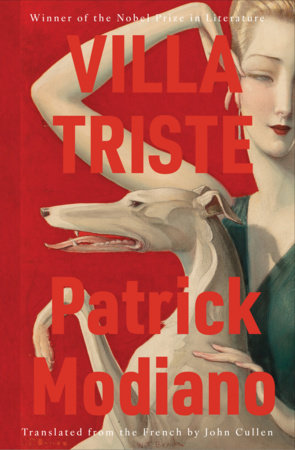
Villa Triste

A Novel

Translated by John Cullen
Paperback
$14.99 US
On sale Aug 25, 2026 | 176 Pages | 9781635425987

One of the most seductive and accessible novels by the Nobel Prize–winning author, the story of a man’s memories of evading responsibility, finding love, and seeking meaning in an uncertain world.

The narrator of Villa Triste, an anxious, roving, stateless young man of eighteen, arrives in a small French lakeside town near Switzerland in the early 1960s. He is fleeing the atmosphere of menace he feels around him and the fear that grips him. Fear of war? Of imminent catastrophe? Of others? Whatever it may be, the proximity of Switzerland, to which he plans to run at the first sign of danger, gives him temporary reassurance.

The young man hides among the other summer visitors until he meets a beautiful young actress named Yvonne Jacquet, and a strange doctor, René Meinthe. These two invite him into their world of soirees and late-night debauchery. But when real life beckons once again, he finds no sympathy from his new companions.

Modiano has written a haunting novel that captures lost youth, the search for identity, and ultimately, the fleetingness of time.
1.

They’ve torn down the Hôtel Verdun. It was an odd building bordered by a rotting wooden veranda, and it stood across from the train station. Commercial travelers would stop there to sleep between two trains. It had a reputation as a hotel that rented rooms by the hour. The rotunda-shaped café next door has also disappeared. Was it called the Dials Café, or maybe the Café of the Future? In any case, now there’s a big vacant space between the station and Place Albert I.
Rue Royale, on the other hand, hasn’t changed a bit, but because the season is winter and the hour late, you feel like you’re walking through a ghost town. You pass shop windows — the Chez Clément Marot bookstore, Horowitz the jeweler’s (“Deauville, Geneva, Le Touquet”), the Fidel-Berger English pastry shop — and then, farther on, the René Pigault hairdressing salon. The Henri à la Pensée windows. Most of these luxury shops are closed during the off-season. When you reach the arcades, you can see the red and green neon lights of the Cintra shining at the end on your left. On the opposite sidewalk, at the corner of Rue Royale and Place du Pâquier, is the Taverne, once a popular meeting place for young people. Does it still have the same clientele today?
Nothing remains of the big café, with its chandeliers and mirrors and the umbrella tables that overflowed onto the pavement. Around eight o’clock in the evening, there would be people moving about from table to table and forming little groups. Bursts of laughter. Blond hair. Clinking glasses. Straw hats. From time to time, a beach robe would add a dash of bright color. Everyone was getting ready for the night’s festivities.
Over there on the right is the Casino, a massive white structure open only from June to September. In the winter, local burghers play bridge twice a week in the baccarat room and the department’s Rotary Club holds its meetings in the grill room. Behind the Casino, the Albigny Park slopes very gently down to the lake and its weeping willows, its bandstand, and the wharf where you can catch the dilapidated boat that shuttles from one small lakeside village to another: Veyrier, Chavoires, Saint-Jorioz, Éden-Roc, Port-Lusatz…Too much cataloging. But there are some words you have to sing to yourself over and over, tirelessly, to a lullaby tune.
You follow Avenue d’Albigny, which is lined with plane trees. It runs along the lake, and at the moment when it curves to the right, you spot a white wooden portal: the entrance to the Sporting Club. A gravel drive, with several tennis courts on either side. Beyond them — all you have to do to remember is close your eyes — the long row of bathing huts and the sandy beach, nearly three hundred meters long. In the background, an English-style garden surrounds the Sporting Club’s restaurant and bar, which stands on the site of an old orangery. This all forms a peninsula, which at the turn of the twentieth century belonged to the automobile manufacturer Gordon-Gramme.
Opposite the Sporting Club, on the other side of Avenue d’Albigny, Boulevard Carabacel begins. It twists and turns up to the Hermitage, Windsor, and Alhambra hotels, or you can take the cable car. In summer it runs until midnight, and you wait for it in a little station that looks like a chalet from the outside. The vegetation here is thoroughly mixed, it’s hard to tell if you’re in the Alps, on the shores of the Mediterranean, or somewhere in the tropics. Umbrella pines. Mimosas. Fir trees. Palms. If you take the boulevard up the hillside, you discover the panorama: the entire lake, the Aravis mountains, and across the water, the elusive country known as Switzerland.
The Hermitage and the Windsor now house only furnished apartments. However, no one has bothered to take out the Windsor’s revolving door or the sun lodge at one end of the Hermitage’s lobby. Remember? It was invaded by bougainvillea. The Windsor dated from around 1910, and its white façade had the same meringue-like appearance as the façades of the Ruhl and the Négresco in Nice. The ocher-colored Hermitage was more sober and more majestic. It resembled the Royal hotel in Deauville — like a twin, actually. Have they really been converted into apartment buildings? No lights at the windows. You’d have to be brave enough to walk through the dark hallways and climb the stairs. Then maybe you’d see for yourself that nobody lives here.
As for the Alhambra, it’s been razed to the ground. There’s no trace of the gardens that once encircled it. Plans are surely afoot to build a modern hotel on the site. It costs me a negligible effort of memory to recall that in summer the gardens of the Hermitage, the Windsor, and the Alhambra closely corresponded to an image of the Garden of Paradise or the Promised Land. But which of the three had the immense bed of dahlias and the balustrade you leaned on to look out over the lake below? It doesn’t matter. We must have been the last witnesses to that little world.
It’s very late on a winter night. On the other side of the lake, you can barely make out the misty lights of Switzerland. There’s nothing left of the luxuriant Carabacel vegetation but some dead trees and stunted bushes. The façades of the Windsor and the Hermitage are black, as though charred. The town has lost its cosmopolitan, summery sheen. It’s dwindled into a departmental capital. A little burg, nestled in the remote French provinces. The notary and the sub-prefect play bridge in the disused Casino. So does Madame Pigault, the owner of the hairdressing salon, a blonde in her forties scented with Shocking. At her side, young Fournier, whose family owns three textile factories in Faverges. Also present is Servoz, of the Chambéry pharmaceutical laboratories, an excellent golfer. It appears that Madame Servoz, as brunette as Madame Pigault is blond, spends much of her time at the wheel of her BMW, driving between Geneva and her villa in Chavoires, and that she’s quite fond of young people. She’s often seen in the company of Pimpin Lavorel. And we could provide a thousand other equally vapid, equally appalling details about daily life in this little town, because people and things here have certainly not changed in twelve years.
The cafés are closed. A pink light filters under the door of the Cintra. Shall we go in and see whether the mahogany paneling has changed and the lamp with the tartan shade is in its proper place to the left of the bar? They haven’t removed the photographs of Émile Allais, taken at Engelberg when he won the world skiing championship. Or those of James Couttet. Or the one of Daniel Hendrickx. They’re all lined up above the rows of aperitif bottles. Of course, the photos have yellowed somewhat. And in the semidarkness, the only customer, a red-faced man wearing a checked jacket, is distractedly groping the barmaid. In the early 1960s, she had a harsh beauty, but since then she’s gained weight.
You can hear the sound of your own footsteps as you walk along the deserted Rue Sommeiller. On your left, the Regent cinema is the same as it ever was: it’s still got the orange roughcast façade, and REGENT is still spelled out in English-style, plum-colored letters. Nevertheless, they must have modernized the inside and changed the wooden seats and the Harcourt portraits of film stars that decorated the lobby. The station square is the only place in the town where some lights are still on and a few signs of life still visible. The Paris express is due at six minutes past midnight. Soldiers on leave from the Berthollet barracks arrive in noisy little groups, carrying their metal or cardboard suitcases. Some of the young men sing “O Christmas Tree,” no doubt because the season is approaching. They cluster together on platform 2, whacking one another on the back. You’d think they were leaving for the front. Among all those military overcoats, a civilian suit, beige in color. The man who’s wearing it doesn’t seem to suffer from the cold; he clasps the green silk scarf around his neck with a nervous hand. He goes from group to group, turning his head left and right with a distraught expression, as if searching for a single face in all that crowd. In fact, he’s just asked a soldier a question, but the young man and his two companions answer him only with derisive looks. Other soldiers turn and whistle as he passes them. He pretends to pay them no attention and nibbles on his cigarette holder. Now he’s standing off to one side with a young and very blond soldier in the elite Chasseurs Alpins, the Alpine Hunters. The youngster looks embarrassed and from time to time glances furtively at his comrades. The man in the suit leans on his shoulder and whispers something in his ear. The young chasseur tries to break away. Then the man slips an envelope into the soldier’s overcoat pocket, looks at him without saying anything, and as it’s beginning to snow, turns up the collar of his jacket.
The man’s name is René Meinthe. He abruptly raises his left hand to his forehead and leaves it there like a visor. A dozen years ago, this was a familiar gesture of his. How he’s aged…
The train has pulled into the station. The soldiers storm aboard, jostle one another in the corridors, lower the windows, pass suitcases through them. Some sing “Auld Lang Syne,” but the majority prefer to bellow “O Christmas Tree.” It’s snowing harder. Meinthe stands there unmoving, still holding up his hand like a visor. The towhead observes him through the window with a slightly cruel smile playing on his young lips. He fiddles with his uniform beret.
Meinthe waves to him. The carriages move off, carrying away their clusters of singing, waving soldiers.With his hands thrust into his jacket pockets, he heads for the restaurant in the station. The two waiters are clearing the tables and sweeping up around them with broad, languid gestures. Behind the bar, a man in a raincoat is putting up the last glasses. Meinthe orders a cognac. The barman curtly informs him that the bar is closed. Meinthe again orders a cognac.
“In this place,” the man replies, lingering on each syllable, “in this place, we don’t serve fairies.”
And the two waiters behind him burst into laughter. Meinthe doesn’t move; he stares at a point somewhere before his eyes and looks exhausted. One of the waiters has switched off the lights on the left-hand wall. The yellowish glow around the bar is the only remaining illumination. They’re waiting with folded arms. Are they going to bust his face? Or, I don’t know, maybe Meinthe’s going to slam his hand down on the grimy counter and declare, “I am Astrid, QUEEN OF THE BELGIANS!” posing and laughing in his old insolent way.
© Catherine Hélie, Gallimard
Patrick Modiano is a French novelist and recipient of the 2014 Nobel Prize in Literature. He previously won the 2012 Austrian State Prize for European Literature, the 2010 Prix mondial Cino Del Duca from the Institut de France for lifetime achievement, the 1978 Prix Goncourt for Rue des boutiques obscures, and the 1972 Grand Prix du roman de l’Académie française for Les Boulevards de ceinture. His works have been translated into more than forty languages. View titles by Patrick Modiano
“It has taken more than 40 years for this small masterpiece by the Nobel prize-winner to find its English translation from the original French. The wait has been worthwhile…This great novel is infused with nostalgia for a lost time, place, and people so intimately described that Victor’s memories begin to feel like our own.” —The Guardian

“A French Nobel laureate’s beguiling 1975 novel about an elusive young man’s memory of love and friendship…Beautifully translated by John Cullen, this novel does not dip into that ‘life-world’ of the French Occupation, but it does bear out the rest of the Nobel citation in being a seductive and at times poignant exploration of memory.” —Minneapolis Star Tribune

“Like all of Modiano’s novels, this is a brilliant evocation of guilt and memory.” —Catholic Herald

“Adding more color to Modiano’s exquisite palette; highly recommended.” —Library Journal (Starred Review)

“Nobel Prize-winning French writer Modiano develops his now-trademark demimonde of secrets kept and personae doffed and donned…A brilliant evocation of place, memory, and loss, shot through with an aching nostalgia.” —Kirkus Reviews

“Beautifully translated by Cullen, [Villa Triste] is more substantial and satisfying than much of what has appeared thus far from Nobel laureate Modiano.” —Booklist

About

One of the most seductive and accessible novels by the Nobel Prize–winning author, the story of a man’s memories of evading responsibility, finding love, and seeking meaning in an uncertain world.

The narrator of Villa Triste, an anxious, roving, stateless young man of eighteen, arrives in a small French lakeside town near Switzerland in the early 1960s. He is fleeing the atmosphere of menace he feels around him and the fear that grips him. Fear of war? Of imminent catastrophe? Of others? Whatever it may be, the proximity of Switzerland, to which he plans to run at the first sign of danger, gives him temporary reassurance.

The young man hides among the other summer visitors until he meets a beautiful young actress named Yvonne Jacquet, and a strange doctor, René Meinthe. These two invite him into their world of soirees and late-night debauchery. But when real life beckons once again, he finds no sympathy from his new companions.

Modiano has written a haunting novel that captures lost youth, the search for identity, and ultimately, the fleetingness of time.

Excerpt

1.

They’ve torn down the Hôtel Verdun. It was an odd building bordered by a rotting wooden veranda, and it stood across from the train station. Commercial travelers would stop there to sleep between two trains. It had a reputation as a hotel that rented rooms by the hour. The rotunda-shaped café next door has also disappeared. Was it called the Dials Café, or maybe the Café of the Future? In any case, now there’s a big vacant space between the station and Place Albert I.
Rue Royale, on the other hand, hasn’t changed a bit, but because the season is winter and the hour late, you feel like you’re walking through a ghost town. You pass shop windows — the Chez Clément Marot bookstore, Horowitz the jeweler’s (“Deauville, Geneva, Le Touquet”), the Fidel-Berger English pastry shop — and then, farther on, the René Pigault hairdressing salon. The Henri à la Pensée windows. Most of these luxury shops are closed during the off-season. When you reach the arcades, you can see the red and green neon lights of the Cintra shining at the end on your left. On the opposite sidewalk, at the corner of Rue Royale and Place du Pâquier, is the Taverne, once a popular meeting place for young people. Does it still have the same clientele today?
Nothing remains of the big café, with its chandeliers and mirrors and the umbrella tables that overflowed onto the pavement. Around eight o’clock in the evening, there would be people moving about from table to table and forming little groups. Bursts of laughter. Blond hair. Clinking glasses. Straw hats. From time to time, a beach robe would add a dash of bright color. Everyone was getting ready for the night’s festivities.
Over there on the right is the Casino, a massive white structure open only from June to September. In the winter, local burghers play bridge twice a week in the baccarat room and the department’s Rotary Club holds its meetings in the grill room. Behind the Casino, the Albigny Park slopes very gently down to the lake and its weeping willows, its bandstand, and the wharf where you can catch the dilapidated boat that shuttles from one small lakeside village to another: Veyrier, Chavoires, Saint-Jorioz, Éden-Roc, Port-Lusatz…Too much cataloging. But there are some words you have to sing to yourself over and over, tirelessly, to a lullaby tune.
You follow Avenue d’Albigny, which is lined with plane trees. It runs along the lake, and at the moment when it curves to the right, you spot a white wooden portal: the entrance to the Sporting Club. A gravel drive, with several tennis courts on either side. Beyond them — all you have to do to remember is close your eyes — the long row of bathing huts and the sandy beach, nearly three hundred meters long. In the background, an English-style garden surrounds the Sporting Club’s restaurant and bar, which stands on the site of an old orangery. This all forms a peninsula, which at the turn of the twentieth century belonged to the automobile manufacturer Gordon-Gramme.
Opposite the Sporting Club, on the other side of Avenue d’Albigny, Boulevard Carabacel begins. It twists and turns up to the Hermitage, Windsor, and Alhambra hotels, or you can take the cable car. In summer it runs until midnight, and you wait for it in a little station that looks like a chalet from the outside. The vegetation here is thoroughly mixed, it’s hard to tell if you’re in the Alps, on the shores of the Mediterranean, or somewhere in the tropics. Umbrella pines. Mimosas. Fir trees. Palms. If you take the boulevard up the hillside, you discover the panorama: the entire lake, the Aravis mountains, and across the water, the elusive country known as Switzerland.
The Hermitage and the Windsor now house only furnished apartments. However, no one has bothered to take out the Windsor’s revolving door or the sun lodge at one end of the Hermitage’s lobby. Remember? It was invaded by bougainvillea. The Windsor dated from around 1910, and its white façade had the same meringue-like appearance as the façades of the Ruhl and the Négresco in Nice. The ocher-colored Hermitage was more sober and more majestic. It resembled the Royal hotel in Deauville — like a twin, actually. Have they really been converted into apartment buildings? No lights at the windows. You’d have to be brave enough to walk through the dark hallways and climb the stairs. Then maybe you’d see for yourself that nobody lives here.
As for the Alhambra, it’s been razed to the ground. There’s no trace of the gardens that once encircled it. Plans are surely afoot to build a modern hotel on the site. It costs me a negligible effort of memory to recall that in summer the gardens of the Hermitage, the Windsor, and the Alhambra closely corresponded to an image of the Garden of Paradise or the Promised Land. But which of the three had the immense bed of dahlias and the balustrade you leaned on to look out over the lake below? It doesn’t matter. We must have been the last witnesses to that little world.
It’s very late on a winter night. On the other side of the lake, you can barely make out the misty lights of Switzerland. There’s nothing left of the luxuriant Carabacel vegetation but some dead trees and stunted bushes. The façades of the Windsor and the Hermitage are black, as though charred. The town has lost its cosmopolitan, summery sheen. It’s dwindled into a departmental capital. A little burg, nestled in the remote French provinces. The notary and the sub-prefect play bridge in the disused Casino. So does Madame Pigault, the owner of the hairdressing salon, a blonde in her forties scented with Shocking. At her side, young Fournier, whose family owns three textile factories in Faverges. Also present is Servoz, of the Chambéry pharmaceutical laboratories, an excellent golfer. It appears that Madame Servoz, as brunette as Madame Pigault is blond, spends much of her time at the wheel of her BMW, driving between Geneva and her villa in Chavoires, and that she’s quite fond of young people. She’s often seen in the company of Pimpin Lavorel. And we could provide a thousand other equally vapid, equally appalling details about daily life in this little town, because people and things here have certainly not changed in twelve years.
The cafés are closed. A pink light filters under the door of the Cintra. Shall we go in and see whether the mahogany paneling has changed and the lamp with the tartan shade is in its proper place to the left of the bar? They haven’t removed the photographs of Émile Allais, taken at Engelberg when he won the world skiing championship. Or those of James Couttet. Or the one of Daniel Hendrickx. They’re all lined up above the rows of aperitif bottles. Of course, the photos have yellowed somewhat. And in the semidarkness, the only customer, a red-faced man wearing a checked jacket, is distractedly groping the barmaid. In the early 1960s, she had a harsh beauty, but since then she’s gained weight.
You can hear the sound of your own footsteps as you walk along the deserted Rue Sommeiller. On your left, the Regent cinema is the same as it ever was: it’s still got the orange roughcast façade, and REGENT is still spelled out in English-style, plum-colored letters. Nevertheless, they must have modernized the inside and changed the wooden seats and the Harcourt portraits of film stars that decorated the lobby. The station square is the only place in the town where some lights are still on and a few signs of life still visible. The Paris express is due at six minutes past midnight. Soldiers on leave from the Berthollet barracks arrive in noisy little groups, carrying their metal or cardboard suitcases. Some of the young men sing “O Christmas Tree,” no doubt because the season is approaching. They cluster together on platform 2, whacking one another on the back. You’d think they were leaving for the front. Among all those military overcoats, a civilian suit, beige in color. The man who’s wearing it doesn’t seem to suffer from the cold; he clasps the green silk scarf around his neck with a nervous hand. He goes from group to group, turning his head left and right with a distraught expression, as if searching for a single face in all that crowd. In fact, he’s just asked a soldier a question, but the young man and his two companions answer him only with derisive looks. Other soldiers turn and whistle as he passes them. He pretends to pay them no attention and nibbles on his cigarette holder. Now he’s standing off to one side with a young and very blond soldier in the elite Chasseurs Alpins, the Alpine Hunters. The youngster looks embarrassed and from time to time glances furtively at his comrades. The man in the suit leans on his shoulder and whispers something in his ear. The young chasseur tries to break away. Then the man slips an envelope into the soldier’s overcoat pocket, looks at him without saying anything, and as it’s beginning to snow, turns up the collar of his jacket.
The man’s name is René Meinthe. He abruptly raises his left hand to his forehead and leaves it there like a visor. A dozen years ago, this was a familiar gesture of his. How he’s aged…
The train has pulled into the station. The soldiers storm aboard, jostle one another in the corridors, lower the windows, pass suitcases through them. Some sing “Auld Lang Syne,” but the majority prefer to bellow “O Christmas Tree.” It’s snowing harder. Meinthe stands there unmoving, still holding up his hand like a visor. The towhead observes him through the window with a slightly cruel smile playing on his young lips. He fiddles with his uniform beret.
Meinthe waves to him. The carriages move off, carrying away their clusters of singing, waving soldiers.With his hands thrust into his jacket pockets, he heads for the restaurant in the station. The two waiters are clearing the tables and sweeping up around them with broad, languid gestures. Behind the bar, a man in a raincoat is putting up the last glasses. Meinthe orders a cognac. The barman curtly informs him that the bar is closed. Meinthe again orders a cognac.
“In this place,” the man replies, lingering on each syllable, “in this place, we don’t serve fairies.”
And the two waiters behind him burst into laughter. Meinthe doesn’t move; he stares at a point somewhere before his eyes and looks exhausted. One of the waiters has switched off the lights on the left-hand wall. The yellowish glow around the bar is the only remaining illumination. They’re waiting with folded arms. Are they going to bust his face? Or, I don’t know, maybe Meinthe’s going to slam his hand down on the grimy counter and declare, “I am Astrid, QUEEN OF THE BELGIANS!” posing and laughing in his old insolent way.

Author

© Catherine Hélie, Gallimard
Patrick Modiano is a French novelist and recipient of the 2014 Nobel Prize in Literature. He previously won the 2012 Austrian State Prize for European Literature, the 2010 Prix mondial Cino Del Duca from the Institut de France for lifetime achievement, the 1978 Prix Goncourt for Rue des boutiques obscures, and the 1972 Grand Prix du roman de l’Académie française for Les Boulevards de ceinture. His works have been translated into more than forty languages. View titles by Patrick Modiano

Praise

“It has taken more than 40 years for this small masterpiece by the Nobel prize-winner to find its English translation from the original French. The wait has been worthwhile…This great novel is infused with nostalgia for a lost time, place, and people so intimately described that Victor’s memories begin to feel like our own.” —The Guardian

“A French Nobel laureate’s beguiling 1975 novel about an elusive young man’s memory of love and friendship…Beautifully translated by John Cullen, this novel does not dip into that ‘life-world’ of the French Occupation, but it does bear out the rest of the Nobel citation in being a seductive and at times poignant exploration of memory.” —Minneapolis Star Tribune

“Like all of Modiano’s novels, this is a brilliant evocation of guilt and memory.” —Catholic Herald

“Adding more color to Modiano’s exquisite palette; highly recommended.” —Library Journal (Starred Review)

“Nobel Prize-winning French writer Modiano develops his now-trademark demimonde of secrets kept and personae doffed and donned…A brilliant evocation of place, memory, and loss, shot through with an aching nostalgia.” —Kirkus Reviews

“Beautifully translated by Cullen, [Villa Triste] is more substantial and satisfying than much of what has appeared thus far from Nobel laureate Modiano.” —Booklist