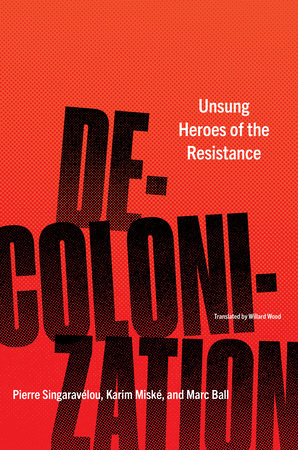
Full of gripping historical vignettes and evocative photographs, an accessible overview of the dynamic figures who resisted colonization, from India, Senegal, and Algeria to Vietnam, Kenya, and Congo.

Decolonization started on the very first day of colonization.

From the arrival of the Europeans, the peoples of Africa and Asia rose up. No one willingly accepts subjugation, but in order to one day regain freedom, you first and foremost need to stay alive. Faced with the Europeans’ machine guns, the colonized hit back in other ways: from civil disobedience to communist revolution, by way of soccer and literature. It was a struggle marked by infinite patience and unlimited determination, fought by heroic men and women now largely unknown.
    Condensing a wealth of scholarly research into short, lively chapters, Decolonization brings their extraordinary stories to light:
    Manikarnika Tambe, the Indian queen who led her troops into battle against the British;
    Mary Nyanjiru, the Kenyan activist who spearheaded a protest in Nairobi;
    Lamine Senghor, the Senegalese infantryman who became an anti-colonial militant in Paris;
    and many more.
    With them, a current of resistance swept the world, culminating in the independence of almost all the colonies in the 1960s. But at what price? In the atomic India of Indira Gandhi, in the Congo subjected to Mobutu’s dictatorship, or in a London shaken by the rioting of young immigrants, we can see just how crucial it is that we understand and learn from this painful history.
Preface  
 
DECOLONIZATION. Even the word is deceptive. As if the Western powers suddenly decided to give back control to the people they had conquered. As if, after engaging in such a radical form of domination, it was even possible to return to some hypothetical state of original purity. As if the historical process of decolonization wasn’t the upshot of constant rebellions lasting more than a century and extending from India to Senegal, from Algeria to Vietnam, from Kenya to the Democratic Republic of the Congo. As if the engine of change had not been insubordination, rebellion, and insurrection. Countless words and actions that in the end forced white men and women to go home.
So it’s time to tell the story the right way around. From the point of view of its main actors: the people seeking their freedom. Give voice to the revolt, this breath of rebellion gusting far and wide. This fierce energy constantly dissipating and regrouping. This phoenix that died in one place only to be reborn in another. This iron will that took shape in the minds of women, the hearts of men, when injustice, wrongfulness, and domination became more unbearable than death itself. When human dignity was trampled underfoot morning, noon, and night. When the invaders from abroad finally got through to the colonized that there would never be equality between them.
When there was nothing left to lose.
It’s time to capture this spark, this breath of air, with words and sentences. Harness the poor means available to say the unsayable. This mix of love and hate. This cold rage, dull pain, infinite patience. Putting history back the right way around is like knocking over the table. An accident, a hole in the frame of language. It can’t be done with the usual words, with conventional turns of phrase. It calls for rhythm, nerve, transgression. It calls for speaking with the breath of the revolt itself. Breathing with the actors in this story. Accepting that they are the ancestors of us all. Wherever we’re from, whatever our skin color, our beliefs, our given name. Because in the end they fought for us all. So that the world might be more habitable for each of us. By taking back control of their own life, the insurgents also freed their oppressors.
 
“Brushing History Against the Grain”

Christopher Columbus, Vasco da Gama, Captain James Cook . . . Joseph Dupleix, Cecil Rhodes, Charles Gordon, Hubert Lyautey . . . or yet again Franklin D. Roosevelt, Clement Attlee, Pierre Mendès France, Charles de Gaulle — any well-versed high school student can reel off a list of the heroes of exploration, colonization, and even decolonization. But all of them are of European descent. As though the parties most deeply implicated — the Amerindian, Asian, and African populations — had no part to play. As though, in the role of passive victims or powerless barbarians, they were absent from their own history. This imperial fiction has been debunked by several generations of researchers who have made it their task to restore alternate points of view and to supply the missing parts of a common history. The present book initiates us into this reversal of perspective by focusing on resistance movements against Western colonial domination. It summons up a more complex past than is retailed either by the neocolonialist historians of the former imperial powers or the nationalist historians of the former colonies. Although they privilege opposing political options, both groups overestimate the Europeans’ ability to dominate. The supposed omnipotence of the West was a notion welcomed by both the self-satisfied Western elites and the new rulers of the former colonies, who found it a useful political argument both to excuse their derelictions and to maintain their power. The colonial enterprise provoked fierce resistance from the outset in Asia and Africa. The conquest and occasional acquisition of territories was usually a slow process — difficult and never entirely successful. Far from resembling the glossy image of imperial peace, European domination was constantly challenged by activist minorities while a small fraction of indigenous elites cooperated with the colonizers to secure their own social and economic power. This collaboration was a sine qua non of colonial expansion. “To brush history against the grain,” Walter Benjamin’s felicitous phrase, consists in discovering — from below — the capacity for action of the “colonized,” the anonymous women and men who decolonized the contemporary world. And putting back on the shelf once and for all the reassuring hagiographies and imposing nationalist icons, to heed instead the point of the proverb so dear to the Nigerian writer Chinua Achebe: “Until the lions have their own historians, the history of the hunt will always glorify the hunter!”
© Claire Delfino
Pierre Singaravélou is British Academy Global Professor at King’s College London and Professor of History at Panthéon-Sorbonne University. He has published numerous works on the history of empires, colonialism, and globalization, including A Past of Possibilities (with Quentin Deluermoz) and France in the World (editor, with Patrick Boucheron, et al). View titles by Pierre Singaravélou
Karim Miské grew up in Paris and studied journalism in Dakar. Now resident in France, he makes documentary films on a wide range of subjects including deafness and the common roots between the Judaism and Islam. His first novel, Arab Jazz, won the Grand Prix de Littérature Policière and the Prix du Goéland Masqué. View titles by Karim Miské
Marc Ball is a documentary filmmaker whose films set out to describe the world around us from the people’s perspective. He has directed, with Karim Miské, Tunisie, les voix de la revolution, for Arte, and Police, illégitime violence, for France 3 and Public Sénat. View titles by Marc Ball
“[The authors] pay moving tribute to the ‘iron will’ of generations of people who found injustice ‘more unbearable than death itself.’…a valuable overview of the people and forces behind decolonization.” —Publishers Weekly

“Many people assume that decolonization was handed down benevolently from above. Nothing could be further from the truth. This book tells the extraordinary story of how the most oppressed people on the planet struggled against and overthrew the world’s most powerful empires. Gripping, powerful, timely—don’t miss this book.” —Jason Hickel, author of The Divide and Less Is More

“An eye-opening collection of stories, portraits, and images that powerfully capture the resilience and courage of the women and men who resisted colonialism over two hundred years. A timely intervention and a page-turning read.” —Robert Gildea, author of Empires of the Mind: The Colonial Past and the Politics of the Present

“The authors of Decolonization unpack and reimagine what is often written about the end of European empires. The book mirrors the very creativity, dynamism, and unpredictability of its subjects—the men and women who endured colonialism and fought for independence. Global in scope, but deeply personal in content, Decolonization is guaranteed to provoke and inspire its readers to think anew about the making of the postcolonial world.” —J. P. Daughton, author of In the Forest of No Joy: The Congo-Océan Railroad and the Tragedy of French Colonialism

“Decolonization as you’ve never seen it before…the story of the European domination of many African and Asian populations is told not from the perspective of the colonizers, but of the colonized. Who are presented not as passive victims, but as ‘actors in their own story.’” —Télérama

“Striking…This panorama inverts the focus to recount from the point of view of the colonized 150 years of struggle against the subjugation of Africa and Asia.” —Afrique Magazine

About

Full of gripping historical vignettes and evocative photographs, an accessible overview of the dynamic figures who resisted colonization, from India, Senegal, and Algeria to Vietnam, Kenya, and Congo.

Decolonization started on the very first day of colonization.

From the arrival of the Europeans, the peoples of Africa and Asia rose up. No one willingly accepts subjugation, but in order to one day regain freedom, you first and foremost need to stay alive. Faced with the Europeans’ machine guns, the colonized hit back in other ways: from civil disobedience to communist revolution, by way of soccer and literature. It was a struggle marked by infinite patience and unlimited determination, fought by heroic men and women now largely unknown.
    Condensing a wealth of scholarly research into short, lively chapters, Decolonization brings their extraordinary stories to light:
    Manikarnika Tambe, the Indian queen who led her troops into battle against the British;
    Mary Nyanjiru, the Kenyan activist who spearheaded a protest in Nairobi;
    Lamine Senghor, the Senegalese infantryman who became an anti-colonial militant in Paris;
    and many more.
    With them, a current of resistance swept the world, culminating in the independence of almost all the colonies in the 1960s. But at what price? In the atomic India of Indira Gandhi, in the Congo subjected to Mobutu’s dictatorship, or in a London shaken by the rioting of young immigrants, we can see just how crucial it is that we understand and learn from this painful history.

Excerpt

Preface  
 
DECOLONIZATION. Even the word is deceptive. As if the Western powers suddenly decided to give back control to the people they had conquered. As if, after engaging in such a radical form of domination, it was even possible to return to some hypothetical state of original purity. As if the historical process of decolonization wasn’t the upshot of constant rebellions lasting more than a century and extending from India to Senegal, from Algeria to Vietnam, from Kenya to the Democratic Republic of the Congo. As if the engine of change had not been insubordination, rebellion, and insurrection. Countless words and actions that in the end forced white men and women to go home.
So it’s time to tell the story the right way around. From the point of view of its main actors: the people seeking their freedom. Give voice to the revolt, this breath of rebellion gusting far and wide. This fierce energy constantly dissipating and regrouping. This phoenix that died in one place only to be reborn in another. This iron will that took shape in the minds of women, the hearts of men, when injustice, wrongfulness, and domination became more unbearable than death itself. When human dignity was trampled underfoot morning, noon, and night. When the invaders from abroad finally got through to the colonized that there would never be equality between them.
When there was nothing left to lose.
It’s time to capture this spark, this breath of air, with words and sentences. Harness the poor means available to say the unsayable. This mix of love and hate. This cold rage, dull pain, infinite patience. Putting history back the right way around is like knocking over the table. An accident, a hole in the frame of language. It can’t be done with the usual words, with conventional turns of phrase. It calls for rhythm, nerve, transgression. It calls for speaking with the breath of the revolt itself. Breathing with the actors in this story. Accepting that they are the ancestors of us all. Wherever we’re from, whatever our skin color, our beliefs, our given name. Because in the end they fought for us all. So that the world might be more habitable for each of us. By taking back control of their own life, the insurgents also freed their oppressors.
 
“Brushing History Against the Grain”

Christopher Columbus, Vasco da Gama, Captain James Cook . . . Joseph Dupleix, Cecil Rhodes, Charles Gordon, Hubert Lyautey . . . or yet again Franklin D. Roosevelt, Clement Attlee, Pierre Mendès France, Charles de Gaulle — any well-versed high school student can reel off a list of the heroes of exploration, colonization, and even decolonization. But all of them are of European descent. As though the parties most deeply implicated — the Amerindian, Asian, and African populations — had no part to play. As though, in the role of passive victims or powerless barbarians, they were absent from their own history. This imperial fiction has been debunked by several generations of researchers who have made it their task to restore alternate points of view and to supply the missing parts of a common history. The present book initiates us into this reversal of perspective by focusing on resistance movements against Western colonial domination. It summons up a more complex past than is retailed either by the neocolonialist historians of the former imperial powers or the nationalist historians of the former colonies. Although they privilege opposing political options, both groups overestimate the Europeans’ ability to dominate. The supposed omnipotence of the West was a notion welcomed by both the self-satisfied Western elites and the new rulers of the former colonies, who found it a useful political argument both to excuse their derelictions and to maintain their power. The colonial enterprise provoked fierce resistance from the outset in Asia and Africa. The conquest and occasional acquisition of territories was usually a slow process — difficult and never entirely successful. Far from resembling the glossy image of imperial peace, European domination was constantly challenged by activist minorities while a small fraction of indigenous elites cooperated with the colonizers to secure their own social and economic power. This collaboration was a sine qua non of colonial expansion. “To brush history against the grain,” Walter Benjamin’s felicitous phrase, consists in discovering — from below — the capacity for action of the “colonized,” the anonymous women and men who decolonized the contemporary world. And putting back on the shelf once and for all the reassuring hagiographies and imposing nationalist icons, to heed instead the point of the proverb so dear to the Nigerian writer Chinua Achebe: “Until the lions have their own historians, the history of the hunt will always glorify the hunter!”

Author

© Claire Delfino
Pierre Singaravélou is British Academy Global Professor at King’s College London and Professor of History at Panthéon-Sorbonne University. He has published numerous works on the history of empires, colonialism, and globalization, including A Past of Possibilities (with Quentin Deluermoz) and France in the World (editor, with Patrick Boucheron, et al). View titles by Pierre Singaravélou
Karim Miské grew up in Paris and studied journalism in Dakar. Now resident in France, he makes documentary films on a wide range of subjects including deafness and the common roots between the Judaism and Islam. His first novel, Arab Jazz, won the Grand Prix de Littérature Policière and the Prix du Goéland Masqué. View titles by Karim Miské
Marc Ball is a documentary filmmaker whose films set out to describe the world around us from the people’s perspective. He has directed, with Karim Miské, Tunisie, les voix de la revolution, for Arte, and Police, illégitime violence, for France 3 and Public Sénat. View titles by Marc Ball

Praise

“[The authors] pay moving tribute to the ‘iron will’ of generations of people who found injustice ‘more unbearable than death itself.’…a valuable overview of the people and forces behind decolonization.” —Publishers Weekly

“Many people assume that decolonization was handed down benevolently from above. Nothing could be further from the truth. This book tells the extraordinary story of how the most oppressed people on the planet struggled against and overthrew the world’s most powerful empires. Gripping, powerful, timely—don’t miss this book.” —Jason Hickel, author of The Divide and Less Is More

“An eye-opening collection of stories, portraits, and images that powerfully capture the resilience and courage of the women and men who resisted colonialism over two hundred years. A timely intervention and a page-turning read.” —Robert Gildea, author of Empires of the Mind: The Colonial Past and the Politics of the Present

“The authors of Decolonization unpack and reimagine what is often written about the end of European empires. The book mirrors the very creativity, dynamism, and unpredictability of its subjects—the men and women who endured colonialism and fought for independence. Global in scope, but deeply personal in content, Decolonization is guaranteed to provoke and inspire its readers to think anew about the making of the postcolonial world.” —J. P. Daughton, author of In the Forest of No Joy: The Congo-Océan Railroad and the Tragedy of French Colonialism

“Decolonization as you’ve never seen it before…the story of the European domination of many African and Asian populations is told not from the perspective of the colonizers, but of the colonized. Who are presented not as passive victims, but as ‘actors in their own story.’” —Télérama

“Striking…This panorama inverts the focus to recount from the point of view of the colonized 150 years of struggle against the subjugation of Africa and Asia.” —Afrique Magazine

Books for Asian American, Native Hawaiian, and Pacific Islander Heritage Month

Each May, we honor the stories, histories, and cultures of Asian Americans, Native Hawaiians, and Pacific Islanders. Below is a selection of acclaimed fiction and nonfiction books by AANHPI creators to share with your students this month and throughout the year. Find our full collection of titles for Higher Education here.

Read more