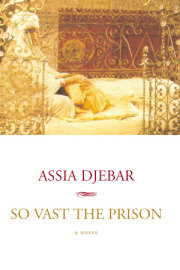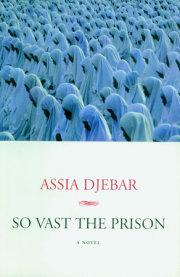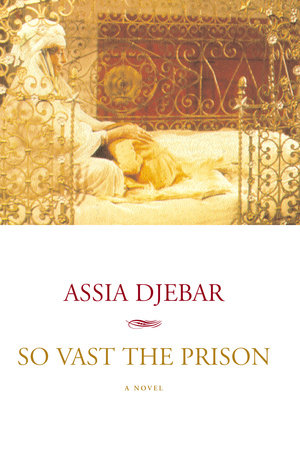

So Vast the Prison is the double-threaded story of a modern, educated Algerian woman existing in a man's society, and, not surprisingly, living a life of contradictions. Djebar, too, tackles cross-cultural issues just by writing in French of an Arab society (the actual act of writing contrasting with the strong oral traditions of the indigenous culture), as a woman who has seen revolution in a now post-colonial country, and as an Algerian living in exile.
In this new novel, Djebar brilliantly plays these contradictions against the bloody history of Carthage, a great civilization the Berbers were once compared to, and makes it both a tribute to the loss of Berber culture and a meeting-point of culture and language. As the story of one woman's experience in Algeria, it is a private tale, but one embedded in a vast history.
A radically singular voice in the world of literature, Assia Djebar's work ultimately reaches beyond the particulars of Algeria to embrace, in stark yet sensuous language, the universal themes of violence, intimacy, ostracism, victimization, and exile.
With her Berber and Muslim roots, her accomplishments as an Arab woman at the highest echelons of Western society in France and America, and her relentless output as a novelist and filmmaker, ASSIA DJEBAR speaks for the women, the poor, victims of both terrorism and the “War on Terror” that began in Algeria forty years before it arrived on US soil, and provides a much needed alternative voice to the litanies of the “experts.” Djebar won the Neustadt Prize in 1996, Germany’s Peace Prize in 2000, and in 2005 became the first Arab woman elected to the Académie Française. She is Silver Professor of Francophone Literature and Civilization at NYU. Djebar lives in Paris and New York.
“Assia Djebar . . .has given weeping its words and longing its lyrics.” –William Gass


“Marx . . . wanted to be a 'citizen of the world.' Listening to Assia Djebar's torn yet majestically flowing voice gives us some sense of what is involved in that admirable aspiration.” –Christopher Prendergast, Times Literary Suplement


“Writing becomes weapon and refuge for the oppressed in this fiercely intelligent, intricate novel set in a tragic, bewitching Algeria. Expressing the bitterness of being caught between traditional Islamic and modern European cultures, married 36-year-old Isma begins her story the summer she has an affair with a student. A highly educated musicologist, Isma is also governed by Islamic tradition. When her husband discovers her dalliance, he beats her, intending to blind her. The affair marks Isma's awakening and the beginning of her quest for true independence, though she stays with her husband for a little while longer. When she finally leaves him, she embarks on a semi-documentary film project, to be called Arable Woman. Intertwining her experiences in the mountains filming peasant women with memories of her childhood and stories about her female ancestors and relatives, Isma weaves a complicated tapestry of images and sentiments. The tales she unearths are richly detailed and gracefully told, and the book becomes a moving common history of cultural exile and captivity. Djebar, winner of the 1996 Neustadt Prize for Contributions to World Literature, has a talent for narrating the stories of those who are 'freed and voiceless' without heavy-handed moralizing or judgment.” Publishers Weekly


“From time to time, we hear about books that supposedly tear away the veil from the lives of Arab women. I don't know anyone who has done this with more intelligence and passion . . . than Assia Djebar. That murmur beneath her images soon begins to sound like a roar.” –Alan Cheuse, All Things Considered


“[A] polymorphously lyrical novel by . . . Algeria's foremost literary voice.” –Jonathan Levi, Los Angeles Times Book Review

About

So Vast the Prison is the double-threaded story of a modern, educated Algerian woman existing in a man's society, and, not surprisingly, living a life of contradictions. Djebar, too, tackles cross-cultural issues just by writing in French of an Arab society (the actual act of writing contrasting with the strong oral traditions of the indigenous culture), as a woman who has seen revolution in a now post-colonial country, and as an Algerian living in exile.
In this new novel, Djebar brilliantly plays these contradictions against the bloody history of Carthage, a great civilization the Berbers were once compared to, and makes it both a tribute to the loss of Berber culture and a meeting-point of culture and language. As the story of one woman's experience in Algeria, it is a private tale, but one embedded in a vast history.
A radically singular voice in the world of literature, Assia Djebar's work ultimately reaches beyond the particulars of Algeria to embrace, in stark yet sensuous language, the universal themes of violence, intimacy, ostracism, victimization, and exile.

Author

With her Berber and Muslim roots, her accomplishments as an Arab woman at the highest echelons of Western society in France and America, and her relentless output as a novelist and filmmaker, ASSIA DJEBAR speaks for the women, the poor, victims of both terrorism and the “War on Terror” that began in Algeria forty years before it arrived on US soil, and provides a much needed alternative voice to the litanies of the “experts.” Djebar won the Neustadt Prize in 1996, Germany’s Peace Prize in 2000, and in 2005 became the first Arab woman elected to the Académie Française. She is Silver Professor of Francophone Literature and Civilization at NYU. Djebar lives in Paris and New York.

Praise

“Assia Djebar . . .has given weeping its words and longing its lyrics.” –William Gass


“Marx . . . wanted to be a 'citizen of the world.' Listening to Assia Djebar's torn yet majestically flowing voice gives us some sense of what is involved in that admirable aspiration.” –Christopher Prendergast, Times Literary Suplement


“Writing becomes weapon and refuge for the oppressed in this fiercely intelligent, intricate novel set in a tragic, bewitching Algeria. Expressing the bitterness of being caught between traditional Islamic and modern European cultures, married 36-year-old Isma begins her story the summer she has an affair with a student. A highly educated musicologist, Isma is also governed by Islamic tradition. When her husband discovers her dalliance, he beats her, intending to blind her. The affair marks Isma's awakening and the beginning of her quest for true independence, though she stays with her husband for a little while longer. When she finally leaves him, she embarks on a semi-documentary film project, to be called Arable Woman. Intertwining her experiences in the mountains filming peasant women with memories of her childhood and stories about her female ancestors and relatives, Isma weaves a complicated tapestry of images and sentiments. The tales she unearths are richly detailed and gracefully told, and the book becomes a moving common history of cultural exile and captivity. Djebar, winner of the 1996 Neustadt Prize for Contributions to World Literature, has a talent for narrating the stories of those who are 'freed and voiceless' without heavy-handed moralizing or judgment.” Publishers Weekly


“From time to time, we hear about books that supposedly tear away the veil from the lives of Arab women. I don't know anyone who has done this with more intelligence and passion . . . than Assia Djebar. That murmur beneath her images soon begins to sound like a roar.” –Alan Cheuse, All Things Considered


“[A] polymorphously lyrical novel by . . . Algeria's foremost literary voice.” –Jonathan Levi, Los Angeles Times Book Review