Books for Jewish American Heritage Month
In celebration of Jewish American Heritage Month in May, we are sharing books by authors who share their individual stories, experiences, and lives. Find our full collection of books here.
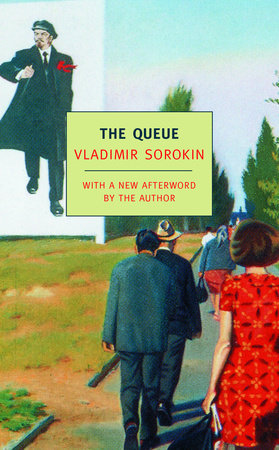
[A] landmark of international postmodern fiction.
— Keith Gessen
"If queues were arranged in order of merit, it would only be fair to put the young Soviet writer Vladimir Sorokin at the head." -Guardian
"With humor, anger and irony, Sorokin creates a brilliant set piece, conveying the absurdity, the dehumanization and, above all, the inevitability of waiting in line." —Publishers Weekly
"The Queue dispenses entirely with authorial interpolation; indeed, it dispenses with everything except dialogue, mostly curt one-liners, as though transcribed direct from a radio play. The uncredited voices are queueing outside a clothes shop in summer: Party panjandrums barge in front of the accompaniment of quickly muffled protests; vodka circulates; the Moscow sun dexlines; romance germinates. Anti-Soviet elements will perhaps coo over Valdimir Sorokin's happy mining of elemental koptimism from an unlikely seam; more pertinent to our purposes this book, alone of the quartet, displays genuine zest." -The Times (London)
"This novel reduces to delightful absurdity the rough democracy of the long lines that Soviet people-in-the-street endure in order to buy "luxury" goods. Sorokin is an innovative young writer, never published officially in the USSR, who draws on two great Russian traditions sorely missing from Soviet literature: avant-garde experiment and a flair for nonsense. The book has no description, settings, or stage directionnothing but voices: snatches of conversation, rumors, jokes, howls of rage, roll calls, and sexy moans. Sorokin's magic pen turns this framework into a mini-picaresque novel with a hero of sorts. Readers with some imagination will enjoy following Vadim and his co-queuers through their days and nights on line and off." -Library Journal
Mr. Sorokin demonstrates a remarkable ear for dialogue...Occasionally in its characters’ speech The Queue resembles, as befits a colloquial account of an overnight queue, Waiting for Godot. Its humor, however, is broader and nowhere as stark.
— The New York Times
"The Queue is a devastating satire of Soviet bureaucracy, and its message is made even more effective by the deadpan method chosen for its delivery...reminiscent of Kafka, Orwell and Beckett in their explorations of nightmare societies...It's ending is ironic and funny, while reinforcing the cynical tone of the whole novel and the impression that the Soviet Union is a vast, unmanageable bureaucracy." -Globe and Mail

[A] landmark of international postmodern fiction.
— Keith Gessen
"If queues were arranged in order of merit, it would only be fair to put the young Soviet writer Vladimir Sorokin at the head." -Guardian
"With humor, anger and irony, Sorokin creates a brilliant set piece, conveying the absurdity, the dehumanization and, above all, the inevitability of waiting in line." —Publishers Weekly
"The Queue dispenses entirely with authorial interpolation; indeed, it dispenses with everything except dialogue, mostly curt one-liners, as though transcribed direct from a radio play. The uncredited voices are queueing outside a clothes shop in summer: Party panjandrums barge in front of the accompaniment of quickly muffled protests; vodka circulates; the Moscow sun dexlines; romance germinates. Anti-Soviet elements will perhaps coo over Valdimir Sorokin's happy mining of elemental koptimism from an unlikely seam; more pertinent to our purposes this book, alone of the quartet, displays genuine zest." -The Times (London)
"This novel reduces to delightful absurdity the rough democracy of the long lines that Soviet people-in-the-street endure in order to buy "luxury" goods. Sorokin is an innovative young writer, never published officially in the USSR, who draws on two great Russian traditions sorely missing from Soviet literature: avant-garde experiment and a flair for nonsense. The book has no description, settings, or stage directionnothing but voices: snatches of conversation, rumors, jokes, howls of rage, roll calls, and sexy moans. Sorokin's magic pen turns this framework into a mini-picaresque novel with a hero of sorts. Readers with some imagination will enjoy following Vadim and his co-queuers through their days and nights on line and off." -Library Journal
Mr. Sorokin demonstrates a remarkable ear for dialogue...Occasionally in its characters’ speech The Queue resembles, as befits a colloquial account of an overnight queue, Waiting for Godot. Its humor, however, is broader and nowhere as stark.
— The New York Times
"The Queue is a devastating satire of Soviet bureaucracy, and its message is made even more effective by the deadpan method chosen for its delivery...reminiscent of Kafka, Orwell and Beckett in their explorations of nightmare societies...It's ending is ironic and funny, while reinforcing the cynical tone of the whole novel and the impression that the Soviet Union is a vast, unmanageable bureaucracy." -Globe and Mail
In celebration of Jewish American Heritage Month in May, we are sharing books by authors who share their individual stories, experiences, and lives. Find our full collection of books here.
For Mental Health Awareness Month in May, we are sharing books to educate and raise awareness about mental health and the various factors that may affect it, and to provide tools and resources for student wellness. Find our full collection of titles here.
Each May, we honor the stories, histories, and cultures of Asian Americans, Native Hawaiians, and Pacific Islanders. Below is a selection of acclaimed fiction and nonfiction books by AANHPI creators to share with your students this month and throughout the year. Find our full collection of titles for Higher Education here.