
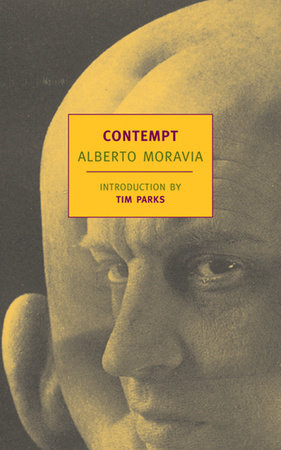

Contempt

Introduction by Tim Parks
Translated by Angus Davidson
Look inside
Contempt is a brilliant and unsettling work by one of the revolutionary masters of modern European literature. All the qualities for which Alberto Moravia is justly famous—his cool clarity of expression, his exacting attention to psychological complexity and social pretension, his still-striking openness about sex—are evident in this story of a failing marriage. Contempt (which was to inspire Jean-Luc Godard's no-less-celebrated film) is an unflinching examination of desperation and self-deception in the emotional vacuum of modern consumer society.
Alberto Moravia, born in Rome in 1907, was one of the greatest Italian writers of the twentieth century. His novels, which include The Woman of Rome, The Conformist, Contempt, and Two Women, have been turned into films by Bernardo Bertolucci and Jean-Luc Godard. He died in 1990. View titles by Alberto Moravia
Rich in substance and resonant with meaning…a rare achievement.
The New York Times

Moravia remains one of the twentieth century’s smoothest and most entertaining poets of paralysis, of the genial ennui generated by the triumph of materialism over humane values…his novels offer a bracing counterpoint to today’s soft-hearted and -headed fiction.
Boston Review

About

Contempt is a brilliant and unsettling work by one of the revolutionary masters of modern European literature. All the qualities for which Alberto Moravia is justly famous—his cool clarity of expression, his exacting attention to psychological complexity and social pretension, his still-striking openness about sex—are evident in this story of a failing marriage. Contempt (which was to inspire Jean-Luc Godard's no-less-celebrated film) is an unflinching examination of desperation and self-deception in the emotional vacuum of modern consumer society.

Author

Alberto Moravia, born in Rome in 1907, was one of the greatest Italian writers of the twentieth century. His novels, which include The Woman of Rome, The Conformist, Contempt, and Two Women, have been turned into films by Bernardo Bertolucci and Jean-Luc Godard. He died in 1990. View titles by Alberto Moravia

Praise

Rich in substance and resonant with meaning…a rare achievement.
The New York Times

Moravia remains one of the twentieth century’s smoothest and most entertaining poets of paralysis, of the genial ennui generated by the triumph of materialism over humane values…his novels offer a bracing counterpoint to today’s soft-hearted and -headed fiction.
Boston Review