Freedom of Speech

A People’s History of Democracy’s Most Essential Right

Foreword by Randall Kennedy
Paperback
$17.95 US
On sale May 19, 2026 | 256 Pages | 9781586424527

See Additional Formats
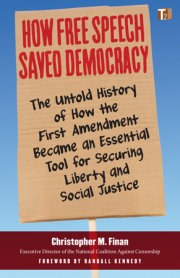
An essential look at how, throughout American history, the powerless have exercised their 1st Amendment right to free speech, informing how we can defend democracy today.

"Great storytelling about the history and importance of the 1st Amendment, from someone who has spent his life defending—and using—it."  — Mary Beth Tinker


From the beginning of American history, free speech has been crucial for the pursuit of justice and expansion of democracy. Yet today, we are seeing growing attempts to roll back free speech protections in America: cultural warriors are banning books from library shelves at a level not seen in decades, and elected officials are attacking free speech principles to undermine other rights and consolidate their own power.

Uncovering vivid and engaging stories about 1st Amendment pioneers throughout American history, historian and leading censorship expert Christopher Finan highlights how free speech has been used to advocate for change. In the 19th century, abolitionists, advocates for women's rights, and leaders of the labor movement had to fight for free speech. In the 20th century, the civil rights and anti-war movements expanded free speech, creating a shield for every protest movement that we have seen since.

With sharp insight and page-turning storytelling, Finan demonstrates that the most effective antidote for the growth of hate speech, misinformation, political violence, and anti-democratic efforts by government officials is support for and cultivation of a free and robust marketplace of ideas.
Foreword
Introduction

1. The Martyr Age
Founding Principles
A Very Precious Right (abolition)
The Women's Movement

2. Fighting for Free Speech
Workers' Rights
A Civil Liberties Meltdown
"This Alleged Democracy"
A Free Trade in Ideas

3. Free Speech Revolution
"Ideas Can Be Dangerous"
New York Times v. Sullivan
Civil Rights, Vietnam, Watergate: The Right to Protest and the Right to Know

4. The Fight Continues
Homeland Security
Free Speech Becomes Controversial
Free Speech -- The Indispensable Change Agent
Book banning, Due Process, Habeas Corpus, and Intimidation Suits
Founding Principles

Matthew Lyon spat in the face of Roger Griswold during an argument on the floor of the US House of Represen-tatives on January 30, 1798. Griswold belonged to the party in control of the presidency and Congress, the Federalists, and Lyon was a member of the opposition, the Democratic-Republican Party.

Griswold’s colleagues introduced a motion to expel Lyon. When the motion was defeated several weeks later, Griswold took matters into his own hands. Using a hickory walking stick he bought for the occasion, he attacked Lyon as he was sitting at his desk waiting for the day’s session to begin.

“I called him a scoundrel & struck him with my cane, and pursued him with more than twenty blows on his head and back,” Griswold wrote. When Lyon attempted to fight back with a pair of fire tongs he managed to grab, Griswold tackled him and punched him several times before his friends pulled him away.

It was almost inevitable that Lyon and Griswold would come to blows. They came from different worlds. Lyon was one of the “new men” who had risen to political prominence during the American Revolu-tion. When he arrived in the British colonies, he was an indentured servant from Ireland. The Irish people as a whole were widely despised in America, although Lyon’s lot would have been even worse had he been a Catholic.

Leaving Ireland alone at the age of fifteen to take his chances in the new world, he had succeeded against the odds. After completing his term as a servant and toil-ing for a brief period as a farmer, he began to purchase unclaimed land in what would become Vermont.
Lyon joined the Continental army and received an officer’s commission. Following the defeat of the Brit-ish, he resumed his land purchases, buying up proper-ty abandoned by those who had opposed the war. The sale of land provided the capital that he used to become a successful entrepreneur. Among other endeav-ors, he owned various kinds of mills and published a newspaper.

Griswold, on the other hand, descended from an aristocratic Connecticut family. The rise of men from the lower classes into political leadership offended him, as it did other Federalists. He especially despised Lyon for being Irish and for his former servitude. “[H]e is lit-erally one of the most ignorant contemptible and bru-tal fellows in Congress and that is saying a great deal,” Griswold wrote a friend.

In light of this assessment, Griswold should have known better than to lay his hand upon the arm of Lyon, who was known to be inclined to bursts of tem-per, and insult his war record to his face. The personal quarrel that ensued on the floor of the House set the stage for the first free speech crisis in US history.

In 1798, the US Constitution was only ten years old. Yet some of the assumptions of the founding fathers were already eroding. They had hoped to prevent the emergence of political factions, but differences over policies had produced two parties that were deeply sus-picious of each other. With the retirement of George Washington, the Federalists were in decline. The new president, John Adams, had narrowly defeated Thomas Jefferson, the leader of the Democratic-Republicans.

At this moment, when the country’s democratic insti-tutions were new and fragile, the possibility of war with France loomed, and the nation was unprepared for a conflict with a major power. Moreover, there were no precedents for handling dissent. The First Amendment promised Americans freedom of speech and freedom of the press, but the language of the Constitution did not clearly delineate the extent of these freedoms.
Matthew Lyon was the first victim during the age of martyrs. The American government would censor a wide variety of speech for more than a century, and many men and women who would fight for free expres-sion rights would suffer dire consequences.

Lyon had fought in the Battle of Saratoga, which blocked the advance of British troops marching south from Canada. The victory was crucial because it con-vinced France to enter the war on the side of the Americans.

But the good feelings between the Americans and the French began to wane as France experienced its own revolution that started as an effort to reform the mon-archy and quickly led to a reign of terror that cost the lives of the king, his family, and tens of thousands of aristocrats.

The developments in France were deeply shocking to the ruling classes in Europe and Britain, who mobilized military forces in an effort to prevent the spread of the revolutionary contagion to their countries. In the Unit-ed States, the Federalists shared this fear, and the rela-tionship between the former allies became increasingly strained after France declared war on Britain.
Even after learning of the executions, however, many Americans continued to feel strong bonds of sympa-thy with the French. They saw in the struggle against a despotic ruler a replay of their own fight against King George and welcomed the revolution as confirmation that democracy would eventually conquer the world.

“This is a day of general insurrection of Man against their tyrants and cruel usurpers of their rights,” Lyon wrote in the Farmers’ Library, a newspaper he founded to expound his political views. “A day when every Des-pot from the great Moguls and Emperors of the East, down to the Kings and petty princes of Europe are trembling for fear of the loss of that power they have so cabbalistically [sic] acquired over Man.”

Tensions were growing. Although the Adams admin-istration sought to remain neutral in the war between France and Britain, the French accused it of siding with their enemy. When Adams sent emissaries to negotiate, they were met with a demand that they pay a large bribe first.
Americans were outraged. Many Federalists demand-ed an immediate declaration of war. They also saw this as a moment to attack Lyon and other leaders of the emerging Democratic-Republican Party. “I believe there are men in this country, in this House [of Repre-sentatives], whose hatred and abhorrence of our Gov-ernment lead them to prefer another, profligate and ferocious as it is,” one Federalist declared.4 The accu-sation that those who disagree with conservatives must hate America has been made repeatedly throughout our nation’s history and continues to be made in the present day.

The Federalists and the Republicans disagreed about more than foreign policy. They held fundamentally different views of the political process itself. Federal-ists rejected the idea of opposing political parties alto-gether. It was their view that once voters had elected the nation’s leaders, they were obliged to support the government’s policies. So, at a time when the country faced the threat of war, they saw nothing wrong with passing a law that banned criticism of the president and Congress.

On July 4, 1798, Congress enacted a Sedition Act that punished with imprisonment and a heavy fine anyone who wrote, published, or spoke anything “false, scan-dalous or malicious” about federal officials in an effort to “excite against them the hatred of the people.”

Republicans had a different opinion. They had orga-nized to represent people who opposed the Federalists, and they believed they had a legitimate role to play as critics of the government. They argued that the Sedition Act violated the Constitution. Jefferson, who was the leader of the Democratic-Republicans and had lost the presidential election of 1796 to Adams, expressed his outrage to James Madison. “They have brought into the lower house a sedition bill which among other enormi-ties, undertakes to make printing certain matters crimi-nal tho’ one of the amendments of the Constitution has so expressly taken religion, printing press, etc. out of their coercion,” he wrote.

Lyon, who had joined his Republican colleagues in denouncing the Sedition Act on the floor of the House, was in no doubt about the effect of this, the first viola-tion of the First Amendment. He warned that if the bill became law, people “had better hold their tongues and make toothpicks of their pens.”

Lyon was also aware of the personal consequences of the legislation. “[I]t was doubtlessly intended for mem-bers of Congress, and very likely would be brought to bear on me the very first,” he wrote another House member. On October 5, a friend appeared at the door of his home in Vermont to warn that a grand jury made up of his political enemies was about to indict him under the Sedition Act. He rejected the suggestion that he flee and quietly submitted to arrest the following night.

Lyon’s trial started four days later before two Feder-alist judges. He stood accused of violating the law by writing a letter to the editor of a local newspaper that described the Adams administration as “swallowed up in a continual grasp for power, in an unbounded thirst for ridiculous pomp, foolish adulation or selfish avarice.”
© Sandra Benvenuto
Christopher M. Finan has been involved in the fight against censorshiop for 35 years. He is executive director of the National Coalition Against Censorship and the former president of the American Booksellers Foundation for Free Expression. After working as a newspaper reporter, he studied American history at Columbia University, where he received his Ph.D. in 1992. He is the author of Alfred E. Smith: The Happy Warrior, Drunks: An American History, and From the Palmer Raids to the Patriot Act: A History of the Fight for Free Speech in America, winner of the American Library Association’s Eli M. Oboler Award. View titles by Christopher M. Finan

About

An essential look at how, throughout American history, the powerless have exercised their 1st Amendment right to free speech, informing how we can defend democracy today.

"Great storytelling about the history and importance of the 1st Amendment, from someone who has spent his life defending—and using—it."  — Mary Beth Tinker


From the beginning of American history, free speech has been crucial for the pursuit of justice and expansion of democracy. Yet today, we are seeing growing attempts to roll back free speech protections in America: cultural warriors are banning books from library shelves at a level not seen in decades, and elected officials are attacking free speech principles to undermine other rights and consolidate their own power.

Uncovering vivid and engaging stories about 1st Amendment pioneers throughout American history, historian and leading censorship expert Christopher Finan highlights how free speech has been used to advocate for change. In the 19th century, abolitionists, advocates for women's rights, and leaders of the labor movement had to fight for free speech. In the 20th century, the civil rights and anti-war movements expanded free speech, creating a shield for every protest movement that we have seen since.

With sharp insight and page-turning storytelling, Finan demonstrates that the most effective antidote for the growth of hate speech, misinformation, political violence, and anti-democratic efforts by government officials is support for and cultivation of a free and robust marketplace of ideas.

Table of Contents

Foreword
Introduction

1. The Martyr Age
Founding Principles
A Very Precious Right (abolition)
The Women's Movement

2. Fighting for Free Speech
Workers' Rights
A Civil Liberties Meltdown
"This Alleged Democracy"
A Free Trade in Ideas

3. Free Speech Revolution
"Ideas Can Be Dangerous"
New York Times v. Sullivan
Civil Rights, Vietnam, Watergate: The Right to Protest and the Right to Know

4. The Fight Continues
Homeland Security
Free Speech Becomes Controversial
Free Speech -- The Indispensable Change Agent
Book banning, Due Process, Habeas Corpus, and Intimidation Suits

Excerpt

Founding Principles

Matthew Lyon spat in the face of Roger Griswold during an argument on the floor of the US House of Represen-tatives on January 30, 1798. Griswold belonged to the party in control of the presidency and Congress, the Federalists, and Lyon was a member of the opposition, the Democratic-Republican Party.

Griswold’s colleagues introduced a motion to expel Lyon. When the motion was defeated several weeks later, Griswold took matters into his own hands. Using a hickory walking stick he bought for the occasion, he attacked Lyon as he was sitting at his desk waiting for the day’s session to begin.

“I called him a scoundrel & struck him with my cane, and pursued him with more than twenty blows on his head and back,” Griswold wrote. When Lyon attempted to fight back with a pair of fire tongs he managed to grab, Griswold tackled him and punched him several times before his friends pulled him away.

It was almost inevitable that Lyon and Griswold would come to blows. They came from different worlds. Lyon was one of the “new men” who had risen to political prominence during the American Revolu-tion. When he arrived in the British colonies, he was an indentured servant from Ireland. The Irish people as a whole were widely despised in America, although Lyon’s lot would have been even worse had he been a Catholic.

Leaving Ireland alone at the age of fifteen to take his chances in the new world, he had succeeded against the odds. After completing his term as a servant and toil-ing for a brief period as a farmer, he began to purchase unclaimed land in what would become Vermont.
Lyon joined the Continental army and received an officer’s commission. Following the defeat of the Brit-ish, he resumed his land purchases, buying up proper-ty abandoned by those who had opposed the war. The sale of land provided the capital that he used to become a successful entrepreneur. Among other endeav-ors, he owned various kinds of mills and published a newspaper.

Griswold, on the other hand, descended from an aristocratic Connecticut family. The rise of men from the lower classes into political leadership offended him, as it did other Federalists. He especially despised Lyon for being Irish and for his former servitude. “[H]e is lit-erally one of the most ignorant contemptible and bru-tal fellows in Congress and that is saying a great deal,” Griswold wrote a friend.

In light of this assessment, Griswold should have known better than to lay his hand upon the arm of Lyon, who was known to be inclined to bursts of tem-per, and insult his war record to his face. The personal quarrel that ensued on the floor of the House set the stage for the first free speech crisis in US history.

In 1798, the US Constitution was only ten years old. Yet some of the assumptions of the founding fathers were already eroding. They had hoped to prevent the emergence of political factions, but differences over policies had produced two parties that were deeply sus-picious of each other. With the retirement of George Washington, the Federalists were in decline. The new president, John Adams, had narrowly defeated Thomas Jefferson, the leader of the Democratic-Republicans.

At this moment, when the country’s democratic insti-tutions were new and fragile, the possibility of war with France loomed, and the nation was unprepared for a conflict with a major power. Moreover, there were no precedents for handling dissent. The First Amendment promised Americans freedom of speech and freedom of the press, but the language of the Constitution did not clearly delineate the extent of these freedoms.
Matthew Lyon was the first victim during the age of martyrs. The American government would censor a wide variety of speech for more than a century, and many men and women who would fight for free expres-sion rights would suffer dire consequences.

Lyon had fought in the Battle of Saratoga, which blocked the advance of British troops marching south from Canada. The victory was crucial because it con-vinced France to enter the war on the side of the Americans.

But the good feelings between the Americans and the French began to wane as France experienced its own revolution that started as an effort to reform the mon-archy and quickly led to a reign of terror that cost the lives of the king, his family, and tens of thousands of aristocrats.

The developments in France were deeply shocking to the ruling classes in Europe and Britain, who mobilized military forces in an effort to prevent the spread of the revolutionary contagion to their countries. In the Unit-ed States, the Federalists shared this fear, and the rela-tionship between the former allies became increasingly strained after France declared war on Britain.
Even after learning of the executions, however, many Americans continued to feel strong bonds of sympa-thy with the French. They saw in the struggle against a despotic ruler a replay of their own fight against King George and welcomed the revolution as confirmation that democracy would eventually conquer the world.

“This is a day of general insurrection of Man against their tyrants and cruel usurpers of their rights,” Lyon wrote in the Farmers’ Library, a newspaper he founded to expound his political views. “A day when every Des-pot from the great Moguls and Emperors of the East, down to the Kings and petty princes of Europe are trembling for fear of the loss of that power they have so cabbalistically [sic] acquired over Man.”

Tensions were growing. Although the Adams admin-istration sought to remain neutral in the war between France and Britain, the French accused it of siding with their enemy. When Adams sent emissaries to negotiate, they were met with a demand that they pay a large bribe first.
Americans were outraged. Many Federalists demand-ed an immediate declaration of war. They also saw this as a moment to attack Lyon and other leaders of the emerging Democratic-Republican Party. “I believe there are men in this country, in this House [of Repre-sentatives], whose hatred and abhorrence of our Gov-ernment lead them to prefer another, profligate and ferocious as it is,” one Federalist declared.4 The accu-sation that those who disagree with conservatives must hate America has been made repeatedly throughout our nation’s history and continues to be made in the present day.

The Federalists and the Republicans disagreed about more than foreign policy. They held fundamentally different views of the political process itself. Federal-ists rejected the idea of opposing political parties alto-gether. It was their view that once voters had elected the nation’s leaders, they were obliged to support the government’s policies. So, at a time when the country faced the threat of war, they saw nothing wrong with passing a law that banned criticism of the president and Congress.

On July 4, 1798, Congress enacted a Sedition Act that punished with imprisonment and a heavy fine anyone who wrote, published, or spoke anything “false, scan-dalous or malicious” about federal officials in an effort to “excite against them the hatred of the people.”

Republicans had a different opinion. They had orga-nized to represent people who opposed the Federalists, and they believed they had a legitimate role to play as critics of the government. They argued that the Sedition Act violated the Constitution. Jefferson, who was the leader of the Democratic-Republicans and had lost the presidential election of 1796 to Adams, expressed his outrage to James Madison. “They have brought into the lower house a sedition bill which among other enormi-ties, undertakes to make printing certain matters crimi-nal tho’ one of the amendments of the Constitution has so expressly taken religion, printing press, etc. out of their coercion,” he wrote.

Lyon, who had joined his Republican colleagues in denouncing the Sedition Act on the floor of the House, was in no doubt about the effect of this, the first viola-tion of the First Amendment. He warned that if the bill became law, people “had better hold their tongues and make toothpicks of their pens.”

Lyon was also aware of the personal consequences of the legislation. “[I]t was doubtlessly intended for mem-bers of Congress, and very likely would be brought to bear on me the very first,” he wrote another House member. On October 5, a friend appeared at the door of his home in Vermont to warn that a grand jury made up of his political enemies was about to indict him under the Sedition Act. He rejected the suggestion that he flee and quietly submitted to arrest the following night.

Lyon’s trial started four days later before two Feder-alist judges. He stood accused of violating the law by writing a letter to the editor of a local newspaper that described the Adams administration as “swallowed up in a continual grasp for power, in an unbounded thirst for ridiculous pomp, foolish adulation or selfish avarice.”

Author

© Sandra Benvenuto
Christopher M. Finan has been involved in the fight against censorshiop for 35 years. He is executive director of the National Coalition Against Censorship and the former president of the American Booksellers Foundation for Free Expression. After working as a newspaper reporter, he studied American history at Columbia University, where he received his Ph.D. in 1992. He is the author of Alfred E. Smith: The Happy Warrior, Drunks: An American History, and From the Palmer Raids to the Patriot Act: A History of the Fight for Free Speech in America, winner of the American Library Association’s Eli M. Oboler Award. View titles by Christopher M. Finan