


























Books for Jewish American Heritage Month
In celebration of Jewish American Heritage Month in May, we are sharing books by authors who share their individual stories, experiences, and lives. Find our full collection of books here.
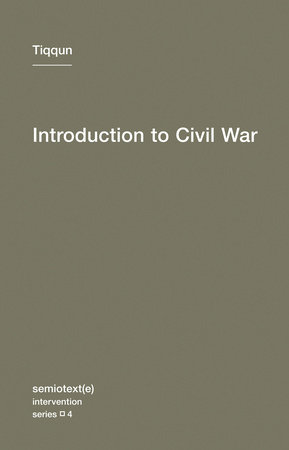
Society no longer exists, at least in the sense of a differentiated whole. There is only a tangle of norms and mechanisms through which THEY hold together the scattered tatters of the global biopolitical fabric, through which THEY prevent its violent disintegration. Empire is the administrator of this desolation, the supreme manager of a process of listless implosion.—from Introduction to Civil War Society is not in crisis, society is at an end. The things we used to take for granted have all been vaporized. Politics was one of these things, a Greek invention that condenses around an equation: to hold a position means to take sides, and to take sides means to unleash civil war. Civil war, position, sides—these were all one word in the Greek: stasis. If the history of the modern state in all its forms—absolute, liberal, welfare—has been the continuous attempt to ward off this stasis, the great novelty of contemporary imperial power is its embrace of civil war as a technique of governance and disorder as a means of maintaining control. Where the modern state was founded on the institution of the law and its constellation of divisions, exclusions, and repressions, imperial power has replaced them with a network of norms and apparatuses that conspire in the production of the biopolitical citizens of Empire. In their first book available in English, Tiqqun explores the possibility of a new practice of communism, finding a foundation for an ontology of the common in the politics of friendship and the free play of forms-of-life. They see the ruins of society as the ideal setting for the construction of the community to come. In other words: the situation is excellent. Now is not the time to lose courage.
In celebration of Jewish American Heritage Month in May, we are sharing books by authors who share their individual stories, experiences, and lives. Find our full collection of books here.
For Mental Health Awareness Month in May, we are sharing books to educate and raise awareness about mental health and the various factors that may affect it, and to provide tools and resources for student wellness. Find our full collection of titles here.
Each May, we honor the stories, histories, and cultures of Asian Americans, Native Hawaiians, and Pacific Islanders. Below is a selection of acclaimed fiction and nonfiction books by AANHPI creators to share with your students this month and throughout the year. Find our full collection of titles for Higher Education here.