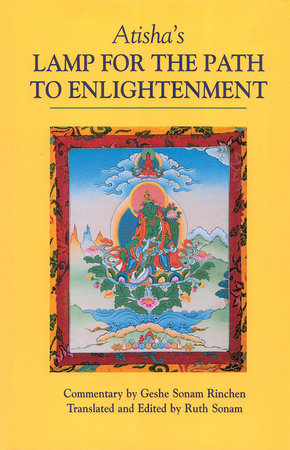
Atisha's most celebrated text sets forth the entire Buddhist path
Atisha, the eleventh-century Indian Buddhist scholar and saint, came to Tibet at the invitation of the king of Western Tibet, Lha Lama Yeshe Wo, and his nephew, Jangchub Wo. His coming initiated the period of the second transmission of Buddhism to Tibet, formative for the Sakya Kagyu and Gelug traditions of Tibetan Buddhism.
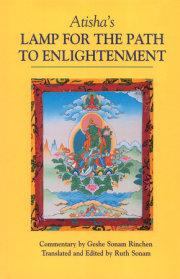
Atisha's most celebrated text, Lamp for the Path to Enlightenment, sets forth the entire Buddhist path within the framework of three levels of motivation on the part of the practitioner. Atisha's text thus became the source of the lamrim tradition, or graduated stages of the path to enlightenment, an approach to spiritual practice incorporated within all schools of Tibetan Buddhism.
Geshe Sonam Rinchen (1933–2013) studied at Sera Je Monastery and in 1980 received the Lharampa Geshe degree. He taught Buddhist philosophy and practice at the Library of Tibetan Works and Archives in Dharamsala, India, as well as in dharma centers around the world.
"Geshe Sonam Rinchen's lucid and engaging commentary draws out Atisha's meaning for today's practitioners with warmth and wit, bringing the light of this age-old wisdom into the modern world."—Indian International Journal of Buddhist Studies
Atisha's most celebrated text sets forth the entire Buddhist path
Atisha, the eleventh-century Indian Buddhist scholar and saint, came to Tibet at the invitation of the king of Western Tibet, Lha Lama Yeshe Wo, and his nephew, Jangchub Wo. His coming initiated the period of the second transmission of Buddhism to Tibet, formative for the Sakya Kagyu and Gelug traditions of Tibetan Buddhism.
Atisha's most celebrated text, Lamp for the Path to Enlightenment, sets forth the entire Buddhist path within the framework of three levels of motivation on the part of the practitioner. Atisha's text thus became the source of the lamrim tradition, or graduated stages of the path to enlightenment, an approach to spiritual practice incorporated within all schools of Tibetan Buddhism.
Author
Geshe Sonam Rinchen (1933–2013) studied at Sera Je Monastery and in 1980 received the Lharampa Geshe degree. He taught Buddhist philosophy and practice at the Library of Tibetan Works and Archives in Dharamsala, India, as well as in dharma centers around the world.
"Geshe Sonam Rinchen's lucid and engaging commentary draws out Atisha's meaning for today's practitioners with warmth and wit, bringing the light of this age-old wisdom into the modern world."—Indian International Journal of Buddhist Studies