
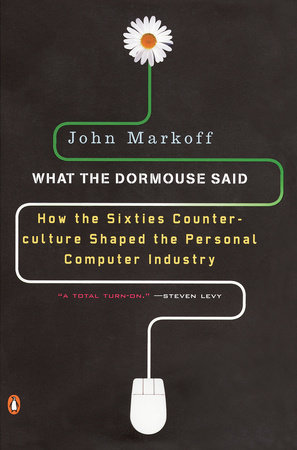


What the Dormouse Said

How the Sixties Counterculture Shaped the Personal Computer Industry

“This makes entertaining reading. Many accounts of the birth of personal computing have been written, but this is the first close look at the drug habits of the earliest pioneers.” —New York Times

Most histories of the personal computer industry focus on technology or business. John Markoff’s landmark book is about the culture and consciousness behind the first PCs—the culture being counter– and the consciousness expanded, sometimes chemically. It’s a brilliant evocation of Stanford, California, in the 1960s and ’70s, where a group of visionaries set out to turn computers into a means for freeing minds and information. In these pages one encounters Ken Kesey and the phone hacker Cap’n Crunch, est and LSD, The Whole Earth Catalog and the Homebrew Computer Lab. What the Dormouse Said is a poignant, funny, and inspiring book by one of the smartest technology writers around.

John Markoff was one of a team of New York Times reporters who won the 2013 Pulitzer Prize for Explanatory Reporting. He has covered Silicon Valley since 1977, wrote the first account of the World Wide Web in 1993, and broke the story of Google’s self-driving car in 2010. He is the author of five books, including What the Dormouse Said: How the Sixties Counterculture Shaped the Personal Computer Industry and Machines of Loving Grace: The Quest for Common Ground Between Humans and Robots.

View titles by John Markoff
“This makes entertaining reading. Many accounts of the birth of personal computing have been written, but this is the first close look at the drug habits of the earliest pioneers.” —New York Times

“A lively prehistory of Silicon Valley and its brilliant denizens of yore . . . Technogeeks will know much of this history already, but Markoff does a fine job of distilling it here while pointing out how much bleaker the world might be if the pioneers had just said no.” —Kirkus

“Wonderful . . . [It] makes a mind-blowing case that our current silicon marvels were inspired by the psychedelic-tinged, revolution-minded spirit of the sixties. It's a total turn-on.” —Steven Levy, author of Hackers

About

“This makes entertaining reading. Many accounts of the birth of personal computing have been written, but this is the first close look at the drug habits of the earliest pioneers.” —New York Times

Most histories of the personal computer industry focus on technology or business. John Markoff’s landmark book is about the culture and consciousness behind the first PCs—the culture being counter– and the consciousness expanded, sometimes chemically. It’s a brilliant evocation of Stanford, California, in the 1960s and ’70s, where a group of visionaries set out to turn computers into a means for freeing minds and information. In these pages one encounters Ken Kesey and the phone hacker Cap’n Crunch, est and LSD, The Whole Earth Catalog and the Homebrew Computer Lab. What the Dormouse Said is a poignant, funny, and inspiring book by one of the smartest technology writers around.

Author

John Markoff was one of a team of New York Times reporters who won the 2013 Pulitzer Prize for Explanatory Reporting. He has covered Silicon Valley since 1977, wrote the first account of the World Wide Web in 1993, and broke the story of Google’s self-driving car in 2010. He is the author of five books, including What the Dormouse Said: How the Sixties Counterculture Shaped the Personal Computer Industry and Machines of Loving Grace: The Quest for Common Ground Between Humans and Robots.

View titles by John Markoff

Praise

“This makes entertaining reading. Many accounts of the birth of personal computing have been written, but this is the first close look at the drug habits of the earliest pioneers.” —New York Times

“A lively prehistory of Silicon Valley and its brilliant denizens of yore . . . Technogeeks will know much of this history already, but Markoff does a fine job of distilling it here while pointing out how much bleaker the world might be if the pioneers had just said no.” —Kirkus

“Wonderful . . . [It] makes a mind-blowing case that our current silicon marvels were inspired by the psychedelic-tinged, revolution-minded spirit of the sixties. It's a total turn-on.” —Steven Levy, author of Hackers

Books for Women’s History Month

In honor of Women’s History Month in March, we are sharing books by women who have shaped history and have fought for their communities. Our list includes books about women who fought for racial justice, abortion rights, equality in the workplace, and ranges in topics from women in politics and prominent women in history to

Read more