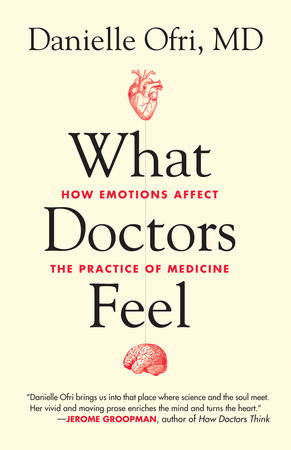
What Doctors Feel

How Emotions Affect the Practice of Medicine

Paperback
$17.95 US
On sale May 06, 2014 | 232 Pages | 9780807033302

See Additional Formats
The quality of medical care is influenced by what doctors feel, an aspect of medicine that is usually left out of discussions of health care today. Drawing on scientific studies, as well as on real-life stories from other physicians and her own medical practice, Dr. Danielle Ofri examines the impact of emotions on medical care. Contemporary media portrayals of doctors focus on the decision making and medical techniques, reinforcing an image of rational, unflinching doctors. But though the challenges in medicine are unique, doctors respond with the same emotions as the rest of us–shame, anger, empathy, frustration, hope, pride, occasionally despair, and sometimes even love.

With her renowned eye for dramatic detail, Dr. Ofri takes us into the swirling heart of patient care. She faces the humiliation of an error that nearly killed one of her patients and the forever fear of making another. She mourns when a long-time patient is denied a heart transplant. And she tells the riveting stories of doctors who have faced their own death, have faced a newborn dying in their arms, have faced the glares of lawyers. Emotions have a distinct effect on a doctor’s behavior and how they care for their patients. For both doctors and patients, understanding this can make all the difference in ensuring effective medical treatment.

“Here is a book that is at once sad and joyful, frightening and thought-provoking.  In her lucid and passionate explanations of the important role that emotions play in the practice of medicine and in healing and health, Danielle Ofri tells stories of great importance to both doctors and patients.” –Perri Klass, author of Treatment Kind and Fair: Letters to a Young Doctor

“An invaluable guide for doctors and patients on how to ‘recognize and navigate the emotional subtexts’ of the doctor-patient relationship.” –Kirkus Reviews

 “Ofri (Medicine in Translation: Journey’s with My Patients) offers an eloquent and honest take on the inner life of medical professionals….Ofri’s passionate examination of her own fears and doubts alongside broader concerns within the medical field should be eye-opening for the public — and required reading for medical students.” - Publishers Weekly
 
Praise for Danielle Ofri
 
“The world of patient and doctor exists in a special sacred space. Danielle Ofri brings us into that place where science and the soul meet. Her vivid and moving prose enriches the mind and turns the heart.” –Jerome Groopman, author of How Doctors Think
                                     
“Danielle Ofri is a finely gifted writer, a born storyteller as well as a born physician.” –Oliver Sacks, author of Awakenings    
 
“Danielle Ofri … is dogged, perceptive, unafraid, and willing to probe her own motives, as well as those of others. This is what it takes for a good physician to arrive at the truth, and these same qualities make her an essayist of the first order.” –Abraham Verghese, author of Cutting for Stone
  
“Her writing tumbles forth with color and emotion. She demonstrates an ear for dialogue, a humility about the limits of her medical training, and an extraordinary capacity to be touched by human suffering.” –Jan Gardner, Boston Globe
Intoduction: Why Doctors Act That Way

Chapter 1: The Doctor Can't See You Now
Julia, part one 
Chapter 2: We Build a Better Doctor?
Julia, part two
Chapter 3: Scared Witless
Julia, part three
Chapter 4: A Daily Dose of Death
Julia, part four
Chapter 5: Burning with Shame
Julia, part five
Chapter 6: Drowning
Julia, part six
Chapter 7: Under the Microscope 
Julia, part seven

Afterword
Acknowledgments
Notes
Index
Introduction

Why Doctors Act That Way


The experiences of medical training and the hospital world have been extensively documented in books, television, and film. Some of this has been probing and incisive, and some has been entertaining nonsense.

Much has been written about what doctors do and how they frame their thoughts. But the emotional side of medicine—the parts that are less rational, less amenable to systematic intervention—has not been examined as thoroughly, yet it may be at least as important.

The public remains both fascinated and anxious about the medical world—a world with which everyone must eventually interact. Within this fascination is a frustration that the health-care system does not function as ideally as people would like. Despite societal pressures, legislative reforms, and legal wrangling, doctors don’t always live up to these ideals. I hope to delve beneath the cerebral side of medicine to see what actually makes MDs tick.

One might reasonably say, I don’t give a damn how my doctor feels as long as she gets me better. In straightforward medical cases, this line of thinking is probably valid. Doctors who are angry, nervous, jealous, burned out, terrified, or ashamed can usually still treat bronchitis or ankle sprains competently.

The problems arise when clinical situations are convoluted, unyielding, or overlaid with unexpected complications, medical errors, or psychological components. This is where factors other than clinical competency come into play.

At this juncture in our society’s history, nearly every patient—at least those in the developed world—can have access to the same fund of medical knowledge that doctors work from. Anyone can search WebMD for basic information or PubMed for the latest research. Medical textbooks and journals are available online. The relevant issue— the one that has the practical impact on the patient—is how doctors use that knowledge.

There has been a steady stream of research into how doctors think. In his insightful and practically titled book How Doctors Think, Jerome Groopman explored the various styles and strategies that doctors use to guide diagnosis and treatment, pointing out the flaws and strengths along the way. He studied the cognitive processes that doctors use and observed that emotions can strongly influence these thought patterns, sometimes in ways that gravely damage our patients. “Most [medical] errors are mistakes in thinking,” Groopman writes. “And part of what causes these cognitive errors is our inner feelings, feelings we do not readily admit to and often don’t even recognize.”1

Research bears this out. Positive emotions tend to be associated with a more global view of a situation (“the forest”) and more flexibility in problem solving. Negative emotions tend to diminish the importance of the bigger picture in favor of the smaller details (“the trees”). In cognitive psychology studies, subjects with negative emotions are more prone to anchoring bias—that is, latching on to a single detail at the expense of others. Anchoring bias is a potent source of diagnostic error, causing doctors to stick with an initial impression and avoid considering conflicting data. Subjects with positive emotions are also prone to bias; they are more likely to succumb to attribution bias. In medicine, this is the tendency to attribute a disease to who the patient is (a drug user, say) rather than what the situation is (exposure to bacteria, for example).

This is not to say that positive emotions are better or worse than negative emotions—both are part of the normal human spectrum. But if you consider the range of cognitive territory that doctors traverse with their patients—genetic testing, ordinary screenings, invasive procedures, ICU monitoring, and end-of-life decisions—you can appreciate how the final outcomes can be strongly influenced by a doctor’s emotional state.

Neuroscientist Antonio Damasio describes emotions as the “continuous musical line of our minds, the unstoppable humming.”3 This basso continuo thrums along while doctors make a steady stream of conscious medical decisions. How this underlying bass line affects our actions as doctors—and the net effect on our patients (and on doctors when we ourselves become patients!)—is what intrigues me.

By now, even the most hard-core, old-school doctors recognize that emotions are present in medicine at every level, but typically this is lumped in with the catch-all of stress or fatigue, with the unspoken assumption that with enough self-discipline, physicians can corral and master these irritants.

The emotional layers in medicine, however, are far more nuanced and pervasive than we may like to believe. In fact, they can often be the dominant players in medical decision-making, handily overshadowing evidenced-based medicine, clinical algorithms, quality control measures, even medical experience. And this can occur without anyone’s conscious awareness.

It could easily be argued that doctors are no more emotionally complex than accountants, plumbers, or the cable-repair guy, but the net result of doctors’ behavior—logical, emotional, irrational, or otherwise— can have life-and-death consequences for patients, which is to say, for all of us.

We all want excellent medical care for ourselves and our families, and we’d like to assume that the best care comes from the doctors with the best training, or the most experience, or the best U.S. News & World Report rating. However, the myriad effects of emotional underpinnings can confound all of these factors.

Despite this, the conventional stereotype that doctors are fairly emotionless continues to maintain its hold. Many trace this back to the eminent Canadian physician Sir William Osler, often considered the father of modern medicine for such revolutionary ideas as whisking medical students out of the staid classroom and bringing them to the bedside to learn medicine by examining actual patients. The current educational system of clinical clerkships and residency training is largely attributed to Osler, as are hundreds of snappy quotations. His continuing influence is apparent in the scores of diseases, endless libraries, and numerous medical buildings, hospital wings, societies, and awards that bear his name.

On May 1, 1889, Dr. Osler stood before the graduating medical class at the University of Pennsylvania and delivered a valedictory— and now canonical—speech entitled “Aequanimitas.”4 He stressed to these fledgling doctors that “a certain measure of insensibility is not only an advantage, but a positive necessity in the exercise of a calm judgment.”

While Osler may not have created these attitudes, he neatly encapsulated the general feeling about how doctors should behave.

Though he did warn against “hardening the human heart,” the stereotype of the detached, coolheaded physician springs from this idea of equanimity.

Popular culture has embodied this. Television doctors from Ben Casey to Gregory House are detached from their patients, lauded for their technological and diagnostic acumen. Even the selflessly idealist doctors (in Arrowsmith, Middlemarch, and Cutting for Stone) and the bitingly sarcastic doctors (in M*A*S*H, House of God, and Scrubs) maintain an equanimitous distance from their patients.

Every hospital dutifully includes the word compassion somewhere in its mission statement. Every medical school rhapsodizes about the ideals of caring. But the often unspoken (and sometimes spoken) message in the real-life trenches of medical training is that doctors shouldn’t get too emotionally involved with their patients. Emotions cloud judgment, students are told. Any component of a curriculum upon which interns slap the “touchy-feely” label is doomed in terms of attendance. Hyperefficient, technically savvy medical care is still prized over all else.

But no matter how it’s portrayed, and no matter how many high-tech tools enter the picture, the doctor-patient interaction is still primarily a human one. And when humans connect, emotions by necessity weave an underlying network. The most distant, aloof doctor is subject to the same flood of emotions as the most touchy-feely one. Emotions are in the air just as oxygen is. But how we doctors choose—or choose not—to notice and process these emotions varies greatly. And it is the patient at the other end of the relationship who is affected most by this variability.

This book is intended to shed light on the vast emotional vocabulary of medicine and how it affects the practice of medicine at all levels. Hopefully, the next time we find ourselves in a patient gown, we’ll better understand the workings of those who care for us. “Cognition and emotion are inseparable,” Groopman observes. “The two mix in every encounter with every patient.” In some scenarios, this mix is highly beneficial to patients. In others, it can be calamitous.

Understanding the positive and negative influence of emotions in the doctor-patient interaction is a crucial element in maximizing the quality of medical care. Every patient deserves the best possible care that doctors can offer. Learning to recognize and navigate the emotional subtexts is a critical tool on both sides of the exam table.
Danielle Ofri, MD, PhD, is an associate professor of medicine at the New York University School of Medicine and has cared for patients at New York’s Bellevue Hospital for more than two decades. Ofri’s books and articles have become academic staples in medical schools, universities and residency programs. She is the editor in chief of the Bellevue Literary Review and writes regularly for the New York Times.
“Taut, vivid prose . . . She writes for a lay audience with a practiced hand.”
New York Times

“In her lucid and passionate explanations of the important role that emotions play in the practice of medicine and in healing and health, Danielle Ofri tells stories of great importance to both doctors and patients.”
—Perri Klass, author of Treatment Kind and Fair

“An invaluable guide for doctors and patients.”
Kirkus Reviews

“Insightful and invigorating…makes the case that it’s better for patients if a physician’s emotional compass-needle points in a positive direction.”
Booklist, starred review

“A fascinating journey into the heart and mind of a physician struggling to do the best for her patients while navigating an imperfect health care system.”
Boston Globe

“Ofri gives voice and color to the heartbreak, stress, and joy that attends medical practice.”
Library Journal

“A fabulous read.”
Greater Good

“Essential reading in Medical HumanitiesShe weaves together personal anecdotes and medical learning in a compelling account of her medical decisions and reflections. Highly recommended.”
—Sara van den Berg, Professor of English, Saint Louis University

“Dr. Ofri's real-life experiences can be incorporated into a variety of health science curricula bringing course theory together with practical application. Readers gain critical insight into why applying theory in the practice of medicine requires empathy for the physicians.”
—Christine Whittrock, Department of Pharmaceutical Sciences, Temple University

“Part of medical education now is not only core competencies from a factual standpoint but also a social standpoint. Dr. Ofri has a way of communicating those lessons in a clear a cogent and very personal fashion.”
—Beth Dollinger M.D., Arnot Ogden Medical Center

The perfect book for my teaching on the subject of lack of empathy in medical school students.”
—James Asa Shield, Jr., MD, Professor, Chairman, Department of Psychiatry, Virginia Commonwealth University

About

The quality of medical care is influenced by what doctors feel, an aspect of medicine that is usually left out of discussions of health care today. Drawing on scientific studies, as well as on real-life stories from other physicians and her own medical practice, Dr. Danielle Ofri examines the impact of emotions on medical care. Contemporary media portrayals of doctors focus on the decision making and medical techniques, reinforcing an image of rational, unflinching doctors. But though the challenges in medicine are unique, doctors respond with the same emotions as the rest of us–shame, anger, empathy, frustration, hope, pride, occasionally despair, and sometimes even love.

With her renowned eye for dramatic detail, Dr. Ofri takes us into the swirling heart of patient care. She faces the humiliation of an error that nearly killed one of her patients and the forever fear of making another. She mourns when a long-time patient is denied a heart transplant. And she tells the riveting stories of doctors who have faced their own death, have faced a newborn dying in their arms, have faced the glares of lawyers. Emotions have a distinct effect on a doctor’s behavior and how they care for their patients. For both doctors and patients, understanding this can make all the difference in ensuring effective medical treatment.

“Here is a book that is at once sad and joyful, frightening and thought-provoking.  In her lucid and passionate explanations of the important role that emotions play in the practice of medicine and in healing and health, Danielle Ofri tells stories of great importance to both doctors and patients.” –Perri Klass, author of Treatment Kind and Fair: Letters to a Young Doctor

“An invaluable guide for doctors and patients on how to ‘recognize and navigate the emotional subtexts’ of the doctor-patient relationship.” –Kirkus Reviews

 “Ofri (Medicine in Translation: Journey’s with My Patients) offers an eloquent and honest take on the inner life of medical professionals….Ofri’s passionate examination of her own fears and doubts alongside broader concerns within the medical field should be eye-opening for the public — and required reading for medical students.” - Publishers Weekly
 
Praise for Danielle Ofri
 
“The world of patient and doctor exists in a special sacred space. Danielle Ofri brings us into that place where science and the soul meet. Her vivid and moving prose enriches the mind and turns the heart.” –Jerome Groopman, author of How Doctors Think
                                     
“Danielle Ofri is a finely gifted writer, a born storyteller as well as a born physician.” –Oliver Sacks, author of Awakenings    
 
“Danielle Ofri … is dogged, perceptive, unafraid, and willing to probe her own motives, as well as those of others. This is what it takes for a good physician to arrive at the truth, and these same qualities make her an essayist of the first order.” –Abraham Verghese, author of Cutting for Stone
  
“Her writing tumbles forth with color and emotion. She demonstrates an ear for dialogue, a humility about the limits of her medical training, and an extraordinary capacity to be touched by human suffering.” –Jan Gardner, Boston Globe

Table of Contents

Intoduction: Why Doctors Act That Way

Chapter 1: The Doctor Can't See You Now
Julia, part one 
Chapter 2: We Build a Better Doctor?
Julia, part two
Chapter 3: Scared Witless
Julia, part three
Chapter 4: A Daily Dose of Death
Julia, part four
Chapter 5: Burning with Shame
Julia, part five
Chapter 6: Drowning
Julia, part six
Chapter 7: Under the Microscope 
Julia, part seven

Afterword
Acknowledgments
Notes
Index

Excerpt

Introduction

Why Doctors Act That Way


The experiences of medical training and the hospital world have been extensively documented in books, television, and film. Some of this has been probing and incisive, and some has been entertaining nonsense.

Much has been written about what doctors do and how they frame their thoughts. But the emotional side of medicine—the parts that are less rational, less amenable to systematic intervention—has not been examined as thoroughly, yet it may be at least as important.

The public remains both fascinated and anxious about the medical world—a world with which everyone must eventually interact. Within this fascination is a frustration that the health-care system does not function as ideally as people would like. Despite societal pressures, legislative reforms, and legal wrangling, doctors don’t always live up to these ideals. I hope to delve beneath the cerebral side of medicine to see what actually makes MDs tick.

One might reasonably say, I don’t give a damn how my doctor feels as long as she gets me better. In straightforward medical cases, this line of thinking is probably valid. Doctors who are angry, nervous, jealous, burned out, terrified, or ashamed can usually still treat bronchitis or ankle sprains competently.

The problems arise when clinical situations are convoluted, unyielding, or overlaid with unexpected complications, medical errors, or psychological components. This is where factors other than clinical competency come into play.

At this juncture in our society’s history, nearly every patient—at least those in the developed world—can have access to the same fund of medical knowledge that doctors work from. Anyone can search WebMD for basic information or PubMed for the latest research. Medical textbooks and journals are available online. The relevant issue— the one that has the practical impact on the patient—is how doctors use that knowledge.

There has been a steady stream of research into how doctors think. In his insightful and practically titled book How Doctors Think, Jerome Groopman explored the various styles and strategies that doctors use to guide diagnosis and treatment, pointing out the flaws and strengths along the way. He studied the cognitive processes that doctors use and observed that emotions can strongly influence these thought patterns, sometimes in ways that gravely damage our patients. “Most [medical] errors are mistakes in thinking,” Groopman writes. “And part of what causes these cognitive errors is our inner feelings, feelings we do not readily admit to and often don’t even recognize.”1

Research bears this out. Positive emotions tend to be associated with a more global view of a situation (“the forest”) and more flexibility in problem solving. Negative emotions tend to diminish the importance of the bigger picture in favor of the smaller details (“the trees”). In cognitive psychology studies, subjects with negative emotions are more prone to anchoring bias—that is, latching on to a single detail at the expense of others. Anchoring bias is a potent source of diagnostic error, causing doctors to stick with an initial impression and avoid considering conflicting data. Subjects with positive emotions are also prone to bias; they are more likely to succumb to attribution bias. In medicine, this is the tendency to attribute a disease to who the patient is (a drug user, say) rather than what the situation is (exposure to bacteria, for example).

This is not to say that positive emotions are better or worse than negative emotions—both are part of the normal human spectrum. But if you consider the range of cognitive territory that doctors traverse with their patients—genetic testing, ordinary screenings, invasive procedures, ICU monitoring, and end-of-life decisions—you can appreciate how the final outcomes can be strongly influenced by a doctor’s emotional state.

Neuroscientist Antonio Damasio describes emotions as the “continuous musical line of our minds, the unstoppable humming.”3 This basso continuo thrums along while doctors make a steady stream of conscious medical decisions. How this underlying bass line affects our actions as doctors—and the net effect on our patients (and on doctors when we ourselves become patients!)—is what intrigues me.

By now, even the most hard-core, old-school doctors recognize that emotions are present in medicine at every level, but typically this is lumped in with the catch-all of stress or fatigue, with the unspoken assumption that with enough self-discipline, physicians can corral and master these irritants.

The emotional layers in medicine, however, are far more nuanced and pervasive than we may like to believe. In fact, they can often be the dominant players in medical decision-making, handily overshadowing evidenced-based medicine, clinical algorithms, quality control measures, even medical experience. And this can occur without anyone’s conscious awareness.

It could easily be argued that doctors are no more emotionally complex than accountants, plumbers, or the cable-repair guy, but the net result of doctors’ behavior—logical, emotional, irrational, or otherwise— can have life-and-death consequences for patients, which is to say, for all of us.

We all want excellent medical care for ourselves and our families, and we’d like to assume that the best care comes from the doctors with the best training, or the most experience, or the best U.S. News & World Report rating. However, the myriad effects of emotional underpinnings can confound all of these factors.

Despite this, the conventional stereotype that doctors are fairly emotionless continues to maintain its hold. Many trace this back to the eminent Canadian physician Sir William Osler, often considered the father of modern medicine for such revolutionary ideas as whisking medical students out of the staid classroom and bringing them to the bedside to learn medicine by examining actual patients. The current educational system of clinical clerkships and residency training is largely attributed to Osler, as are hundreds of snappy quotations. His continuing influence is apparent in the scores of diseases, endless libraries, and numerous medical buildings, hospital wings, societies, and awards that bear his name.

On May 1, 1889, Dr. Osler stood before the graduating medical class at the University of Pennsylvania and delivered a valedictory— and now canonical—speech entitled “Aequanimitas.”4 He stressed to these fledgling doctors that “a certain measure of insensibility is not only an advantage, but a positive necessity in the exercise of a calm judgment.”

While Osler may not have created these attitudes, he neatly encapsulated the general feeling about how doctors should behave.

Though he did warn against “hardening the human heart,” the stereotype of the detached, coolheaded physician springs from this idea of equanimity.

Popular culture has embodied this. Television doctors from Ben Casey to Gregory House are detached from their patients, lauded for their technological and diagnostic acumen. Even the selflessly idealist doctors (in Arrowsmith, Middlemarch, and Cutting for Stone) and the bitingly sarcastic doctors (in M*A*S*H, House of God, and Scrubs) maintain an equanimitous distance from their patients.

Every hospital dutifully includes the word compassion somewhere in its mission statement. Every medical school rhapsodizes about the ideals of caring. But the often unspoken (and sometimes spoken) message in the real-life trenches of medical training is that doctors shouldn’t get too emotionally involved with their patients. Emotions cloud judgment, students are told. Any component of a curriculum upon which interns slap the “touchy-feely” label is doomed in terms of attendance. Hyperefficient, technically savvy medical care is still prized over all else.

But no matter how it’s portrayed, and no matter how many high-tech tools enter the picture, the doctor-patient interaction is still primarily a human one. And when humans connect, emotions by necessity weave an underlying network. The most distant, aloof doctor is subject to the same flood of emotions as the most touchy-feely one. Emotions are in the air just as oxygen is. But how we doctors choose—or choose not—to notice and process these emotions varies greatly. And it is the patient at the other end of the relationship who is affected most by this variability.

This book is intended to shed light on the vast emotional vocabulary of medicine and how it affects the practice of medicine at all levels. Hopefully, the next time we find ourselves in a patient gown, we’ll better understand the workings of those who care for us. “Cognition and emotion are inseparable,” Groopman observes. “The two mix in every encounter with every patient.” In some scenarios, this mix is highly beneficial to patients. In others, it can be calamitous.

Understanding the positive and negative influence of emotions in the doctor-patient interaction is a crucial element in maximizing the quality of medical care. Every patient deserves the best possible care that doctors can offer. Learning to recognize and navigate the emotional subtexts is a critical tool on both sides of the exam table.

Author

Danielle Ofri, MD, PhD, is an associate professor of medicine at the New York University School of Medicine and has cared for patients at New York’s Bellevue Hospital for more than two decades. Ofri’s books and articles have become academic staples in medical schools, universities and residency programs. She is the editor in chief of the Bellevue Literary Review and writes regularly for the New York Times.

Praise

“Taut, vivid prose . . . She writes for a lay audience with a practiced hand.”
New York Times

“In her lucid and passionate explanations of the important role that emotions play in the practice of medicine and in healing and health, Danielle Ofri tells stories of great importance to both doctors and patients.”
—Perri Klass, author of Treatment Kind and Fair

“An invaluable guide for doctors and patients.”
Kirkus Reviews

“Insightful and invigorating…makes the case that it’s better for patients if a physician’s emotional compass-needle points in a positive direction.”
Booklist, starred review

“A fascinating journey into the heart and mind of a physician struggling to do the best for her patients while navigating an imperfect health care system.”
Boston Globe

“Ofri gives voice and color to the heartbreak, stress, and joy that attends medical practice.”
Library Journal

“A fabulous read.”
Greater Good

“Essential reading in Medical HumanitiesShe weaves together personal anecdotes and medical learning in a compelling account of her medical decisions and reflections. Highly recommended.”
—Sara van den Berg, Professor of English, Saint Louis University

“Dr. Ofri's real-life experiences can be incorporated into a variety of health science curricula bringing course theory together with practical application. Readers gain critical insight into why applying theory in the practice of medicine requires empathy for the physicians.”
—Christine Whittrock, Department of Pharmaceutical Sciences, Temple University

“Part of medical education now is not only core competencies from a factual standpoint but also a social standpoint. Dr. Ofri has a way of communicating those lessons in a clear a cogent and very personal fashion.”
—Beth Dollinger M.D., Arnot Ogden Medical Center

The perfect book for my teaching on the subject of lack of empathy in medical school students.”
—James Asa Shield, Jr., MD, Professor, Chairman, Department of Psychiatry, Virginia Commonwealth University