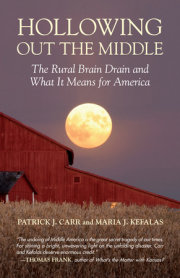
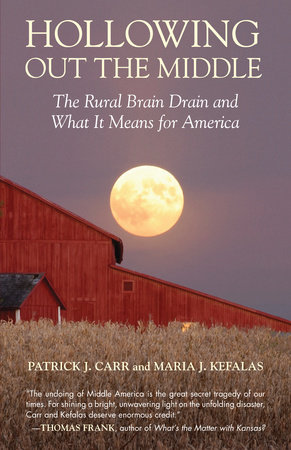
Hollowing Out the Middle

The Rural Brain Drain and What It Means for America

In 2001, with funding from the MacArthur Foundation, sociologists Patrick J. Carr and Maria J. Kefalas moved to Iowa to understand the rural brain drain and the exodus of young people from America’s countryside. Articles and books–notably Richard Florida’s The Rise of the Creative Class–celebrate the migration of highly productive and creative workers to key cities. But what happens to the towns that they desert, and to the people who are left behind?

To answer that question, Carr and Kefalas moved to “Ellis,” a small town of two thousand. Ellis is typical of many places struggling to survive, and Iowa is typical of many states in the Heartland, aging rapidly. One reason is that many small towns simply aren’t regenerating, but another is that its educated young people are leaving in droves.

In Ellis, Carr and Kefalas met the working-class “stayers,” trying to survive in the region’s dying agro-industrial economy; the high-achieving and college-bound “achievers,” who often leave for good; the “seekers” who head off to war to see what the world beyond offers; and the “returners,” who eventually circle back to their hometowns. What surprised Carr and Kefalas most, was that adults in the community were playing a pivotal part in the town’s decline by pushing the best and brightest young people to leave, and by underinvesting in those who choose to stay–even though these young people are their best chance for a future.

The emptying out of small towns is a national concern, but there are strategies for arresting the process and creating sustainable, thriving communities. Hollowing Out the Middle is a wake-up call we cannot afford to ignore–not only because sixty million Americans still live in rural communities and small towns, but because our nation’s economic health and future is tied to the Heartland.

Hollowing Out the Middle is a fascinating study that brilliantly describes and analyzes the problems of rural towns in America that are emptying out. It will raise national awareness of a serious domestic problem that has largely escaped media, political, and scholarly attention.” –William Julius Wilson, Lewis P. and Linda L. Geyser University Professor, Harvard University

Hollowing Out the Middle is a rural panorama of heart-wrenching proportion.”–Stephen G. Bloom, author of Postville: A Clash of Cultures in Heartland America and The Oxford Project

“Reminiscent of the great sociological classics, Middletown and Elmtown’s Youth, Pat Carr and Maria Kefalas have produced an exemplary account of coming of age in a midwestern town. This book is required reading for the policy and research community and anyone thinking about issues facing young adults in America.”–Frank Furstenberg, Zellerbach Family Chair of Sociology, University of Pennsylvania, and author of Destinies of the Disadvantaged: The Politics of Teenage Childbearing
Patrick J. Carr is associate professor of sociology at Rutgers University-New Brunswick and the author of Clean Streets. Maria J. Kefalas is a professor of sociology at Saint Joseph’s University, the author of Working-Class Heroes, and coauthor of Promises I Can Keep. The authors live outside Philadelphia.
“Written in an easily accessible style for the lay reader, this volume is filled with their observations of life in a rural community that is just “hanging on,” and stories from the young adults they met.”
Journal of Rural Social Sciences

“An intriguing new book . . . [They] argue that it will take more than just free land initiatives to reverse rural America’s brain drain.”
—Christina Gillham, Newsweek
 
“A fascinating study that brilliantly describes and analyzes the problems of rural towns in America that are emptying out.”
—William Julius Wilson, Lewis P. and Linda L. Geyser University Professor, Harvard University
 
“The authors present a brave and daunting examination of why the most talented, the most productive young people leave our small towns. . . . This book is so generative, so fiercely compelling . . . I urge you to read it.”
—Mildred Armstrong Kalish, author of Little Heathens: Hard Times and High Spirits on an Iowa Farm During the Great Depression

“The undoing of Middle America is the great secret tragedy of our times. For shining a bright, unwavering light on the unfolding disaster, Carr and Kefalas deserve enormous credit.”
—Thomas Frank, author of What’s the Matter with Kansas?

“Deft and detailed case studies bring the population to life . . . The authors alert readers to this major change with clarity and compassion.”
Publishers Weekly, starred review
 
“A worthy contribution to a conversation we desperately need to have.”
—Bill Kauffman, Wall Street Journal
 
“Deftly researched and written, this book is highly recommended for sociologists, educators, policymakers, and anyone concerned about the future of this country.”
Library Journal, starred review

About

In 2001, with funding from the MacArthur Foundation, sociologists Patrick J. Carr and Maria J. Kefalas moved to Iowa to understand the rural brain drain and the exodus of young people from America’s countryside. Articles and books–notably Richard Florida’s The Rise of the Creative Class–celebrate the migration of highly productive and creative workers to key cities. But what happens to the towns that they desert, and to the people who are left behind?

To answer that question, Carr and Kefalas moved to “Ellis,” a small town of two thousand. Ellis is typical of many places struggling to survive, and Iowa is typical of many states in the Heartland, aging rapidly. One reason is that many small towns simply aren’t regenerating, but another is that its educated young people are leaving in droves.

In Ellis, Carr and Kefalas met the working-class “stayers,” trying to survive in the region’s dying agro-industrial economy; the high-achieving and college-bound “achievers,” who often leave for good; the “seekers” who head off to war to see what the world beyond offers; and the “returners,” who eventually circle back to their hometowns. What surprised Carr and Kefalas most, was that adults in the community were playing a pivotal part in the town’s decline by pushing the best and brightest young people to leave, and by underinvesting in those who choose to stay–even though these young people are their best chance for a future.

The emptying out of small towns is a national concern, but there are strategies for arresting the process and creating sustainable, thriving communities. Hollowing Out the Middle is a wake-up call we cannot afford to ignore–not only because sixty million Americans still live in rural communities and small towns, but because our nation’s economic health and future is tied to the Heartland.

Hollowing Out the Middle is a fascinating study that brilliantly describes and analyzes the problems of rural towns in America that are emptying out. It will raise national awareness of a serious domestic problem that has largely escaped media, political, and scholarly attention.” –William Julius Wilson, Lewis P. and Linda L. Geyser University Professor, Harvard University

Hollowing Out the Middle is a rural panorama of heart-wrenching proportion.”–Stephen G. Bloom, author of Postville: A Clash of Cultures in Heartland America and The Oxford Project

“Reminiscent of the great sociological classics, Middletown and Elmtown’s Youth, Pat Carr and Maria Kefalas have produced an exemplary account of coming of age in a midwestern town. This book is required reading for the policy and research community and anyone thinking about issues facing young adults in America.”–Frank Furstenberg, Zellerbach Family Chair of Sociology, University of Pennsylvania, and author of Destinies of the Disadvantaged: The Politics of Teenage Childbearing


Author

Patrick J. Carr is associate professor of sociology at Rutgers University-New Brunswick and the author of Clean Streets. Maria J. Kefalas is a professor of sociology at Saint Joseph’s University, the author of Working-Class Heroes, and coauthor of Promises I Can Keep. The authors live outside Philadelphia.

Praise

“Written in an easily accessible style for the lay reader, this volume is filled with their observations of life in a rural community that is just “hanging on,” and stories from the young adults they met.”
Journal of Rural Social Sciences

“An intriguing new book . . . [They] argue that it will take more than just free land initiatives to reverse rural America’s brain drain.”
—Christina Gillham, Newsweek
 
“A fascinating study that brilliantly describes and analyzes the problems of rural towns in America that are emptying out.”
—William Julius Wilson, Lewis P. and Linda L. Geyser University Professor, Harvard University
 
“The authors present a brave and daunting examination of why the most talented, the most productive young people leave our small towns. . . . This book is so generative, so fiercely compelling . . . I urge you to read it.”
—Mildred Armstrong Kalish, author of Little Heathens: Hard Times and High Spirits on an Iowa Farm During the Great Depression

“The undoing of Middle America is the great secret tragedy of our times. For shining a bright, unwavering light on the unfolding disaster, Carr and Kefalas deserve enormous credit.”
—Thomas Frank, author of What’s the Matter with Kansas?

“Deft and detailed case studies bring the population to life . . . The authors alert readers to this major change with clarity and compassion.”
Publishers Weekly, starred review
 
“A worthy contribution to a conversation we desperately need to have.”
—Bill Kauffman, Wall Street Journal
 
“Deftly researched and written, this book is highly recommended for sociologists, educators, policymakers, and anyone concerned about the future of this country.”
Library Journal, starred review