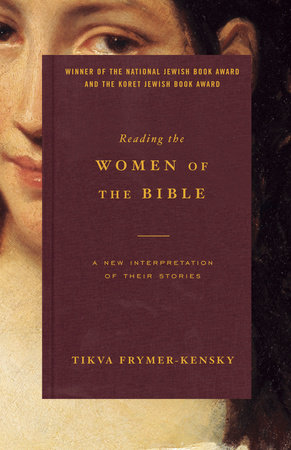
In this fascinating and important study, Tikva Frymer-Kensky—biblical scholar, assyriologist, feminist—takes up two of the most significant intellectual and religious issues of our day: the experiences of women in a patriarchal society and the relevance of the Bible to modern life. She examines the stories of Sarah, Rebecca, and Rachel; of Dinah, Tamar, Deborah, Ruth, and Jezebel; of biblical women young and old, married and single, named and anonymous. She considers them individually and collectively, and she uncovers four patterns that emerge from within their lives: woman as victor, as victim, as bride/wife, and as voice of God.

Reading the Women of the Bible is a product of serious scholarship that also enables us to consider what relevance these stories have for today's women, whose lives are in many ways vastly different from the stories of our biblical ancestors. Frymer-Kensky succeeds in illuminating with equal intensity the world of the Bible and our contemporary culture.


“A welcome book, engagingly written. It is a valuable contribution to the growing bibliography of feminist biblical interpretation.” —Dr. Phyllis Trible, University Professor, Wake Forest University Divinity School

“Frymer-Kensky has applied her expertise in the culture and traditions of the ancient Near East to the Hebrew Bible, with remarkable results: Reading the Women of the Bible contains new insights and brilliant analyses, and a whole set of creative syntheses. This book has much to say about and to women of every era and age, but its spirit, scope, and breadth go beyond any generic limits: men—perhaps even more than women—can and should learn much from it, both about the Bible and the women in it.” —David Noel Freedman, Professor of Hebrew Biblical Studies, University of California, San Diego, and editor-in-chief, The Anchor Bible

“Frymer-Kensky presents the women of the Hebrew Bible freshly and brilliantly, bringing to her study a profound mastery of the literatures and cultures of the lands surrounding the Bible. Here is biblical interpretation that eliminates much of the distance between the text and the reader: These stories illuminate the themes and dangers, hopes and fears, that are characteristic of human life anywhere and at any time. And the entire work is presented in a style and with a grace that delight the eye, the ear, and the heart.” —Dr. Walter Harrelson, Vanderbilt University

“A major voice in feminist reading of the Hebrew Bible, Frymer-Kensky advances our understanding of the gender issues in the Bible by proposing a fresh and suggestive taxonomy of four discourses concerning women. Her persuasive power rests upon her immense capacity to read texts carefully and discerningly. Reading the Women of the Bible lets us move back and forth between ancient text and contemporary gender issues in a generative way—a most welcome and important read!” —Dr. Walter Brueggeman, Columbia Theological Seminary

“You'll never see the women of the Bible in quite the same way after reading Tikva Frymer-Kensky's excellent new book. In her able hands, these women emerge from the ancient texts with new strength and vigor. Frymer-Kensky is a dazzling thinker who presents her ideas with unusual energy and clarity.” —Ari L. Goldman, author of The Search for God at Harvard
Acknowledgments

Introduction 

Part I. Victors
The Hand That Rocks the Cradle: The Rivka Stories
Saviors of the Exodus
The Guardian at the Door: Rahab
Warriors by Weapon and Word: Deborah and Yael
A Wise Woman of Power
The Shunammite
Villains: Potiphar’s Wife, Delilah, and Athaliah

Part II. Victims
The Disposable Wife
Daddy’s Daughters
Father-right Awry: Jephthah and His Daughter
The Bad Old Days: Concubine and Chaos
Kings to the Rescue?
“Off with His Head”: David, Uriah, and Bathsheba
Trauma and Tragedy: The Betrayals of Tamar
Power and Person: A Problem of Political Life

Part III. Virgins
The Dinah Affair
To the Barricades: Views Against the Other
Queen Jezebel, or Deuteronomy’s Worst Nightmare
Cozbi
Hagar, My Other, My Self
Royal Origins: Ruth on the Royal Way
Royal Origins: The Moabite
Royal Origins: Tamar
The Royal Way
Outsider Women: Exile and Ezra

Part IV. Voice
Oracles of the Conquest of Canaan: Rahab and Deborah
Oracles of Saul: Hannah and the Witch of Endor
The Necromancer at Endor
Abigail
Huldah
Woman as Voice

Part V. Reading the Women of the Bible
Women of Metaphor, Metaphors of Women
The Later Adventures of Biblical Women
Mirrors and Voices: Reading These Stories Today

Notes

Index 
From the
INTRODUCTION: READING THE WOMEN OF THE BIBLE


The women of ancient Israel have carved a place for themselves in our consciousness. Sarah, Rebekkah, Rachel, and Leah are the mothers of Israel; the biblical Eve is our mother in myth, now joined by “mitochondrial Eve” as our mother in genes. Bathsheba and Delilah: their very names conjure up scenes in our imagination, nights of ancient sex and betrayal. Children walk around today bearing the names of Miriam and Deborah, ancient leaders, poets, and prophets, and the names of Abigail, Yael, Ruth, Naomi, and Esther, heroines and queens of the Hebrew Bible. Faced with the memory of so many prominent women, a visitor from a distant planet might justifiably conclude that ancient Israel was a feminist paradise.

But the visitor would be wrong. Ancient Israel, like all other great historical civilizations, was a patriarchy. Men owned almost all the land, which was passed on from father to son. The legal tribunals consisted of men: the judges at the central courts and the elders in their local councils. The army was composed of men, as was the administrative bureaucracy. Men also dominated public religious life, serving as officiants in local and national rituals and holding all the positions in the temple hierarchy. Women, while not physically confined to the home, expended most of their energies there. Economically dependent on the head of their households, they had a limited ability to determine events beyond their own families, and even within the family they ultimately had to conform to the wishes of the father or husband.

Our visitor from a distant planet might not be troubled by this discovery, but readers from the late twentieth century are often startled. The Bible, after all, has informed and continues to inform much of our own moral thinking. How can a book that teaches the common divine origin of all humanity and the sacred nature of each human being reflect a social order in which women are systematically disadvantaged and subordinated? This question creates a whole range of answers among contemporary readers. At one end of the spectrum is the leadership of the Southern Baptists, who embrace the biblical system and mandate that today’s women suppress their demand for equality and be subordinate to their husbands. Other readers, at the opposite pole of the spectrum, find the patriarchy of the Bible a reason to abandon the monotheist religions based on it. They suspect that the Bible itself led to patriarchy. These readers argue that since Israel had only one god, and this god is referred to as “He,” this male “Lord” provides a divine model for males as master. After all, as Mary Daley said concerning contemporary religion, “If God is a man, than a man is god.” Monotheism, then (according to this argument), created patriarchy.

Like the visitor from a distant planet, these twentieth-century theorists are drawing logical conclusions, but they are simply wrong. History shows that patriarchy was well entrenched fifteen hundred years before Israel first came into being. As we trace our written records from the beginning of writing in ancient Sumer through the ensuing centuries and millennia in the ancient world, we can trace the intensification of patriarchy as time goes on. But even the first written records reflect a social system in which males were predominant. Male-dominated social systems were (and are) very widespread, encompassing geographically distant societies with very different religious and sociopolitical systems. Biblical Israel did not invent patriarchy. It was not even the most intense or thorough patriarchy in the ancient world. Other classical societies, like Assyria and Athens, show a much greater degree of domination of women. The worship of Ishtar in Assyria and Athena in Athens did not lessen male control over real women. The male Lord did not create patriarchy. The truth is just the opposite: patriarchal thought required that the one Lord of all be conceived as a male and portrayed in a masculine grammar.

It is important to get the facts straight; though patriarchy preexisted the Bible, the Bible was not written to construct it. Readers can accept the Bible’s moral stature without conforming to the patriarchal social structure within it. At the same time, there is no ignoring the fact that even though the Bible did not create patriarchy, it also did not eliminate it. The Bible did not question the patriarchy in the social structure it shared with the rest of the ancient world, just as it did not question another glaring social inequity, slavery. Biblical thinkers, so radical in their transformation of ideas about God and about the relationship of humanity to the cosmos, never conceived of a radical transformation of society. They were very aware of social problems, trying to ameliorate the suffering of the downtrodden, curtailing abuses, helping runaway slaves stay free, redeeming those sold into slavery, and calling for a limit to capitalist aggrandizement. Despite such concerns, the Bible did not eradicate slavery, it did not eliminate patriarchy, it did not eradicate economic oppression.

However, the Bible also does not defend the status quo, for the idea of social revolution is integral to biblical thought. God is a god of change, for God elevates the lowly, brings the marginalized to the center, and raises high the socially inferior. In this way, power and privilege are necessarily impermanent. But reversing position does not create a more egalitarian world any more than ameliorating suffering does: it only changes the fortunes of individual people. Biblical thinkers never conceived of a social order without hierarchy.

The Bible, a product of this patriarchal society, is shaped by the concerns of the men of Israel who were involved in public life. As such, it is a public book, concerned with matters of government, law, ritual, and social behavior. But why, then, does this clearly androcentric text from a patriarchal society have so many stories that revolve around women? And why are there so many memorable women in the Bible? The sheer number of their stories demands an explanation: What are they doing here? Why were they written? Why were they included in this compact text?

One possible answer soon occurred to me: could the biblical stories about women have been written because of the desire of Israelite men to explore the nature of women and their role and to understand the question of gender? To explore this possibility, I analyzed the biblical stories from the perspective of gender questions: What, according to these stories, do women want? What are they like? How do they achieve their goals? The results, documented in In the Wake of the Goddesses, were unexpected. Contrary to all assumptions—my own included—the Hebrew Bible, unlike other ancient literature, does not present any ideas about women as the “Other.” The role of woman is clearly subordinate, but the Hebrew Bible does not “explain” or justify this subordination by portraying women as different or inferior. The stories do not reflect any differences in goals and desires between men and women. Nor do they point out any strategies or methods used by women that are different from those used by men who are not in positions of authority. There are no personality traits or psychological characteristics that are unique to women, and the familiar Western notions of “feminine wiles,” “the battle between the sexes,” “sisterly solidarity,” and “sex as weapon” are all absent, as are any discussions of the nature of women. There are also no negative statements and stereotypes about women, no gynophobic (“woman-fearing”) discourse. The only misogynist statement in the Bible comes very late in biblical development, in the book of Ecclesiastes, and shows the introduction of the classical Greek denigration of women into Israel.

The Bible’s lack of ideas about female otherness does not make it a feminist paradise any more than the presence of memorable women does. Women were still socially disadvantaged and excluded from public power. But the Bible does not add insult to this disadvantage, does not claim that women need to be controlled because they are wild, or need to be led because they are foolish, or need to be directed because they are passive, or any of the other justifications for male domination that have been prevalent in Western culture.

The Bible’s lack of justification for social inequity can be interpreted in two radically different ways. Reading with a hermeneutic of suspicion, we might speculate that the Bible did not need to justify patriarchy, because patriarchy was so firmly entrenched, and that the Bible’s lack of stereotypes about women is simply a gender blindness that totally ignores everyone but economically advantaged males. If, however, we follow the hermeneutic of suspicion with a hermeneutic of grace, we might conclude that even though the Bible failed to eradicate or even notice patriarchy, it created a vision of humanity that is gender neutral. Biblical thinkers treated social structure as a historical given: they sought to regulate social behavior, but not to explain or justify the social structure itself.

The Bible’s view of gender sets up a dramatic clash between theory and reality. On the one hand, women occupied a socially subordinate position. On the other hand, the Bible did not label them as inferior. This gap between ideology and social structure has a major disadvantage: it did not explain people’s lives, did not give people a way to understand why women had no access to public decision making. Such dissonance could not last forever: one of the two had to give, and the Bible’s vision of a gender-neutral humanity ultimately gave way in the face of ongoing patriarchy. At the same time, the biblical vision had the enormous advantage of not adding prejudice to powerlessness. The biblical view understood that women were powerless and subordinate without being inferior. This insight had enormous implications for the way Israel viewed itself. Israel was always small and vulnerable in comparison to the empires surrounding it. As time went on, this vulnerability gave way to defeat, and Israel was conquered by more powerful nations. The Bible’s view of women became central to Israel’s thinking, for it provided a paradigm for understanding powerlessness and subordination without recourse to prejudicial ideas. Israel was subject to the power and authority of others on an international level just as women were subordinate within Israelite society, and the Bible’s own image of women enabled its thinkers to accept this powerlessness without translating it into a sense of inferiority or worthlessness. In this way, the Bible’s image of women was an essential element in its self-image and its understanding of Israel’s destiny.
Tikva Frymer-Kensky was a professor of Hebrew bible at the Divinity School at the University of Chicago. She was educated at Yale University. She is the writer of The Judicial Ordeal in the Ancient Near East, In the Wake of the Goddess: Women, Culture, and the Biblical Transformation of Pagan Myth, and Studies in the Bible and Feminist Criticism.  View titles by Tikva Frymer-Kensky

Winner of the National Jewish Book Award and the Koret Jewish Book Award

“This book has much to say about and to women of every era and age, but its spirit, scope, and breadth go beyond any generic limits. Men—perhaps even more than women—can and should learn much from it, both about the Bible and the women in it.”
—David Noel Freedman, editor in chief, The Anchor Bible

“Frymer-Kensky addresses both modern hypotheses and traditional beliefs, and acknowledges which arguments can be supported and which questions remain unanswered. [A] very approachable text that streamlines what could otherwise be a complicated discussion.”
Houston Chronicle

"You'll never see the women of the Bible in quite the same way after reading Tikva Frymer-Kensky's excellent new book. In her able hands, these women emerge from the ancient texts with new strength and vigor. Frymer-Kensky is a dazzling thinker who presents her ideas with unusual energy and clarity."
—Ari L. Goldman, author of Living a Year of Kaddish and The Search for God at Harvard
 
“A welcome book, engagingly written. It is a valuable contribution to the growing bibliography of feminist biblical interpretation.”
—Dr. Phyllis Trible, University Professor, Wake Forest University Divinity School
 
“Frymer-Kensky advances our understanding of the gender issues in the Bible by proposing a fresh and suggestive taxonomy of four discourses concerning women. Her persuasive power rests upon her immense capacity to read texts carefully and discerningly. A most welcome and important read!”
—Dr. Walter Brueggeman, Columbia Theological Seminary
 
"Frymer-Kensky presents the women of the Hebrew Bible freshly and brilliantly, bringing to her study a profound mastery of the literatures and cultures of the lands surrounding the Bible. Here is biblical interpretation that eliminates much of the distance between the text and the reader: These stories illuminate the themes and dangers, hopes and fears, that are characteristic of human life anywhere and at any time. And the entire work is presented in a style and with a grace that delight the eye, the ear, and the heart."
—Dr. Walter Harrelson, Vanderbilt University

About

In this fascinating and important study, Tikva Frymer-Kensky—biblical scholar, assyriologist, feminist—takes up two of the most significant intellectual and religious issues of our day: the experiences of women in a patriarchal society and the relevance of the Bible to modern life. She examines the stories of Sarah, Rebecca, and Rachel; of Dinah, Tamar, Deborah, Ruth, and Jezebel; of biblical women young and old, married and single, named and anonymous. She considers them individually and collectively, and she uncovers four patterns that emerge from within their lives: woman as victor, as victim, as bride/wife, and as voice of God.

Reading the Women of the Bible is a product of serious scholarship that also enables us to consider what relevance these stories have for today's women, whose lives are in many ways vastly different from the stories of our biblical ancestors. Frymer-Kensky succeeds in illuminating with equal intensity the world of the Bible and our contemporary culture.


“A welcome book, engagingly written. It is a valuable contribution to the growing bibliography of feminist biblical interpretation.” —Dr. Phyllis Trible, University Professor, Wake Forest University Divinity School

“Frymer-Kensky has applied her expertise in the culture and traditions of the ancient Near East to the Hebrew Bible, with remarkable results: Reading the Women of the Bible contains new insights and brilliant analyses, and a whole set of creative syntheses. This book has much to say about and to women of every era and age, but its spirit, scope, and breadth go beyond any generic limits: men—perhaps even more than women—can and should learn much from it, both about the Bible and the women in it.” —David Noel Freedman, Professor of Hebrew Biblical Studies, University of California, San Diego, and editor-in-chief, The Anchor Bible

“Frymer-Kensky presents the women of the Hebrew Bible freshly and brilliantly, bringing to her study a profound mastery of the literatures and cultures of the lands surrounding the Bible. Here is biblical interpretation that eliminates much of the distance between the text and the reader: These stories illuminate the themes and dangers, hopes and fears, that are characteristic of human life anywhere and at any time. And the entire work is presented in a style and with a grace that delight the eye, the ear, and the heart.” —Dr. Walter Harrelson, Vanderbilt University

“A major voice in feminist reading of the Hebrew Bible, Frymer-Kensky advances our understanding of the gender issues in the Bible by proposing a fresh and suggestive taxonomy of four discourses concerning women. Her persuasive power rests upon her immense capacity to read texts carefully and discerningly. Reading the Women of the Bible lets us move back and forth between ancient text and contemporary gender issues in a generative way—a most welcome and important read!” —Dr. Walter Brueggeman, Columbia Theological Seminary

“You'll never see the women of the Bible in quite the same way after reading Tikva Frymer-Kensky's excellent new book. In her able hands, these women emerge from the ancient texts with new strength and vigor. Frymer-Kensky is a dazzling thinker who presents her ideas with unusual energy and clarity.” —Ari L. Goldman, author of The Search for God at Harvard

Table of Contents

Acknowledgments

Introduction 

Part I. Victors
The Hand That Rocks the Cradle: The Rivka Stories
Saviors of the Exodus
The Guardian at the Door: Rahab
Warriors by Weapon and Word: Deborah and Yael
A Wise Woman of Power
The Shunammite
Villains: Potiphar’s Wife, Delilah, and Athaliah

Part II. Victims
The Disposable Wife
Daddy’s Daughters
Father-right Awry: Jephthah and His Daughter
The Bad Old Days: Concubine and Chaos
Kings to the Rescue?
“Off with His Head”: David, Uriah, and Bathsheba
Trauma and Tragedy: The Betrayals of Tamar
Power and Person: A Problem of Political Life

Part III. Virgins
The Dinah Affair
To the Barricades: Views Against the Other
Queen Jezebel, or Deuteronomy’s Worst Nightmare
Cozbi
Hagar, My Other, My Self
Royal Origins: Ruth on the Royal Way
Royal Origins: The Moabite
Royal Origins: Tamar
The Royal Way
Outsider Women: Exile and Ezra

Part IV. Voice
Oracles of the Conquest of Canaan: Rahab and Deborah
Oracles of Saul: Hannah and the Witch of Endor
The Necromancer at Endor
Abigail
Huldah
Woman as Voice

Part V. Reading the Women of the Bible
Women of Metaphor, Metaphors of Women
The Later Adventures of Biblical Women
Mirrors and Voices: Reading These Stories Today

Notes

Index 

Excerpt

From the
INTRODUCTION: READING THE WOMEN OF THE BIBLE


The women of ancient Israel have carved a place for themselves in our consciousness. Sarah, Rebekkah, Rachel, and Leah are the mothers of Israel; the biblical Eve is our mother in myth, now joined by “mitochondrial Eve” as our mother in genes. Bathsheba and Delilah: their very names conjure up scenes in our imagination, nights of ancient sex and betrayal. Children walk around today bearing the names of Miriam and Deborah, ancient leaders, poets, and prophets, and the names of Abigail, Yael, Ruth, Naomi, and Esther, heroines and queens of the Hebrew Bible. Faced with the memory of so many prominent women, a visitor from a distant planet might justifiably conclude that ancient Israel was a feminist paradise.

But the visitor would be wrong. Ancient Israel, like all other great historical civilizations, was a patriarchy. Men owned almost all the land, which was passed on from father to son. The legal tribunals consisted of men: the judges at the central courts and the elders in their local councils. The army was composed of men, as was the administrative bureaucracy. Men also dominated public religious life, serving as officiants in local and national rituals and holding all the positions in the temple hierarchy. Women, while not physically confined to the home, expended most of their energies there. Economically dependent on the head of their households, they had a limited ability to determine events beyond their own families, and even within the family they ultimately had to conform to the wishes of the father or husband.

Our visitor from a distant planet might not be troubled by this discovery, but readers from the late twentieth century are often startled. The Bible, after all, has informed and continues to inform much of our own moral thinking. How can a book that teaches the common divine origin of all humanity and the sacred nature of each human being reflect a social order in which women are systematically disadvantaged and subordinated? This question creates a whole range of answers among contemporary readers. At one end of the spectrum is the leadership of the Southern Baptists, who embrace the biblical system and mandate that today’s women suppress their demand for equality and be subordinate to their husbands. Other readers, at the opposite pole of the spectrum, find the patriarchy of the Bible a reason to abandon the monotheist religions based on it. They suspect that the Bible itself led to patriarchy. These readers argue that since Israel had only one god, and this god is referred to as “He,” this male “Lord” provides a divine model for males as master. After all, as Mary Daley said concerning contemporary religion, “If God is a man, than a man is god.” Monotheism, then (according to this argument), created patriarchy.

Like the visitor from a distant planet, these twentieth-century theorists are drawing logical conclusions, but they are simply wrong. History shows that patriarchy was well entrenched fifteen hundred years before Israel first came into being. As we trace our written records from the beginning of writing in ancient Sumer through the ensuing centuries and millennia in the ancient world, we can trace the intensification of patriarchy as time goes on. But even the first written records reflect a social system in which males were predominant. Male-dominated social systems were (and are) very widespread, encompassing geographically distant societies with very different religious and sociopolitical systems. Biblical Israel did not invent patriarchy. It was not even the most intense or thorough patriarchy in the ancient world. Other classical societies, like Assyria and Athens, show a much greater degree of domination of women. The worship of Ishtar in Assyria and Athena in Athens did not lessen male control over real women. The male Lord did not create patriarchy. The truth is just the opposite: patriarchal thought required that the one Lord of all be conceived as a male and portrayed in a masculine grammar.

It is important to get the facts straight; though patriarchy preexisted the Bible, the Bible was not written to construct it. Readers can accept the Bible’s moral stature without conforming to the patriarchal social structure within it. At the same time, there is no ignoring the fact that even though the Bible did not create patriarchy, it also did not eliminate it. The Bible did not question the patriarchy in the social structure it shared with the rest of the ancient world, just as it did not question another glaring social inequity, slavery. Biblical thinkers, so radical in their transformation of ideas about God and about the relationship of humanity to the cosmos, never conceived of a radical transformation of society. They were very aware of social problems, trying to ameliorate the suffering of the downtrodden, curtailing abuses, helping runaway slaves stay free, redeeming those sold into slavery, and calling for a limit to capitalist aggrandizement. Despite such concerns, the Bible did not eradicate slavery, it did not eliminate patriarchy, it did not eradicate economic oppression.

However, the Bible also does not defend the status quo, for the idea of social revolution is integral to biblical thought. God is a god of change, for God elevates the lowly, brings the marginalized to the center, and raises high the socially inferior. In this way, power and privilege are necessarily impermanent. But reversing position does not create a more egalitarian world any more than ameliorating suffering does: it only changes the fortunes of individual people. Biblical thinkers never conceived of a social order without hierarchy.

The Bible, a product of this patriarchal society, is shaped by the concerns of the men of Israel who were involved in public life. As such, it is a public book, concerned with matters of government, law, ritual, and social behavior. But why, then, does this clearly androcentric text from a patriarchal society have so many stories that revolve around women? And why are there so many memorable women in the Bible? The sheer number of their stories demands an explanation: What are they doing here? Why were they written? Why were they included in this compact text?

One possible answer soon occurred to me: could the biblical stories about women have been written because of the desire of Israelite men to explore the nature of women and their role and to understand the question of gender? To explore this possibility, I analyzed the biblical stories from the perspective of gender questions: What, according to these stories, do women want? What are they like? How do they achieve their goals? The results, documented in In the Wake of the Goddesses, were unexpected. Contrary to all assumptions—my own included—the Hebrew Bible, unlike other ancient literature, does not present any ideas about women as the “Other.” The role of woman is clearly subordinate, but the Hebrew Bible does not “explain” or justify this subordination by portraying women as different or inferior. The stories do not reflect any differences in goals and desires between men and women. Nor do they point out any strategies or methods used by women that are different from those used by men who are not in positions of authority. There are no personality traits or psychological characteristics that are unique to women, and the familiar Western notions of “feminine wiles,” “the battle between the sexes,” “sisterly solidarity,” and “sex as weapon” are all absent, as are any discussions of the nature of women. There are also no negative statements and stereotypes about women, no gynophobic (“woman-fearing”) discourse. The only misogynist statement in the Bible comes very late in biblical development, in the book of Ecclesiastes, and shows the introduction of the classical Greek denigration of women into Israel.

The Bible’s lack of ideas about female otherness does not make it a feminist paradise any more than the presence of memorable women does. Women were still socially disadvantaged and excluded from public power. But the Bible does not add insult to this disadvantage, does not claim that women need to be controlled because they are wild, or need to be led because they are foolish, or need to be directed because they are passive, or any of the other justifications for male domination that have been prevalent in Western culture.

The Bible’s lack of justification for social inequity can be interpreted in two radically different ways. Reading with a hermeneutic of suspicion, we might speculate that the Bible did not need to justify patriarchy, because patriarchy was so firmly entrenched, and that the Bible’s lack of stereotypes about women is simply a gender blindness that totally ignores everyone but economically advantaged males. If, however, we follow the hermeneutic of suspicion with a hermeneutic of grace, we might conclude that even though the Bible failed to eradicate or even notice patriarchy, it created a vision of humanity that is gender neutral. Biblical thinkers treated social structure as a historical given: they sought to regulate social behavior, but not to explain or justify the social structure itself.

The Bible’s view of gender sets up a dramatic clash between theory and reality. On the one hand, women occupied a socially subordinate position. On the other hand, the Bible did not label them as inferior. This gap between ideology and social structure has a major disadvantage: it did not explain people’s lives, did not give people a way to understand why women had no access to public decision making. Such dissonance could not last forever: one of the two had to give, and the Bible’s vision of a gender-neutral humanity ultimately gave way in the face of ongoing patriarchy. At the same time, the biblical vision had the enormous advantage of not adding prejudice to powerlessness. The biblical view understood that women were powerless and subordinate without being inferior. This insight had enormous implications for the way Israel viewed itself. Israel was always small and vulnerable in comparison to the empires surrounding it. As time went on, this vulnerability gave way to defeat, and Israel was conquered by more powerful nations. The Bible’s view of women became central to Israel’s thinking, for it provided a paradigm for understanding powerlessness and subordination without recourse to prejudicial ideas. Israel was subject to the power and authority of others on an international level just as women were subordinate within Israelite society, and the Bible’s own image of women enabled its thinkers to accept this powerlessness without translating it into a sense of inferiority or worthlessness. In this way, the Bible’s image of women was an essential element in its self-image and its understanding of Israel’s destiny.

Author

Tikva Frymer-Kensky was a professor of Hebrew bible at the Divinity School at the University of Chicago. She was educated at Yale University. She is the writer of The Judicial Ordeal in the Ancient Near East, In the Wake of the Goddess: Women, Culture, and the Biblical Transformation of Pagan Myth, and Studies in the Bible and Feminist Criticism.  View titles by Tikva Frymer-Kensky

Praise

Winner of the National Jewish Book Award and the Koret Jewish Book Award

“This book has much to say about and to women of every era and age, but its spirit, scope, and breadth go beyond any generic limits. Men—perhaps even more than women—can and should learn much from it, both about the Bible and the women in it.”
—David Noel Freedman, editor in chief, The Anchor Bible

“Frymer-Kensky addresses both modern hypotheses and traditional beliefs, and acknowledges which arguments can be supported and which questions remain unanswered. [A] very approachable text that streamlines what could otherwise be a complicated discussion.”
Houston Chronicle

"You'll never see the women of the Bible in quite the same way after reading Tikva Frymer-Kensky's excellent new book. In her able hands, these women emerge from the ancient texts with new strength and vigor. Frymer-Kensky is a dazzling thinker who presents her ideas with unusual energy and clarity."
—Ari L. Goldman, author of Living a Year of Kaddish and The Search for God at Harvard
 
“A welcome book, engagingly written. It is a valuable contribution to the growing bibliography of feminist biblical interpretation.”
—Dr. Phyllis Trible, University Professor, Wake Forest University Divinity School
 
“Frymer-Kensky advances our understanding of the gender issues in the Bible by proposing a fresh and suggestive taxonomy of four discourses concerning women. Her persuasive power rests upon her immense capacity to read texts carefully and discerningly. A most welcome and important read!”
—Dr. Walter Brueggeman, Columbia Theological Seminary
 
"Frymer-Kensky presents the women of the Hebrew Bible freshly and brilliantly, bringing to her study a profound mastery of the literatures and cultures of the lands surrounding the Bible. Here is biblical interpretation that eliminates much of the distance between the text and the reader: These stories illuminate the themes and dangers, hopes and fears, that are characteristic of human life anywhere and at any time. And the entire work is presented in a style and with a grace that delight the eye, the ear, and the heart."
—Dr. Walter Harrelson, Vanderbilt University

Books for LGBTQIA+ Pride Month

In June we celebrate Lesbian, Gay, Bisexual, Transgender, Queer, Intersex, and Asexual + (LGBTQIA+) Pride Month, which honors the 1969 Stonewall riots in Manhattan. Pride Month is a time to both celebrate the accomplishments of those in the LGBTQ+ community and recognize the ongoing struggles faced by many across the world who wish to live

Read more