Download high-resolution image
Listen to a clip from the audiobook
audio play button
0:00
0:00

Censoring an Iranian Love Story

Listen to a clip from the audiobook
audio play button
0:00
0:00
From one of Iran’s most acclaimed and controversial contemporary writers, his first novel to appear in English—a dazzlingly inventive work of fiction that opens a revelatory window onto what it’s like to live, to love, and to be an artist in today’s Iran.

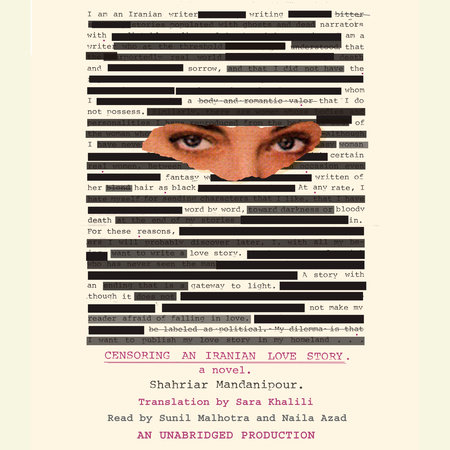
The novel entwines two equally powerful narratives. A writer named Shahriar—the author’s fictional alter ego—has struggled for years against the all-powerful censor at the Ministry of Culture and Islamic Guidance. Now, on the threshold of fifty, tired of writing dark and bitter stories, he has come to realize that the “world around us has enough death and destruction and sorrow.” He sets out instead to write a bewitching love story, one set in present-day Iran. It may be his greatest challenge yet.

Beautiful black-haired Sara and fiercely proud Dara fall in love in the dusty stacks of the library, where they pass secret messages to each other encoded in the pages of their favorite books. But Iran’s Campaign Against Social Corruption forbids their being alone together. Defying the state and their disapproving parents, they meet in secret amid the bustling streets, Internet cafés, and lush private gardens of Tehran.

Yet writing freely of Sara and Dara’s encounters, their desires, would put Shahriar in as much peril as his lovers. Thus we read not just the scenes Shahriar has written but also the sentences and words he’s crossed out or merely imagined, knowing they can never be published.

Laced with surprising humor and irony, at once provocative and deeply moving, Censoring an Iranian Love Story takes us unforgettably to the heart of one of the world’s most alluring yet least understood cultures. It is an ingenious, wholly original novel—a literary tour de force that is a triumph of art and spirit.
DEATH TO DICTATORSHIP, DEATH TO FREEDOMIn the air of Tehran, the scent of spring blossoms, carbon monoxide, and the perfumes and poisons of the tales of One Thousand andOne Nights, sway on top of each other, they whisper together. The city drifts in time.In front of the main entrance of Tehran University, on Liberty Street, a crowd of students is gathered in political protest. With their fists raised they shout, “Death to captivity!” Across the street, members of the Party of God, with clenched fists and perhaps chains and brass knuckles in their pockets, shout “Death to the Liberal . . .” The antiriot police, armed with the most sophisticated paraphernalia, including stun batons purchased from the West, stand facing the students. Both groups try, before they come to blows, to triumph over their opponents by shouting even louder. Drops of sweat ooze from faces and specks of spit spew from mouths. Fists, before pounding on heads, rise without miracle toward the sky.It is perhaps because of these fists that from the sacred sky of Iran no miracle ever descends. Since one hundred and one years ago—when the first revolution for democracy triumphed in Iran—fists similar to these have risen toward the sky of a country with the greatest number of holy men, with the most prayers, tears, and religious lamentations; and today, I believe, the greatest pleas to God for speeding up the day of resurrection rise from Iran.A short distance away, on the sidewalk, with her back to the steel fence lodged in the three- foot- tall stone wall surrounding Tehran University, stands a girl who, unlike most girls in the world but like most girls in Iran, is wearing a black headscarf and a long black coat as a coverall. She possesses a beauty common to all girls in love stories, a beauty that many girls around the world, and in Iran, who read these stories want to possess. If the ghosts of the thousands of poets who died a thousand years ago, seven hundred years ago, or four hundred years ago, and the spirit of those yet to be born—who, unlike the living, in the democracy of death amicably and tolerantly wander the streets of Tehran—see her large black eyes, they will liken them, as is customary of their poetry, to the sad eyes of a gazelle. An old simile for a pair of Oriental eyes that stole Lord Byron’s heart, and Arthur Rimbaud’s, too . . . But contrary to this clichéd simile, there is a mysterious look in this girl’s eyes. It is as if they possess the power to traverse time, the power to pass through the golden walls of harems or perhaps the firewalls of Web sites and Internet filters.But the girl does not know that in precisely seven minutes and seven seconds, at the height of the clash between the students, the police, and the members of the Party of God, in the chaos of attacks and escapes, she will be knocked into with great force, she will fall back, her head will hit against a cement edge, and her sad Oriental eyes will forever close . . .The girl attracts the attention of mysterious people who during political demonstrations in Iran monitor the scene from discreet corners and identify people. They point her out to one another. One of them, from a very professional angle, takes a photograph and films her. I know this girl is not a member of any political party, but she is timidly holding a sign that reads:DEATH TO FREEDOM, DEATH TO CAPTIVITYIt is a strange slogan that I don’t believe has ever been seen or heard under the rule of any dictatorial, Communist, populist, or even so- called liberal regime. And I don’t believe it will ever be heard under the rule of any future regimes that for now remain nameless.When they pause to catch their breath in between shouting their slogans, the students seeking freedom and democracy point to the girl and her sign and ask, “Who in the world is she? What is she trying to say?” The more experienced students, old hands at political protests, respond: “Completely ignore her. She’s an infiltrator. The Party of God has paid her to create distrust and division among us. To defuse the conspiracy,just act as though she doesn’t exist.” On the opposite side, the fanatic members of the Party of God also point to the girl and ask, “What’s that prissy girl trying to say over there?”They hear from their leaders:“The lewd hussy is one of those Communists who have recently come back to life. Their Big Brother in Russia is gaining strength again . . . but the pathetic slobs only have a handful of members in their party. This is how they hope to attract attention . . . Just ignore her. Act as though she doesn’t exist.”With their wireless radios, the secret police pass along the girl’s location and ask, “What does this mean? We have no instructions for such cases. What should we do with her?” And they receive instructions:“Watch her with extreme vigilance and caution. This is most definitely a new conspiracy and a new plot for a velvet revolution orchestrated by American imperialism . . . Keep her under surveillance but do not let her suspect anything. Let her think she doesn’t exist.”Nameless shades of rage and hatred, voiceless cries of blood and hope and darkness, hang in the air. From one direction, meaning Anatole France Avenue, and from the other direction, meaning Revolution Circle, the police have blocked all car and pedestrian traffic to this section of Liberty Street. In Revolution Circle, hundreds of cars are logjammed, anxious and overwrought drivers blow their horns, and amid the cars curious people stand peering toward Tehran University. It was right here that more than a quarter century ago, on a cloudy winter day, the people of Tehran for the last time dragged down the metal statue of the Shah sitting astride a horse. Of course in those days, when it came to dragging down metal statues of dictators, American tanks sided with the world’s dictators.The student protesters, aware that they are about to be attacked, break into a heartrending anthem:My fellow schoolmate,you are with me and beside me,. . . you are my tear and my sigh,. . . the scars of the lashes of tyranny rest on our bodies,our uncultured wasteland, all its wild plants weeds,be it good, be it bad,dead are the souls of its people,our hands must tear down these curtains,who other than you and I can cure our pain . . .In the lyrics and melody of this anthem lies an age- old Iranian sorrow that brings tears to the girl’s eyes . . . She raises her sign even higher. From behind the veil of her tears, the world is transformed into undulating buildings, severed shadows, and rippling reflections on water . . . The young girl’s isolation and her fear of strangers heighten. She looks up to find some solace in the blue of the sky. She sees a winged horse that like a white cloud, ignoring the people below, flies by. Terrified, she sees flames rising from the horse’s back. The blazing horse disappears behind a high- rise. The girl waits, but the horse does not reappear . . .Then she imagines that in the midst of the shouts of anger and spite, a muffled voice is calling her name.“Sara . . . ! Sara . . . !” The girl wipes away her tears and looks around. There are people and shadows moving in every direction. It seems they are afraid of coming close to her.“Dimwit . . . ! Dimwit . . . ! I’m talking to you!”The voice bears the same chill and odor that gust out of a refrigerator that has not been opened in a month. The girl looks behind her. Adark face, neckless and torsoless, is suspended in the air. Two of the steel bars in the green fence surrounding Tehran University that have broken out of the stone wall have sectioned the face in three . . . She thinks this face belongs to one of those sprites her grandmother said have parties in the city’s public bathhouses at night and that the only way to tell them apart from humans is by their hoofed feet . . .“Hey! Dimwit! Get rid of that sign and escape! I’m talking to you . . . !”Again the girl looks behind her. She sees that same fluid dark face on the other side of the fence. She thinks perhaps someone is squattingdown behind the wall and has lifted his head up to the fence.“Hey! Daydreamer, go home! . . . Today death has it in for you. Go home! . . . Do you understand? It’s been half an hour since death fell inlove with you. It’s sharpening its sickle to stab it into your body. Run while you can . . . Do you hear me . . . ?” No, this face and its cobwebbed voice cannot be real. Sara peeks through the fence and behind the stone wall and sees the figure of a hunchback midget dressed in clothes that seem to belong to centuries ago . . . She opens her mouth to ask:What in the world do you want from me?But her words choke in her throat. Petrified, she realizes that at this moment, any question and all the words in the world will seem absurd and meaningless. There appear to be no eyeballs in the round eye sockets on that face. They resemble two wells with moonlight reflecting on the dark water at their pit.“What do you want with my eyes? Think of yourself. You will be killed . . . Do you understand? . . . Run! The fighting will start any minute now.”The scuffle begins. The shouts of slogans and obscenities and the screams of boys and girls being beaten drown in the daily clamor of the city of eleven million.We skip past this scene because it seems to have nothing to do with a love story. However, if you have paid attention, you will have noticed that I, with that notorious cunning of a writer, have described the scuffle between the police and the students in such a way that I cannot be accused of political bias.If you ask me who I am, I will say:I am an Iranian writer tired of writing dark and bitter stories, stories populated by ghosts and dead narrators with predictable endings of death and destruction. I am a writer who at the threshold of fifty has understood that the purportedly real world around us has enough death and destruction and sorrow, and that I did not have the right to add even more defeat and hopelessness to it with my stories. In my stories and novels there are men whom I have created with a body and romantic valor that I do not possess. Similarly, there are women whose bodies and personalities I have reproduced from the body and soul of the woman whom I have longingly seen in my dreams—although I have never had the sincerity to give this fantasy woman a permanent face so that I don’t confuse her with certain real women. Between you and me, I have on occasion even cheated on this fantasy woman and imagined and written of her blond hair as black, and once as auburn. At any rate, I hate myself for sending characters that I like, that I have scrupulously created word by word, toward darkness or bloody death at the end of my stories, like Dr. Frankenstein.For these reasons, and for reasons that like other writers I will probably discover later, I, with all my being, want to write a love story. The love story of a girl who has never seen the man who has been in love with her for a year and whom she loves very much. A story with an ending that is a gateway to light. A story that, although it does not have a happy ending like romantic Hollywood movies, still has an ending that will not make my reader afraid of falling in love. And, of course, a story that cannot be labeled as political. My dilemma is that I want to publish my love story in my homeland . . . Unlike in many countries around the world, writing and publishing a love story in my beloved Iran are not easy tasks. Following the victory of one of our last revolutions—during which our shouts for freedom, with the assistance of Western media, deafened the universe— to make up for twenty- five hundred years of dictatorial rule by kings, an Islamic constitution was written. This new constitution allows the printing and publishing of any and all books and journals and strictly prohibits their censorship and inspection. Unfortunately, however, our constitution makes no mention of these books and publications being allowed to freely leave the print shop.In the early days following the revolution, after a book had been printed, its publisher had to present three copies of it to the Ministry of Culture and Islamic Guidance to receive a permit for it to be shipped out of the print shop and to be distributed. However, if the ministry deemed the book to be corruptive, the printed copies would remain imprisoned in the print shop’s dark storage, and its publisher, in addition to having paid printing costs, either would have to pay storage costs, too, or would have to recycle the books into cardboard. This system had driven many publishers to the brink of bankruptcy.In more recent years, to limit their financial risk and for books not to remain in storage houses for years and grow moldy waiting for an exit permit, based on a semiverbal, semiformal agreement, prior to actually printing a book, the independent Iranian publisher will voluntarily, with his own two hands and two feet, deliver three copies of the manuscript prepared with the latest typesetting and page design software to the Ministry of Culture and Islamic Guidance to receive a permit before the book is actually printed.In a particular department at this ministry, a man with the alias Porfiry Petrovich (yes, the detective in charge of solving Raskolnikov’s murders) is responsible for carefully reading books, in particular novels and shortstory collections, and especially love stories. He underlines every word, every sentence, every paragraph, or even every page that is indecent and that endangers public morality and the time- honored values of society. If there are too many such underlines, the book will likely be considered unworthy of print; if there are not that many, the publisher and the writer will be informed that they must simply revise certain words or sentences. For Mr. Petrovich this job is not just a vocation; it is a moral and religious responsibility. In other words, a holy profession. He must not allow immoral and corruptive words and phrases to appear before the eyes of simple and innocent people, especially the youth, and pollute their pure minds. Sometimes he even tells himself:“Look here, man! If one word or phrase escapes your pen and provokes a young person, you will share in his sin, or, worse, you will be just as guilty as those depraved people who produce pornographic films and photos and illegally distribute them among the public.”From his perspective, writers are generally devious, immoral, and faithless people, some of whom are directly or indirectly agents of Zionism and American imperialism, and they try to deceive him with their tricks and ploys. Given his profound sense of responsibility, while he reads the typeset manuscripts, Mr. Petrovich’s heart beats wildly. As he advances page by page, slowly the words begin to make strange movements before his eyes. In his mind, amid the echoes of the words, he hears mysterious whisperings that put him on his guard. Suspicious, he goes back a few pages and reads more carefully.His face begins to perspire, and his fingers start to tremble as they turn the pages. The more he pays attention, the more devious the criminal words become. They move around; the sentences intertwine. Implicit expressions, explicit expressions, innuendos, and connotations concealed in shadows begin to parade around in his head and create an uproar. He sees that some motherfucking words are lending letters to one another to create vulgar words or raunchy images. The sound of the pages turning resembles the sound of a guillotine blade falling. Mr. Petrovich hears the hue and cry of the words explode in his ears. He yells:“Shut the hell up!”
© Elena Seibert
Shahriar Mandanipour has won numerous awards for his novels, short stories, and nonfiction in Iran, although he was unable to publish his fiction from 1992 until 1997 as a result of censorship. He came to the United States in 2006 as the third International Writers Project Fellow at Brown University. He is currently a visiting scholar at Harvard University and lives in Cambridge, Massachusetts. His work has appeared in PEN America, The Literary Review, and The Kenyon Review. View titles by Shahriar Mandanipour
"In what now reads like an eerie echo of the killing of a young Iranian woman cut down by a bullet during this month's election protests, the Iranian author of this new novel [in its opening pages] foresees the possible death of his heroine in the streets of Tehran. At once a novel about two young Iranians trying to conduct a covert romance in Tehran; a postmodern account of the efforts of their creator to grapple with the harsh censorship rules of his homeland; and an Escher-like meditation on the interplay of life and art, reality and fiction, [Censoring an Iranian Love Story] leaves the reader with a harrowing sense of what it is like to live in Tehran under the mullahs' rule, and the myriad ways in which the Islamic government's strict edicts on everything from clothing to relationships between the sexes permeate daily life. The novel provides a darkly comic view of the Kafkaesque absurdities of living in a country where movies could be subject to review by a blind censor; where records of enrollment at a university can be so thoroughly erased by authorities that a student can come to doubt even his own name. At its best, Censoring an Iranian Love Story becomes a Kundera-like rumination on philosophy and politics [that] playfully investigates the possibilities and limits of storytelling. . . . A clever Rubik's Cube of a story, [and] a haunting portrait of life in the Islamic Republic of Iran, even before the brutalities of the current crackdown."
–Michiko Kakutani, The New York Times

"Censorship is an endlessly fascinating subject; a puzzle box, a Russian nesting doll in which the writer's truth is buried and often lost. . . . In Censoring an Iranian Love Story, a writer (also named Shahriar Mandanipour and the author's alter ego) tries to write the story of Sara and Dara, a young couple in love, and finds himself in a metaphorical burka. He is forced to change his story, characters and dialogue to comply with the restrictions of the Ministry of Culture and Islamic Guidance in the person of a Dostoevskian character, Mr. Petrovich. . . . The only thing a writer can do is treat the censorship like a new form [of art], a villanelle or a sonnet . . . Censorship is just another way of messing with reality. It's hard enough to generate one's own ideas without having someone else's superimposed over them, but the fictional Mandanipour finds soaring metaphors to replace simple, yet offensive actions. Things are crossed out, political and sexual, that will prevent his book from being published. He writes a love story that is convincingly, achingly impossible in a place where men and women cannot even look at each other in public. The effect (as every good Victorian understood) is deliriously sensual prose. . . . A 'perfect and beautiful story,' Shahriar warned his censor, 'is the most dangerous story.' Mandanipour has triumphed."
–Susan Salter Reynolds, Los Angeles Times

“Lucid and affecting, ambitious and challenging . . . Censoring an Iranian Love Story, in all its playfulness and complexity, provides American and European readers with an introduction unlike any other to Iranian literary history and also to Iran’s present reality. . . . When, last summer, YouTube disseminated from Tehran the extraordinary cell phone images of a young woman as she expired from [a] bullet at a pro-democracy demonstration, perhaps few thought first of all of [this novel]. And yet [it] opens with the prefiguring of just such a tragedy. At the book’s outset we see a young girl, a student [named Sara], standing on the edges of a demonstration . . .  Sara is fated to sacrifice her life simply because she is standing there, then. . . . It is clear from the novel’s outset that what seem like Calvinoesque intellectual literary games are, in an Iranian setting, played for far higher stakes: Mandanipour’s narrator writes in an attempt to divert the course of history. He writes even a love story—perhaps especially a love story—to save lives. Mandanipour wants us, his Western audience, to understand that in contemporary Iran, there is no boundary between realism and surrealism. . . . Sara’s world could not be more diametrically opposed to our own; in this sense, her realism is our surrealism. Importantly to Mandanipour, that strange state of unreal reality has its most notable precedents, for Westerners at least, in literature: in Dostoevsky and Gogl, to both of whom the novel alludes explicitly . . . But there are also precedents in contemporary fiction like Milan Kundera’s, or in film; and in classical Sufi poetry . . . Mandanipour’s novel is a collage of the factual, the historical, the fantastical, the fictional, the metafictional, and the cartoonish. . . . The ironies for Mandanipour are rife. To record the realities of contemporary Iran, whether inside or outside Iran, is to be banished forever, like a character in a classical poem. The love story of the novel’s title is that of Sara and Dara; but it is also that of Mandanipour and his native country, a love story that cannot, at present, end happily. . . . He is persona non grata in Iran. Albeit reluctantly, but with considerable passion, he writes to us, his new compatriots. But he writes for his old compatriots, his heart’s true love, in the hope—may it not be in vain—that he might alter the course of fate. The first step, of course, is for us in the West to read, to listen, and to try to understand.”
—Claire Messud, The New York Review of Books

"Exciting . . . Powerful . . . Perhaps we look enviously at those who have the misfortune to live in countries where literature is taken seriously enough to be censored, and writers venerated with imprisonment. . . . Among other things, Censoring an Iranian Love Story is a tough reply to such maundering. . . . This novel, [Mandanipour's] first major work to be translated into English, was written in Farsi but cannot be read in Iran. His book is thus acutely displaced: it had to have been written with an audience outside of Iran in mind, but in a language that this audience would mostly not understand; it depends on translation for its being, yet its being is thoroughly Iranian, lovingly and allusively so, dense with local reference. And it takes as its subject exactly these paradoxes, for it is explicitly about what can and cannot be written in contemporary Iranian fiction. . . . Two Tehran natives, Dara and Sara, meet at a student demonstration outside Tehran University, and spend the next two hundred and eighty pages attempting not so much to consummate their relationship as simply to begin it. It is like something out of Laurence Sterne, and Mandanipour . . . is playfully alive to the elasticated comedy of a story that expends all its energy on failing to start. But this narrative foreplay isn't just play, because it is forced and not free, conditioned by Iranian political reality. . . . Mandanipour's inventive way of depicting censorship in his novel is to inscribe it, quite literally, in the pages of his novel. So throughout the book, whenever the story of Dara and Sara becomes unacceptably political or erotic, offending sentences are crossed out . . . The text is veiled, but the author lifts the veil for his non-Iranian audience. . . . It is an effective, simple idea . . . Censoring an Iranian Love Story is not simply prohibited by censorship but made by it. For Mandanipour, the censor is a kind of co-writer of the book . . . Even more interesting, the writer, in this situation, becomes his characters; he wants what they want. Their freedom is bound up with his. This interdependency does provocative things to the relation of fiction to reality. On the one hand, fiction becomes more real–real enough to strike lines through. On the other hand, fiction becomes more fictional–multiple writers (the author and his censors) are making up a collective story as they go along, improvising, cutting, editing, bargaining with each other. One of the great successes of this book is how thoroughly it persuades the reader that a novel about censorship could not help also being a novel about fiction-making; and it thus brings a political gravity to a fictive self-consciousness sometimes abused by the more weightless postmodernism. [The author's] commentary, in which Mandanipour writes as himself, entertainingly informs the reader about the riskier aspects of the two protagonists, the history of censorship in Iran, the revolution of 1979, and so on. . . . Mandanipour's writing is exuberant, bonhomous, clever, profuse with puns and literary-political references; the reader unversed in contemporary Iranian fiction might easily think of Kundera (who is alluded to), or of the Rushdie of Midnight's Children. . . . Charming and often witty."
–James Wood, The New Yorker

"In this brilliantly conceived and cleverly written novel, characters and author together and separately act and write with sly purpose, disguising and disavowing their subversive ends–to live, love, and create in today's repressive Iranian society."
–Barbara Fisher, Boston Sunday Globe

"In his first novel to be translated into English, Shahriar Mandanipour sets out to write the story of young lovers struggling to consummate their prenuptial passion under the eyes of the Iranian morals police. They hang out in Internet cafes, dark movie houses and on the jammed and smoggy streets of modern-day Tehran. The clandestine courtship comes at a time when university students protest, and vigilantes watch out for transgressing neighbors. A war with U.S. troops and suicide bombers rages in next-door Iraq. Telling amorous tales in post-Islamic-revolution Iran is tricky, if not downright dangerous, but a fictional writer named Shahriar Mandanipour is up to the task. . . . As he tells his censor-wary story, the matchmaking narrator employs symbol, metaphor and plenty of heartache–nods to Barthes and Borges that of course don't go unnoticed by the narrator. American pop culture references (Danielle Steele, Steve McQueen, John Wayne, Linkin Park, Titanic, and Vertigo), combined with a reverie-like prose, summon Murakami. Hypothetical narratives and digressions lend humor and irony. Like some stylishly innovative movies (Brazil and Eternal Sunshine of the Spotless Mind leap to mind), the form is essential to the work's overall meaning. Unable to publish his fiction from 1992 until 1997 because of censorship, Mandanipour the real-life novelist lets loose. . . . And as much as humor dominates the book, it quietly gets at something else–the omnipotence of tyranny. In the novel, censors scrub literature, magazines, movies of anything that may invoke love or lust. The idea of an Iranian love story is a sad oxymoron. . . . Reconciling differences in morality and religion is complicated, but Mandanipour takes a stab at it. While we may know the author's allegiances, he also seems to be arguing that we should at least write about those differences, as difficult as they are."
–Trenton Daniel, The Miami Herald

"It's not your typical love story: Boy sees Girl's shoes under a card catalog at the library. Boy falls in love with Girl and writes her coded letters in books. Writer goes nuts trying to pen a love scene in a country where Boy and Girl can't legally be together, either in public or private. Then the corpse of a hunchback dwarf shows up.  If you're looking for a tale of love triumphing over all obstacles or a Middle Eastern Romeo and Juliet, seek elsewhere. [But] if you like the intellectual challenge of the metafiction of J.M. Coetzee or Paul Auster, or the sheer spiraling loopiness of Charlie Kaufman films such as Adaptation, then grab a copy [of Censoring an Iranian Love Story] and prepare to enjoy a meditation on culture, modern Iran, and the power of what is left out. Oh, and make sure you read all the crossed-out lines: There's some pretty pivotal information hiding under there. As with Adaptation, Mandanipour's main character is named Shahriar Mandanipour, a novelist who's having a horrible time writing a 'simple love story.' His problem is the difficulty of trying to find ways to outsmart the government censor. Also, his characters won't do what he tells them. As Mandanipour rewrites different scenes, frantically crosses out lines, and explains cultural references from 700-year-old ghazals to the Al Pacino film Scent of a Woman (good luck getting that title past the censors), he is instructing a Western reader in the art of the unwritten. The ellipsis, we are given to understand, is one of the most powerful tools of a reader operating under censorship. . . . Mandanipour can't describe his female character' s beauty without using produce metaphors (there are many pomegranate references) and his main characters can be beaten and arrested for walking down the street together. So creativity is the order of the day. One of [his lovers'] dates takes place in an emergency room of a hospital; another time they arrange to meet walking into a mosque. . . . By the end of this witty, hyper-intelligent riff on life under a repressive regime, the writer has demonstrated the mental and emotional contortions necessary to survive and fully convinced a reader of this vast understatement: 'publishing a love story in Iran is not a simple undertaking.' Mandanipour pulls everything but a rabbit out of his hat. But then, Byron and Shakespeare never had to operate under these conditions . . ."
–Yvonne Zipp, The Christian Science Monitor

"Slyly alive . . . Devious and engaging . . . A droll, even cheerful portrait of totalitarian craziness, it unfolds under the star of a book to which Mandanipour refers more than once: Milan Kundera's The Unbearable Lightness of Being. Like Kundera's novel, Censoring an Iranian Love Story takes place on two planes. The first is the simple, sad love story itself. . . . Second, there's the essay level, on which the author talks directly to his readers about Iranian history and hypocrisy, the problems the plot is giving him and, especially, the headache of getting his sentences around the censor. . . . Both novelists are drunk on literature, stuffing their prose with references to favorite books (and music and movies). . . . Mandanipour is conversant with everyone from Dostoyevsky to Danielle Steel."
—Craig Seligman, Bloomberg News


"Playful . . . As [the] love story progresses, Mandanipour elucidates the history of censorship in Iran, dating back hundreds of years to the intricate metaphors and complicated allegories employed by such poets as Rumi, Hafez and Khayam. . . . A brilliant novel about the complexities of writing and publishing in Iran. It will help to further understanding of the frustrating and sometimes perilous situation of the book industry in a country where copyright is not respected, where writers struggle desperately to publish and can be jailed simply for exercising their imaginations."
—Saeed Kamali Dehghan, The Guardian

"Intriguing . . . Dara and Sara meet at a demonstration in Tehran. From the start, their courtship is necessarily as steeped in deception and danger as it is in passion. . . . Imagination, for Mandanipour, is about the space between reality and perception. It is the '. . .' of Iranian literature, where author leaves reader to imagine the rest, and the censor invariably decides that readers cannot be trusted to do so and gets out his scissors. . . . There is masses of clever, dark humor here, in what could easily have been a thoroughly bleak novel. . . .[An] absorbing and unique novel [with] depth of feeling for words and stories in Iran. . . . In a country where ill-advised words can cost you your life, they assume an importance and power that is almost impossible to grasp in a free society."
—Fiona Atherton, The Scotsman

"Rich and riveting . . . Perceptive commentaries on the unfolding political turmoil [in Iran]. [Mandanipour's] works of fiction, densely metaphorical and replete with symbolisms drawn from the Persian literary tradition, reflect the extraordinary times he and his country have witnessed without being overtly political or tediously ideological. . . . This complex exploration of love, literature and censorship is the account of an Iranian writer's efforts (Mandanipour himself), to write a love story both acceptable to the Ministry of Islamic Guidance and true to its romantic aims. The book juggles three concurrent layers of narrative and meta-narrative which increasingly begin to seep into each other. The postmodernist techniques are reminiscent of Mario Vargas Llosa's Aunt Julia and the Scriptwriter and Italo Calvino's If on a Winter's Night a Traveller, but Censoring remains essentially Iranian and bears many hallmarks of a unique Persian literary heritage. . . . At the meta-fictional level, the author tries to pre-empt the censor by drawing lines over passages, sentences, or even single words that may offend the sensitive censor. The choices of what is struck out and their alternative formulations give the reader a first-hand experience of the twisted logic of censors in Iran. . . . The absurdities of life in the Islamic Republic of Iran provide frequent moments of hilarity—typical of political satires in the tradition of Milan Kundera. . . . Mandanipour's book in both its content and style gives us a timely glimpse of the complex and infuriatingly paradoxical society that is today's Iran. As a writer in exile he has a difficult journey ahead, not least of which is to decide on his intended audience. He has, I think, the potential to create a genre of Persian literature that could breach the gap in literary sensibilities that separates readers from vastly different traditions."
—Maria Baghramian, The Irish Times

"The headline nation of Iran: it's the novelist's version. CNN pictures of a botched election and a nation, a mullah-cracy, in turmoil, are one thing. But Censoring an Iranian Love Story is something else. It takes you deep into an ecosystem of paranoia. Mandanipour's Iran is eternally a young people's country, where the revolutionary generations don't much listen or learn from each other. It's the home of inspired storytelling, going back to the Thousand and One Nights and before, but it also has this very bad habit of censoring its best writers. . . . This wonderful novel is about a boy and a girl trying to find a foothold for love inside this turmoil and the Puritanism of Tehran today. . . . It's a desperately tender story, and I kept wondering, what is the problem with love in Iran today, with boys and girls being innocently enchanted with each other? . . . You make a kind of wonderful little joke about censorship: it's been said that censorship is the end of stories, in your case, no, it's the beginning of the story. Your story is about these lovers and the writer telling their story in battle with the censor. But the censor eventually falls in love with the girl you've created, so censorship is the beginning of the story. . . . One of the beauties about your book is that it gives us Iran as a whole ecosystem of history and culture, a great deal of paranoia, authoritarian politics. These from the folks who we know better than we realize—this is where the wine of Shiraz comes from, the Thousand and One Nights, all those nightingales and almonds and apples, the jasmine, the hidden gardens. And yet it also has this recurring theme of a police state, public hangings, cruelty, repression, violence. . . . Censoring an Iranian Love Story, for me, is a wonderfully coherent picture of a society in pain. We see it on television, but it's different and richer in your book. And I have to say also, I believe in the love story at the end, I love Sara and Dara, and we all end up believing in their love if not being able to bet on it, exactly."
—Christopher Lydon, "Open Source," Public Radio International

"There is no such thing as a simple love story in Tehran—and the problem is as great for the author as for hero and heroine. . . . As [Mandanipour] delights in showing, the [Iranian] censor's scissors are blunt instruments compared with the novelist's tools. Thus, as the romance between Dara and Sara falteringly progresses, so does a parallel debate between Mandanipour and his would-be censor. The ancient poets conjured eroticism in terms of flowers and ripe fruits, but how can lovers express themselves in modern Iran? This is Mandanipour's question as he searches to unite his smitten character—characters who, unnervingly, seem to have ideas of their own. . . . This important, timely novel is sharp, playful and zesty with life."
—Stephanie Cross, Daily Mail (UK)

"[Censoring an Iranian Love Story] explores expression and censorship . . . Mandanipour's headscarf-sporting [protagonist], Sara, has to be wily. Her name will be familiar to Iranian readers as a character in a children's reading primer from before the revolution—she wore bright clothes and her hair uncovered—and thus evokes a freedom no writer would dare to describe in words. Instead she has to use metaphors involving fruit and flowers to summon passion; great swaths of text are struck through to show what cannot be said. . . . A powerful, provocative and timely novel."
—Francesca Segal, The Observer (UK)
"Parts of this novel have been crossed out, and that is the point. In Iran stories must struggle through a fog of censorship to make themselves heard. Shahriar, the narrator, is trying to write a love story . . . But this is a ticklish task when love is something that can be expressed only in codes and inferences, and these are not permitted. Language is supple, however, and forbidden love can be smuggled in between the lines . . . This is a very special novel–a passionate, inventive and humorous exposure of the stupidity and cruelty of a society ruled by fear."
–Kate Saunders, The Times (London)

"In a country where censors wield scissors at the merest hint of impropriety, how do you write about a love affair? In this wry, playful novel, Shahriar Mandanipour faces just such a problem as he recounts the tale of Sara and Dara, who meet at a demonstration in Tehran. Chronicling the pair's faltering courtship requires formal inventiveness from both the real Mandanipour and his fictional alter ego. . . . Reminiscent of Milan Kundera, this is a lively account of life and letters in contemporary Iran."
–Adrian Turpin, Financial Times

"A subtle, multi-layered work . . . Imagine, for a moment, that you had been deprived of the opportunity to read a major foreign-language contemporary novelist until this week. I mean one of the big names: Michel Houllebecq, say, or Javier Marias, or Victor Pelevin. Then, suddenly, this novelist arrived at last on bookshelves, and here was your first chance to discover his work. [Now] brings just such a rare prospect, with the publication of Iranian novelist Shahriar Mandanipour' s Censoring an Iranian Love Story. . . . It tells the story of an author in Tehran writing a love story about two young Tehranis. We get the love story itself, but also the author's commentary on his constant battle with the Ministry of Culture over what he is permitted to write, and what is forbidden. Sentences that are 'unIslamic' –such as a description of an illicit encounter at an internet café–are written and then crossed out, so that to read this novel is to read both a simple love story, and the simultaneous, terrible censorship of that story. . . . The novel will give western readers a rare glimpse of life in contemporary Iran as seen by an insider; if you want to understand more about the young, educated, cyber-age Tehranis who poured on to the streets in the wake of last month's presidential election, then this book is a great place to start. . . . One of Iran's greatest novelists is living and writing in the West, and readers of English are able at last to commune with his novelistic intelligence."
–David Mattin, The Guardian Books Blog

"The main character in this novel happens to be the novelist himself, and he's trying to tell a love story . . . But it turns out that it's pretty hard to tell a love story in Iran because there are censorship issues, the fact that men and women can't get together in public or even in private, the police are always on the verge of arresting those who are crossing the morality lines. So the novel becomes his effort to try to tell a love story. . . . It's a lot of fun to see the story that he's trying to tell, the story that's getting crossed out [for fear of censorship], and the real back story. And the back story gives us a picture of Iran that's the picture that we can't get through Twitter or through what few cell phone images come through over the protests of the last several weeks. In fact, this is what Iran looks like from the inside."
–Lisa Mullins and Christopher Merrill, "The World," Public Radio International

"Sara is annoyed to note purple dots disfiguring the pages of The Blind Owl, a classic she's picked up from a street peddler. Then she realizes it's code: the young peddler wants to meet her. Since this is Iran, post-revolution, simply saying hello has its risks, and as someone who dabbles in banned books and suspect foreign films, peddler Dara is not what anyone would consider desirable company. But they manage a fraught relationship, fueled by a love of literature and narrated by an author who tells their story but also uses it to comment on censorship in Iran and its consequences, even wittily showing readers crossed out lines and boldfacing passages that could be trouble. The result is magisterial metafiction that makes an ordinary love affair astonishing and provides a rich understanding of life under repressive Islamic rule. Iranian author Mandanipour, currently a visiting scholar at Harvard, could not publish in Iran during much of the Nineties; readers will welcome his first full-length book in English. Highly recommended."
–Barbara Hoffert, Library Journal (starred review)

"What do we really know about life in Iran? CNN crawlers may bring us up to the moment, but literature opens a door that no amount of accumulated sound bites can. Censoring an Iranian Love Story is part political allegory, part love story. Its unique perspective will dazzle and amuse, but also deepen the reader's understanding of a complex country. Censoring tells the story of a well-known Iranian writer (with the same name as the author) who is determined to write a bewitching love story set in modern-day Iran. While this may seem like nothing special to the Western reader, in Iran, authors must submit their writing to a censorship board before publication. In Mandanipour's imagined manuscript, proud Dara and beautiful Sara, whose names simultaneously recall schoolbook characters and the Iranian version of Barbie and Ken, are forbidden to be alone together. Their secret love affair is conducted in emails and encoded notes in library books. Their love story runs parallel to Mandanipour's ongoing struggle with the censor, which reads almost like a thriller. Censoring includes scenes that can never appear in the final manuscript, as well as sentences and words crossed out, suggesting that authors become their own harshest critics under censorship. Several fictional characters from Iranian literature appear in the novel, as do references to Kafka, Orwell, and, unexpectedly, Danielle Steel, adding a healthy dose of absurdity. In fact, the remarkable thing about Censoring is how funny it is–not just the bitter humor of irony, but the wit of a literate, broad-minded, slightly cheeky author sharing some hard-earned wisdom."
–Lauren Bufferd, Bookpage

"Imagine trying to write about romance in a society in which it's a crime for a woman to walk down the street with a man who isn't a relative, and in which government censors scrutinize every line. Shahriar Mandanipour, the struggling Iranian author portrayed with mischievous wit and serious intent in this elaborately chambered double-novel by the real-life Shahriar Mandanipour–a prominent, censored Iranian writer–labors anxiously over the love story of Sara and Dara under the sharp eyes of a censor of disturbingly omniscient powers. [Sara and Dara's] passion is taboo, yet nothing keeps them apart, not tapped phones, nosy neighbors, or the brutal patrols for the Campaign Against Social Corruption. Poor Shahriar fumes, crossing out lines, jettisoning entire scenes, and decrying the contrast between the sensuous glory of Persia's poetic tradition and the puritanical tyranny of today's Iran. From Kafkaesque bureaucracy to a blind movie censor to violent repression, Mandanipour, summoning both irony and outrage . . . illuminates the labyrinth of paradoxes entrapping the politically repressed, and celebrates the liberating powers of literature and love. A charming, canny, and rambunctious novel of courage and freedom against all odds."
–Donna Seaman, Booklist (starred review)

"[Censoring an Iranian Love Story] follows an ambitious but censored Iranian writer as he attempts to write a Nobel-caliber love story that will pass the censors' inspection. As a professional writer, narrator Shahriar has known his censor for long enough that he can anticipate his objections. Shahriar's work in progress, which unfolds as a subnarrative within the novel, concerns Dara and Sara . . . as they explore sexual and emotional love in a nation that forbids physical or social interaction between young people of the opposite sex. As the couple's love grows, the self-censoring writer strikes out whole passages in anticipation of his censor's objections. All the while, the writer converses with his censor, his characters, the reader and himself to create an intriguing multifaceted romance steeped in Iranian culture. Kudos to Khalili for a wonderfully fluid translation of an intricately layered text."
Publishers Weekly

"Mandanipour's first full-length work to appear in English is a postmodern novel complete with running commentary on the fictional narrative and its author' s trials. . . . [The author] opts for a romance, introducing us to Sara, a student at Tehran University, and Dara, a former student who teases and intrigues her by putting dots under letters in certain books at the library to spell out tentative amatory messages. Needless to say, the course of their true love does not run smoothly. Neither does the author's writing; every word must be scrutinized by a censor at the Ministry of Culture and Islamic Guidance . . . and there's no telling what he will interpret as unacceptable or indecent. . . . Mandanipour guides the reader through this maze by having his 'novel' printed in bold font and the commentary in regular font. He has even more fun by leaving in some crossed-out sentences and phrases, so we can see what he's rejecting, sometimes in deference to the censor and sometimes because they don't fit the growing love relationship. . . . Complex, witty, clever and entertaining."
Kirkus Reviews

"The news out of Iran has heightened my interest in a new novel, Censoring an Iranian Love Story, by Shahriar Mandanipour. It is a fascinating look at life, love, and censorship. It's a love story that has been censored so you see what the author has crossed out or merely imagined, knowing that certain things can never be published. This young couple takes extreme measures to express their feelings without bringing the wrath of the government down on themselves. Dara initially expresses his feelings for Sara by making purple dots under letters in a banned book to spell out his message. The novel is as witty as the censorship is horrifying."
–Jan Gardner, The Boston Globe Off the Shelf blog

"With the many books about Iran flooding the shelves, it is a joy to come across Censoring an Iranian Love Story, which offers a perspective that is neither sentimental nor nostalgic, romanticized nor demonized. Looking at his country and its inhabitants through a fiction writer's authentic spectacles, Shahriar Mandanipour has written a novel that is witty, smart, funny, and honest. It is an important book for our times."
–Rabih Alameddine, author of The Hakawati

"I absolutely loved Censoring an Iranian Love Story. Insightful and sensual, humorous and sly, allegorical and literary, it is an endless pleasure: a celebration of love and the written word from a part of the world where both still matter."
–Gary Shteyngart, author of Absurdistan

"Filled with marvels and revolutions, political absurdity, and cinematic exploration, Censoring an Iranian Love Story is much more than a fractured love story. It's a conversation with art, tyranny, and morality, a syncopated meditation on popular culture and ancient history. Shahriar Mandanipour's wonderful, digressive novel shimmers with the power of the unwritten, the suggested, and the excised. This story of an author and his wayward characters provides all of us–no matter what our culture–with instructions on how to resist the censors of the world and make our way to freedom. An exciting and original work–a beautiful novel."
–Diana Abu-Jaber, author of Crescent


About

From one of Iran’s most acclaimed and controversial contemporary writers, his first novel to appear in English—a dazzlingly inventive work of fiction that opens a revelatory window onto what it’s like to live, to love, and to be an artist in today’s Iran.

The novel entwines two equally powerful narratives. A writer named Shahriar—the author’s fictional alter ego—has struggled for years against the all-powerful censor at the Ministry of Culture and Islamic Guidance. Now, on the threshold of fifty, tired of writing dark and bitter stories, he has come to realize that the “world around us has enough death and destruction and sorrow.” He sets out instead to write a bewitching love story, one set in present-day Iran. It may be his greatest challenge yet.

Beautiful black-haired Sara and fiercely proud Dara fall in love in the dusty stacks of the library, where they pass secret messages to each other encoded in the pages of their favorite books. But Iran’s Campaign Against Social Corruption forbids their being alone together. Defying the state and their disapproving parents, they meet in secret amid the bustling streets, Internet cafés, and lush private gardens of Tehran.

Yet writing freely of Sara and Dara’s encounters, their desires, would put Shahriar in as much peril as his lovers. Thus we read not just the scenes Shahriar has written but also the sentences and words he’s crossed out or merely imagined, knowing they can never be published.

Laced with surprising humor and irony, at once provocative and deeply moving, Censoring an Iranian Love Story takes us unforgettably to the heart of one of the world’s most alluring yet least understood cultures. It is an ingenious, wholly original novel—a literary tour de force that is a triumph of art and spirit.

Excerpt

DEATH TO DICTATORSHIP, DEATH TO FREEDOMIn the air of Tehran, the scent of spring blossoms, carbon monoxide, and the perfumes and poisons of the tales of One Thousand andOne Nights, sway on top of each other, they whisper together. The city drifts in time.In front of the main entrance of Tehran University, on Liberty Street, a crowd of students is gathered in political protest. With their fists raised they shout, “Death to captivity!” Across the street, members of the Party of God, with clenched fists and perhaps chains and brass knuckles in their pockets, shout “Death to the Liberal . . .” The antiriot police, armed with the most sophisticated paraphernalia, including stun batons purchased from the West, stand facing the students. Both groups try, before they come to blows, to triumph over their opponents by shouting even louder. Drops of sweat ooze from faces and specks of spit spew from mouths. Fists, before pounding on heads, rise without miracle toward the sky.It is perhaps because of these fists that from the sacred sky of Iran no miracle ever descends. Since one hundred and one years ago—when the first revolution for democracy triumphed in Iran—fists similar to these have risen toward the sky of a country with the greatest number of holy men, with the most prayers, tears, and religious lamentations; and today, I believe, the greatest pleas to God for speeding up the day of resurrection rise from Iran.A short distance away, on the sidewalk, with her back to the steel fence lodged in the three- foot- tall stone wall surrounding Tehran University, stands a girl who, unlike most girls in the world but like most girls in Iran, is wearing a black headscarf and a long black coat as a coverall. She possesses a beauty common to all girls in love stories, a beauty that many girls around the world, and in Iran, who read these stories want to possess. If the ghosts of the thousands of poets who died a thousand years ago, seven hundred years ago, or four hundred years ago, and the spirit of those yet to be born—who, unlike the living, in the democracy of death amicably and tolerantly wander the streets of Tehran—see her large black eyes, they will liken them, as is customary of their poetry, to the sad eyes of a gazelle. An old simile for a pair of Oriental eyes that stole Lord Byron’s heart, and Arthur Rimbaud’s, too . . . But contrary to this clichéd simile, there is a mysterious look in this girl’s eyes. It is as if they possess the power to traverse time, the power to pass through the golden walls of harems or perhaps the firewalls of Web sites and Internet filters.But the girl does not know that in precisely seven minutes and seven seconds, at the height of the clash between the students, the police, and the members of the Party of God, in the chaos of attacks and escapes, she will be knocked into with great force, she will fall back, her head will hit against a cement edge, and her sad Oriental eyes will forever close . . .The girl attracts the attention of mysterious people who during political demonstrations in Iran monitor the scene from discreet corners and identify people. They point her out to one another. One of them, from a very professional angle, takes a photograph and films her. I know this girl is not a member of any political party, but she is timidly holding a sign that reads:DEATH TO FREEDOM, DEATH TO CAPTIVITYIt is a strange slogan that I don’t believe has ever been seen or heard under the rule of any dictatorial, Communist, populist, or even so- called liberal regime. And I don’t believe it will ever be heard under the rule of any future regimes that for now remain nameless.When they pause to catch their breath in between shouting their slogans, the students seeking freedom and democracy point to the girl and her sign and ask, “Who in the world is she? What is she trying to say?” The more experienced students, old hands at political protests, respond: “Completely ignore her. She’s an infiltrator. The Party of God has paid her to create distrust and division among us. To defuse the conspiracy,just act as though she doesn’t exist.” On the opposite side, the fanatic members of the Party of God also point to the girl and ask, “What’s that prissy girl trying to say over there?”They hear from their leaders:“The lewd hussy is one of those Communists who have recently come back to life. Their Big Brother in Russia is gaining strength again . . . but the pathetic slobs only have a handful of members in their party. This is how they hope to attract attention . . . Just ignore her. Act as though she doesn’t exist.”With their wireless radios, the secret police pass along the girl’s location and ask, “What does this mean? We have no instructions for such cases. What should we do with her?” And they receive instructions:“Watch her with extreme vigilance and caution. This is most definitely a new conspiracy and a new plot for a velvet revolution orchestrated by American imperialism . . . Keep her under surveillance but do not let her suspect anything. Let her think she doesn’t exist.”Nameless shades of rage and hatred, voiceless cries of blood and hope and darkness, hang in the air. From one direction, meaning Anatole France Avenue, and from the other direction, meaning Revolution Circle, the police have blocked all car and pedestrian traffic to this section of Liberty Street. In Revolution Circle, hundreds of cars are logjammed, anxious and overwrought drivers blow their horns, and amid the cars curious people stand peering toward Tehran University. It was right here that more than a quarter century ago, on a cloudy winter day, the people of Tehran for the last time dragged down the metal statue of the Shah sitting astride a horse. Of course in those days, when it came to dragging down metal statues of dictators, American tanks sided with the world’s dictators.The student protesters, aware that they are about to be attacked, break into a heartrending anthem:My fellow schoolmate,you are with me and beside me,. . . you are my tear and my sigh,. . . the scars of the lashes of tyranny rest on our bodies,our uncultured wasteland, all its wild plants weeds,be it good, be it bad,dead are the souls of its people,our hands must tear down these curtains,who other than you and I can cure our pain . . .In the lyrics and melody of this anthem lies an age- old Iranian sorrow that brings tears to the girl’s eyes . . . She raises her sign even higher. From behind the veil of her tears, the world is transformed into undulating buildings, severed shadows, and rippling reflections on water . . . The young girl’s isolation and her fear of strangers heighten. She looks up to find some solace in the blue of the sky. She sees a winged horse that like a white cloud, ignoring the people below, flies by. Terrified, she sees flames rising from the horse’s back. The blazing horse disappears behind a high- rise. The girl waits, but the horse does not reappear . . .Then she imagines that in the midst of the shouts of anger and spite, a muffled voice is calling her name.“Sara . . . ! Sara . . . !” The girl wipes away her tears and looks around. There are people and shadows moving in every direction. It seems they are afraid of coming close to her.“Dimwit . . . ! Dimwit . . . ! I’m talking to you!”The voice bears the same chill and odor that gust out of a refrigerator that has not been opened in a month. The girl looks behind her. Adark face, neckless and torsoless, is suspended in the air. Two of the steel bars in the green fence surrounding Tehran University that have broken out of the stone wall have sectioned the face in three . . . She thinks this face belongs to one of those sprites her grandmother said have parties in the city’s public bathhouses at night and that the only way to tell them apart from humans is by their hoofed feet . . .“Hey! Dimwit! Get rid of that sign and escape! I’m talking to you . . . !”Again the girl looks behind her. She sees that same fluid dark face on the other side of the fence. She thinks perhaps someone is squattingdown behind the wall and has lifted his head up to the fence.“Hey! Daydreamer, go home! . . . Today death has it in for you. Go home! . . . Do you understand? It’s been half an hour since death fell inlove with you. It’s sharpening its sickle to stab it into your body. Run while you can . . . Do you hear me . . . ?” No, this face and its cobwebbed voice cannot be real. Sara peeks through the fence and behind the stone wall and sees the figure of a hunchback midget dressed in clothes that seem to belong to centuries ago . . . She opens her mouth to ask:What in the world do you want from me?But her words choke in her throat. Petrified, she realizes that at this moment, any question and all the words in the world will seem absurd and meaningless. There appear to be no eyeballs in the round eye sockets on that face. They resemble two wells with moonlight reflecting on the dark water at their pit.“What do you want with my eyes? Think of yourself. You will be killed . . . Do you understand? . . . Run! The fighting will start any minute now.”The scuffle begins. The shouts of slogans and obscenities and the screams of boys and girls being beaten drown in the daily clamor of the city of eleven million.We skip past this scene because it seems to have nothing to do with a love story. However, if you have paid attention, you will have noticed that I, with that notorious cunning of a writer, have described the scuffle between the police and the students in such a way that I cannot be accused of political bias.If you ask me who I am, I will say:I am an Iranian writer tired of writing dark and bitter stories, stories populated by ghosts and dead narrators with predictable endings of death and destruction. I am a writer who at the threshold of fifty has understood that the purportedly real world around us has enough death and destruction and sorrow, and that I did not have the right to add even more defeat and hopelessness to it with my stories. In my stories and novels there are men whom I have created with a body and romantic valor that I do not possess. Similarly, there are women whose bodies and personalities I have reproduced from the body and soul of the woman whom I have longingly seen in my dreams—although I have never had the sincerity to give this fantasy woman a permanent face so that I don’t confuse her with certain real women. Between you and me, I have on occasion even cheated on this fantasy woman and imagined and written of her blond hair as black, and once as auburn. At any rate, I hate myself for sending characters that I like, that I have scrupulously created word by word, toward darkness or bloody death at the end of my stories, like Dr. Frankenstein.For these reasons, and for reasons that like other writers I will probably discover later, I, with all my being, want to write a love story. The love story of a girl who has never seen the man who has been in love with her for a year and whom she loves very much. A story with an ending that is a gateway to light. A story that, although it does not have a happy ending like romantic Hollywood movies, still has an ending that will not make my reader afraid of falling in love. And, of course, a story that cannot be labeled as political. My dilemma is that I want to publish my love story in my homeland . . . Unlike in many countries around the world, writing and publishing a love story in my beloved Iran are not easy tasks. Following the victory of one of our last revolutions—during which our shouts for freedom, with the assistance of Western media, deafened the universe— to make up for twenty- five hundred years of dictatorial rule by kings, an Islamic constitution was written. This new constitution allows the printing and publishing of any and all books and journals and strictly prohibits their censorship and inspection. Unfortunately, however, our constitution makes no mention of these books and publications being allowed to freely leave the print shop.In the early days following the revolution, after a book had been printed, its publisher had to present three copies of it to the Ministry of Culture and Islamic Guidance to receive a permit for it to be shipped out of the print shop and to be distributed. However, if the ministry deemed the book to be corruptive, the printed copies would remain imprisoned in the print shop’s dark storage, and its publisher, in addition to having paid printing costs, either would have to pay storage costs, too, or would have to recycle the books into cardboard. This system had driven many publishers to the brink of bankruptcy.In more recent years, to limit their financial risk and for books not to remain in storage houses for years and grow moldy waiting for an exit permit, based on a semiverbal, semiformal agreement, prior to actually printing a book, the independent Iranian publisher will voluntarily, with his own two hands and two feet, deliver three copies of the manuscript prepared with the latest typesetting and page design software to the Ministry of Culture and Islamic Guidance to receive a permit before the book is actually printed.In a particular department at this ministry, a man with the alias Porfiry Petrovich (yes, the detective in charge of solving Raskolnikov’s murders) is responsible for carefully reading books, in particular novels and shortstory collections, and especially love stories. He underlines every word, every sentence, every paragraph, or even every page that is indecent and that endangers public morality and the time- honored values of society. If there are too many such underlines, the book will likely be considered unworthy of print; if there are not that many, the publisher and the writer will be informed that they must simply revise certain words or sentences. For Mr. Petrovich this job is not just a vocation; it is a moral and religious responsibility. In other words, a holy profession. He must not allow immoral and corruptive words and phrases to appear before the eyes of simple and innocent people, especially the youth, and pollute their pure minds. Sometimes he even tells himself:“Look here, man! If one word or phrase escapes your pen and provokes a young person, you will share in his sin, or, worse, you will be just as guilty as those depraved people who produce pornographic films and photos and illegally distribute them among the public.”From his perspective, writers are generally devious, immoral, and faithless people, some of whom are directly or indirectly agents of Zionism and American imperialism, and they try to deceive him with their tricks and ploys. Given his profound sense of responsibility, while he reads the typeset manuscripts, Mr. Petrovich’s heart beats wildly. As he advances page by page, slowly the words begin to make strange movements before his eyes. In his mind, amid the echoes of the words, he hears mysterious whisperings that put him on his guard. Suspicious, he goes back a few pages and reads more carefully.His face begins to perspire, and his fingers start to tremble as they turn the pages. The more he pays attention, the more devious the criminal words become. They move around; the sentences intertwine. Implicit expressions, explicit expressions, innuendos, and connotations concealed in shadows begin to parade around in his head and create an uproar. He sees that some motherfucking words are lending letters to one another to create vulgar words or raunchy images. The sound of the pages turning resembles the sound of a guillotine blade falling. Mr. Petrovich hears the hue and cry of the words explode in his ears. He yells:“Shut the hell up!”

Author

© Elena Seibert
Shahriar Mandanipour has won numerous awards for his novels, short stories, and nonfiction in Iran, although he was unable to publish his fiction from 1992 until 1997 as a result of censorship. He came to the United States in 2006 as the third International Writers Project Fellow at Brown University. He is currently a visiting scholar at Harvard University and lives in Cambridge, Massachusetts. His work has appeared in PEN America, The Literary Review, and The Kenyon Review. View titles by Shahriar Mandanipour

Praise

"In what now reads like an eerie echo of the killing of a young Iranian woman cut down by a bullet during this month's election protests, the Iranian author of this new novel [in its opening pages] foresees the possible death of his heroine in the streets of Tehran. At once a novel about two young Iranians trying to conduct a covert romance in Tehran; a postmodern account of the efforts of their creator to grapple with the harsh censorship rules of his homeland; and an Escher-like meditation on the interplay of life and art, reality and fiction, [Censoring an Iranian Love Story] leaves the reader with a harrowing sense of what it is like to live in Tehran under the mullahs' rule, and the myriad ways in which the Islamic government's strict edicts on everything from clothing to relationships between the sexes permeate daily life. The novel provides a darkly comic view of the Kafkaesque absurdities of living in a country where movies could be subject to review by a blind censor; where records of enrollment at a university can be so thoroughly erased by authorities that a student can come to doubt even his own name. At its best, Censoring an Iranian Love Story becomes a Kundera-like rumination on philosophy and politics [that] playfully investigates the possibilities and limits of storytelling. . . . A clever Rubik's Cube of a story, [and] a haunting portrait of life in the Islamic Republic of Iran, even before the brutalities of the current crackdown."
–Michiko Kakutani, The New York Times

"Censorship is an endlessly fascinating subject; a puzzle box, a Russian nesting doll in which the writer's truth is buried and often lost. . . . In Censoring an Iranian Love Story, a writer (also named Shahriar Mandanipour and the author's alter ego) tries to write the story of Sara and Dara, a young couple in love, and finds himself in a metaphorical burka. He is forced to change his story, characters and dialogue to comply with the restrictions of the Ministry of Culture and Islamic Guidance in the person of a Dostoevskian character, Mr. Petrovich. . . . The only thing a writer can do is treat the censorship like a new form [of art], a villanelle or a sonnet . . . Censorship is just another way of messing with reality. It's hard enough to generate one's own ideas without having someone else's superimposed over them, but the fictional Mandanipour finds soaring metaphors to replace simple, yet offensive actions. Things are crossed out, political and sexual, that will prevent his book from being published. He writes a love story that is convincingly, achingly impossible in a place where men and women cannot even look at each other in public. The effect (as every good Victorian understood) is deliriously sensual prose. . . . A 'perfect and beautiful story,' Shahriar warned his censor, 'is the most dangerous story.' Mandanipour has triumphed."
–Susan Salter Reynolds, Los Angeles Times

“Lucid and affecting, ambitious and challenging . . . Censoring an Iranian Love Story, in all its playfulness and complexity, provides American and European readers with an introduction unlike any other to Iranian literary history and also to Iran’s present reality. . . . When, last summer, YouTube disseminated from Tehran the extraordinary cell phone images of a young woman as she expired from [a] bullet at a pro-democracy demonstration, perhaps few thought first of all of [this novel]. And yet [it] opens with the prefiguring of just such a tragedy. At the book’s outset we see a young girl, a student [named Sara], standing on the edges of a demonstration . . .  Sara is fated to sacrifice her life simply because she is standing there, then. . . . It is clear from the novel’s outset that what seem like Calvinoesque intellectual literary games are, in an Iranian setting, played for far higher stakes: Mandanipour’s narrator writes in an attempt to divert the course of history. He writes even a love story—perhaps especially a love story—to save lives. Mandanipour wants us, his Western audience, to understand that in contemporary Iran, there is no boundary between realism and surrealism. . . . Sara’s world could not be more diametrically opposed to our own; in this sense, her realism is our surrealism. Importantly to Mandanipour, that strange state of unreal reality has its most notable precedents, for Westerners at least, in literature: in Dostoevsky and Gogl, to both of whom the novel alludes explicitly . . . But there are also precedents in contemporary fiction like Milan Kundera’s, or in film; and in classical Sufi poetry . . . Mandanipour’s novel is a collage of the factual, the historical, the fantastical, the fictional, the metafictional, and the cartoonish. . . . The ironies for Mandanipour are rife. To record the realities of contemporary Iran, whether inside or outside Iran, is to be banished forever, like a character in a classical poem. The love story of the novel’s title is that of Sara and Dara; but it is also that of Mandanipour and his native country, a love story that cannot, at present, end happily. . . . He is persona non grata in Iran. Albeit reluctantly, but with considerable passion, he writes to us, his new compatriots. But he writes for his old compatriots, his heart’s true love, in the hope—may it not be in vain—that he might alter the course of fate. The first step, of course, is for us in the West to read, to listen, and to try to understand.”
—Claire Messud, The New York Review of Books

"Exciting . . . Powerful . . . Perhaps we look enviously at those who have the misfortune to live in countries where literature is taken seriously enough to be censored, and writers venerated with imprisonment. . . . Among other things, Censoring an Iranian Love Story is a tough reply to such maundering. . . . This novel, [Mandanipour's] first major work to be translated into English, was written in Farsi but cannot be read in Iran. His book is thus acutely displaced: it had to have been written with an audience outside of Iran in mind, but in a language that this audience would mostly not understand; it depends on translation for its being, yet its being is thoroughly Iranian, lovingly and allusively so, dense with local reference. And it takes as its subject exactly these paradoxes, for it is explicitly about what can and cannot be written in contemporary Iranian fiction. . . . Two Tehran natives, Dara and Sara, meet at a student demonstration outside Tehran University, and spend the next two hundred and eighty pages attempting not so much to consummate their relationship as simply to begin it. It is like something out of Laurence Sterne, and Mandanipour . . . is playfully alive to the elasticated comedy of a story that expends all its energy on failing to start. But this narrative foreplay isn't just play, because it is forced and not free, conditioned by Iranian political reality. . . . Mandanipour's inventive way of depicting censorship in his novel is to inscribe it, quite literally, in the pages of his novel. So throughout the book, whenever the story of Dara and Sara becomes unacceptably political or erotic, offending sentences are crossed out . . . The text is veiled, but the author lifts the veil for his non-Iranian audience. . . . It is an effective, simple idea . . . Censoring an Iranian Love Story is not simply prohibited by censorship but made by it. For Mandanipour, the censor is a kind of co-writer of the book . . . Even more interesting, the writer, in this situation, becomes his characters; he wants what they want. Their freedom is bound up with his. This interdependency does provocative things to the relation of fiction to reality. On the one hand, fiction becomes more real–real enough to strike lines through. On the other hand, fiction becomes more fictional–multiple writers (the author and his censors) are making up a collective story as they go along, improvising, cutting, editing, bargaining with each other. One of the great successes of this book is how thoroughly it persuades the reader that a novel about censorship could not help also being a novel about fiction-making; and it thus brings a political gravity to a fictive self-consciousness sometimes abused by the more weightless postmodernism. [The author's] commentary, in which Mandanipour writes as himself, entertainingly informs the reader about the riskier aspects of the two protagonists, the history of censorship in Iran, the revolution of 1979, and so on. . . . Mandanipour's writing is exuberant, bonhomous, clever, profuse with puns and literary-political references; the reader unversed in contemporary Iranian fiction might easily think of Kundera (who is alluded to), or of the Rushdie of Midnight's Children. . . . Charming and often witty."
–James Wood, The New Yorker

"In this brilliantly conceived and cleverly written novel, characters and author together and separately act and write with sly purpose, disguising and disavowing their subversive ends–to live, love, and create in today's repressive Iranian society."
–Barbara Fisher, Boston Sunday Globe

"In his first novel to be translated into English, Shahriar Mandanipour sets out to write the story of young lovers struggling to consummate their prenuptial passion under the eyes of the Iranian morals police. They hang out in Internet cafes, dark movie houses and on the jammed and smoggy streets of modern-day Tehran. The clandestine courtship comes at a time when university students protest, and vigilantes watch out for transgressing neighbors. A war with U.S. troops and suicide bombers rages in next-door Iraq. Telling amorous tales in post-Islamic-revolution Iran is tricky, if not downright dangerous, but a fictional writer named Shahriar Mandanipour is up to the task. . . . As he tells his censor-wary story, the matchmaking narrator employs symbol, metaphor and plenty of heartache–nods to Barthes and Borges that of course don't go unnoticed by the narrator. American pop culture references (Danielle Steele, Steve McQueen, John Wayne, Linkin Park, Titanic, and Vertigo), combined with a reverie-like prose, summon Murakami. Hypothetical narratives and digressions lend humor and irony. Like some stylishly innovative movies (Brazil and Eternal Sunshine of the Spotless Mind leap to mind), the form is essential to the work's overall meaning. Unable to publish his fiction from 1992 until 1997 because of censorship, Mandanipour the real-life novelist lets loose. . . . And as much as humor dominates the book, it quietly gets at something else–the omnipotence of tyranny. In the novel, censors scrub literature, magazines, movies of anything that may invoke love or lust. The idea of an Iranian love story is a sad oxymoron. . . . Reconciling differences in morality and religion is complicated, but Mandanipour takes a stab at it. While we may know the author's allegiances, he also seems to be arguing that we should at least write about those differences, as difficult as they are."
–Trenton Daniel, The Miami Herald

"It's not your typical love story: Boy sees Girl's shoes under a card catalog at the library. Boy falls in love with Girl and writes her coded letters in books. Writer goes nuts trying to pen a love scene in a country where Boy and Girl can't legally be together, either in public or private. Then the corpse of a hunchback dwarf shows up.  If you're looking for a tale of love triumphing over all obstacles or a Middle Eastern Romeo and Juliet, seek elsewhere. [But] if you like the intellectual challenge of the metafiction of J.M. Coetzee or Paul Auster, or the sheer spiraling loopiness of Charlie Kaufman films such as Adaptation, then grab a copy [of Censoring an Iranian Love Story] and prepare to enjoy a meditation on culture, modern Iran, and the power of what is left out. Oh, and make sure you read all the crossed-out lines: There's some pretty pivotal information hiding under there. As with Adaptation, Mandanipour's main character is named Shahriar Mandanipour, a novelist who's having a horrible time writing a 'simple love story.' His problem is the difficulty of trying to find ways to outsmart the government censor. Also, his characters won't do what he tells them. As Mandanipour rewrites different scenes, frantically crosses out lines, and explains cultural references from 700-year-old ghazals to the Al Pacino film Scent of a Woman (good luck getting that title past the censors), he is instructing a Western reader in the art of the unwritten. The ellipsis, we are given to understand, is one of the most powerful tools of a reader operating under censorship. . . . Mandanipour can't describe his female character' s beauty without using produce metaphors (there are many pomegranate references) and his main characters can be beaten and arrested for walking down the street together. So creativity is the order of the day. One of [his lovers'] dates takes place in an emergency room of a hospital; another time they arrange to meet walking into a mosque. . . . By the end of this witty, hyper-intelligent riff on life under a repressive regime, the writer has demonstrated the mental and emotional contortions necessary to survive and fully convinced a reader of this vast understatement: 'publishing a love story in Iran is not a simple undertaking.' Mandanipour pulls everything but a rabbit out of his hat. But then, Byron and Shakespeare never had to operate under these conditions . . ."
–Yvonne Zipp, The Christian Science Monitor

"Slyly alive . . . Devious and engaging . . . A droll, even cheerful portrait of totalitarian craziness, it unfolds under the star of a book to which Mandanipour refers more than once: Milan Kundera's The Unbearable Lightness of Being. Like Kundera's novel, Censoring an Iranian Love Story takes place on two planes. The first is the simple, sad love story itself. . . . Second, there's the essay level, on which the author talks directly to his readers about Iranian history and hypocrisy, the problems the plot is giving him and, especially, the headache of getting his sentences around the censor. . . . Both novelists are drunk on literature, stuffing their prose with references to favorite books (and music and movies). . . . Mandanipour is conversant with everyone from Dostoyevsky to Danielle Steel."
—Craig Seligman, Bloomberg News


"Playful . . . As [the] love story progresses, Mandanipour elucidates the history of censorship in Iran, dating back hundreds of years to the intricate metaphors and complicated allegories employed by such poets as Rumi, Hafez and Khayam. . . . A brilliant novel about the complexities of writing and publishing in Iran. It will help to further understanding of the frustrating and sometimes perilous situation of the book industry in a country where copyright is not respected, where writers struggle desperately to publish and can be jailed simply for exercising their imaginations."
—Saeed Kamali Dehghan, The Guardian

"Intriguing . . . Dara and Sara meet at a demonstration in Tehran. From the start, their courtship is necessarily as steeped in deception and danger as it is in passion. . . . Imagination, for Mandanipour, is about the space between reality and perception. It is the '. . .' of Iranian literature, where author leaves reader to imagine the rest, and the censor invariably decides that readers cannot be trusted to do so and gets out his scissors. . . . There is masses of clever, dark humor here, in what could easily have been a thoroughly bleak novel. . . .[An] absorbing and unique novel [with] depth of feeling for words and stories in Iran. . . . In a country where ill-advised words can cost you your life, they assume an importance and power that is almost impossible to grasp in a free society."
—Fiona Atherton, The Scotsman

"Rich and riveting . . . Perceptive commentaries on the unfolding political turmoil [in Iran]. [Mandanipour's] works of fiction, densely metaphorical and replete with symbolisms drawn from the Persian literary tradition, reflect the extraordinary times he and his country have witnessed without being overtly political or tediously ideological. . . . This complex exploration of love, literature and censorship is the account of an Iranian writer's efforts (Mandanipour himself), to write a love story both acceptable to the Ministry of Islamic Guidance and true to its romantic aims. The book juggles three concurrent layers of narrative and meta-narrative which increasingly begin to seep into each other. The postmodernist techniques are reminiscent of Mario Vargas Llosa's Aunt Julia and the Scriptwriter and Italo Calvino's If on a Winter's Night a Traveller, but Censoring remains essentially Iranian and bears many hallmarks of a unique Persian literary heritage. . . . At the meta-fictional level, the author tries to pre-empt the censor by drawing lines over passages, sentences, or even single words that may offend the sensitive censor. The choices of what is struck out and their alternative formulations give the reader a first-hand experience of the twisted logic of censors in Iran. . . . The absurdities of life in the Islamic Republic of Iran provide frequent moments of hilarity—typical of political satires in the tradition of Milan Kundera. . . . Mandanipour's book in both its content and style gives us a timely glimpse of the complex and infuriatingly paradoxical society that is today's Iran. As a writer in exile he has a difficult journey ahead, not least of which is to decide on his intended audience. He has, I think, the potential to create a genre of Persian literature that could breach the gap in literary sensibilities that separates readers from vastly different traditions."
—Maria Baghramian, The Irish Times

"The headline nation of Iran: it's the novelist's version. CNN pictures of a botched election and a nation, a mullah-cracy, in turmoil, are one thing. But Censoring an Iranian Love Story is something else. It takes you deep into an ecosystem of paranoia. Mandanipour's Iran is eternally a young people's country, where the revolutionary generations don't much listen or learn from each other. It's the home of inspired storytelling, going back to the Thousand and One Nights and before, but it also has this very bad habit of censoring its best writers. . . . This wonderful novel is about a boy and a girl trying to find a foothold for love inside this turmoil and the Puritanism of Tehran today. . . . It's a desperately tender story, and I kept wondering, what is the problem with love in Iran today, with boys and girls being innocently enchanted with each other? . . . You make a kind of wonderful little joke about censorship: it's been said that censorship is the end of stories, in your case, no, it's the beginning of the story. Your story is about these lovers and the writer telling their story in battle with the censor. But the censor eventually falls in love with the girl you've created, so censorship is the beginning of the story. . . . One of the beauties about your book is that it gives us Iran as a whole ecosystem of history and culture, a great deal of paranoia, authoritarian politics. These from the folks who we know better than we realize—this is where the wine of Shiraz comes from, the Thousand and One Nights, all those nightingales and almonds and apples, the jasmine, the hidden gardens. And yet it also has this recurring theme of a police state, public hangings, cruelty, repression, violence. . . . Censoring an Iranian Love Story, for me, is a wonderfully coherent picture of a society in pain. We see it on television, but it's different and richer in your book. And I have to say also, I believe in the love story at the end, I love Sara and Dara, and we all end up believing in their love if not being able to bet on it, exactly."
—Christopher Lydon, "Open Source," Public Radio International

"There is no such thing as a simple love story in Tehran—and the problem is as great for the author as for hero and heroine. . . . As [Mandanipour] delights in showing, the [Iranian] censor's scissors are blunt instruments compared with the novelist's tools. Thus, as the romance between Dara and Sara falteringly progresses, so does a parallel debate between Mandanipour and his would-be censor. The ancient poets conjured eroticism in terms of flowers and ripe fruits, but how can lovers express themselves in modern Iran? This is Mandanipour's question as he searches to unite his smitten character—characters who, unnervingly, seem to have ideas of their own. . . . This important, timely novel is sharp, playful and zesty with life."
—Stephanie Cross, Daily Mail (UK)

"[Censoring an Iranian Love Story] explores expression and censorship . . . Mandanipour's headscarf-sporting [protagonist], Sara, has to be wily. Her name will be familiar to Iranian readers as a character in a children's reading primer from before the revolution—she wore bright clothes and her hair uncovered—and thus evokes a freedom no writer would dare to describe in words. Instead she has to use metaphors involving fruit and flowers to summon passion; great swaths of text are struck through to show what cannot be said. . . . A powerful, provocative and timely novel."
—Francesca Segal, The Observer (UK)
"Parts of this novel have been crossed out, and that is the point. In Iran stories must struggle through a fog of censorship to make themselves heard. Shahriar, the narrator, is trying to write a love story . . . But this is a ticklish task when love is something that can be expressed only in codes and inferences, and these are not permitted. Language is supple, however, and forbidden love can be smuggled in between the lines . . . This is a very special novel–a passionate, inventive and humorous exposure of the stupidity and cruelty of a society ruled by fear."
–Kate Saunders, The Times (London)

"In a country where censors wield scissors at the merest hint of impropriety, how do you write about a love affair? In this wry, playful novel, Shahriar Mandanipour faces just such a problem as he recounts the tale of Sara and Dara, who meet at a demonstration in Tehran. Chronicling the pair's faltering courtship requires formal inventiveness from both the real Mandanipour and his fictional alter ego. . . . Reminiscent of Milan Kundera, this is a lively account of life and letters in contemporary Iran."
–Adrian Turpin, Financial Times

"A subtle, multi-layered work . . . Imagine, for a moment, that you had been deprived of the opportunity to read a major foreign-language contemporary novelist until this week. I mean one of the big names: Michel Houllebecq, say, or Javier Marias, or Victor Pelevin. Then, suddenly, this novelist arrived at last on bookshelves, and here was your first chance to discover his work. [Now] brings just such a rare prospect, with the publication of Iranian novelist Shahriar Mandanipour' s Censoring an Iranian Love Story. . . . It tells the story of an author in Tehran writing a love story about two young Tehranis. We get the love story itself, but also the author's commentary on his constant battle with the Ministry of Culture over what he is permitted to write, and what is forbidden. Sentences that are 'unIslamic' –such as a description of an illicit encounter at an internet café–are written and then crossed out, so that to read this novel is to read both a simple love story, and the simultaneous, terrible censorship of that story. . . . The novel will give western readers a rare glimpse of life in contemporary Iran as seen by an insider; if you want to understand more about the young, educated, cyber-age Tehranis who poured on to the streets in the wake of last month's presidential election, then this book is a great place to start. . . . One of Iran's greatest novelists is living and writing in the West, and readers of English are able at last to commune with his novelistic intelligence."
–David Mattin, The Guardian Books Blog

"The main character in this novel happens to be the novelist himself, and he's trying to tell a love story . . . But it turns out that it's pretty hard to tell a love story in Iran because there are censorship issues, the fact that men and women can't get together in public or even in private, the police are always on the verge of arresting those who are crossing the morality lines. So the novel becomes his effort to try to tell a love story. . . . It's a lot of fun to see the story that he's trying to tell, the story that's getting crossed out [for fear of censorship], and the real back story. And the back story gives us a picture of Iran that's the picture that we can't get through Twitter or through what few cell phone images come through over the protests of the last several weeks. In fact, this is what Iran looks like from the inside."
–Lisa Mullins and Christopher Merrill, "The World," Public Radio International

"Sara is annoyed to note purple dots disfiguring the pages of The Blind Owl, a classic she's picked up from a street peddler. Then she realizes it's code: the young peddler wants to meet her. Since this is Iran, post-revolution, simply saying hello has its risks, and as someone who dabbles in banned books and suspect foreign films, peddler Dara is not what anyone would consider desirable company. But they manage a fraught relationship, fueled by a love of literature and narrated by an author who tells their story but also uses it to comment on censorship in Iran and its consequences, even wittily showing readers crossed out lines and boldfacing passages that could be trouble. The result is magisterial metafiction that makes an ordinary love affair astonishing and provides a rich understanding of life under repressive Islamic rule. Iranian author Mandanipour, currently a visiting scholar at Harvard, could not publish in Iran during much of the Nineties; readers will welcome his first full-length book in English. Highly recommended."
–Barbara Hoffert, Library Journal (starred review)

"What do we really know about life in Iran? CNN crawlers may bring us up to the moment, but literature opens a door that no amount of accumulated sound bites can. Censoring an Iranian Love Story is part political allegory, part love story. Its unique perspective will dazzle and amuse, but also deepen the reader's understanding of a complex country. Censoring tells the story of a well-known Iranian writer (with the same name as the author) who is determined to write a bewitching love story set in modern-day Iran. While this may seem like nothing special to the Western reader, in Iran, authors must submit their writing to a censorship board before publication. In Mandanipour's imagined manuscript, proud Dara and beautiful Sara, whose names simultaneously recall schoolbook characters and the Iranian version of Barbie and Ken, are forbidden to be alone together. Their secret love affair is conducted in emails and encoded notes in library books. Their love story runs parallel to Mandanipour's ongoing struggle with the censor, which reads almost like a thriller. Censoring includes scenes that can never appear in the final manuscript, as well as sentences and words crossed out, suggesting that authors become their own harshest critics under censorship. Several fictional characters from Iranian literature appear in the novel, as do references to Kafka, Orwell, and, unexpectedly, Danielle Steel, adding a healthy dose of absurdity. In fact, the remarkable thing about Censoring is how funny it is–not just the bitter humor of irony, but the wit of a literate, broad-minded, slightly cheeky author sharing some hard-earned wisdom."
–Lauren Bufferd, Bookpage

"Imagine trying to write about romance in a society in which it's a crime for a woman to walk down the street with a man who isn't a relative, and in which government censors scrutinize every line. Shahriar Mandanipour, the struggling Iranian author portrayed with mischievous wit and serious intent in this elaborately chambered double-novel by the real-life Shahriar Mandanipour–a prominent, censored Iranian writer–labors anxiously over the love story of Sara and Dara under the sharp eyes of a censor of disturbingly omniscient powers. [Sara and Dara's] passion is taboo, yet nothing keeps them apart, not tapped phones, nosy neighbors, or the brutal patrols for the Campaign Against Social Corruption. Poor Shahriar fumes, crossing out lines, jettisoning entire scenes, and decrying the contrast between the sensuous glory of Persia's poetic tradition and the puritanical tyranny of today's Iran. From Kafkaesque bureaucracy to a blind movie censor to violent repression, Mandanipour, summoning both irony and outrage . . . illuminates the labyrinth of paradoxes entrapping the politically repressed, and celebrates the liberating powers of literature and love. A charming, canny, and rambunctious novel of courage and freedom against all odds."
–Donna Seaman, Booklist (starred review)

"[Censoring an Iranian Love Story] follows an ambitious but censored Iranian writer as he attempts to write a Nobel-caliber love story that will pass the censors' inspection. As a professional writer, narrator Shahriar has known his censor for long enough that he can anticipate his objections. Shahriar's work in progress, which unfolds as a subnarrative within the novel, concerns Dara and Sara . . . as they explore sexual and emotional love in a nation that forbids physical or social interaction between young people of the opposite sex. As the couple's love grows, the self-censoring writer strikes out whole passages in anticipation of his censor's objections. All the while, the writer converses with his censor, his characters, the reader and himself to create an intriguing multifaceted romance steeped in Iranian culture. Kudos to Khalili for a wonderfully fluid translation of an intricately layered text."
Publishers Weekly

"Mandanipour's first full-length work to appear in English is a postmodern novel complete with running commentary on the fictional narrative and its author' s trials. . . . [The author] opts for a romance, introducing us to Sara, a student at Tehran University, and Dara, a former student who teases and intrigues her by putting dots under letters in certain books at the library to spell out tentative amatory messages. Needless to say, the course of their true love does not run smoothly. Neither does the author's writing; every word must be scrutinized by a censor at the Ministry of Culture and Islamic Guidance . . . and there's no telling what he will interpret as unacceptable or indecent. . . . Mandanipour guides the reader through this maze by having his 'novel' printed in bold font and the commentary in regular font. He has even more fun by leaving in some crossed-out sentences and phrases, so we can see what he's rejecting, sometimes in deference to the censor and sometimes because they don't fit the growing love relationship. . . . Complex, witty, clever and entertaining."
Kirkus Reviews

"The news out of Iran has heightened my interest in a new novel, Censoring an Iranian Love Story, by Shahriar Mandanipour. It is a fascinating look at life, love, and censorship. It's a love story that has been censored so you see what the author has crossed out or merely imagined, knowing that certain things can never be published. This young couple takes extreme measures to express their feelings without bringing the wrath of the government down on themselves. Dara initially expresses his feelings for Sara by making purple dots under letters in a banned book to spell out his message. The novel is as witty as the censorship is horrifying."
–Jan Gardner, The Boston Globe Off the Shelf blog

"With the many books about Iran flooding the shelves, it is a joy to come across Censoring an Iranian Love Story, which offers a perspective that is neither sentimental nor nostalgic, romanticized nor demonized. Looking at his country and its inhabitants through a fiction writer's authentic spectacles, Shahriar Mandanipour has written a novel that is witty, smart, funny, and honest. It is an important book for our times."
–Rabih Alameddine, author of The Hakawati

"I absolutely loved Censoring an Iranian Love Story. Insightful and sensual, humorous and sly, allegorical and literary, it is an endless pleasure: a celebration of love and the written word from a part of the world where both still matter."
–Gary Shteyngart, author of Absurdistan

"Filled with marvels and revolutions, political absurdity, and cinematic exploration, Censoring an Iranian Love Story is much more than a fractured love story. It's a conversation with art, tyranny, and morality, a syncopated meditation on popular culture and ancient history. Shahriar Mandanipour's wonderful, digressive novel shimmers with the power of the unwritten, the suggested, and the excised. This story of an author and his wayward characters provides all of us–no matter what our culture–with instructions on how to resist the censors of the world and make our way to freedom. An exciting and original work–a beautiful novel."
–Diana Abu-Jaber, author of Crescent

Books for Women’s History Month

In honor of Women’s History Month in March, we are sharing books by women who have shaped history and have fought for their communities. Our list includes books about women who fought for racial justice, abortion rights, equality in the workplace, and ranges in topics from women in politics and prominent women in history to

Read more