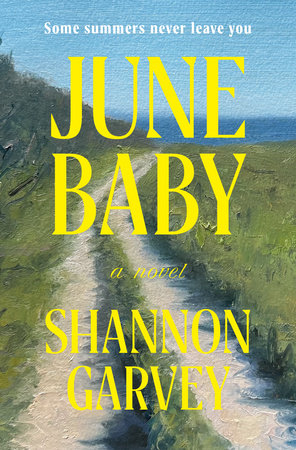
June Baby

A Novel

Look inside
Hardcover
$30.00 US
On sale May 12, 2026 | 352 Pages | 9780593979907

See Additional Formats
Some summers never leave you.

In this moving debut novel, set over the course of one transformative summer in the lush, beachy enclave of Block Island, a young woman reckons with love, loss, and the choices she must make to move forward.

“The book of the summer! It has everything I want in a beach read: juicy romance, explosive family secrets, and a delicious island setting.”—Elin Hilderbrand


At seventeen, Ruth lost her mother to cancer, and her father, unable to handle his grieving daughter, shipped her off to Block Island with nothing but a name scribbled on the back of a receipt: Diana Beckett. Diana, a renowned photographer, took Ruth in for the summer, and Block Island became Ruth’s refuge, a place of beauty and creativity, a place where she could nurture her dreams of being a writer, a place where she could fall in love for the first time—with Diana’s nephew, Charlie.

Now, at twenty-seven, Ruth has spent the last ten summers living and working among the lucky few who get to vacation in this wealthy beach town, and the rest of the year just scraping by, yearning to return to the place where she feels safe and unburdened. But then Ruth’s world is upended by tragedy again. Desperate for an anchor, she reaches for the person she’s been pining for since she met him—Charlie—who has his own startling revelation to share. And when another surprise comes in the form of a box left to Ruth by Diana, its contents raise questions about just how well she knew the two women who raised her. Torn between what to believe about her past, and what her future might hold, Ruth is faced with another choice: does she dare to rewrite her story entirely?

Both a heartfelt coming-of-age story and a tender exploration of love and grief, set against a backdrop of golden dunes and seaside sunsets, June Baby shows us what it might look like to embrace a life shaped not by loss, but by possibility.
1

Ruth stared at her truck smoking in the sandy garage lot. The clouds were high and gray, and the wind coming off the ocean was unseasonably cold, rustling the branches of the privet bushes and the mulberry trees, all low and warped into odd angles from a life of trying to grow amid strong salt wind.

Wrapping her large flannel shirt around her chest, Ruth held herself close. The mechanic, her dad’s friend Bill, approached her from inside the open shop door. A seagull circled and landed on the lip of the flat roof, seeming to look down at the barren scene, its eyes blank, its left foot broken, dangling midair.

It didn’t feel like June—the gray sky, the thin air, the strong cold wind. Next door a construction crew was digging in a foundation, the ground ripped open, wet mud stuck to the claw of the excavator, the team nowhere around, everyone on break. The smell of the exposed earth hit Ruth, and she was brought back to her mother’s cold face unrecognizable in the coffin that Ruth helped to pick out. For the past ten years, the smell of defrosting earth and mud had reminded her of the smell that emanated from the grave as they lowered that wooden box into the newly opened ground, fresh grass starting to sprout around the head of the new tombstone and red-winged blackbirds trilling in the trees above.

“She’s dead, right?” Ruth asked, shaking the memory and pointing at the truck.

Bill sighed and stuffed his hands into the back pockets of his worn jeans. His look of pity made Ruth drop her hand from her eyes and wrap herself more tightly into her own arms.

“Sorry, Ruth—totaled.”

“Can I sell it to you for any parts?” she asked.

“I can give you two hundred for it,” Bill said, and Ruth knew he was being generous, that it was worth nothing. There was a moment when her pride told her to call him on his bluff, but she paused when she thought about what little was left in her bank account. The flood of shame that followed made Ruth’s eyes drop to the ground.

“You don’t have to do that,” she said, still hoping that he wouldn’t rescind the offer.

“Don’t be silly,” Bill replied, walking into the shop toward the old cash register on the counter. “The tires are still good. Those will go for fifty each,” he said, approaching her with his arm outstretched and putting two hundred-dollar bills in her hand.

Ruth looked at the bald tires. She imagined them collecting rainwater behind the building, added to the pyramid of rubber that had no use.

“Did you see Joel before you came out?” Bill asked, and Ruth’s gaze dropped to the ground again. She knew that her father had always asked him to keep an eye on her while she was out on the island.

“I didn’t,” she said. “It was a pretty abrupt move this year.”

Bill’s look of pity returned, and she knew he was going to ask her about Diana, about what happened, and how she was holding up. All of Block Island would know by now, Ruth thought. Already, The New York Times had run a short death announcement noting Diana’s sudden passing, and her contributions to the fashion and photography world. Ruth had stopped reading after the first few words, unable to think about Diana in the past tense.

She had missed the calls the night before. It had been a busy shift at the bar in Maine where Ruth worked in the off-season, which she was glad about. She was leaving for the island at the end of the week and needed all the tips she could get, so she kept the bar open a little longer than usual, extending last call, hoping that the cash would fall more freely out of everyone’s wallets as they finally settled their tabs. It was one in the morning when she finally looked at her phone and saw all the missed calls, voicemails, and texts from Charlie, Diana’s nephew. Ruth closed the bar without cleaning, locked the door behind her, and listened to Charlie’s messages huddled next to the dark building, the wind making it hard to hear.

“We’re at Rhode Island Hospital in Providence. Diana’s . . . Diana’s dying, Ruth. She had lung cancer . . . for a long time and it got bad and . . . They don’t know if she’s going to make it through the night, and you need to come. You need to come now.”

Ruth ran the short distance from the bar to her apartment, threw her clothes into trash bags, tossed them into the bed of her truck, and started driving south in the darkness without telling her roommate she was leaving. Watching the sun come up over the highway, she stopped only for gas and large cups of coffee that made her breath and stomach sour.

While she drove, she tried to understand what Charlie’s messages meant and tried to focus on the road through her panic. Diana had been sick—lung cancer. She had known for a long time. Ruth ran through the past year in her mind, trying to catalogue the moments when she should have known, whether it had been obvious and she had missed it.

The first time Ruth had noticed Diana’s wheezing cough was this past Christmas, when Diana had called to wish her a happy holiday. They’d ended up fighting, and the anger had driven any concern from Ruth’s mind. But the last time they’d spoken, only a month ago, Diana had still been coughing, though she brushed it off as a cold, said she was taking care of herself.

Ruth was replaying the phone call, her foot weighing heavy on the gas pedal, the truck groaning to accelerate the last hour to the hospital, when Charlie called again to tell her that Diana had passed.

He was crying and Ruth held the phone in her lap, listening to the sound of him sob close to the receiver. Ruth hadn’t made it in time. She let him cry, focused on the beeping of the monitors in the background, and said nothing. A feeling was growing in her, one that made her clench the steering wheel so that even in the darkness she could see the whites of her knuckles.

When Charlie hung up, Ruth kept driving. The walls of the cab seemed to tighten around her, the guardrail to her left feeling so close that her wheel would clip it at any second.

She hated herself in that moment for ever forgetting that she was alone. Then she hated herself for the self-pity. She hated herself most for not being there.

She kept driving, headed to Galilee.

When she arrived to catch the first ferry to Block Island, she ignored the familiar harbor, the faded and stained fishing boats that sandwiched the ferry, the circling birds, the abandoned Lighthouse Inn across the street, splattered in seagull shit.

Once Ruth backed the truck up the ramp and into the hull of the Carol Jean ferryboat, she turned off the engine, smelling exhaust, and listened to the reverberating din of cars and people echoing off the heavy metal hull. Ruth was loosely aware of the numbing haze she was in, could feel somewhere in the back of her mind how she was dissociating, pulling the knowledge of Diana’s death away from herself, until she was left with only a thrumming tightness in her chest, one she was familiar with, one that she could handle.

A couple backed their vintage Land Rover up in front of Ruth’s truck, their golden retriever sitting between them in the narrow cab. As they got out, Ruth admired their clean woolen sweaters, their pressed pants, their stylish eyeglasses. It was an easy affluence she should be used to by now, a quieter wealth that came from generations of security, of beautiful homes in coveted places, of grandmothers passing on tasteful furniture, solid gold earrings, property in Europe. There were many people on the island who looked like this, coming and going for weekends and holidays, trekking out to houses on the far west of the island, secluded from town. She had catered their parties over the years, passed trays at Fourth of July and Memorial Day celebrations, while friends of hers plucked the standup bass or shucked oysters on the pristine deck. These were the only times that Ruth felt unwelcome on the island, shooed off the properties as soon as she got paid, her bike rattling as she cruised back toward the noise of town, back toward the boarding houses for the summer employees, toward the raucous bars and boats.

Ruth was still staring as the couple led their dog toward the stairs and up onto the deck. After the ferry horn blared and she felt the boat jolt away from the dock, she let herself drift into a light sleep, the early morning highway lanes she’d sped through still burned into her mind’s eye.

When she arrived on the island, she drove up the hill from the ferry ramp. The National Hotel stood large, white, and empty in the late spring morning. She made it the half mile out of town and onto the dirt driveway of her usual summer housing, a small, uninsulated cottage that was still boarded up for the winter, before the truck started to smoke. At first Ruth wondered if she was seeing things, but the gray fumes eked out the edges of the white hood as if it were a candle whose flame had just been extinguished, growing thicker and twisting in the wind. The smell of spent engine oil was sharp against the cool spring air.
Shannon Garvey received her MFA from the University of New Hampshire, where she taught undergraduate classes. She has published short fiction in The Saturday Evening Post. She grew up in Rhode Island, and now lives on the rocky New Hampshire coast. She researched June Baby during many years waiting tables in tourist towns and her time working on Block Island. View titles by Shannon Garvey
“What a treat to get lost in the sharply drawn, salt-washed world of June Baby. This novel about grief, first love, and the slow, uncertain work of growing up is tender and precise, and Garvey’s prose reveals a writer of real emotional intelligence and depth.”—Coco Mellors, New York Times bestselling author of Blue Sisters

“A sun-drenched novel of love, tragedy, beauty, and creativity, June Baby is a glittering debut novel from an exciting new voice.”—Jenny Jackson, New York Times bestselling author of Pineapple Street

“The kind of gorgeous book that carries us back to the sharp sweet days of longing and late sunlight, summer days that are always more than themselves, where we grow to become the people we are now. . . . Absorbing and moving, I loved every second of my time with Ruth on the island—a world of salt, sorrow, and immeasurable love.”—Sarah Blake, New York Times bestselling author of The Postmistress

June Baby has everything I want in a beach read: juicy romance, explosive family secrets, and a delicious island setting. Shannon Garvey has delivered the book of the summer!”—Elin Hilderbrand, #1 New York Times bestselling author of The Five-Star Weekend

“Amid white sand dunes and star-kissed nights, this tender debut aches with longing as it explores how the idea of love can sometimes outlast love itself. . . . A layered, hopeful meditation on grief, second chances, and the home found within each of us.”—Emma Brodie, author of Songs in Ursa Major

“From its opening pages, June Baby transports readers to the wind-swept dunes and watercolor skies of Block Island—and the quiet, impossible decisions we face in our twenties. Through an unflinching lens, Shannon Garvey explores the choices we do and don’t get to make as we navigate loss and opportunity with gorgeous prose. This shimmering debut about the agony and thrill of growing up is a dazzler.”—Beck Dorey-Stein, author of Spectacular Things

“A real find . . . Shannon Garvey is a writer of depth and vivid detail, and I was swept away by her story of Ruth’s breathless summer of decision. This absorbing novel is an honest examination of the choices—of love, friendship, and vocation—a young woman faces, that feels fresh and alive.”—Judy Blundell, author of The High Season

“Garvey’s debut is a character-driven deep dive that transports readers to island summers, first love, and the messy realities of both family and found family.”Booklist

About

Some summers never leave you.

In this moving debut novel, set over the course of one transformative summer in the lush, beachy enclave of Block Island, a young woman reckons with love, loss, and the choices she must make to move forward.

“The book of the summer! It has everything I want in a beach read: juicy romance, explosive family secrets, and a delicious island setting.”—Elin Hilderbrand


At seventeen, Ruth lost her mother to cancer, and her father, unable to handle his grieving daughter, shipped her off to Block Island with nothing but a name scribbled on the back of a receipt: Diana Beckett. Diana, a renowned photographer, took Ruth in for the summer, and Block Island became Ruth’s refuge, a place of beauty and creativity, a place where she could nurture her dreams of being a writer, a place where she could fall in love for the first time—with Diana’s nephew, Charlie.

Now, at twenty-seven, Ruth has spent the last ten summers living and working among the lucky few who get to vacation in this wealthy beach town, and the rest of the year just scraping by, yearning to return to the place where she feels safe and unburdened. But then Ruth’s world is upended by tragedy again. Desperate for an anchor, she reaches for the person she’s been pining for since she met him—Charlie—who has his own startling revelation to share. And when another surprise comes in the form of a box left to Ruth by Diana, its contents raise questions about just how well she knew the two women who raised her. Torn between what to believe about her past, and what her future might hold, Ruth is faced with another choice: does she dare to rewrite her story entirely?

Both a heartfelt coming-of-age story and a tender exploration of love and grief, set against a backdrop of golden dunes and seaside sunsets, June Baby shows us what it might look like to embrace a life shaped not by loss, but by possibility.

Excerpt

1

Ruth stared at her truck smoking in the sandy garage lot. The clouds were high and gray, and the wind coming off the ocean was unseasonably cold, rustling the branches of the privet bushes and the mulberry trees, all low and warped into odd angles from a life of trying to grow amid strong salt wind.

Wrapping her large flannel shirt around her chest, Ruth held herself close. The mechanic, her dad’s friend Bill, approached her from inside the open shop door. A seagull circled and landed on the lip of the flat roof, seeming to look down at the barren scene, its eyes blank, its left foot broken, dangling midair.

It didn’t feel like June—the gray sky, the thin air, the strong cold wind. Next door a construction crew was digging in a foundation, the ground ripped open, wet mud stuck to the claw of the excavator, the team nowhere around, everyone on break. The smell of the exposed earth hit Ruth, and she was brought back to her mother’s cold face unrecognizable in the coffin that Ruth helped to pick out. For the past ten years, the smell of defrosting earth and mud had reminded her of the smell that emanated from the grave as they lowered that wooden box into the newly opened ground, fresh grass starting to sprout around the head of the new tombstone and red-winged blackbirds trilling in the trees above.

“She’s dead, right?” Ruth asked, shaking the memory and pointing at the truck.

Bill sighed and stuffed his hands into the back pockets of his worn jeans. His look of pity made Ruth drop her hand from her eyes and wrap herself more tightly into her own arms.

“Sorry, Ruth—totaled.”

“Can I sell it to you for any parts?” she asked.

“I can give you two hundred for it,” Bill said, and Ruth knew he was being generous, that it was worth nothing. There was a moment when her pride told her to call him on his bluff, but she paused when she thought about what little was left in her bank account. The flood of shame that followed made Ruth’s eyes drop to the ground.

“You don’t have to do that,” she said, still hoping that he wouldn’t rescind the offer.

“Don’t be silly,” Bill replied, walking into the shop toward the old cash register on the counter. “The tires are still good. Those will go for fifty each,” he said, approaching her with his arm outstretched and putting two hundred-dollar bills in her hand.

Ruth looked at the bald tires. She imagined them collecting rainwater behind the building, added to the pyramid of rubber that had no use.

“Did you see Joel before you came out?” Bill asked, and Ruth’s gaze dropped to the ground again. She knew that her father had always asked him to keep an eye on her while she was out on the island.

“I didn’t,” she said. “It was a pretty abrupt move this year.”

Bill’s look of pity returned, and she knew he was going to ask her about Diana, about what happened, and how she was holding up. All of Block Island would know by now, Ruth thought. Already, The New York Times had run a short death announcement noting Diana’s sudden passing, and her contributions to the fashion and photography world. Ruth had stopped reading after the first few words, unable to think about Diana in the past tense.

She had missed the calls the night before. It had been a busy shift at the bar in Maine where Ruth worked in the off-season, which she was glad about. She was leaving for the island at the end of the week and needed all the tips she could get, so she kept the bar open a little longer than usual, extending last call, hoping that the cash would fall more freely out of everyone’s wallets as they finally settled their tabs. It was one in the morning when she finally looked at her phone and saw all the missed calls, voicemails, and texts from Charlie, Diana’s nephew. Ruth closed the bar without cleaning, locked the door behind her, and listened to Charlie’s messages huddled next to the dark building, the wind making it hard to hear.

“We’re at Rhode Island Hospital in Providence. Diana’s . . . Diana’s dying, Ruth. She had lung cancer . . . for a long time and it got bad and . . . They don’t know if she’s going to make it through the night, and you need to come. You need to come now.”

Ruth ran the short distance from the bar to her apartment, threw her clothes into trash bags, tossed them into the bed of her truck, and started driving south in the darkness without telling her roommate she was leaving. Watching the sun come up over the highway, she stopped only for gas and large cups of coffee that made her breath and stomach sour.

While she drove, she tried to understand what Charlie’s messages meant and tried to focus on the road through her panic. Diana had been sick—lung cancer. She had known for a long time. Ruth ran through the past year in her mind, trying to catalogue the moments when she should have known, whether it had been obvious and she had missed it.

The first time Ruth had noticed Diana’s wheezing cough was this past Christmas, when Diana had called to wish her a happy holiday. They’d ended up fighting, and the anger had driven any concern from Ruth’s mind. But the last time they’d spoken, only a month ago, Diana had still been coughing, though she brushed it off as a cold, said she was taking care of herself.

Ruth was replaying the phone call, her foot weighing heavy on the gas pedal, the truck groaning to accelerate the last hour to the hospital, when Charlie called again to tell her that Diana had passed.

He was crying and Ruth held the phone in her lap, listening to the sound of him sob close to the receiver. Ruth hadn’t made it in time. She let him cry, focused on the beeping of the monitors in the background, and said nothing. A feeling was growing in her, one that made her clench the steering wheel so that even in the darkness she could see the whites of her knuckles.

When Charlie hung up, Ruth kept driving. The walls of the cab seemed to tighten around her, the guardrail to her left feeling so close that her wheel would clip it at any second.

She hated herself in that moment for ever forgetting that she was alone. Then she hated herself for the self-pity. She hated herself most for not being there.

She kept driving, headed to Galilee.

When she arrived to catch the first ferry to Block Island, she ignored the familiar harbor, the faded and stained fishing boats that sandwiched the ferry, the circling birds, the abandoned Lighthouse Inn across the street, splattered in seagull shit.

Once Ruth backed the truck up the ramp and into the hull of the Carol Jean ferryboat, she turned off the engine, smelling exhaust, and listened to the reverberating din of cars and people echoing off the heavy metal hull. Ruth was loosely aware of the numbing haze she was in, could feel somewhere in the back of her mind how she was dissociating, pulling the knowledge of Diana’s death away from herself, until she was left with only a thrumming tightness in her chest, one she was familiar with, one that she could handle.

A couple backed their vintage Land Rover up in front of Ruth’s truck, their golden retriever sitting between them in the narrow cab. As they got out, Ruth admired their clean woolen sweaters, their pressed pants, their stylish eyeglasses. It was an easy affluence she should be used to by now, a quieter wealth that came from generations of security, of beautiful homes in coveted places, of grandmothers passing on tasteful furniture, solid gold earrings, property in Europe. There were many people on the island who looked like this, coming and going for weekends and holidays, trekking out to houses on the far west of the island, secluded from town. She had catered their parties over the years, passed trays at Fourth of July and Memorial Day celebrations, while friends of hers plucked the standup bass or shucked oysters on the pristine deck. These were the only times that Ruth felt unwelcome on the island, shooed off the properties as soon as she got paid, her bike rattling as she cruised back toward the noise of town, back toward the boarding houses for the summer employees, toward the raucous bars and boats.

Ruth was still staring as the couple led their dog toward the stairs and up onto the deck. After the ferry horn blared and she felt the boat jolt away from the dock, she let herself drift into a light sleep, the early morning highway lanes she’d sped through still burned into her mind’s eye.

When she arrived on the island, she drove up the hill from the ferry ramp. The National Hotel stood large, white, and empty in the late spring morning. She made it the half mile out of town and onto the dirt driveway of her usual summer housing, a small, uninsulated cottage that was still boarded up for the winter, before the truck started to smoke. At first Ruth wondered if she was seeing things, but the gray fumes eked out the edges of the white hood as if it were a candle whose flame had just been extinguished, growing thicker and twisting in the wind. The smell of spent engine oil was sharp against the cool spring air.

Author

Shannon Garvey received her MFA from the University of New Hampshire, where she taught undergraduate classes. She has published short fiction in The Saturday Evening Post. She grew up in Rhode Island, and now lives on the rocky New Hampshire coast. She researched June Baby during many years waiting tables in tourist towns and her time working on Block Island. View titles by Shannon Garvey

Praise

“What a treat to get lost in the sharply drawn, salt-washed world of June Baby. This novel about grief, first love, and the slow, uncertain work of growing up is tender and precise, and Garvey’s prose reveals a writer of real emotional intelligence and depth.”—Coco Mellors, New York Times bestselling author of Blue Sisters

“A sun-drenched novel of love, tragedy, beauty, and creativity, June Baby is a glittering debut novel from an exciting new voice.”—Jenny Jackson, New York Times bestselling author of Pineapple Street

“The kind of gorgeous book that carries us back to the sharp sweet days of longing and late sunlight, summer days that are always more than themselves, where we grow to become the people we are now. . . . Absorbing and moving, I loved every second of my time with Ruth on the island—a world of salt, sorrow, and immeasurable love.”—Sarah Blake, New York Times bestselling author of The Postmistress

June Baby has everything I want in a beach read: juicy romance, explosive family secrets, and a delicious island setting. Shannon Garvey has delivered the book of the summer!”—Elin Hilderbrand, #1 New York Times bestselling author of The Five-Star Weekend

“Amid white sand dunes and star-kissed nights, this tender debut aches with longing as it explores how the idea of love can sometimes outlast love itself. . . . A layered, hopeful meditation on grief, second chances, and the home found within each of us.”—Emma Brodie, author of Songs in Ursa Major

“From its opening pages, June Baby transports readers to the wind-swept dunes and watercolor skies of Block Island—and the quiet, impossible decisions we face in our twenties. Through an unflinching lens, Shannon Garvey explores the choices we do and don’t get to make as we navigate loss and opportunity with gorgeous prose. This shimmering debut about the agony and thrill of growing up is a dazzler.”—Beck Dorey-Stein, author of Spectacular Things

“A real find . . . Shannon Garvey is a writer of depth and vivid detail, and I was swept away by her story of Ruth’s breathless summer of decision. This absorbing novel is an honest examination of the choices—of love, friendship, and vocation—a young woman faces, that feels fresh and alive.”—Judy Blundell, author of The High Season

“Garvey’s debut is a character-driven deep dive that transports readers to island summers, first love, and the messy realities of both family and found family.”Booklist