Download high-resolution image
Listen to a clip from the audiobook
audio play button
0:00
0:00

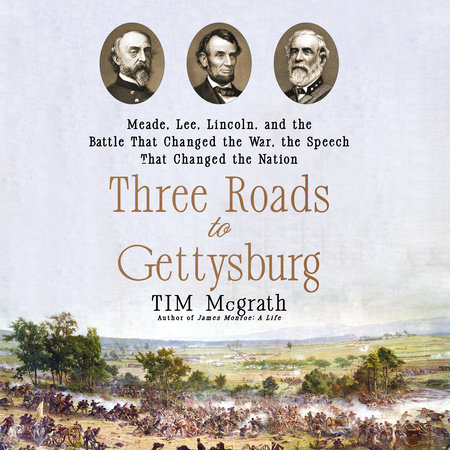
Three Roads to Gettysburg

Meade, Lee, Lincoln, and the Battle That Changed the War, the Speech That Changed the Nation

Read by Vas Eli
Listen to a clip from the audiobook
audio play button
0:00
0:00
An epic, revelatory account of the Battle of Gettysburg, where George Meade, Lincoln's unexpected choice to lead the Union army, defeated Robert E. Lee and changed the course of the Civil War, from the award-winning author of James Monroe: A Life

By mid-1863, the Civil War, with Northern victories in the West and Southern triumphs in the East, seemed unwinnable for Abraham Lincoln. Robert E. Lee’s bold thrust into Pennsylvania, if successful, could mean Southern independence. In a desperate countermove, Lincoln ordered George Gordon Meade—a man hardly known and hardly known in his own army—to take command of the Army of the Potomac and defeat Lee’s seemingly invincible Army of Northern Virginia. Just three days later, the two great armies collided at a small town called Gettysburg. The epic three-day battle that followed proved to be the turning point in the war, and provided Lincoln the perfect opportunity to give the defining speech of the war—and a challenge to each generation of Americans to live by.

These men came from different parts of the country and very different upbringings: Robert E. Lee, son of the aristocratic and slaveholding South; George Gordon Meade, raised in the industrious, straitlaced North; and Abraham Lincoln, from the rowdy, untamed West. Lincoln’s election to the presidency in 1860 split the country in two and triggered the Civil War. Lee and Meade found themselves on opposite sides, while Lincoln had the Sisyphean task of reuniting the country.

With a colorful supporting cast second to none, Three Roads to Gettysburg tells the story of these consequential men, this monumental battle, and the immortal address that has come to define America.
One

Son of the Prairie

Abraham Lincoln his hand and pen he will be
Good but god knows When

-Abraham Lincoln,
from the early 1820s

One wonders if Abraham Lincoln would have written so modestly about his upbringing and surroundings had he known he would become one of history’s immortals. Many figures, including those higher born or with much smaller accomplishments, have stretched, exaggerated, or outright lied about their biographies with barely a pang of guilt, including more than a few American presidents.

But the sixteenth president was made of sterner stuff. Did he prevaricate, befog, or withhold elements of the truth during his career? Yes. But he was almost ensorcelled by the truth. Lying was an anomaly to Lincoln; when the press and public bestowed the nickname “Honest Abe” on him, it did not spring from sarcasm.

Throughout his life he remained understated about his genealogy. “I know so little of our family history,” he commented to distant relative, Solomon Lincoln, in 1848, although he did know the basics:

I was born Feb:12th. 1809 in Hardin county, Kentucky. My father’s name is Thomas; my grandfather’s name was Abraham,— the same of my own. My grandfather went to Rockingham county in Virginia, to Kentucky, about the year 1782; and, two years afterwards. Was killed by the indians. We have a vague tradition, that my great-grandfather went from Pennsylvania to Virginia, and that he was a quaker. Further back than this, I have never heard any thing.

Lincoln would have happily provided Solomon with more information, but “owing to my father being left an orphan at the age of six years, in poverty, in a new country, he became a wholly uneducated man.” Lincoln meant no pique with his father; that was just his reason for the lack of further detail.

Thomas witnessed his father Abraham’s murder by a Native American raiding party while building his new home. His mother, Bathsheba Lincoln, then took her children with her family to central Kentucky. From his teens, Thomas worked at any job that helped put coins or food
on the table—as a day laborer, soldier, surveyor, and prison guard. He had a knack for carpentry. He was tall for the times, five foot, ten inches, big-​boned and barrel-chested. Regarded as someone one would want on their side in a fight, Thomas neither looked for trouble nor walked
away from it. He made his reputation as “a peaceable man.” In a photograph of him in later years he wears a perceptible frown while his clear eyes stare straight at the cameraman. Age has taken some of his dark hair and softened what was once a firm jawline. Surely, Tom Lincoln
was someone to reckon with.

By 1806, Thomas was the owner of a two-​hundred-​plus-​acre farm in Hardin County when two local merchants contracted him to build, man, and take a flatboat laden with their goods down the Mississippi to New Orleans. It was tedious and sometimes dangerous work, as flatboats
manned by amateurs often sank.

He returned in May, having bought himself a fine beaver hat and a pair of silk suspenders. Among his other purchases were ample supplies of linens, silk, scarlet cloth, buttons, and bolts of cloth. Not all of this finery was for his mother and sister. Tom, now twenty-​eight, was in love.

Nancy Hanks had been a small child when her grandparents, Joseph and Ann Hanks, took her from Virginia to Kentucky. Likely illegitimate, she was living with neighbors of Thomas Lincoln when they met. They were married at a simple ceremony on June 12, 1806. Thomas soon took her to Elizabethtown, where he had built a small home; his carpentry skills kept him steadily employed. The following February, they had their first child, Sarah, whom they called Sally.

Two years later, the young family was living in Sinking Spring, where Tom had bought 348 acres of farmland. They were cooped up in a sixteen‑by‑eighteen-foot log cabin when the fourth member of the family, christened Abraham, was born on February 12.

The Lincolns spent just two years in Elizabethtown; fallow farmland and the question of Thomas’s ownership saw to that. He took his family northeast to Knob Creek, where he found more productive acreage, built another log cabin, and soon found demand for his carpentry skills. Knob Creek, with its picturesque hills, lay a few miles from the Cumberland Trail, which ran from Louisville to Nashville, Tennessee. Here, Sally and little Abe attended “ABC schools” in cabins similar to their home. In 1812 another baby, christened Thomas, was born, but he died days afterward.

Thomas Lincoln’s growing status— he was among the top taxpayers in Hardin County— soon brought him into conflict with veterans from an earlier war. Many Continental Army officers from the Revolutionary War had been awarded thousands of acres on the frontier for their services, and disputes frequently arose when they learned that settlers like Tom Lincoln were living on acreage they had legally bought from agents that was not theirs to sell. Lincoln was one of ten farmers who were evicted and was forced to leave the state. Years later, Abe mentioned another reason for the family’s departure: “This removal was partly on account of slavery.”

Abe’s parents belonged to a Baptist church that was stridently against slavery. Although being antislavery did not carry much risk in Hardin County, where over 40 percent of the population were enslaved persons, their free or cheap labor cut into Tom’s getting work more than once.

Between Thomas’s land title difficulty and the growing competition of cheap labor, leaving Kentucky looked to be an astute move. In the fall of 1816, Thomas packed up his family and crossed the Ohio River, bound for Indiana. Once there, he chose a plot of promising farmland on Pigeon Creek, in Spencer County.

Abe called the land “unbroken forest,” endless underbrush “with many bears and other wild animals still in the woods.” By the time he was seven Abe, already tall for his age, was given an axe and shown how to use it. It was the start of endless days of hard work and blisters for the next sixteen years: the axe was like an extension of his arm, “less, of course, in plowing and harvesting seasons.” Working alongside his father, the Lincolns soon had an eighteen‑by‑twenty-foot log cabin for their new home.

He was also expected to hunt game. One day a flock of wild turkeys approached the Lincoln cabin, and Abe grabbed his father’s rifle and shot one. Killing the bird immediately filled him with a sense of guilt that lasted a lifetime. In 1860, he would publicly attest he “has never since pulled a trigger on any larger game.”

In 1818, Nancy Hanks Lincoln contracted the “milk sickness,” a disease from the tainted milk of cattle that ate the poisonous white snakeroot plant. Humans suffered tremors, severe abdominal pain, and constant vomiting. It was an agonizing death for Abe and Sarah to witness. Nancy’s kindnesses to them, her own work ethic, and her devotion never left Abe. “All that I am, or ever hope to be,” he later declared, “I owe to my angel mother.”

Another crisis for Nancy’s children came the following year, one not as heartbreaking as her death, but no less challenging. With their cousin Dennis Hanks left with Abe and Sally for company, Thomas returned to Kentucky in search of a new wife. He was gone for weeks, leaving the three to fend for themselves. Abe later recollected how “the panther’s scream, filled night with fear” while “bears preyed on the swine.” Thomas not only returned with a wife but an entire family. The new Mrs. Lincoln was the former Sarah Bush Johnston, a Kentucky widow. With Sarah’s two daughters and son, the small cabin now sheltered eight; it would remain their home for twelve years.

Thomas Lincoln believed in diligent work and did not drink alcohol, traits he passed on to his son. He also was quite the storyteller and loved a good joke. But there was also a streak of depression inside him. “Everything I ever teched either died, got killed, or was lost,” Thomas once bitterly remarked. His sense of humor and dark spells became ingrained in his son.

Abe and Sally continued their education at various ABC schools, but Abe’s schooling was often interrupted by chores at home and his father’s growing habit of “hiring out” his son. It was a normal practice along the frontier, and as Abe grew, he became a steady source of income for his father. Being big for his age, he worked on farms, ran errands, did basic carpentry, butchered hogs, and even served some time operating a ferryboat.

Abe also split rails, a task that required as much strength and endurance as skill. He would place or roll a tree trunk across two logs, looking for a side with no knots. Maul in hand, he then put an iron wedge in the center, tapped it into the log until firmly in place, then drove it deep enough to make a substantial crack in the log. He followed this with wedges several feet on either side of the first, driving them through the timber until it split in half. He repeated the process on both halves, giving his boss (or father) four equal rails. Then it was on to another trunk, and another, and another. Rail splitting could be as dangerous as it was tedious. “One day, while I was sharpening a wedge on a log, the ax glanced and nearly took my thumb off,” Abe later recalled, showing his listener the scar.

Work took precedence over schooling. In his adult years he concluded that “the aggregate of his schooling did not amount to one year.” Instead, he began educating himself at home, reading anything and everything he could get his hands on, from the Bible to poetry, from Parson Weems’s The Life of Washington to Robinson Crusoe. Abe later admitted that “my father had suffered greatly for the want of education,” and legend has it that Thomas frowned on Abe’s getting one, but his stepmother insisted otherwise. “Mr. Lincoln never made Abe quit reading to do anything if he could avoid it,” she later recalled.

Sarah devotedly stepped into Nancy’s role as Abe’s mother, and he lovingly responded. “Abe never gave me a curious word or look,” and he would do anything she asked of him. He in turn called her “his best Friend.” As Abe grew through his boyhood, teenage years, and into adulthood, her encouragement was a constant in his life. Under Sarah’s watch, he and Sally developed close relationships with Sarah’s children. In 1826, Sally married Aaron Grigsby; she died two years later in childbirth (the baby was stillborn), plunging Abe into a deep, angry sadness, believing that Grigsby and his family’s delay in not riding for a doctor caused her death.

By this time Abe was at or near his full height of six feet four, rail-thin yet muscular. There was no fat on the bone. Having seen (and enjoyed) those times when he witnessed Tom hold court at stores, picnics, or town gatherings, Abe had already begun acquiring his own reputation for spinning a good yarn or telling the funniest of jokes. Well-versed in the Bible, he never officially joined his parents’ church. Like Thomas, however, he had proven his fighting skills more than once, although he shared his father’s wish to avoid fights and stop others. During one fight involving, ironically, the Grigsby brothers, Lincoln declared himself “the big buck of the lick.” When it was over, no one was inclined to take him on.

In the spring of 1828, nineteen- ‑ year‑ old Abraham Lincoln and a friend, Allen Gentry, boarded a flatboat at Gentry’s Landing on the Ohio River near Rockport, Indiana, to begin the long journey down the Ohio and Mississippi Rivers to New Orleans.

Gentry’s father, James, was Pigeon Creek’s most successful citizen, with a 1,000-acre farm, a busy store, and the landing bearing his name on the Ohio River. He had the flatboat loaded with a hefty supply of agricultural goods to sell in the Crescent City. Allen had made the voyage before, but this was Abe’s first trip away from home. Although a newcomer to this journey, Abe was an easy choice for the Gentrys. Lean, muscular, and intimidating, Abe would make the perfect “bow- hand— working the foremost oars,” as his cousin recalled decades later. The boys would be paid $8 a month.

Abe and Allen built the craft, likely with help from Abe’s father, who no doubt gave them advice on navigating their way downriver. Once they arrived at their destination, they were to get the best price possible for the elder Gentry’s goods, break up the flatboat and sell the lumber, and book passage back on a steamboat—a comfortable reward for their efforts.

Boatbuilding is not work for amateurs. A poorly made flatboat would not get five miles down the river. It took seasoned hands to build and caulk; a properly constructed boat could take up to 2,000 boat pins to hold it together. Abe and Allen’s oblong- ‑ shaped boat was forty feet long with a fifteen-foot beam. It was tedious and sometimes dangerous work, as flatboats manned by amateurs often sank.

Springtime brought flood tides from melting snow, quickening the river’s flow and giving even veteran keelboat men challenges aplenty, as a former Mississippi pilot named Samuel Clemens knew all too well:

It is a remarkable river in this: that instead of widening toward its mouth, it grows narrower; grows narrower and deeper. From the junction of the Ohio to a point half way down to the sea, the width averages a mile in high water: thence to the sea the width steadily diminishes, until, at the “Passes,” above the mouth, it is but little over half a mile. At the junction of the Ohio the Mississippi’s depth is eighty-seven feet; the depth increases gradually, reaching one hundred and twenty-nine just above the mouth.

For weeks, the two youths made their way down the Mississippi, their small, clumsy craft part of the traffic heading up‑and downriver. There were small pirogues, canoes favored by trappers; keelboats manned by men who poled their boats steadily downriver; barges, usually carrying at least a mast and jib and square sail, taking advantage of any wind; and the newcomers to the Mississippi: steamboats, their churning paddle wheel propelling them up‑or downstream with ease, especially compared to the boys’ ungainly craft.

Instead of a rudder, most flatboats were steered by a sweep: a long oar that further calloused Abe’s already roughened hands and put his bicepses to good use. The boys learned to handle the Mississippi’s endless S curves, especially from Missouri southward. The spring floods uprooted old trees, sending them into the river, where they became snags or battering rams. Sandbars caught many a flatboat, and high water could suddenly create whirlpools spinning between the eddies close to shore and the river’s current. At sundown, Abe and Allen either ran their boat onto the riverbank for a full night’s rest or waved a lantern in the darkness to let other traveling watercraft see them.
© Courtesy of Cyd McGrath
Tim McGrath is a two-time winner of the Commodore John Barry Book Award, as well as the author of the critically acclaimed biography John Barry: An American Hero in the Age of Sail. View titles by Tim McGrath

About

An epic, revelatory account of the Battle of Gettysburg, where George Meade, Lincoln's unexpected choice to lead the Union army, defeated Robert E. Lee and changed the course of the Civil War, from the award-winning author of James Monroe: A Life

By mid-1863, the Civil War, with Northern victories in the West and Southern triumphs in the East, seemed unwinnable for Abraham Lincoln. Robert E. Lee’s bold thrust into Pennsylvania, if successful, could mean Southern independence. In a desperate countermove, Lincoln ordered George Gordon Meade—a man hardly known and hardly known in his own army—to take command of the Army of the Potomac and defeat Lee’s seemingly invincible Army of Northern Virginia. Just three days later, the two great armies collided at a small town called Gettysburg. The epic three-day battle that followed proved to be the turning point in the war, and provided Lincoln the perfect opportunity to give the defining speech of the war—and a challenge to each generation of Americans to live by.

These men came from different parts of the country and very different upbringings: Robert E. Lee, son of the aristocratic and slaveholding South; George Gordon Meade, raised in the industrious, straitlaced North; and Abraham Lincoln, from the rowdy, untamed West. Lincoln’s election to the presidency in 1860 split the country in two and triggered the Civil War. Lee and Meade found themselves on opposite sides, while Lincoln had the Sisyphean task of reuniting the country.

With a colorful supporting cast second to none, Three Roads to Gettysburg tells the story of these consequential men, this monumental battle, and the immortal address that has come to define America.

Excerpt

One

Son of the Prairie

Abraham Lincoln his hand and pen he will be
Good but god knows When

-Abraham Lincoln,
from the early 1820s

One wonders if Abraham Lincoln would have written so modestly about his upbringing and surroundings had he known he would become one of history’s immortals. Many figures, including those higher born or with much smaller accomplishments, have stretched, exaggerated, or outright lied about their biographies with barely a pang of guilt, including more than a few American presidents.

But the sixteenth president was made of sterner stuff. Did he prevaricate, befog, or withhold elements of the truth during his career? Yes. But he was almost ensorcelled by the truth. Lying was an anomaly to Lincoln; when the press and public bestowed the nickname “Honest Abe” on him, it did not spring from sarcasm.

Throughout his life he remained understated about his genealogy. “I know so little of our family history,” he commented to distant relative, Solomon Lincoln, in 1848, although he did know the basics:

I was born Feb:12th. 1809 in Hardin county, Kentucky. My father’s name is Thomas; my grandfather’s name was Abraham,— the same of my own. My grandfather went to Rockingham county in Virginia, to Kentucky, about the year 1782; and, two years afterwards. Was killed by the indians. We have a vague tradition, that my great-grandfather went from Pennsylvania to Virginia, and that he was a quaker. Further back than this, I have never heard any thing.

Lincoln would have happily provided Solomon with more information, but “owing to my father being left an orphan at the age of six years, in poverty, in a new country, he became a wholly uneducated man.” Lincoln meant no pique with his father; that was just his reason for the lack of further detail.

Thomas witnessed his father Abraham’s murder by a Native American raiding party while building his new home. His mother, Bathsheba Lincoln, then took her children with her family to central Kentucky. From his teens, Thomas worked at any job that helped put coins or food
on the table—as a day laborer, soldier, surveyor, and prison guard. He had a knack for carpentry. He was tall for the times, five foot, ten inches, big-​boned and barrel-chested. Regarded as someone one would want on their side in a fight, Thomas neither looked for trouble nor walked
away from it. He made his reputation as “a peaceable man.” In a photograph of him in later years he wears a perceptible frown while his clear eyes stare straight at the cameraman. Age has taken some of his dark hair and softened what was once a firm jawline. Surely, Tom Lincoln
was someone to reckon with.

By 1806, Thomas was the owner of a two-​hundred-​plus-​acre farm in Hardin County when two local merchants contracted him to build, man, and take a flatboat laden with their goods down the Mississippi to New Orleans. It was tedious and sometimes dangerous work, as flatboats
manned by amateurs often sank.

He returned in May, having bought himself a fine beaver hat and a pair of silk suspenders. Among his other purchases were ample supplies of linens, silk, scarlet cloth, buttons, and bolts of cloth. Not all of this finery was for his mother and sister. Tom, now twenty-​eight, was in love.

Nancy Hanks had been a small child when her grandparents, Joseph and Ann Hanks, took her from Virginia to Kentucky. Likely illegitimate, she was living with neighbors of Thomas Lincoln when they met. They were married at a simple ceremony on June 12, 1806. Thomas soon took her to Elizabethtown, where he had built a small home; his carpentry skills kept him steadily employed. The following February, they had their first child, Sarah, whom they called Sally.

Two years later, the young family was living in Sinking Spring, where Tom had bought 348 acres of farmland. They were cooped up in a sixteen‑by‑eighteen-foot log cabin when the fourth member of the family, christened Abraham, was born on February 12.

The Lincolns spent just two years in Elizabethtown; fallow farmland and the question of Thomas’s ownership saw to that. He took his family northeast to Knob Creek, where he found more productive acreage, built another log cabin, and soon found demand for his carpentry skills. Knob Creek, with its picturesque hills, lay a few miles from the Cumberland Trail, which ran from Louisville to Nashville, Tennessee. Here, Sally and little Abe attended “ABC schools” in cabins similar to their home. In 1812 another baby, christened Thomas, was born, but he died days afterward.

Thomas Lincoln’s growing status— he was among the top taxpayers in Hardin County— soon brought him into conflict with veterans from an earlier war. Many Continental Army officers from the Revolutionary War had been awarded thousands of acres on the frontier for their services, and disputes frequently arose when they learned that settlers like Tom Lincoln were living on acreage they had legally bought from agents that was not theirs to sell. Lincoln was one of ten farmers who were evicted and was forced to leave the state. Years later, Abe mentioned another reason for the family’s departure: “This removal was partly on account of slavery.”

Abe’s parents belonged to a Baptist church that was stridently against slavery. Although being antislavery did not carry much risk in Hardin County, where over 40 percent of the population were enslaved persons, their free or cheap labor cut into Tom’s getting work more than once.

Between Thomas’s land title difficulty and the growing competition of cheap labor, leaving Kentucky looked to be an astute move. In the fall of 1816, Thomas packed up his family and crossed the Ohio River, bound for Indiana. Once there, he chose a plot of promising farmland on Pigeon Creek, in Spencer County.

Abe called the land “unbroken forest,” endless underbrush “with many bears and other wild animals still in the woods.” By the time he was seven Abe, already tall for his age, was given an axe and shown how to use it. It was the start of endless days of hard work and blisters for the next sixteen years: the axe was like an extension of his arm, “less, of course, in plowing and harvesting seasons.” Working alongside his father, the Lincolns soon had an eighteen‑by‑twenty-foot log cabin for their new home.

He was also expected to hunt game. One day a flock of wild turkeys approached the Lincoln cabin, and Abe grabbed his father’s rifle and shot one. Killing the bird immediately filled him with a sense of guilt that lasted a lifetime. In 1860, he would publicly attest he “has never since pulled a trigger on any larger game.”

In 1818, Nancy Hanks Lincoln contracted the “milk sickness,” a disease from the tainted milk of cattle that ate the poisonous white snakeroot plant. Humans suffered tremors, severe abdominal pain, and constant vomiting. It was an agonizing death for Abe and Sarah to witness. Nancy’s kindnesses to them, her own work ethic, and her devotion never left Abe. “All that I am, or ever hope to be,” he later declared, “I owe to my angel mother.”

Another crisis for Nancy’s children came the following year, one not as heartbreaking as her death, but no less challenging. With their cousin Dennis Hanks left with Abe and Sally for company, Thomas returned to Kentucky in search of a new wife. He was gone for weeks, leaving the three to fend for themselves. Abe later recollected how “the panther’s scream, filled night with fear” while “bears preyed on the swine.” Thomas not only returned with a wife but an entire family. The new Mrs. Lincoln was the former Sarah Bush Johnston, a Kentucky widow. With Sarah’s two daughters and son, the small cabin now sheltered eight; it would remain their home for twelve years.

Thomas Lincoln believed in diligent work and did not drink alcohol, traits he passed on to his son. He also was quite the storyteller and loved a good joke. But there was also a streak of depression inside him. “Everything I ever teched either died, got killed, or was lost,” Thomas once bitterly remarked. His sense of humor and dark spells became ingrained in his son.

Abe and Sally continued their education at various ABC schools, but Abe’s schooling was often interrupted by chores at home and his father’s growing habit of “hiring out” his son. It was a normal practice along the frontier, and as Abe grew, he became a steady source of income for his father. Being big for his age, he worked on farms, ran errands, did basic carpentry, butchered hogs, and even served some time operating a ferryboat.

Abe also split rails, a task that required as much strength and endurance as skill. He would place or roll a tree trunk across two logs, looking for a side with no knots. Maul in hand, he then put an iron wedge in the center, tapped it into the log until firmly in place, then drove it deep enough to make a substantial crack in the log. He followed this with wedges several feet on either side of the first, driving them through the timber until it split in half. He repeated the process on both halves, giving his boss (or father) four equal rails. Then it was on to another trunk, and another, and another. Rail splitting could be as dangerous as it was tedious. “One day, while I was sharpening a wedge on a log, the ax glanced and nearly took my thumb off,” Abe later recalled, showing his listener the scar.

Work took precedence over schooling. In his adult years he concluded that “the aggregate of his schooling did not amount to one year.” Instead, he began educating himself at home, reading anything and everything he could get his hands on, from the Bible to poetry, from Parson Weems’s The Life of Washington to Robinson Crusoe. Abe later admitted that “my father had suffered greatly for the want of education,” and legend has it that Thomas frowned on Abe’s getting one, but his stepmother insisted otherwise. “Mr. Lincoln never made Abe quit reading to do anything if he could avoid it,” she later recalled.

Sarah devotedly stepped into Nancy’s role as Abe’s mother, and he lovingly responded. “Abe never gave me a curious word or look,” and he would do anything she asked of him. He in turn called her “his best Friend.” As Abe grew through his boyhood, teenage years, and into adulthood, her encouragement was a constant in his life. Under Sarah’s watch, he and Sally developed close relationships with Sarah’s children. In 1826, Sally married Aaron Grigsby; she died two years later in childbirth (the baby was stillborn), plunging Abe into a deep, angry sadness, believing that Grigsby and his family’s delay in not riding for a doctor caused her death.

By this time Abe was at or near his full height of six feet four, rail-thin yet muscular. There was no fat on the bone. Having seen (and enjoyed) those times when he witnessed Tom hold court at stores, picnics, or town gatherings, Abe had already begun acquiring his own reputation for spinning a good yarn or telling the funniest of jokes. Well-versed in the Bible, he never officially joined his parents’ church. Like Thomas, however, he had proven his fighting skills more than once, although he shared his father’s wish to avoid fights and stop others. During one fight involving, ironically, the Grigsby brothers, Lincoln declared himself “the big buck of the lick.” When it was over, no one was inclined to take him on.

In the spring of 1828, nineteen- ‑ year‑ old Abraham Lincoln and a friend, Allen Gentry, boarded a flatboat at Gentry’s Landing on the Ohio River near Rockport, Indiana, to begin the long journey down the Ohio and Mississippi Rivers to New Orleans.

Gentry’s father, James, was Pigeon Creek’s most successful citizen, with a 1,000-acre farm, a busy store, and the landing bearing his name on the Ohio River. He had the flatboat loaded with a hefty supply of agricultural goods to sell in the Crescent City. Allen had made the voyage before, but this was Abe’s first trip away from home. Although a newcomer to this journey, Abe was an easy choice for the Gentrys. Lean, muscular, and intimidating, Abe would make the perfect “bow- hand— working the foremost oars,” as his cousin recalled decades later. The boys would be paid $8 a month.

Abe and Allen built the craft, likely with help from Abe’s father, who no doubt gave them advice on navigating their way downriver. Once they arrived at their destination, they were to get the best price possible for the elder Gentry’s goods, break up the flatboat and sell the lumber, and book passage back on a steamboat—a comfortable reward for their efforts.

Boatbuilding is not work for amateurs. A poorly made flatboat would not get five miles down the river. It took seasoned hands to build and caulk; a properly constructed boat could take up to 2,000 boat pins to hold it together. Abe and Allen’s oblong- ‑ shaped boat was forty feet long with a fifteen-foot beam. It was tedious and sometimes dangerous work, as flatboats manned by amateurs often sank.

Springtime brought flood tides from melting snow, quickening the river’s flow and giving even veteran keelboat men challenges aplenty, as a former Mississippi pilot named Samuel Clemens knew all too well:

It is a remarkable river in this: that instead of widening toward its mouth, it grows narrower; grows narrower and deeper. From the junction of the Ohio to a point half way down to the sea, the width averages a mile in high water: thence to the sea the width steadily diminishes, until, at the “Passes,” above the mouth, it is but little over half a mile. At the junction of the Ohio the Mississippi’s depth is eighty-seven feet; the depth increases gradually, reaching one hundred and twenty-nine just above the mouth.

For weeks, the two youths made their way down the Mississippi, their small, clumsy craft part of the traffic heading up‑and downriver. There were small pirogues, canoes favored by trappers; keelboats manned by men who poled their boats steadily downriver; barges, usually carrying at least a mast and jib and square sail, taking advantage of any wind; and the newcomers to the Mississippi: steamboats, their churning paddle wheel propelling them up‑or downstream with ease, especially compared to the boys’ ungainly craft.

Instead of a rudder, most flatboats were steered by a sweep: a long oar that further calloused Abe’s already roughened hands and put his bicepses to good use. The boys learned to handle the Mississippi’s endless S curves, especially from Missouri southward. The spring floods uprooted old trees, sending them into the river, where they became snags or battering rams. Sandbars caught many a flatboat, and high water could suddenly create whirlpools spinning between the eddies close to shore and the river’s current. At sundown, Abe and Allen either ran their boat onto the riverbank for a full night’s rest or waved a lantern in the darkness to let other traveling watercraft see them.

Author

© Courtesy of Cyd McGrath
Tim McGrath is a two-time winner of the Commodore John Barry Book Award, as well as the author of the critically acclaimed biography John Barry: An American Hero in the Age of Sail. View titles by Tim McGrath