Chapter 1 Energize Discover why verbs are the secret superpower of language. Learn how precise, dynamic verbs add muscle, clarity, passion, and truth. As soon as Kira caught sight of him, she leaped for the door and zoomed out-like a rocket! Whoosh!
-Winifred and Cecil Lubell
Propped near my desk sits the first book I ever devoured cover to cover. Truly devoured; several pages bear marks of my early habit of chewing on the corners. I'm sentimental about such things. When I was in kindergarten, I read this slender book, titled
Up a Tree, to my classmates, with the teacher holding it for me, the page-turner to my little étude. I was a shy child who avoided drawing attention; still, I'd never felt so confident as I did that day, holding forth on the antics of a cat named Kira. The book describes her outdoor adventure that begins when a neighbor's dog bursts into the house, and Kira zooms out her little cat door with the dog racing after her.
My five-year-old psyche zoomed with her. That instant escape thrilled me-it still does, to be honest.
Up a Tree, by artist and writer Winifred Lubell and her husband, Cecil, a literary scholar, brims with bright, vigorous verbs:
chased, dashed, rushing, running, "yowling her head off." Of course, as a children's book it's striving to keep beginning readers' attention, and the upbeat action helps. I like to think the fast-paced narrative ignited my passion for capturing action in words.
That's what
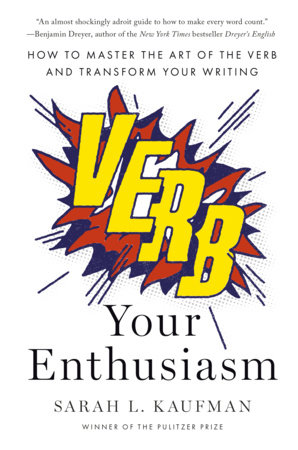
Verb Your Enthusiasm is about, in a nutshell: learning to express action and change, whether bold or quiet, on the page.
I have relied on the power of verbs every day of my career. I started out as a copy editor for various newspapers, fixing blundered syntax and writing verb-centered headlines. On the race-day status of a horse with hives: "Rash May Scratch Alysheba." (Two thoughts spring to mind: That example dates me. And we all could have wept when the edict came down to stop punning the headlines.)
Eventually I landed at
The Washington Post and shifted to writing. I poured years of ballet and tap lessons and everything I'd learned from a college job at a ballet school into nearly three decades as a dance critic. Night after night I had the world's best sight lines onto the most extraordinary athletes of the stage: pliant ballerinas, gallant romantics, quicksilver tappers, experimental shape-shifters. Flamenco dancers, their heels hammering like hail. To watch these artists move was to hear their hearts speak.
As a young critic, this worried me.
How could I possibly interpret this dynamic, wordless poetry in . . . words? These amazing human beings spin miracles out of music, sweat, and thin air. Their poetry appears and disappears with every step. To write something truthful about a live art-well, to me that seemed about as easy as strutting onstage to pound out my own sevillana.
I found my confidence through verbs. When I write about dance, I seek to re-create the experience of being there, by painting an active portrait of the event and the spell it cast. The right verbs help. Initially, I didn't set out to make my mark through verbs, but I did try to make my writing interesting. I covered a rather niche field, after all, and I wanted to reach a wide audience. Verbs showed me the way. I found the means to think and write about vanishing things by choosing the most accurate, evocative verbs. For example, my last review in the
Post focused on a dance by the marvelous Belgian Colombian choreographer Annabelle Lopez Ochoa. Her subject was Argentina's famous former First Lady. This is the opening paragraph:
Eva Perón tears the shoes off her feet and hurls them into the wings. She shouts; she stamps; she flies into the arms of half a dozen lovers. She sprints around the stage trailing white silk like the luminous mist of her own star power.
The verbs I use are simple and blunt. Nothing fancy about them-and that's intentional. I chose short, descriptive verbs that drive the story. They speed it along, conveying, I hope, the energy of the dancer. Also, it's fun to shove aside plain-vanilla
leaps and
turns and instead describe people billowing and drifting across the stage, shuddering and scootching, soaring like shooting stars arcing into darkness. Closely observing action can spark all kinds of images, and getting one's descriptions rolling with dynamic verbs gives a writer the power to trigger the reader's imagination as well.
It’s the classic rule of journalism: Honor the verb, sacrifice the adjective.
The reporter's aim-the aim of any serious writer-is to produce clean, honest, uncluttered prose. Novelists and poets, fact-finding reporters, executives, managers, students: Every writer must set high standards and strive for clarity and coherence. This is true whether the writing concerns fiction or fact, opinion or research.
As a reader, I also look for enthusiasm. What pulls me in is passion, warmth, and spirit. Throughout this book I'll share top-notch writing of all kinds, and what makes these works snap, sizzle, and catch my heart is enthusiasm-which the writers express with vivid verbs. Great writers honor the verb.
In the passage below from Sally Rooney's novel
Beautiful World, Where Are You, a young woman writes to her friend about something rather abstract. She had been trying to reclaim the optimism of past years, she writes, and at last she experienced a sudden flash of it. Notice how Rooney takes us through her narrator's mental actions and then shifts to the actions of an unnameable emotion:
As soon as I realized what I was feeling, I tried to move toward it in my thoughts, to reach out and handle it, but it only cooled a little or shrank away from me, or slipped off further ahead.
This sentence has the clean, flowing energy that Rooney is known for, thanks in large part to her choice of verbs. Simple verbs-
move, handle, cool, shrink-hold down the slippery evanescence of thoughts and feelings, so we can see them (and feel them) from different perspectives, and understand something about them. Maybe the verbs prompt us to reflect on our own fleeting emotions, too. That's what they do to me. The writing swirls and flows and my own thoughts eddy along in rhythm.
The best verbs define intention and action, even subtle thinking action, with elegant simplicity. Let's take a quick look at various kinds of verbs now, because understanding the differences among verbs will help you choose what's best for what
you mean to say. Making deliberate verb choices can sharpen your work.
Think of three piles. The first contains "stative verbs," which are all about a
state of being rather than a dynamic action. They include to be and many other verbs-
appear, believe, know, love, prefer, understand, and more-that describe a static situation such as existence, emotion, thought, or a condition.
The other piles comprise two different kinds of action verbs, which we'll call "basic verbs" and "verbs of manner." A basic verb is neutral, ordinary: The dog
walks. Verbs of manner are the drama queens, descriptive and specific: The dog
wiggles/waddles/wanders. These verbs tell us the
way in which an action happens, its speed, force, and feeling-its manner.
Verb-wise, if you write in English, guess what? It's your birthday every day-with shopping sprees at FAO Schwarz-because English overflows with verbs of manner. It's a special feature of the language. A secret superpower, in fact. Linguist Dan I. Slobin at the University of California, Berkeley, has studied verbs of manner around the world, and he notes that, for example, French and Spanish each have a single verb for a jumping motion (
bondir in French,
saltar in Spanish). But English? It boasts at least half a dozen: jump as well as
hop, leap, spring, bound, and
bounce. You can probably think of more.
Slobin estimates that French, Spanish, Turkish, and Hebrew have just a few dozen verbs of manner. English, however, has
several hundred. (So do German, Dutch, Russian, and Hungarian.) Every language has unique features and advantages, and certainly English has its hitches (all those irregular verbs!). But with a great many verbs of manner at their fingertips, writers can express a specific action and energy with a single word. For example: "The road zigzags up the mountain." Lively, efficient. You'd have to use a few more words in other languages; in Spanish, for instance:
La carretera sube en zigzag por la montaña. ("The road climbs in zigzags up the mountain.")
Take advantage of this deep verb vocabulary to find the exact verb that is accurate and truthful for your purposes. Verbs of manner can pop off the page-or, in this example, out of a character's mouth:
All they do is chatter and bark and eat and the knives and forks click and clack and the words cut and the teeth snap and snarl. And in that place-
there-will live my paintings for all time.
-painter Mark Rothko, in John Logan's play
Red,
railing about the atmosphere at a restaurant
that commissioned his work
Throughout Logan's play, Rothko roars with strong feelings, most of all the fear of being unappreciated and forgotten. In this scene he cloaks that fear with contempt-and aggressive verbs of manner. In the lines above, basic verbs would only sound flat and boring; to wit: "All they do is talk and eat and make noise with their cutlery and teeth. And my paintings will exist there."
You may not wish to use dramatic verbs of manner in every instance, however. It's not wise to do so willy-nilly. It's impossible to write anything coherent without basic verbs and stative verbs. Let's take another look at Sally Rooney, who uses basic verbs with artful intention:
Alice came to their housewarming party, dropped a bottle of vodka on the kitchen tiles, told a very long anecdote about their college years which only Eileen and she herself seemed to find remotely funny, and then went home again.
Comings and goings, klutziness and ramblings-Rooney treats them evenly with basic, neutral verbs. There's fluid movement in this passage, making it lovely to read, but the tone is calm. Rooney's voice is intimate and natural. Her young lovers fall into affairs and misunderstandings, but she doesn't judge them.
Whether toned down, subtle, or bold, verbs can deliver tremendous expressive power. In the coming pages we'll explore how such a small word change as the verb-a
deceptively small change, that is-heightens feeling and intent.
The right verb carries a whole world with it, like an actor transforming the stage:
In the beginning God
created the heavens and the earth.
Friends, Romans, countrymen,
lend me your ears.
Just like me / they
long to be / close to you.
Change the verb (or with
long to be, the verb phrase) in any of these sentences and you sap their strength. As they are, they tell us everything. God is not only skilled and powerful but inventive, too. Shakespeare's Mark Antony wants us to believe that he's polite, undemanding, and not out to steal our time. He's also foreshadowing more ironies to come. And in Burt Bacharach and Hal David's song "(They Long to Be) Close to You," birds, stars, and all the girls in town are past wanting and wishing. They're gripped by desire.
The writers of those lines composed in simple subject-verb format ("God created"), with the subject and verb close together, at or near the beginning of the sentence. This gets meaning across in the clearest and most energetic way, because
the verb contains the meaning. What a productive thing, the choice verb! Find that verb and allow your voice to emerge.
Even advertising turns poetic with a potent verb. A jeweler’s website I stumbled upon described its turquoise as having “slipped from the sky.”
No ordinary stones, these. There's a sense of magic in "slipped from the sky." Destiny, too. Navajo tradition holds that turquoise descended from the heavens.
Slipped echoes this belief. It carries a hint of spiritual intent, as if the stone meant to ease itself free, silent and imperceptible. It didn't just succumb to gravity and fall, like . . . well, like a rock. A mineral that slips won't crash to earth. I imagine it gliding to rest. More mystery, less geology. All in the choice of verb.
Starting your sentences with a subject and verb is wise, but that alone does not guarantee meaning. Your subject needs the
right verb. Fuzzy, misused verbs confuse readers and stop them. Here's an example from a chamber of commerce website, promoting a gala dinner with pricey sponsorships:
The annual meeting represents an evening of celebration, connection and recognition as the Chamber reflects on its accomplishments and shares its priorities for the year ahead.
The writer begins with a subject ("the annual meeting") and a verb ("represents") but the verb is wrong. The meeting
represents an evening of celebration? So it's just a symbol of a celebration, not the real thing? Further on, "the Chamber reflects" is weak and vague. Watching a group "reflect" offers no reason to pony up thousands of dollars for a table.
The chamber's notice is like many press releases and marketing materials: dull, tiresome text that promises a dull, tiresome outcome. It swells with self-importance. Instead of muscular verbs-verbs with drive and energy-this writer used stodgy nouns derived from verbs (
celebration, connection, recognition). Don't let your writing sink under the weight of such starch.
The right verbs, strong and clear, will add muscle to your work, as we'll see throughout this book. To grab their power in this example, speak directly to the reader about your goal. Name the actions you want to see. Assert your point with verbs:
Join us to celebrate what we've achieved together. Connect with members as we reveal our plans.
That's sixteen words instead of the original twenty-six, and I've added
together to stress this meeting's point: connecting.
That's important. Important enough for careful writing.
Here's a line from a doctor's ad in a health magazine:
Dietary intolerances are also common and can be addressed with a physician who is able to address them.
Would you make an appointment with this person? The ad offers no argument for doing so. It meanders in circles-"can be addressed with a physician who is able to address . . ." Yawn. Say it straight. "Dr. Fixit specializes in these."
Instead, this writer failed to convince and the doc failed to proofread. Sloppy writing turns my thoughts to sloppy care.
Copyright © 2026 by Sarah L. Kaufman. All rights reserved. No part of this excerpt may be reproduced or reprinted without permission in writing from the publisher.