Download high-resolution image Look inside
Listen to a clip from the audiobook
audio play button
0:00
0:00

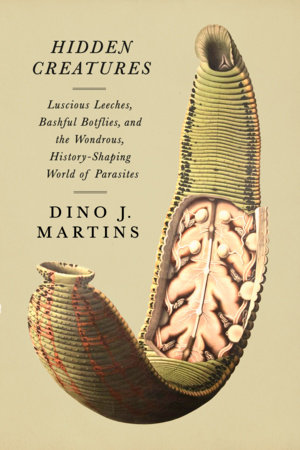
Hidden Creatures

Luscious Leeches, Bashful Botflies, and the Wondrous, History-Shaping World of Parasites

Look inside
Listen to a clip from the audiobook
audio play button
0:00
0:00
Welcome to the hidden, squirming world of parasites—some of the most misunderstood creatures with whom we share the Earth (and our bodies).

"Astonishing, eye-opening, and inspiring." —Chloe Dalton, author of Raising Hare


There is the tapeworm, which can grow 120 feet in length within the gut of a whale; the tsetse fly, a notorious vector of disease that can pierce the skin even of crocodiles with its needle-like mouth; and the most universal symbol of parasitic behavior: the leech. Long villainized as, well, parasitic, these creatures are actually a vital part of every ecosystem—and Dr. Dino Martins, an award-winning entomologist and biologist from Kenya, has made it his life’s mission to demystify these beguiling beings.

Hidden Creatures is a journey across the world ten times over—from Martins’s home in the wilds of East Africa to the rainforests of Borneo to cities and backyards across the globe. Along the way we encounter brilliant and eccentric experts who join Martins on his adventures to investigate not only parasites but their hosts, from hyraxes and hippos to, of course, humans.

Immersive, driven by an utterly infectious curiosity, and sure to transform every reader’s understanding of these organisms, Hidden Creatures has the magnetic force of a David Attenborough documentary and introduces a monumental, charming new voice in science writing.
Practical Pinworms, Happy Hookworms, and Remarkable Roundworms

This is an essay I wrote for the Young Farmers Club in 1989, while at school in Eldoret. (Miss We-Nguru-We and yours truly went on to win the pig competition at the Agricultural Society of Kenya show.)

Once upon a time there lived a worm. This worm made its home inside the body of a pig. This pig was called Miss We-Nguru-We, and sometimes we call her the Porky-Piggles. The We-Nguru-We is my friend. I am a member of the Young Farmers Club and the Wildlife Club. As part of the Young Farmers Club, we keep animals and look after them. I love animals and enjoy looking after them. Every day we help to look after the animals. In the morning, we go to the school farm and I help feed her. I always bring a treat for Miss We-Nguru-We. She likes carrots and mangoes. She also likes pieces of bread and mandazis.

We collect the remaining food from the school kitchen in a bucket. I carry the bucket to the farm. If there is a lot of food remaining, we use the wheelbarrow. Sister Clete is not happy if there are more than two buckets. We must not waste food. We take the buckets to the farm. Miss We-Nguru-We is happy when she sees us bringing the food. She stands up and puts her legs on the wall and looks at us. She makes a lot of noise. We grunt to each other. Ng’ooorr! Ng’ooorr! Sister Clete scolds us. We must not make Ng’ooorr noises because we are not animals. After eating her food, Miss We-Nguru-We likes to be scratched. I scratch her back using a stick. She also likes when you rub her nose.

In the morning one day I found some worms. I was waiting for my friend to come help lift the buckets. It was raining at night. The ground was wet. There is some grass growing around the pigsty. I saw the worms climbing on the grass. The worms are very small. I like looking for insects in the grass. I look for them every day. The worms sat on the grass. They waved from side to side. I picked the grass with the worms. I showed them to my teachers.

Our science and agriculture teachers are Mrs. Misoi, Mrs. Scott, and Mr. Waweru. My teachers helped me to learn about the worms. We looked at them through the microscope. It was amazing! I could see there were many tiny worms all together. One worm is made of many worms. Mrs. Scott told me that worms are parasites. Mrs. Misoi said we must not touch them, but we can observe them. Mr. Waweru said that we can learn more about them. My teachers gave me a book to read from the school library. I like reading books about animals.

There are so many different kinds of animals. Pigs are part of the same family as warthogs, bushpigs, and giant forest hogs. We saw a giant forest hog when we went to Mount Elgon. Bushpigs come to eat potatoes at night on our farm. Worms are parasites. Animals like ticks, fleas, and tapeworms are also parasites. Some parasites live on the outside and some live on the insides of animals. I also found some ticks on Miss We-Nguru-We. Dr. Shah came to give her medicine. There was medicine for the worms and the ticks. I helped Dr. Shah because he is a nice man. He also likes animals. He is a doctor for animals. He is a vet. I like learning about animals. Miss We-Nguru-We did not want to take her medicine. She is big and was making a lot of noise. I helped Dr. Shah. I held a piece of bread near her nose and she was happy. Mrs. Scott said that if I study hard I can become a scientist.

Animals are more interesting than people. Dr. Shah told me about the worms. The worms live inside the pig. Then they also come out of the pig. In Miss We-Nguru-We’s poo. Then they go in the ground. Then they go on the grass. Animals can eat them. Worms can also go inside people. I want to learn more about them. I love my teachers because they teach me new things. I love animals and I want to learn all about them.

I love Miss We-Nguru-We. And her worms.

Perhaps the most important lesson I learned from my teachers in primary school was paying attention to details. All of us have the innate ability to try to see beyond what is directly in front of us. In trying to see and understand what is hidden within nature, we gain deeper insights into understanding ourselves and all the interconnectedness of the world.

And so, some years later, I find myself once again staring intently at the leaves of grasses. Once again, the rains have returned, grass is growing, and life is flourishing. It is 2001 and I am living on the plains south of Nairobi, on a farm and studio set up by Nani (Scribble-Mother). One day I receive the gift of a horse, Koru, who needs a home. Thus begins a stretch of years during which I ride each day with Koru, out onto the savanna, getting up to all sorts of adventures. Through the many hours we are together I start to see, smell, hear, and sense the world a little bit differently. Another universe of details, of hidden layers, coalesces into view.

Thanks to Nani’s insatiable fondness for all creatures, we live with and care for dogs, cats, donkeys, parrots, poultry of all sorts, pigs, goats, cattle, camels, an Egyptian vulture, a donkey called Jesse, a mule called Matilda, and of course the horses I am responsible for. I walk alongside them, and we mingle with herds of zebra, hartebeest, and other wildlife. The plains transform from dusty and threadbare to a lush carpet of knee-high grass. Watching the animals, and especially Koru, as they graze provides many lessons on how animals and plants depend on one another, impact one another, and ultimately live and die.

Then one day something both magical and slightly disturbing happens. A little bit of the world that was previously unseen and unknown is revealed to me. New growth is sprouting from clumps of grass recently grazed by zebra. I examine the tender new leaves. Something moves on their surface. I kneel and pull the leaves from the shadow into the sunlight, then bend them to see more clearly. Hundreds of tiny pale forms are writhing out of the soil onto the leaves of the grasses. I look up and Koru and Jesse are chomping away on either side of me. Then it dawns on me that these tiny forms are being swallowed along with the leaves of grass! And of course these must be some kind of parasitic worm. I stand up and stumble toward Koru, reaching for his head collar. He stubbornly pulls away, lowers his head, and continues grazing. A mouthful of grass. A mouthful of baby worms.

Parasitic worms are among the most familiar and reviled of creatures that are part of the tree of life. The tree of life, as imagined by scientists, is like a vast, many-branched tree, with the twigs and limbs connected representing the ancient lineages and relationships between species, and the buds and leaves the current living species we share the planet with. As past species have given rise to present-day species through evolution, all life is ultimately connected.

The worms, or Vermes, as recognized by Carl Linnaeus, span a number of major branches on the tree of life. Ranging in size from microscopic to the over-three-feet-long guinea worm, they have evolved to make a life as parasites. Some parasites, like ticks and fleas, live on the outside of their host bodies. They are called ectoparasites. Parasitic worms spend time both inside and outside their hosts, depending on their stage of life. The parasitic part of their life cycle is within the host’s body, making them endoparasites. In most parasitic worms, it is the larval or juvenile stages that live out in nature, while the adult stages live inside the bodies of their hosts.

In the 1800s, scientists and naturalists began to unravel the hidden lives of parasitic worms, and one of the major breakthroughs in our understanding came from the recognition that different life stages pass through different animal hosts as part of their life cycle. These parasites have a definitive host where they become sexually mature and produce eggs, but can also live part of their lives within an intermediate or paratenic host. The paratenic hosts serve to help the worms access definitive hosts, survive through difficult times, and disperse and reach farther and wider. But no further transformation or development of the parasite occurs in paratenic hosts, who merely serve as transporters. This is kind of like a social-climbing family upgrading housing when circumstances allow. In the latter part of the nineteenth century, it was established that parasitic worms who live in the lungs of toads and frogs made their way into their amphibian hosts from free-living larvae. Another parasitic worm was found to cycle between mice and flour beetles, and the red worms who infested freshwater fish made their way there through the bodies of copepods, tiny aquatic crustaceans.

Some worms simply cycle between the environment, typically the soil, and their host. Some worms enter hosts via the skin, and a few worms can do both: entering hosts through their mouths or their skin. Scientists have labeled the simpler approach monoxeny, where the host is infected directly by swallowing eggs or by larvae burrowing through the skin, and the more complex strategy heteroxeny.

Even the simplest strategy poses challenges, as the eggs or larvae must survive in the environment for varying periods of time, sometimes under great duress, before they can play the lottery again to gain access into another host’s body. But oh, worms can be even more diabolical and invidious! In some species of parasitic worms, once they are established within a host’s body, they can even go a step further and undertake spreading to new hosts via the unborn young—this route to being a parasite is called transplacental—and yet others even pass through the mother’s milk, which is known as a transmammary infection. A number of mammal and bird parents regurgitate food for their offspring, and here, too, parasites have found a way of hijacking this familial ritual, making their way into the regurgitation and from there into the unsuspecting babies’ bodies.

Parasitic worms who infect humans and our livestock or pets are often called helminths. These are generally large enough in their adult stage to be visible to us without magnification, and are primarily gut-dwellers, making a living within the intestines of their hosts. Helminths that make a living as parasites include various species of flatworms (Platyhelminthes), roundworms (Nematoda), and thorny-headed worms (Acanthocephala). The flatworms include the cestodes, or tapeworms, and the flukes or trematodes we will meet in subsequent chapters. It is among the nematodes that the diversity of parasitic worms truly peaks, with an array of hookworms, roundworms, pinworms, filarial worms, whipworms, lungworms, and strongyles to the macabre guinea worm. They infect everything from ants and other insects to virtually all birds, fish, reptiles, amphibians, and mammals. Studies estimate that there are likely over three hundred thousand species of helminth parasites, and the vast majority of these remain unknown and unstudied.

Scrambling through the tree of life, we find parasitic worms widely distributed and up to all sorts of shenanigans. The delightful and complex bodies of vertebrates have been conquered and divided into partitions by the parasitic nematode worms. Syngamid lungworms live in the lungs and respiratory system of birds and other animals, while one enterprising species makes its home in the urinary tracts of pigs. The tongue-twister genus Mammomonogamus finds a home in the larynx, nasal passages, and middle ear of cattle, sheep, goats, deer, various cats, elephants, and very occasionally in humans. Rhabditid nematodes sneak into the bodies of many vertebrates from the soil, where they live as larvae grazing as bacteria. One species lives in the conjunctiva lining the eyes of mice, voles, and lemmings; another targets the hair follicles of mice.

Blue-tongued lizards in Australia are hosts to a nematode that enters their bodies through the snails and slugs they consume, then penetrates the gut, lives and molts in the body cavity, and eventually slips into the hapless lizard’s lungs, where it matures. The nematode family Strongyloididae, called stronglyes, includes a species that lives in dogs, horses, and people. Again, there are both free-living and parasitic stages. The worms enter through the skin, then go on a pilgrimage through the host’s body, moving from the blood and lymph into the heart and lungs. From the lungs they are coughed up and swallowed, wending into the intestines, where they mature and produce eggs passed out in the poo to start the whole cycle over again. One group of nematodes infests snakes, and it is still a mystery on how exactly they do this, with one study suggesting they enter the female snake’s body through the vulva and into the uterus.

The hookworms that infest humans are part of a larger group that are known from dogs, cats, pigs, raccoons, bears, foxes, wolves, cattle, elephants, sheep, the regal chamois, and even the alpacas have not been spared. Hookworms that infest fur seals and northern sea lions must survive the nine months when these creatures are out at sea and do so by persisting as dormant eggs in the masses of poo left behind on the shore. When the seals return to their breeding grounds to birth their precious pups in rookeries, the worms now have new hosts. While this might seem nefarious, the worms can live happily in their hosts’ guts for over a decade—yes, taking nutrients, but not killing the seals. One notable thing about hookworms is how they can infect different species of animals, including those in whose company they have not directly evolved. The infamous American hookworm (Necator americanus) is normally a parasite of humans, but it has also been found in our cousins the great apes, pigs, rhinos, and even pangolins, traveling around the world aided and abetted by us. No doubt the worms are traveling even now, carried in the bellies of people moving, dreaming, and hoping as they cross the ridiculous superficial borders we’ve drawn all over the planet.
© Liam Frederick
DINO MARTINS is an award-winning entomologist and evolutionary biologist. A professor at Stony Brook University, he has served as the director of the Turkana Basin Institute in Kenya, founded by Dr. Richard Leakey, and previously as the director of the Mpala Research Centre. He holds a PhD in organismic and evolutionary biology from Harvard University. His research and writing have been featured in Smithsonian Magazine, The Guardian, TED, the BBC, Granta, and National Geographic. He lives on Long Island and in Malindi, Kenya. View titles by Dino Martins
“There’s an undeniable appeal to learning about creatures we can’t see or even feel but that have such a huge effect on our health and well-being—and that’s not to mention the charming eccentrics who study them.” —The Boston Globe

“An astonishing, eye-opening, and inspiring guide to the world's microscopic marvels, showing how much we can learn from looking closely at the things we fear, and the beauty of nature's hidden mechanisms. Wonderfully revolting and utterly fascinating, it is a thrilling tribute to the interconnectedness of life, full of awe-inspiring detail and gripping facts. It will make you want to rush out and look at puddles through a magnifying glass. Your world will be larger for reading this book.” —Chloe Dalton, author of Raising Hare

“Only one man—the uniquely gifted storyteller, exquisitely observant naturalist, and skilled artist Dino Martins—could make the (OK, disgusting) subject of parasites simply sing with fascinating horror. Hidden Creatures presents us with the vampires, hijackers, and other evil geniuses of the natural world who are continually doing their nastiest, best work around and inside us. It’s a gripping page-turner, and you will certainly wash your hands before your next meal.” —Carl Safina, author of Beyond Words and Alfie and Me

“Dino Martins' genius is to make you care about the world's most despised and disgusting creatures—and find them fascinating, vital, and even beautiful. A mind-blowing, eye-watering revelation of a book.” —Isabella Tree, author of Wilding

“In Hidden Creatures, Martins brings the reader nose-to-glass, up close to a universe in miniature. If you’ve ever been bitten by a mosquito, plucked a tick or a flea from your dog, dealt with a kid with nits, or suffered an unwelcome bout of intestinal visitors, you’ll find yourself compelled by how these encounters unfold and the ways in which these tiny organisms shape entire ecosystems. Hidden Creatures is nature storytelling at its most compulsive—revealing the hidden dramas playing out in backyards, bodies, bloodstreams, and beyond.” —Aminatta Forna, author of The Memory of Love

“Martins invites us to reconsider our boundaries, our assumptions, and our own place within nature’s intricate and sometimes mysterious design. Hidden Creatures is deep scholarship animated by story, and story grounded in science, carried through a rare, beautiful, and much-awaited voice. A bold and singular literary achievement.” —Yvonne Adhiambo Owuor, Caine Prize–winning author of Dust and The Dragonfly Sea

“Martins is a lover of life and a born teacher. Hidden Creatures is about the interconnectedness of life. It is an important and profoundly penetrating book that should be in the libraries of every school, university, and laboratory.” —Jonathan Kingdon, author of East African Mammals

“A fascinating, loving book about the mysterious, vital, and complex lives of the parasites that live under your feet and in your hair. Hidden Creatures is full of stories—atmospheric, hugely informative, and absolutely disgusting. I loved it.” —Daisy Hildyard, author of The Second Body

“Fascinating and profound and cheerfully written. . . . Life would not exist if not for the parasites that prey on it, and recycle it, is this book’s mantra. Throughout it all, Martins is an enthusiastic guide. . . . A gorgeous (if squirm-inducing) book on the awe-inspiring ways that 'well and truly life begets death and death begets life.'” —Kirkus Review

“An enlightening overview of parasites. . . . Simultaneously repulsive and intriguing, this will strike a chord with the insatiably curious.” Publishers Weekly

About

Welcome to the hidden, squirming world of parasites—some of the most misunderstood creatures with whom we share the Earth (and our bodies).

"Astonishing, eye-opening, and inspiring." —Chloe Dalton, author of Raising Hare


There is the tapeworm, which can grow 120 feet in length within the gut of a whale; the tsetse fly, a notorious vector of disease that can pierce the skin even of crocodiles with its needle-like mouth; and the most universal symbol of parasitic behavior: the leech. Long villainized as, well, parasitic, these creatures are actually a vital part of every ecosystem—and Dr. Dino Martins, an award-winning entomologist and biologist from Kenya, has made it his life’s mission to demystify these beguiling beings.

Hidden Creatures is a journey across the world ten times over—from Martins’s home in the wilds of East Africa to the rainforests of Borneo to cities and backyards across the globe. Along the way we encounter brilliant and eccentric experts who join Martins on his adventures to investigate not only parasites but their hosts, from hyraxes and hippos to, of course, humans.

Immersive, driven by an utterly infectious curiosity, and sure to transform every reader’s understanding of these organisms, Hidden Creatures has the magnetic force of a David Attenborough documentary and introduces a monumental, charming new voice in science writing.

Excerpt

Practical Pinworms, Happy Hookworms, and Remarkable Roundworms

This is an essay I wrote for the Young Farmers Club in 1989, while at school in Eldoret. (Miss We-Nguru-We and yours truly went on to win the pig competition at the Agricultural Society of Kenya show.)

Once upon a time there lived a worm. This worm made its home inside the body of a pig. This pig was called Miss We-Nguru-We, and sometimes we call her the Porky-Piggles. The We-Nguru-We is my friend. I am a member of the Young Farmers Club and the Wildlife Club. As part of the Young Farmers Club, we keep animals and look after them. I love animals and enjoy looking after them. Every day we help to look after the animals. In the morning, we go to the school farm and I help feed her. I always bring a treat for Miss We-Nguru-We. She likes carrots and mangoes. She also likes pieces of bread and mandazis.

We collect the remaining food from the school kitchen in a bucket. I carry the bucket to the farm. If there is a lot of food remaining, we use the wheelbarrow. Sister Clete is not happy if there are more than two buckets. We must not waste food. We take the buckets to the farm. Miss We-Nguru-We is happy when she sees us bringing the food. She stands up and puts her legs on the wall and looks at us. She makes a lot of noise. We grunt to each other. Ng’ooorr! Ng’ooorr! Sister Clete scolds us. We must not make Ng’ooorr noises because we are not animals. After eating her food, Miss We-Nguru-We likes to be scratched. I scratch her back using a stick. She also likes when you rub her nose.

In the morning one day I found some worms. I was waiting for my friend to come help lift the buckets. It was raining at night. The ground was wet. There is some grass growing around the pigsty. I saw the worms climbing on the grass. The worms are very small. I like looking for insects in the grass. I look for them every day. The worms sat on the grass. They waved from side to side. I picked the grass with the worms. I showed them to my teachers.

Our science and agriculture teachers are Mrs. Misoi, Mrs. Scott, and Mr. Waweru. My teachers helped me to learn about the worms. We looked at them through the microscope. It was amazing! I could see there were many tiny worms all together. One worm is made of many worms. Mrs. Scott told me that worms are parasites. Mrs. Misoi said we must not touch them, but we can observe them. Mr. Waweru said that we can learn more about them. My teachers gave me a book to read from the school library. I like reading books about animals.

There are so many different kinds of animals. Pigs are part of the same family as warthogs, bushpigs, and giant forest hogs. We saw a giant forest hog when we went to Mount Elgon. Bushpigs come to eat potatoes at night on our farm. Worms are parasites. Animals like ticks, fleas, and tapeworms are also parasites. Some parasites live on the outside and some live on the insides of animals. I also found some ticks on Miss We-Nguru-We. Dr. Shah came to give her medicine. There was medicine for the worms and the ticks. I helped Dr. Shah because he is a nice man. He also likes animals. He is a doctor for animals. He is a vet. I like learning about animals. Miss We-Nguru-We did not want to take her medicine. She is big and was making a lot of noise. I helped Dr. Shah. I held a piece of bread near her nose and she was happy. Mrs. Scott said that if I study hard I can become a scientist.

Animals are more interesting than people. Dr. Shah told me about the worms. The worms live inside the pig. Then they also come out of the pig. In Miss We-Nguru-We’s poo. Then they go in the ground. Then they go on the grass. Animals can eat them. Worms can also go inside people. I want to learn more about them. I love my teachers because they teach me new things. I love animals and I want to learn all about them.

I love Miss We-Nguru-We. And her worms.

Perhaps the most important lesson I learned from my teachers in primary school was paying attention to details. All of us have the innate ability to try to see beyond what is directly in front of us. In trying to see and understand what is hidden within nature, we gain deeper insights into understanding ourselves and all the interconnectedness of the world.

And so, some years later, I find myself once again staring intently at the leaves of grasses. Once again, the rains have returned, grass is growing, and life is flourishing. It is 2001 and I am living on the plains south of Nairobi, on a farm and studio set up by Nani (Scribble-Mother). One day I receive the gift of a horse, Koru, who needs a home. Thus begins a stretch of years during which I ride each day with Koru, out onto the savanna, getting up to all sorts of adventures. Through the many hours we are together I start to see, smell, hear, and sense the world a little bit differently. Another universe of details, of hidden layers, coalesces into view.

Thanks to Nani’s insatiable fondness for all creatures, we live with and care for dogs, cats, donkeys, parrots, poultry of all sorts, pigs, goats, cattle, camels, an Egyptian vulture, a donkey called Jesse, a mule called Matilda, and of course the horses I am responsible for. I walk alongside them, and we mingle with herds of zebra, hartebeest, and other wildlife. The plains transform from dusty and threadbare to a lush carpet of knee-high grass. Watching the animals, and especially Koru, as they graze provides many lessons on how animals and plants depend on one another, impact one another, and ultimately live and die.

Then one day something both magical and slightly disturbing happens. A little bit of the world that was previously unseen and unknown is revealed to me. New growth is sprouting from clumps of grass recently grazed by zebra. I examine the tender new leaves. Something moves on their surface. I kneel and pull the leaves from the shadow into the sunlight, then bend them to see more clearly. Hundreds of tiny pale forms are writhing out of the soil onto the leaves of the grasses. I look up and Koru and Jesse are chomping away on either side of me. Then it dawns on me that these tiny forms are being swallowed along with the leaves of grass! And of course these must be some kind of parasitic worm. I stand up and stumble toward Koru, reaching for his head collar. He stubbornly pulls away, lowers his head, and continues grazing. A mouthful of grass. A mouthful of baby worms.

Parasitic worms are among the most familiar and reviled of creatures that are part of the tree of life. The tree of life, as imagined by scientists, is like a vast, many-branched tree, with the twigs and limbs connected representing the ancient lineages and relationships between species, and the buds and leaves the current living species we share the planet with. As past species have given rise to present-day species through evolution, all life is ultimately connected.

The worms, or Vermes, as recognized by Carl Linnaeus, span a number of major branches on the tree of life. Ranging in size from microscopic to the over-three-feet-long guinea worm, they have evolved to make a life as parasites. Some parasites, like ticks and fleas, live on the outside of their host bodies. They are called ectoparasites. Parasitic worms spend time both inside and outside their hosts, depending on their stage of life. The parasitic part of their life cycle is within the host’s body, making them endoparasites. In most parasitic worms, it is the larval or juvenile stages that live out in nature, while the adult stages live inside the bodies of their hosts.

In the 1800s, scientists and naturalists began to unravel the hidden lives of parasitic worms, and one of the major breakthroughs in our understanding came from the recognition that different life stages pass through different animal hosts as part of their life cycle. These parasites have a definitive host where they become sexually mature and produce eggs, but can also live part of their lives within an intermediate or paratenic host. The paratenic hosts serve to help the worms access definitive hosts, survive through difficult times, and disperse and reach farther and wider. But no further transformation or development of the parasite occurs in paratenic hosts, who merely serve as transporters. This is kind of like a social-climbing family upgrading housing when circumstances allow. In the latter part of the nineteenth century, it was established that parasitic worms who live in the lungs of toads and frogs made their way into their amphibian hosts from free-living larvae. Another parasitic worm was found to cycle between mice and flour beetles, and the red worms who infested freshwater fish made their way there through the bodies of copepods, tiny aquatic crustaceans.

Some worms simply cycle between the environment, typically the soil, and their host. Some worms enter hosts via the skin, and a few worms can do both: entering hosts through their mouths or their skin. Scientists have labeled the simpler approach monoxeny, where the host is infected directly by swallowing eggs or by larvae burrowing through the skin, and the more complex strategy heteroxeny.

Even the simplest strategy poses challenges, as the eggs or larvae must survive in the environment for varying periods of time, sometimes under great duress, before they can play the lottery again to gain access into another host’s body. But oh, worms can be even more diabolical and invidious! In some species of parasitic worms, once they are established within a host’s body, they can even go a step further and undertake spreading to new hosts via the unborn young—this route to being a parasite is called transplacental—and yet others even pass through the mother’s milk, which is known as a transmammary infection. A number of mammal and bird parents regurgitate food for their offspring, and here, too, parasites have found a way of hijacking this familial ritual, making their way into the regurgitation and from there into the unsuspecting babies’ bodies.

Parasitic worms who infect humans and our livestock or pets are often called helminths. These are generally large enough in their adult stage to be visible to us without magnification, and are primarily gut-dwellers, making a living within the intestines of their hosts. Helminths that make a living as parasites include various species of flatworms (Platyhelminthes), roundworms (Nematoda), and thorny-headed worms (Acanthocephala). The flatworms include the cestodes, or tapeworms, and the flukes or trematodes we will meet in subsequent chapters. It is among the nematodes that the diversity of parasitic worms truly peaks, with an array of hookworms, roundworms, pinworms, filarial worms, whipworms, lungworms, and strongyles to the macabre guinea worm. They infect everything from ants and other insects to virtually all birds, fish, reptiles, amphibians, and mammals. Studies estimate that there are likely over three hundred thousand species of helminth parasites, and the vast majority of these remain unknown and unstudied.

Scrambling through the tree of life, we find parasitic worms widely distributed and up to all sorts of shenanigans. The delightful and complex bodies of vertebrates have been conquered and divided into partitions by the parasitic nematode worms. Syngamid lungworms live in the lungs and respiratory system of birds and other animals, while one enterprising species makes its home in the urinary tracts of pigs. The tongue-twister genus Mammomonogamus finds a home in the larynx, nasal passages, and middle ear of cattle, sheep, goats, deer, various cats, elephants, and very occasionally in humans. Rhabditid nematodes sneak into the bodies of many vertebrates from the soil, where they live as larvae grazing as bacteria. One species lives in the conjunctiva lining the eyes of mice, voles, and lemmings; another targets the hair follicles of mice.

Blue-tongued lizards in Australia are hosts to a nematode that enters their bodies through the snails and slugs they consume, then penetrates the gut, lives and molts in the body cavity, and eventually slips into the hapless lizard’s lungs, where it matures. The nematode family Strongyloididae, called stronglyes, includes a species that lives in dogs, horses, and people. Again, there are both free-living and parasitic stages. The worms enter through the skin, then go on a pilgrimage through the host’s body, moving from the blood and lymph into the heart and lungs. From the lungs they are coughed up and swallowed, wending into the intestines, where they mature and produce eggs passed out in the poo to start the whole cycle over again. One group of nematodes infests snakes, and it is still a mystery on how exactly they do this, with one study suggesting they enter the female snake’s body through the vulva and into the uterus.

The hookworms that infest humans are part of a larger group that are known from dogs, cats, pigs, raccoons, bears, foxes, wolves, cattle, elephants, sheep, the regal chamois, and even the alpacas have not been spared. Hookworms that infest fur seals and northern sea lions must survive the nine months when these creatures are out at sea and do so by persisting as dormant eggs in the masses of poo left behind on the shore. When the seals return to their breeding grounds to birth their precious pups in rookeries, the worms now have new hosts. While this might seem nefarious, the worms can live happily in their hosts’ guts for over a decade—yes, taking nutrients, but not killing the seals. One notable thing about hookworms is how they can infect different species of animals, including those in whose company they have not directly evolved. The infamous American hookworm (Necator americanus) is normally a parasite of humans, but it has also been found in our cousins the great apes, pigs, rhinos, and even pangolins, traveling around the world aided and abetted by us. No doubt the worms are traveling even now, carried in the bellies of people moving, dreaming, and hoping as they cross the ridiculous superficial borders we’ve drawn all over the planet.

Author

© Liam Frederick
DINO MARTINS is an award-winning entomologist and evolutionary biologist. A professor at Stony Brook University, he has served as the director of the Turkana Basin Institute in Kenya, founded by Dr. Richard Leakey, and previously as the director of the Mpala Research Centre. He holds a PhD in organismic and evolutionary biology from Harvard University. His research and writing have been featured in Smithsonian Magazine, The Guardian, TED, the BBC, Granta, and National Geographic. He lives on Long Island and in Malindi, Kenya. View titles by Dino Martins

Praise

“There’s an undeniable appeal to learning about creatures we can’t see or even feel but that have such a huge effect on our health and well-being—and that’s not to mention the charming eccentrics who study them.” —The Boston Globe

“An astonishing, eye-opening, and inspiring guide to the world's microscopic marvels, showing how much we can learn from looking closely at the things we fear, and the beauty of nature's hidden mechanisms. Wonderfully revolting and utterly fascinating, it is a thrilling tribute to the interconnectedness of life, full of awe-inspiring detail and gripping facts. It will make you want to rush out and look at puddles through a magnifying glass. Your world will be larger for reading this book.” —Chloe Dalton, author of Raising Hare

“Only one man—the uniquely gifted storyteller, exquisitely observant naturalist, and skilled artist Dino Martins—could make the (OK, disgusting) subject of parasites simply sing with fascinating horror. Hidden Creatures presents us with the vampires, hijackers, and other evil geniuses of the natural world who are continually doing their nastiest, best work around and inside us. It’s a gripping page-turner, and you will certainly wash your hands before your next meal.” —Carl Safina, author of Beyond Words and Alfie and Me

“Dino Martins' genius is to make you care about the world's most despised and disgusting creatures—and find them fascinating, vital, and even beautiful. A mind-blowing, eye-watering revelation of a book.” —Isabella Tree, author of Wilding

“In Hidden Creatures, Martins brings the reader nose-to-glass, up close to a universe in miniature. If you’ve ever been bitten by a mosquito, plucked a tick or a flea from your dog, dealt with a kid with nits, or suffered an unwelcome bout of intestinal visitors, you’ll find yourself compelled by how these encounters unfold and the ways in which these tiny organisms shape entire ecosystems. Hidden Creatures is nature storytelling at its most compulsive—revealing the hidden dramas playing out in backyards, bodies, bloodstreams, and beyond.” —Aminatta Forna, author of The Memory of Love

“Martins invites us to reconsider our boundaries, our assumptions, and our own place within nature’s intricate and sometimes mysterious design. Hidden Creatures is deep scholarship animated by story, and story grounded in science, carried through a rare, beautiful, and much-awaited voice. A bold and singular literary achievement.” —Yvonne Adhiambo Owuor, Caine Prize–winning author of Dust and The Dragonfly Sea

“Martins is a lover of life and a born teacher. Hidden Creatures is about the interconnectedness of life. It is an important and profoundly penetrating book that should be in the libraries of every school, university, and laboratory.” —Jonathan Kingdon, author of East African Mammals

“A fascinating, loving book about the mysterious, vital, and complex lives of the parasites that live under your feet and in your hair. Hidden Creatures is full of stories—atmospheric, hugely informative, and absolutely disgusting. I loved it.” —Daisy Hildyard, author of The Second Body

“Fascinating and profound and cheerfully written. . . . Life would not exist if not for the parasites that prey on it, and recycle it, is this book’s mantra. Throughout it all, Martins is an enthusiastic guide. . . . A gorgeous (if squirm-inducing) book on the awe-inspiring ways that 'well and truly life begets death and death begets life.'” —Kirkus Review

“An enlightening overview of parasites. . . . Simultaneously repulsive and intriguing, this will strike a chord with the insatiably curious.” Publishers Weekly