Download high-resolution image
Listen to a clip from the audiobook
audio play button
0:00
0:00

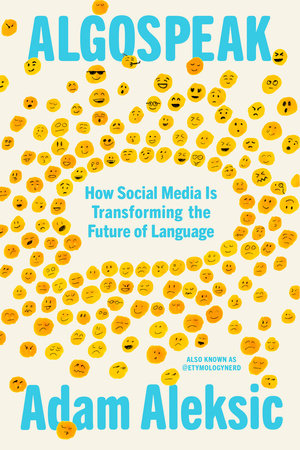
Algospeak

How Social Media Is Transforming the Future of Language

Listen to a clip from the audiobook
audio play button
0:00
0:00
NEW YORK TIMES BESTSELLER • From linguist Adam Aleksic, known as @etymologynerd on social media, comes a captivating exploration of how internet algorithms are transforming language and communication in unprecedented ways.

“Packed with fascinating facts, of-the-moment observations, and a sparkling voice, Algospeak is a gift to any word nerd. Deftly covering everything from emoji etymologies and trendbait to Taylor Swift fanilects... Adam Aleksic is the wise, yet accessible internet linguistics oracle we need.”—Amanda Montell, author of The Age of Magical Overthinking and Cultish


From “brainrot” memes and incel slang to the trend of adding  “-core” to different influencer aesthetics, the internet has ushered in an unprecedented linguistic upheaval. We’re entering an entirely new era of etymology, heralded by the invisible forces driving social media algorithms. Thankfully, Algospeak is here to explain. As a professional linguist, Adam Aleksic understands the gravity of language and the way we use it: he knows the ways it has morphed and changed, how it reflects society, and how, in its everyday usage, we carry centuries of human history on our tongues. As a social media influencer, Aleksic is also intimately familiar with the internet’s reach and how social media impacts the way we engage with one another. New slang emerges and goes viral overnight. Accents are shaped or erased on YouTube. Grammatical rules, loopholes, and patterns surface and transform language as we know it. Our interactions, social norms, and habits—both online and in person—shift into something completely different.

As Aleksic uses original surveys, data, and internet archival research to usher us through this new linguistic landscape, he also illuminates how communication is changing in both familiar and unexpected ways. From our use of emojis to sentence structure to the ways younger generations talk about sex and death (see unalive in English and desvivirse in Spanish), we are in a brand-new world, one shaped by algorithms and technology. Algospeak is an energetic, astonishing journey into language, the internet, and what this intersection means for all of us.
Chapter 1

How to Play Linguistic Whac-A-Mole

Remember Whac-A-Mole? The slightly unhinged arcade game where new characters keep popping up no matter how many times you smack them with your mallet? It might seem ridiculous to use coin-operated violence as an analogy for the serious linguistic changes we’re experiencing online, but Whac-A-Mole truly is the perfect metaphor for explaining how humans react to censorship. As soon as a word is banned, we find a way around it; that is, until content moderators catch wind of the new word and ban that, too. Then another word pops up, and the cycle repeats, trapping users and platforms in a never-ending loop of new spellings and substitutions that disappear once the algorithm catches on and the mallet comes down again. The faster and better the moderation tools are, the more words will be created. This is because the underlying idea—and our desire to talk about it—remains.

People have been playing this game since the early days of the internet. Frustrated with text filters on bulletin boards in the 1980s, netizens turned to “leetspeak,” a hacker dialect characterized by creatively respelled words. Since terms like “suicide” were censored in some chat rooms, leetspeakers wrote out coded replacements like “5U1C1D3” in much the same way that people began using “unalive.” If the chat-room moderators caught on, they could just change the spelling to another easily recognizable form, like “$U!C!D€.”

The tools being used have since grown more sophisticated, but the underlying process remains the same. Rudimentary word identification scripts might have been upgraded to fancy, AI-powered algorithms, but censorship is still driving linguistic creativity. If anything, the algorithmic era has spurred more innovation, because the game is happening faster, with more guesswork involved. Due to intellectual property concerns, not much is known about how these apps actually recommend content. Influencers are often subject to the whims of unknown and unfair criteria, with only opaque community guidelines as reference points.

This marks a major difference between leetspeak and algospeak: You could always immediately tell when leetspeak worked, because you would see your comment posted onto a message board. For algospeak, however, the goal is to make it onto a user’s “recommended page,” and it’s much harder to tell when you’ve successfully done that. Videos with sensitive keywords aren’t always removed outright. Sometimes, they’ll be “suppressed,” or shown to fewer followers. Creators can also be “shadowbanned” without warning or notification. We—and I’m including myself here—receive very little communication from the platforms, so we’re not sure whether videos do poorly because they’re bad or because they’re being censored. Understandably, then, we’ll err on the side of caution when it comes to euphemization.

Creators can sort of tell what does and doesn’t get onto the recommended page by looking at our video analytics. If I usually get most of my views from the recommended page, and then all of a sudden a video is getting views only from the “followers” feed, that’s a semi-reliable indication that some part of my video made the algorithm unhappy. Through this kind of trial and error, influencers can extrapolate a pretty good idea of what the algorithm rewards and penalizes, and it’s in this context that “unalive” was forged. When the word “suicide” wasn’t getting views, people turned to the next best term to tell their story.

While linguistic innovation like this is an exciting and normal thing, it’s reasonable to be alarmed at the way community guidelines are shaping important conversations, especially as people increasingly turn to short-form video for news or advice. Oftentimes, the mysterious rules governing social media are arbitrary or outright discriminatory. TikTok has historically been proven,1 for example, to artificially suppress videos by “ugly,” old, and poor creators, because they’re not as appealing to new users. This means that it’s often difficult to include larger audiences in discussions about things like disability, age, and income inequality. Nevertheless, we have no choice but to play the game and tiptoe around community guidelines wherever we can.


In 2022, the Charles Dickens Museum began a desperate social media campaign to get itself un-shadowbanned from TikTok. Whenever users would search for the museum’s account, nothing would show up. Instead, they would be cautioned2 that “this phrase may be associated with behavior or content that violates our guidelines” and that “promoting a safe and positive experience is TikTok’s top priority.”

Of course, the Charles Dickens Museum wasn’t doing anything wrong. They were mostly posting house tours or excerpts of old letters. Instead, the problem was with the TikTok algorithm, which was flagging the museum’s videos as obscene because they included the keyword “dick.” For all its fancy high-tech machine learning, the algorithm had fallen victim to a classic internet pitfall: the Scunthorpe problem, named for an English village where residents discovered they were unable to create AOL accounts because their hometown contained the word “cunt.”

Following an intense #FreeDickens campaign on Twitter, TikTok eventually agreed to unblock Charles Dickens–related search terms. However, it still remains difficult to curse—intentionally or accidentally—on any platform. While your videos won’t get removed outright, they’ll often be suppressed in search just like the museum’s. Especially if you’re cursing too much or too severely, your content will be hampered by the algorithm. If a video is eligible for the recommended page but still contains mature language, TikTok and Instagram will prevent it from appearing in clusters of similar videos in a user’s feed, which means that it’ll be pushed to a smaller audience than its work-safe competitors.3

Likewise, on YouTube, creators posting videos with severe or repeated profanity have to contend with “demonetization,” where they lose the ability to earn revenue from advertisements on their content. This is especially scary to influencers whose livelihoods depend on a steady income stream from their videos.

All this means that we have a lot of reasons to respell our swear words creatively online. If you look up the keyword “bitch” through TikTok’s search function, for example, you’ll likely encounter variations such as “btch,” “b!tch,” and “b*tch” in the video captions. Same with “fuck,” which will probably give you “fck,” “fvck,” and “f*ck”—none too different from the leetspeak letter substitutions of the past.

The practice of respelling offensive words is a centuries-old tradition known as bowdlerization, named for the Englishman Thomas Bowdler, who is mainly remembered for publishing some egregiously family-safe edits of William Shakespeare’s plays.

Self-bowdlerizing to avoid media constraints is not new: People have been doing it since at least the days of early newspaper comics, where sequences of graphic characters called grawlixes are still used instead of swear words to circumvent stringent syndication standards. The earliest known example is from this 1901 Lady Bountiful comic by Gene Carr:


Over time, some grawlixes got less thinly veiled as cultural norms against profanity loosened up. Cartoonists began drawing on symbols with a visual similarity to the letters they were replacing: “@##” and “$#*!” are now industry standards for the words “ass” and “shit.” Fast-forward to today, and influencers are re-creating this process in social media captions. Words like “fvck,” “b!tch,” and “@ss” are born out of the same motivations, drawing on the same cultural tradition of bowdlerization.

Until the twentieth century, the preferred method of bowdlerization across all media formats was the double em dash (——), typically replacing the entirety of a word save for a few identifiable letters. Grawlixes marked a turning point, and the asterisk (*) became more widespread for its ease and simplicity. Around this time, symbolic swearing also shifted to replace individual letters, specifically vowels. The primary reason for this is intelligibility: There are simply fewer options to go through when guessing the meaning of “f*ck” than with “*uck,” which could also mean something like “suck.” It’s the same reason the vowel is omitted in truncations like “fck” and “btch” on social media.

Another option is to change the word to something similar, but funnier. If you’re trying to sneak past robotic censors, why not make it a little silly? You can easily swap letters to spell words like “fukc” and “bicht,” or drop them entirely to make “fuk” and “bich.” You can also up the goofiness by replacing consonants entirely, like with “fucc” for “fuck” or “ahh” for “ass.” One can also add humor or shock value by “swearifying” relatively innocent words, like “m*n” for “men” in some feminist circles of social media, or “Tr*mp” for “Trump” in political circles. However we choose to bowdlerize, there are so many profanity options that we don’t have to stop at evading content moderation filters—we can also parody that reality.


Back when I was just getting started on TikTok, one of the first videos I made was on how the words “pen” and “pencil” are entirely unrelated. In the video, I described how “pencil” actually traces to the Latin word penis, meaning “tail”—and, yes, that’s also the source of the English word “penis.” Being uninitiated to the platform, I included the full word in my captions and received a content warning that TikTok wouldn’t let me post the video. I went back and edited the spelling to pen*s, which worked, although the video still performed much worse than other videos I was posting around that time. I realized that my video was probably being suppressed by the algorithm and felt very frustrated that I was restricted from making certain kinds of educational content.

Because I wanted my content to be seen, I begrudgingly refrained from discussing any other sexual etymologies. This, however, isn’t an option for the many creators on social media making educational content on health, medicine, or sex positivity—which should have been permissible according to the TikTok community guidelines, but was still suppressed. It’s easier for the algorithm to categorically penalize a word than to distinguish between use-specific exceptions.

As a result, even trained medical professionals on social media will regularly replace the word “penis” with “p3nis,” “pen1s,” and the eggplant emoji, . If they want their content to be seen, these creators have to get inventive with captions.

Well beyond doctors and sex educators, emojis are by far the most common way to substitute pornographic words on social media. It’s very common for any creator talking about sex to use instead of “penis” in their captions, and instead of “ass” or “vagina,” to a point where I’ve seen people physically say “eggplant” and “peach” when describing genitalia online. Along with for “boobs,” these substitutions all draw on visual similarity to the things they refer to, which I think is rather poetic. Written language emerged from the increasing abstraction of pictographs, and now we’re looping back around.

The entire field of semiotics is dedicated to studying pictographs like these. In the same way that public facilities use for “phone” and for “restroom,” the eggplant, peach, and cherries are symbolic substitutions for a concept. Emojis are just repopularizing that kind of communication through a new medium.

Many risqué creators have also used , literally interpreted as “spicy” or “spicy time” but figuratively understood to mean “sexy” or “sex.” While these terms were already around before social media, they’ve definitely been popularized by short-form video: Google Trends shows searches for “spicy time” escalating in recent years, and I’ve been noticing more and more friends saying “spicy” since TikTok popularized the phrase.

All of our sexual emojis are notably based on some kind of food product, drawing on a long-standing link between food and sexuality. Fruits, especially, have a history of symbolizing sensuality in art, while their names often function as colloquial terms of endearment, so it’s not surprising that we would revert to more evocative emojis for pornographic algospeak.

Outside sexual food emojis, there are a few other algospeak symbols drawing on shared meanings (think for “shit”), but many others instead rely on acoustic similarity. The ninja emoji () stands in for the n-word, the corn emoji () works as a replacement for “porn,” and the grape emoji () is understood as a common stand-in for “rape.” These substitutions depend not on physical resemblance but on rhymes or slant rhymes.

I’ve seen a lot of criticism of these emojis online, but this is exactly what Cockney rhyming slang was doing in the early nineteenth century. The expression “blow a raspberry,” for example, came from “raspberry tart” being a common slang stand-in for the word “fart,” in the same way that “corn” now replaces “porn.” Once again, we see people drawing on age-old processes to sneak past online censorship.


Emojis are just one of many ways that people self-bowdlerize naughty terms. You’ll still come across sex educators spelling the word “sex” as “s*x” or “s3x,” but the most frequently used alternative in the early 2020s didn’t involve a creative substitution or respelling. Instead, it introduced an entirely new sound sequence by modifying the k sound to a g sound.

I’m talking, of course, about the word “seggs,” wholeheartedly embraced by creators in the infancy of TikTok. The hashtag #seggs has been used in more than 100,000 posts, #seggseducation shows up in more than 40,000 informative videos, and I’ve also heard my friends ironically use “seggs” offline.

Rather than just respelling the word to something immediately phonetic like “secks,” people chose to make the word sound a little sillier, which is a very common pattern on social media. There’s also “nip nops” for “nipples”; “peen” for “penis”; and “kermit sewerslide” for “commit suicide.” These terms are all examples of diminutives—words meant to sound smaller, cuter, or less intense. It’s the same reason a little kid might refer to his penis as a “weenie,” “pee-pee,” or “willy.” Diminutives make words sound friendlier, and many people may be more comfortable using them online for that reason. Plus, sex is funny. These terms are all slightly goofier than their more serious counterparts, making them catchier and therefore more likely to go viral.

Many of these examples of sexual algospeak fall into the category of minced oaths, euphemisms created by misspelling or mispronouncing offensive words. We’ve been mincing our oaths forever: That’s why we say “heck” instead of “hell” or “gosh” instead of “God.” Much like “peen,” these words sound like a less intense version of what they represent, making them more palatable to easily offended audiences. We still understand what the words mean, but they lack the shock value to really upset societal sensibilities.

Minced oaths can also involve replacing entire phrases. In late 2021, the chant “Let’s Go Brandon” served as a MAGA minced oath for the words “Fuck Joe Biden.” Is that really so different from using “kermit sewerslide” instead of “commit suicide”? Both allude to more serious phrases through phonetic similarity, both became popular through their PG silliness, and both spread beyond meme status: I recently caught my Harvard linguistics friend ironically saying “sewerslide” in real life, which is exactly how these words start to enter the mainstream lexicon.
© Alefiyah Gandhi
ADAM ALEKSIC is a linguist and content creator posting educational videos as the “Etymology Nerd” to an audience of over two million. As a linguistics student at Harvard College, he founded and served as president of the Harvard Undergraduate Linguistics Society. He’s discussed online language on NPR, repeatedly contributed to The Washington Post, and his work has been mentioned in The New York Times, The Economist, and The Guardian. He’s lectured on language and social media at Stanford, Yale, Georgetown, and other top universities, including a TEDx talk at the University of Pennsylvania. Adam is based in New York City, where he spends a lot of time scrolling TikTok for “research.” View titles by Adam Aleksic
“Aleksic offers an insider’s view of a new oral tradition. . . . The fact that he’s chosen to explain this moment in the long, careful, linear form of a book is part of what makes Algospeak so valuable. Aleksic is a code-switcher for the algorithmic age, fluent in both the old language and the new.”
—Sadie Dingfelder, The Washington Post

“[A] savvy book. . . . Aleksic is [a] peppy ambassador of the extremely online’s resourcefulness.”
—Alexandra Jacobs, The New York Times Book Review

Algospeak is a fascinating blend of etymology, psychology, cultural analysis and first-person perspective. The book acts as both a snapshot of our current, social media-imbued society and as an intellectual foundation for language developments to come. . . . Aleksic’s writing feels personable and knowledgeable as he translates his online presence offline, and in doing so, demonstrates his own claims about parasocial relationships and owning one’s audience.”
—Rachel S. Hunt, Associated Press

“Aleksic is an enthusiastic guide with an infectiously optimistic outlook. . . . He’s refreshingly candid about the tactics influencers have developed to monetize engagement and go viral online—and that these tricks are a form of emotional manipulation in the Darwinian competition for attention. . . . Algospeak reaches an optimistic conclusion—that we are not, in fact, ‘cooked.’”
—Helena Aeberli, Los Angeles Review of Books

“Packed with fascinating facts, of-the-moment observations, and a sparkling voice, Algospeak is a gift to any word nerd. Deftly covering everything from emoji etymologies and trendbait to Taylor Swift fanilects, incel slang, and the true origins of ‘cool’ words, Adam Aleksic is the wise, yet accessible internet linguistics oracle we need.”
—Amanda Montell, New York Times bestselling author of The Age of Magical Overthinking and Cultish

“There’s no one who understands the internet and language better than Adam Aleksic. Blending meticulous research, original data, and an unmatched fluency in online culture, Adam unpacks how our vocabularies are evolving in real time. Algospeak is a masterclass in linguistic evolution and online culture. It doesn’t just unpack what’s happening to language, but also reveals the many ways the internet is impacting culture and the ways we communicate and connect in person. Incisive and funny, this is a page turner from start to finish. Algospeak is a must read for anyone seeking to understand how we communicate today.”
—Taylor Lorenz, author of Extremely Online

“As someone who has neither Tik'd or Tok'd, I found Algospeak enthrallingly enlightening, written in an enticingly friendly way by one of the medium's most linguistically aware and experienced practitioners. Any Gen V [vintage] linguist like me has to read it. But not just us. All who use social media, or are puzzled by it, or are infuriated by it, will benefit from a reading. It's a brilliant exposé of the aims and strategies underlying the algorithms that control these media, and of the motivations of the companies who create them, as well as providing a beautifully illustrated account of how users change language in order to respond to them. Algospeak takes our understanding of online communication to a new level.”
—David Crystal, author of How Language Works

“A breezy tour through how young people are speaking with each other online.”
—Gretchen McCulloch, author of Because Internet

“Here is your chance to decode the linguistic mysteries of TikTok with one of the internet’s most astute linguistic content creators. Algospeak is a fun and engaging read, and Adam Aleksic is the perfect guide to understanding how social media users are morphing their language to avoid algorithmic censorship and to keep their content monetized.”
—Sarah Ogilvie, author of The Dictionary People

“This was a glorious romp through the myriad of ways video-powered social media is changing how we speak. Few have studied or witnessed this as closely as Adam, as expert in content creation as he is in linguistics. Turns out, he's a great writer too. Is there anything he can't do? For linguists, this is desperately needed research and commentary that expands language change analysis beyond the text-based social media of yesteryear; for the rest of us, it's insight into how we too might be innovating language change in the doomscrolls, livestreams and—heaven forbid—skibidi toilet references we make every day.”
—Sophia Smith Galer, founder of Viralect and author of How to Kill a Language

“Etymology meets the algorithm in this sharp debut from linguist Aleksic. Drawing on archival research and his own posts on TikTok and Reddit, Aleksic explains how social media triggers innovations in language and creates ‘algospeak,’ in which algorithms, which filter and prioritize certain information, ‘shape who gets exposed to certain words, how those words spread, and how popular’ they become…. An energetic and eye-opening study.”
Publishers Weekly

“Aleksic is more than a worthy guide through the complexities of algospeak. . . . [The book] is overall a fun, illuminating read. Language evolves, as does culture. But humans remain, at our core, a hopeful, creative and loving species. No cap.”
—Amy Scribner, BookPage

“An insightful and entertaining examination of social media’s impact on how we speak.”
—Kirkus

About

NEW YORK TIMES BESTSELLER • From linguist Adam Aleksic, known as @etymologynerd on social media, comes a captivating exploration of how internet algorithms are transforming language and communication in unprecedented ways.

“Packed with fascinating facts, of-the-moment observations, and a sparkling voice, Algospeak is a gift to any word nerd. Deftly covering everything from emoji etymologies and trendbait to Taylor Swift fanilects... Adam Aleksic is the wise, yet accessible internet linguistics oracle we need.”—Amanda Montell, author of The Age of Magical Overthinking and Cultish


From “brainrot” memes and incel slang to the trend of adding  “-core” to different influencer aesthetics, the internet has ushered in an unprecedented linguistic upheaval. We’re entering an entirely new era of etymology, heralded by the invisible forces driving social media algorithms. Thankfully, Algospeak is here to explain. As a professional linguist, Adam Aleksic understands the gravity of language and the way we use it: he knows the ways it has morphed and changed, how it reflects society, and how, in its everyday usage, we carry centuries of human history on our tongues. As a social media influencer, Aleksic is also intimately familiar with the internet’s reach and how social media impacts the way we engage with one another. New slang emerges and goes viral overnight. Accents are shaped or erased on YouTube. Grammatical rules, loopholes, and patterns surface and transform language as we know it. Our interactions, social norms, and habits—both online and in person—shift into something completely different.

As Aleksic uses original surveys, data, and internet archival research to usher us through this new linguistic landscape, he also illuminates how communication is changing in both familiar and unexpected ways. From our use of emojis to sentence structure to the ways younger generations talk about sex and death (see unalive in English and desvivirse in Spanish), we are in a brand-new world, one shaped by algorithms and technology. Algospeak is an energetic, astonishing journey into language, the internet, and what this intersection means for all of us.

Excerpt

Chapter 1

How to Play Linguistic Whac-A-Mole

Remember Whac-A-Mole? The slightly unhinged arcade game where new characters keep popping up no matter how many times you smack them with your mallet? It might seem ridiculous to use coin-operated violence as an analogy for the serious linguistic changes we’re experiencing online, but Whac-A-Mole truly is the perfect metaphor for explaining how humans react to censorship. As soon as a word is banned, we find a way around it; that is, until content moderators catch wind of the new word and ban that, too. Then another word pops up, and the cycle repeats, trapping users and platforms in a never-ending loop of new spellings and substitutions that disappear once the algorithm catches on and the mallet comes down again. The faster and better the moderation tools are, the more words will be created. This is because the underlying idea—and our desire to talk about it—remains.

People have been playing this game since the early days of the internet. Frustrated with text filters on bulletin boards in the 1980s, netizens turned to “leetspeak,” a hacker dialect characterized by creatively respelled words. Since terms like “suicide” were censored in some chat rooms, leetspeakers wrote out coded replacements like “5U1C1D3” in much the same way that people began using “unalive.” If the chat-room moderators caught on, they could just change the spelling to another easily recognizable form, like “$U!C!D€.”

The tools being used have since grown more sophisticated, but the underlying process remains the same. Rudimentary word identification scripts might have been upgraded to fancy, AI-powered algorithms, but censorship is still driving linguistic creativity. If anything, the algorithmic era has spurred more innovation, because the game is happening faster, with more guesswork involved. Due to intellectual property concerns, not much is known about how these apps actually recommend content. Influencers are often subject to the whims of unknown and unfair criteria, with only opaque community guidelines as reference points.

This marks a major difference between leetspeak and algospeak: You could always immediately tell when leetspeak worked, because you would see your comment posted onto a message board. For algospeak, however, the goal is to make it onto a user’s “recommended page,” and it’s much harder to tell when you’ve successfully done that. Videos with sensitive keywords aren’t always removed outright. Sometimes, they’ll be “suppressed,” or shown to fewer followers. Creators can also be “shadowbanned” without warning or notification. We—and I’m including myself here—receive very little communication from the platforms, so we’re not sure whether videos do poorly because they’re bad or because they’re being censored. Understandably, then, we’ll err on the side of caution when it comes to euphemization.

Creators can sort of tell what does and doesn’t get onto the recommended page by looking at our video analytics. If I usually get most of my views from the recommended page, and then all of a sudden a video is getting views only from the “followers” feed, that’s a semi-reliable indication that some part of my video made the algorithm unhappy. Through this kind of trial and error, influencers can extrapolate a pretty good idea of what the algorithm rewards and penalizes, and it’s in this context that “unalive” was forged. When the word “suicide” wasn’t getting views, people turned to the next best term to tell their story.

While linguistic innovation like this is an exciting and normal thing, it’s reasonable to be alarmed at the way community guidelines are shaping important conversations, especially as people increasingly turn to short-form video for news or advice. Oftentimes, the mysterious rules governing social media are arbitrary or outright discriminatory. TikTok has historically been proven,1 for example, to artificially suppress videos by “ugly,” old, and poor creators, because they’re not as appealing to new users. This means that it’s often difficult to include larger audiences in discussions about things like disability, age, and income inequality. Nevertheless, we have no choice but to play the game and tiptoe around community guidelines wherever we can.


In 2022, the Charles Dickens Museum began a desperate social media campaign to get itself un-shadowbanned from TikTok. Whenever users would search for the museum’s account, nothing would show up. Instead, they would be cautioned2 that “this phrase may be associated with behavior or content that violates our guidelines” and that “promoting a safe and positive experience is TikTok’s top priority.”

Of course, the Charles Dickens Museum wasn’t doing anything wrong. They were mostly posting house tours or excerpts of old letters. Instead, the problem was with the TikTok algorithm, which was flagging the museum’s videos as obscene because they included the keyword “dick.” For all its fancy high-tech machine learning, the algorithm had fallen victim to a classic internet pitfall: the Scunthorpe problem, named for an English village where residents discovered they were unable to create AOL accounts because their hometown contained the word “cunt.”

Following an intense #FreeDickens campaign on Twitter, TikTok eventually agreed to unblock Charles Dickens–related search terms. However, it still remains difficult to curse—intentionally or accidentally—on any platform. While your videos won’t get removed outright, they’ll often be suppressed in search just like the museum’s. Especially if you’re cursing too much or too severely, your content will be hampered by the algorithm. If a video is eligible for the recommended page but still contains mature language, TikTok and Instagram will prevent it from appearing in clusters of similar videos in a user’s feed, which means that it’ll be pushed to a smaller audience than its work-safe competitors.3

Likewise, on YouTube, creators posting videos with severe or repeated profanity have to contend with “demonetization,” where they lose the ability to earn revenue from advertisements on their content. This is especially scary to influencers whose livelihoods depend on a steady income stream from their videos.

All this means that we have a lot of reasons to respell our swear words creatively online. If you look up the keyword “bitch” through TikTok’s search function, for example, you’ll likely encounter variations such as “btch,” “b!tch,” and “b*tch” in the video captions. Same with “fuck,” which will probably give you “fck,” “fvck,” and “f*ck”—none too different from the leetspeak letter substitutions of the past.

The practice of respelling offensive words is a centuries-old tradition known as bowdlerization, named for the Englishman Thomas Bowdler, who is mainly remembered for publishing some egregiously family-safe edits of William Shakespeare’s plays.

Self-bowdlerizing to avoid media constraints is not new: People have been doing it since at least the days of early newspaper comics, where sequences of graphic characters called grawlixes are still used instead of swear words to circumvent stringent syndication standards. The earliest known example is from this 1901 Lady Bountiful comic by Gene Carr:


Over time, some grawlixes got less thinly veiled as cultural norms against profanity loosened up. Cartoonists began drawing on symbols with a visual similarity to the letters they were replacing: “@##” and “$#*!” are now industry standards for the words “ass” and “shit.” Fast-forward to today, and influencers are re-creating this process in social media captions. Words like “fvck,” “b!tch,” and “@ss” are born out of the same motivations, drawing on the same cultural tradition of bowdlerization.

Until the twentieth century, the preferred method of bowdlerization across all media formats was the double em dash (——), typically replacing the entirety of a word save for a few identifiable letters. Grawlixes marked a turning point, and the asterisk (*) became more widespread for its ease and simplicity. Around this time, symbolic swearing also shifted to replace individual letters, specifically vowels. The primary reason for this is intelligibility: There are simply fewer options to go through when guessing the meaning of “f*ck” than with “*uck,” which could also mean something like “suck.” It’s the same reason the vowel is omitted in truncations like “fck” and “btch” on social media.

Another option is to change the word to something similar, but funnier. If you’re trying to sneak past robotic censors, why not make it a little silly? You can easily swap letters to spell words like “fukc” and “bicht,” or drop them entirely to make “fuk” and “bich.” You can also up the goofiness by replacing consonants entirely, like with “fucc” for “fuck” or “ahh” for “ass.” One can also add humor or shock value by “swearifying” relatively innocent words, like “m*n” for “men” in some feminist circles of social media, or “Tr*mp” for “Trump” in political circles. However we choose to bowdlerize, there are so many profanity options that we don’t have to stop at evading content moderation filters—we can also parody that reality.


Back when I was just getting started on TikTok, one of the first videos I made was on how the words “pen” and “pencil” are entirely unrelated. In the video, I described how “pencil” actually traces to the Latin word penis, meaning “tail”—and, yes, that’s also the source of the English word “penis.” Being uninitiated to the platform, I included the full word in my captions and received a content warning that TikTok wouldn’t let me post the video. I went back and edited the spelling to pen*s, which worked, although the video still performed much worse than other videos I was posting around that time. I realized that my video was probably being suppressed by the algorithm and felt very frustrated that I was restricted from making certain kinds of educational content.

Because I wanted my content to be seen, I begrudgingly refrained from discussing any other sexual etymologies. This, however, isn’t an option for the many creators on social media making educational content on health, medicine, or sex positivity—which should have been permissible according to the TikTok community guidelines, but was still suppressed. It’s easier for the algorithm to categorically penalize a word than to distinguish between use-specific exceptions.

As a result, even trained medical professionals on social media will regularly replace the word “penis” with “p3nis,” “pen1s,” and the eggplant emoji, . If they want their content to be seen, these creators have to get inventive with captions.

Well beyond doctors and sex educators, emojis are by far the most common way to substitute pornographic words on social media. It’s very common for any creator talking about sex to use instead of “penis” in their captions, and instead of “ass” or “vagina,” to a point where I’ve seen people physically say “eggplant” and “peach” when describing genitalia online. Along with for “boobs,” these substitutions all draw on visual similarity to the things they refer to, which I think is rather poetic. Written language emerged from the increasing abstraction of pictographs, and now we’re looping back around.

The entire field of semiotics is dedicated to studying pictographs like these. In the same way that public facilities use for “phone” and for “restroom,” the eggplant, peach, and cherries are symbolic substitutions for a concept. Emojis are just repopularizing that kind of communication through a new medium.

Many risqué creators have also used , literally interpreted as “spicy” or “spicy time” but figuratively understood to mean “sexy” or “sex.” While these terms were already around before social media, they’ve definitely been popularized by short-form video: Google Trends shows searches for “spicy time” escalating in recent years, and I’ve been noticing more and more friends saying “spicy” since TikTok popularized the phrase.

All of our sexual emojis are notably based on some kind of food product, drawing on a long-standing link between food and sexuality. Fruits, especially, have a history of symbolizing sensuality in art, while their names often function as colloquial terms of endearment, so it’s not surprising that we would revert to more evocative emojis for pornographic algospeak.

Outside sexual food emojis, there are a few other algospeak symbols drawing on shared meanings (think for “shit”), but many others instead rely on acoustic similarity. The ninja emoji () stands in for the n-word, the corn emoji () works as a replacement for “porn,” and the grape emoji () is understood as a common stand-in for “rape.” These substitutions depend not on physical resemblance but on rhymes or slant rhymes.

I’ve seen a lot of criticism of these emojis online, but this is exactly what Cockney rhyming slang was doing in the early nineteenth century. The expression “blow a raspberry,” for example, came from “raspberry tart” being a common slang stand-in for the word “fart,” in the same way that “corn” now replaces “porn.” Once again, we see people drawing on age-old processes to sneak past online censorship.


Emojis are just one of many ways that people self-bowdlerize naughty terms. You’ll still come across sex educators spelling the word “sex” as “s*x” or “s3x,” but the most frequently used alternative in the early 2020s didn’t involve a creative substitution or respelling. Instead, it introduced an entirely new sound sequence by modifying the k sound to a g sound.

I’m talking, of course, about the word “seggs,” wholeheartedly embraced by creators in the infancy of TikTok. The hashtag #seggs has been used in more than 100,000 posts, #seggseducation shows up in more than 40,000 informative videos, and I’ve also heard my friends ironically use “seggs” offline.

Rather than just respelling the word to something immediately phonetic like “secks,” people chose to make the word sound a little sillier, which is a very common pattern on social media. There’s also “nip nops” for “nipples”; “peen” for “penis”; and “kermit sewerslide” for “commit suicide.” These terms are all examples of diminutives—words meant to sound smaller, cuter, or less intense. It’s the same reason a little kid might refer to his penis as a “weenie,” “pee-pee,” or “willy.” Diminutives make words sound friendlier, and many people may be more comfortable using them online for that reason. Plus, sex is funny. These terms are all slightly goofier than their more serious counterparts, making them catchier and therefore more likely to go viral.

Many of these examples of sexual algospeak fall into the category of minced oaths, euphemisms created by misspelling or mispronouncing offensive words. We’ve been mincing our oaths forever: That’s why we say “heck” instead of “hell” or “gosh” instead of “God.” Much like “peen,” these words sound like a less intense version of what they represent, making them more palatable to easily offended audiences. We still understand what the words mean, but they lack the shock value to really upset societal sensibilities.

Minced oaths can also involve replacing entire phrases. In late 2021, the chant “Let’s Go Brandon” served as a MAGA minced oath for the words “Fuck Joe Biden.” Is that really so different from using “kermit sewerslide” instead of “commit suicide”? Both allude to more serious phrases through phonetic similarity, both became popular through their PG silliness, and both spread beyond meme status: I recently caught my Harvard linguistics friend ironically saying “sewerslide” in real life, which is exactly how these words start to enter the mainstream lexicon.

Author

© Alefiyah Gandhi
ADAM ALEKSIC is a linguist and content creator posting educational videos as the “Etymology Nerd” to an audience of over two million. As a linguistics student at Harvard College, he founded and served as president of the Harvard Undergraduate Linguistics Society. He’s discussed online language on NPR, repeatedly contributed to The Washington Post, and his work has been mentioned in The New York Times, The Economist, and The Guardian. He’s lectured on language and social media at Stanford, Yale, Georgetown, and other top universities, including a TEDx talk at the University of Pennsylvania. Adam is based in New York City, where he spends a lot of time scrolling TikTok for “research.” View titles by Adam Aleksic

Praise

“Aleksic offers an insider’s view of a new oral tradition. . . . The fact that he’s chosen to explain this moment in the long, careful, linear form of a book is part of what makes Algospeak so valuable. Aleksic is a code-switcher for the algorithmic age, fluent in both the old language and the new.”
—Sadie Dingfelder, The Washington Post

“[A] savvy book. . . . Aleksic is [a] peppy ambassador of the extremely online’s resourcefulness.”
—Alexandra Jacobs, The New York Times Book Review

Algospeak is a fascinating blend of etymology, psychology, cultural analysis and first-person perspective. The book acts as both a snapshot of our current, social media-imbued society and as an intellectual foundation for language developments to come. . . . Aleksic’s writing feels personable and knowledgeable as he translates his online presence offline, and in doing so, demonstrates his own claims about parasocial relationships and owning one’s audience.”
—Rachel S. Hunt, Associated Press

“Aleksic is an enthusiastic guide with an infectiously optimistic outlook. . . . He’s refreshingly candid about the tactics influencers have developed to monetize engagement and go viral online—and that these tricks are a form of emotional manipulation in the Darwinian competition for attention. . . . Algospeak reaches an optimistic conclusion—that we are not, in fact, ‘cooked.’”
—Helena Aeberli, Los Angeles Review of Books

“Packed with fascinating facts, of-the-moment observations, and a sparkling voice, Algospeak is a gift to any word nerd. Deftly covering everything from emoji etymologies and trendbait to Taylor Swift fanilects, incel slang, and the true origins of ‘cool’ words, Adam Aleksic is the wise, yet accessible internet linguistics oracle we need.”
—Amanda Montell, New York Times bestselling author of The Age of Magical Overthinking and Cultish

“There’s no one who understands the internet and language better than Adam Aleksic. Blending meticulous research, original data, and an unmatched fluency in online culture, Adam unpacks how our vocabularies are evolving in real time. Algospeak is a masterclass in linguistic evolution and online culture. It doesn’t just unpack what’s happening to language, but also reveals the many ways the internet is impacting culture and the ways we communicate and connect in person. Incisive and funny, this is a page turner from start to finish. Algospeak is a must read for anyone seeking to understand how we communicate today.”
—Taylor Lorenz, author of Extremely Online

“As someone who has neither Tik'd or Tok'd, I found Algospeak enthrallingly enlightening, written in an enticingly friendly way by one of the medium's most linguistically aware and experienced practitioners. Any Gen V [vintage] linguist like me has to read it. But not just us. All who use social media, or are puzzled by it, or are infuriated by it, will benefit from a reading. It's a brilliant exposé of the aims and strategies underlying the algorithms that control these media, and of the motivations of the companies who create them, as well as providing a beautifully illustrated account of how users change language in order to respond to them. Algospeak takes our understanding of online communication to a new level.”
—David Crystal, author of How Language Works

“A breezy tour through how young people are speaking with each other online.”
—Gretchen McCulloch, author of Because Internet

“Here is your chance to decode the linguistic mysteries of TikTok with one of the internet’s most astute linguistic content creators. Algospeak is a fun and engaging read, and Adam Aleksic is the perfect guide to understanding how social media users are morphing their language to avoid algorithmic censorship and to keep their content monetized.”
—Sarah Ogilvie, author of The Dictionary People

“This was a glorious romp through the myriad of ways video-powered social media is changing how we speak. Few have studied or witnessed this as closely as Adam, as expert in content creation as he is in linguistics. Turns out, he's a great writer too. Is there anything he can't do? For linguists, this is desperately needed research and commentary that expands language change analysis beyond the text-based social media of yesteryear; for the rest of us, it's insight into how we too might be innovating language change in the doomscrolls, livestreams and—heaven forbid—skibidi toilet references we make every day.”
—Sophia Smith Galer, founder of Viralect and author of How to Kill a Language

“Etymology meets the algorithm in this sharp debut from linguist Aleksic. Drawing on archival research and his own posts on TikTok and Reddit, Aleksic explains how social media triggers innovations in language and creates ‘algospeak,’ in which algorithms, which filter and prioritize certain information, ‘shape who gets exposed to certain words, how those words spread, and how popular’ they become…. An energetic and eye-opening study.”
Publishers Weekly

“Aleksic is more than a worthy guide through the complexities of algospeak. . . . [The book] is overall a fun, illuminating read. Language evolves, as does culture. But humans remain, at our core, a hopeful, creative and loving species. No cap.”
—Amy Scribner, BookPage

“An insightful and entertaining examination of social media’s impact on how we speak.”
—Kirkus