IntroductionI’ve built a reputation over the years as a writer of stories, but I started out writing songs.
This earlier career of mine began in earnest at the age of fifteen, when I wrote a Leonard Cohen-style song called ‘Shingles’ (the sort encountered beside the sea, not the painful skin affliction) and performed it to bemused schoolfriends gathered that evening for a domestic table tennis tournament. After that I became unstoppable, and by the time I began work on my first novel,
A Pale View of Hills, in my mid-twenties, I’d written well over a hundred songs.
The songs were mostly ghastly. But I look back now on this songwriting era of my life as an apprenticeship for the career I came to have. I see today a clear line leading from the songs of my adolescence, through the handful of short stories I wrote at the University of East Anglia the year I turned twenty-five, all the way to my latest novel. It was as a songwriter that I passed through the typical phases authors often negotiate early in their careers; in song, not prose, that I journeyed through my introspective, autobiographical period, then into my ‘experimental’ purple-prose one. (Delirious stream-of-consciousness lines yelled over thrashing jazz chords.) Eventually, I settled into a more pared-down style. Fewer and simpler chords. Understated, almost mundane lyrics, with emotions placed between the lines, only occasionally pushing to the surface. That was my arrival point as a songwriter, and I took these same priorities into my early fiction. It’s more or less where I am today, over forty years later.
I was fortunate to receive a first-rate education at my state grammar school. But I didn’t grow up steeped in literature in the way I found many of my fellow writers had done when I first emerged on the British book scene of the 1980s. Even by the time I published my third book,
The Remains of the Day, aged thirty-four, vast hunks of the accepted literary canon of the day were still unfamiliar to me. On the other hand, I’d soaked up by then a huge amount of cinema from different countries and periods (but that’s another story), and committed to memory the words and music to around two hundred songs. I loved the way I could utterly lose myself inside a song; the way a song would not so much tell me a story as plunge me right into the midst of one, as a participant groping to find my bearings. Bob Dylan, Leonard Cohen, Joni Mitchell; Irish and Scottish songs like ‘Wild Mountain Thyme’, ‘The Lowlands of Holland’, ‘Mountains o’ Mourne’, ‘Donal Og’; Robert Johnson’s ‘From Four Until Late’, ‘Love in Vain’, ‘Come On in My Kitchen’; Jimmy Webb’s ‘By the Time I Get to Phoenix’, ‘Wichita Lineman’; about a dozen sublime Antonio Carlos Jobim songs; Hank Williams’s ‘Cold Cold Heart’, ‘I’m So Lonesome I Could Cry’; Jimmie Rodgers’s ‘Miss the Mississippi and You’; Gordon Lightfoot’s ‘Early Morning Rain’; Kris Kristofferson’s ‘Sunday Mornin’ Comin’ Down’, ‘Me and Bobbie McGee’; Hoagy Carmichael, Rodgers and Hart, Gershwin, Harold Arlen, Cole Porter; ‘Cry Me a River’, ‘Nobody Knows You When You’re Down and Out’, ‘Moon River’, ‘My Funny Valentine’, ‘In the Wee Small Hours of the Morning’. On and on and on.
If you’re reading this and you’re someone starting out as a novelist, please understand I’m not necessarily recommending you take a crash course in the history of the popular song. And certainly not at the expense of the great works of literature. I’m just describing to you what happened to me and the path down which I chanced to come.
In any case, here’s a question I’ve often asked myself: did those endless hours spent bent over a guitar bestow any unique benefits on my later novel-writing life? And if so, what were they?
I feel the answer to the first part is ‘yes’ and, after reflection, I think I can identify several things gained. Not ‘advantages’ necessarily, more stylistic preferences I can recognise as deriving from a sustained exposure to songs and songwriting at a formative stage. For example, the fondness for a certain kind of first-person voice. Or the tendency towards narrative vacuums and gaps; an oblique approach to the releasing of information; and that placing of emotion ‘between the lines’ I touched on before. I don’t have space here to go into them all, but I do want to focus for a moment on one particular influence of songs that’s increasingly preoccupied me as time has gone on.
I’ve noticed a lot of discussion, in writers’ groups and manuals, around the writerly techniques needed to grab a reader’s attention, then to hold it – sometimes relentlessly, sometimes subtly – through to the denouement. Likewise around pacing, the use of mystery and suspense, ways to map compellingly a character’s psyche. All good and proper, and I have nothing against any of this. But it surprises me how little gets said concerning what for me is a fundamental question about a story’s impact on a reader: how do you create a story that lingers in the mind for days, months, even years after a book is finished?
This may be a matter of taste. A story that lingers long in the mind may not be better than one that doesn’t. But because of my background in song, the longevity of a story’s impact has always been of paramount importance to me. When I struggle to put a novel together, I’m often struggling to figure out not so much how to grip the reader (though that too), but how to say what I wish to say in a way that might haunt people for a long, long time.
It’s probably already clear how this near-obsession comes from songwriting. A song lasts only a few minutes. Its impact can’t afford to reside just in what happens during the moment of direct contact. A song lives or dies by its ability to infiltrate the listener’s emotions and memory, and, like a parasite, take up long-term residence, ready to come to the fore in moments of joy, grief, exhilaration, heartbreak, whatever. No one aspires to write a song that catches the attention only while it’s being heard, then gets forgotten. That’s not how songs work.
Although I’ve often tried, I’ve yet to identify the magic ingredients – the elements in a story that will ensure that it lingers and haunts. Conversely, I remain unsure why certain books are so gripping while you’re reading them, yet so hard to recall even a day after you’ve finished. If I could just work this out – if I could bottle the magic ingredients – I’d not only resolve a question that’s nagged me for years, I’d have the Giant Key to great writing.
As I say, I’m unable to name the essential elements for you here. But my hunch is that great songs – even halfway decent ones – can provide us with a clue.
I’ve often wondered, for instance, if there isn’t something in the unresolved, incomplete quality of so many well-loved songs that’s significant here. In the world of prose fiction, there’s a strong impulse to achieve completeness; to tie every knot, answer every question, to leave no loose ends hanging. By contrast, in the world of songs, there’s a much lower bar when it comes to literal sense-making. The tiny number of words available, the internal logic of the melody, the emotional context imposed by chords and chord sequences mean that the ability of a song to connect has little to do with, say, convincing psychological back stories or even the clear readability of the scenes unfolding before us.
It occurs to me that good songs may haunt the mind not
despite their incompleteness, but because of it. The experience of entering a song can be strangely reminiscent of lived experience – filled with bafflement, corners one can’t see around, longed-for resolutions that hang out of reach. And yet a good song, like a good story, must at the same time offer at least a small catharsis; a shape to place over scattered incoherence; an emotional vocabulary where one didn’t exist before.
I first became an ardent fan of the American jazz singer Stacey Kent when I heard her 1999 album
The Tender Trap. I proceeded to buy her earlier albums and go to her concerts. And when in 2002 I appeared on BBC Radio 4’s
Desert Island Discs, I chose a Stacey Kent track as one of the eight with which I wished to be marooned on my lonely desert island. At this point I’d met neither her nor her husband, Jim Tomlinson. But following the broadcast, a request came from her record company: would I write the liner notes to her forthcoming album? I accepted immediately and sat down to articulate why Stacey’s music had come to mean so much to me. Here’s a part of what I wrote back then:
Stacey’s singing never lets us forget these songs are about people. Her protagonists come to life so fully in her voice you sometimes have to remind yourself the CD has no visuals. She has, in fact, much in common with today’s finest screen actors who, assured of the camera’s ability to pick out detail, portray complex shades of personality, motive and feeling through subtle adjustments of face and posture. Like them, Stacey has complete mastery of her tools, but hardly allows us to be aware of them. In song after song, we find a route to the emotional heart of the music without having first to admire her technique . . . She conveys as well as any singer I’ve heard the sense of a person talking to herself; the faltering hesitancies, the exuberant rushes of inner thought.
I was nervous she’d not like my take on her art, but thankfully she did. At least, she graciously gave me that impression. Not long afterwards, my wife Lorna and I met Stacey and Jim, and we became friends. Even so, I was surprised when they approached me with the idea of my writing lyrics for original material that Stacey could perform.
I found myself in their north London house one afternoon in 2006, sitting at a large table, boardroom style, with Stacey, in wraparound sunglasses, presiding as chair. They explained to me they were about to change record label – to the legendary Blue Note – and wished their first album there to mark a new era for them. (The album,
Breakfast on the Morning Tram, went on to earn platinum status and a Grammy nomination.) They told me they’d loved covering the Great American Songbook over the years, but were now ambitious to record original songs written expressly for Stacey. Jim had many ideas on the musical side, but neither he nor Stacey felt comfortable about writing lyrics. Dauntingly for me, as we sat around that table they began to recite examples of what they considered to be woeful original lyrics people had sent in to them. I wasn’t so sure I could do any better, but my old yearning for songwriting came rushing back and I told them, yes, I’d love to try.
Several interesting issues immediately confronted us. What should a modern-day jazz song look like? To what extent should we attempt to evoke the pre-World War II heyday of the Great American Song, and the musical and lyrical vernacular of that era? (Things being ‘swell’, barmen addressed as ‘buddy’.) And where, geographically, would our songs take place? We came to the view that our kind of jazz song should reflect the world we ourselves lived in. That despite Stacey being American, we’d locate our songs largely in Europe, sometimes even the Far East. That the lyrics should stay away from pastiche and evoke contemporary settings and situations, even if that meant imagery that was incongruous, even surreal, in a jazz-song context (bullet trains, ice hotels, rucksacks, moorland cattle). The songs would, for now, be exclusively love songs. And there was one other instruction I received that day.
Stacey told me that although she’d been an admirer of my novels for many years, she’d noticed they were often ‘pretty sad’. This was all very well as far as my novels were concerned. But when I wrote words for her to sing, there was one important remit: however sad, however bleak the song became, there
had to remain an element of hope. Even if only a tiny sliver – she held up to me a forefinger and thumb to illustrate – because that was what she, as an artist, needed to work with. She needed that sliver of hope to reach into the hearts of her audience.
I remember thinking that day, ‘Okay, this is profound.’ It was an insight into not only the art of a sublime singer, but into something even bigger, something about us all.
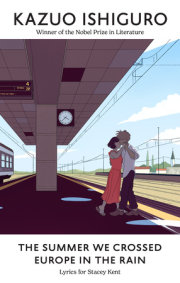
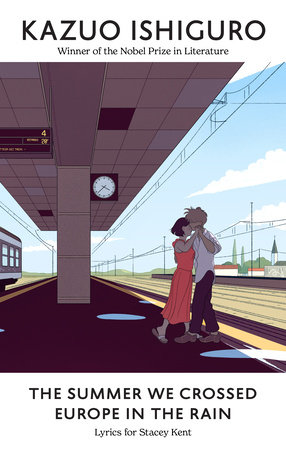
What follows in this volume are my lyrics to sixteen of the songs Jim Tomlinson and I have created for Stacey since that first discussion. I must say here that I’ve often felt ambivalent about the practice of publishing on printed pages the lyrics of songs created to be performed. It’s rare that a song lyric, isolated from its melody, orchestration and performance, can satisfyingly double as something to be read. And it remains my belief that a song lyric is not, and works quite differently from, a poem. Mindful of this challenge, my editors and I have attempted to create with this book something fresh and unique by persuading the brilliant Italian comics artist Bianca Bagnarelli (with whom I’ve collaborated before, and of whose work I’ve become an avid fan) to bring her own vision and dimension to each song.
And it’s my wish that after looking through these pages, you’ll want to experience, if you’ve not done so already, the recorded versions of our songs via the QR link provided. The songs’ musical side is entirely the work of the magnificently talented Jim Tomlinson – composer, saxophonist, flautist, bandleader, arranger and record producer. Eleven of these songs – the other five are works-in-progress – have appeared on various Stacey Kent albums over the years and have been performed, often many times over, in some of the most vaunted venues around the world, such as the Birdland Jazz Club in New York, Ronnie Scott’s in London, La Cigale in Paris and the Blue Note Tokyo.
My hope is that you’ll find here a gateway into our special world. Something that will amuse, move – perhaps even haunt.
Kazuo Ishiguro,
21 September 2023
Copyright © 2024 by Kazuo Ishiguro. All rights reserved. No part of this excerpt may be reproduced or reprinted without permission in writing from the publisher.