
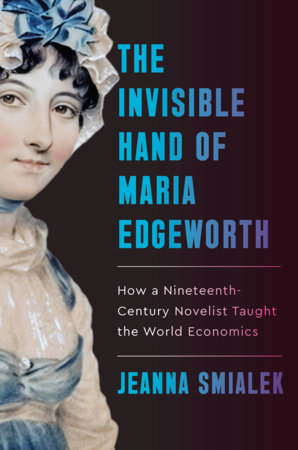


The Invisible Hand of Maria Edgeworth

How a Nineteenth-Century Novelist Taught the World Economics

Hardcover
$32.00 US
On sale Oct 06, 2026 | 304 Pages | 9780593801512

See Additional Formats
The untold story of the nineteenth-century novelist who outearned Jane Austen and wove provocative theories into her fiction—changing economics forever

At the end of the eighteenth century, Europe faced revolutions, famine, and war. It was out of this chaos that the field of economics was born—and while that founding has for centuries been attributed almost entirely to men, they were only part of the story. 

Maria Edgeworth, known to her contemporaries as “the Great Maria,” was one of the most important authors of the Regency era, envied by Lord Byron, admired by Jane Austen, and read avidly by the British royalty. But she was more than just a novelist and a society fixture: She was also a covert economist, working just after Adam Smith and alongside her friends David Ricardo and Thomas Malthus. As the earliest economists established their philosophies on production and investment, Edgeworth published dozens of stories, many with lessons on finance, society, and trade tucked into their plots. Through her fiction, Edgeworth delivered new ideas to a broader public, stretching the boundaries of what a woman of her time could achieve and captivating an empire in the process.

Here, her tale is told alongside those of the men—and women—who invented a field that would reshape our world. Lively and original, The Invisible Hand of Maria Edgeworth brings this astonishing woman and her world vividly to life and rewrites the origin story of modern economics.
© Michael Lionstar
JEANNA SMIALEK is the Brussels bureau chief at The New York Times. She has covered economic policy in one way or another since 2013, and is the author of Limitless, a book on the history and future of the Federal Reserve. She has previously written for Bloomberg News and Bloomberg Businessweek. A native of Pittsburgh, Smialek has spent most of her career in New York City and Washington, D.C., and now lives in Belgium with her husband. View titles by Jeanna Smialek
“Whoever thought economics could be such a joy to read? Maria Edgeworth may have written the novels, but Jeanna Smialek’s book brings them—and their world—to life. Take a fascinating voyage with Ricardo, Malthus, and Maria, from the age of the American, French, and Industrial revolutions to the Great Irish Famine, and learn some economics along the way.” —Claudia Goldin, Nobel Prize Laureate in Economics and author of Career and Family: Women’s Century-Long Journey Toward Equity

“Revelatory and riveting—an original perspective on the history of economic thought that will change how you see today’s economy, and a pleasure to read from start to finish.” —Jason Furman, Professor of Economics at Harvard University and Former Chair of the Council of Economic Advisers

“Lively biography of a woman who has been unjustly disappeared from the history of economics. . . . [Maria Edgeworth] emerges as a humane, politically aware thinker who deserves wider recognition, having been overlooked. . . . A welcome, and anything but dismal, contribution to the history of economics and 19th-century literature alike.” Kirkus Reviews (starred)

About

The untold story of the nineteenth-century novelist who outearned Jane Austen and wove provocative theories into her fiction—changing economics forever

At the end of the eighteenth century, Europe faced revolutions, famine, and war. It was out of this chaos that the field of economics was born—and while that founding has for centuries been attributed almost entirely to men, they were only part of the story. 

Maria Edgeworth, known to her contemporaries as “the Great Maria,” was one of the most important authors of the Regency era, envied by Lord Byron, admired by Jane Austen, and read avidly by the British royalty. But she was more than just a novelist and a society fixture: She was also a covert economist, working just after Adam Smith and alongside her friends David Ricardo and Thomas Malthus. As the earliest economists established their philosophies on production and investment, Edgeworth published dozens of stories, many with lessons on finance, society, and trade tucked into their plots. Through her fiction, Edgeworth delivered new ideas to a broader public, stretching the boundaries of what a woman of her time could achieve and captivating an empire in the process.

Here, her tale is told alongside those of the men—and women—who invented a field that would reshape our world. Lively and original, The Invisible Hand of Maria Edgeworth brings this astonishing woman and her world vividly to life and rewrites the origin story of modern economics.

Author

© Michael Lionstar
JEANNA SMIALEK is the Brussels bureau chief at The New York Times. She has covered economic policy in one way or another since 2013, and is the author of Limitless, a book on the history and future of the Federal Reserve. She has previously written for Bloomberg News and Bloomberg Businessweek. A native of Pittsburgh, Smialek has spent most of her career in New York City and Washington, D.C., and now lives in Belgium with her husband. View titles by Jeanna Smialek

Praise

“Whoever thought economics could be such a joy to read? Maria Edgeworth may have written the novels, but Jeanna Smialek’s book brings them—and their world—to life. Take a fascinating voyage with Ricardo, Malthus, and Maria, from the age of the American, French, and Industrial revolutions to the Great Irish Famine, and learn some economics along the way.” —Claudia Goldin, Nobel Prize Laureate in Economics and author of Career and Family: Women’s Century-Long Journey Toward Equity

“Revelatory and riveting—an original perspective on the history of economic thought that will change how you see today’s economy, and a pleasure to read from start to finish.” —Jason Furman, Professor of Economics at Harvard University and Former Chair of the Council of Economic Advisers

“Lively biography of a woman who has been unjustly disappeared from the history of economics. . . . [Maria Edgeworth] emerges as a humane, politically aware thinker who deserves wider recognition, having been overlooked. . . . A welcome, and anything but dismal, contribution to the history of economics and 19th-century literature alike.” Kirkus Reviews (starred)

Books for LGBTQIA+ Pride Month

In June we celebrate Lesbian, Gay, Bisexual, Transgender, Queer, Intersex, and Asexual + (LGBTQIA+) Pride Month, which honors the 1969 Stonewall riots in Manhattan. Pride Month is a time to both celebrate the accomplishments of those in the LGBTQ+ community and recognize the ongoing struggles faced by many across the world who wish to live

Read more