Download high-resolution image Look inside
Listen to a clip from the audiobook
audio play button
0:00
0:00

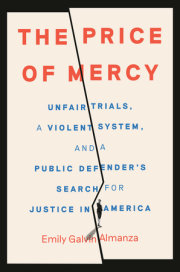
The Price of Mercy

Unfair Trials, a Violent System, and a Public Defender's Search for Justice in America

Author Emily Galvin Almanza On Tour
Look inside
Listen to a clip from the audiobook
audio play button
0:00
0:00
Hardcover
$32.00 US
On sale Feb 17, 2026 | 384 Pages | 9780593799116

See Additional Formats
A former public defender takes us behind the closed doors of America's criminal courts, revealing how the institutions that claim to protect us are doing the exact opposite—and offering a blueprint for finally fixing it.

“A searing, compassionate, and utterly necessary book that pulls back the curtain with the clarity of a lawyer and the heart of someone who’s seen the criminal legal system’s devastating consequences up close.”—Michelle Alexander, author of The New Jim Crow


As Americans, we are told a rose-tinted story about our criminal courts—that these are the hallowed halls of justice, that the purpose of our legal process is to find the truth, and that those who enforce the law are both equitable and heroic. But what if the reality is purposefully obscured to hide something rotten at the system’s core?

In The Price of Mercy, attorney and former public defender Emily Galvin Almanza weaves hard data and unforgettable stories, dark humor and compelling evidence to tell us the truth about what’s really going on behind the closed doors of America’s criminal courts. She shows us how jails actually increase future crime, the dirty tricks police use to make millions in overtime pay, how a man could spend decades in prison because scientists mistook dog hair for his own, the perverse incentives that push prosecutors to seek convictions even when they themselves don’t want to, and how judges may decide cases differently after lunch.

We’ll learn what’s working, too: how public defenders can improve public health and even economic mobility, and how planting more trees can reduce a neighborhood’s murder rates. But a lone defender winning a case won’t change the system. Galvin Almanza argues that we need an engaged public to confront the stark reality of our crime-generating, poverty-entrenching, health-destroying legal apparatus and rebuild it into something that can save our collective present and prevent our future from being torn apart.

Provocative and eye-opening, The Price of Mercy lifts the curtain on the way our laws really operate and presents a path forward for true transformation of the American criminal court system. Justice, and the law itself, is not some static thing. It is something enacted together, decision by decision, in acts of inhumanity or mercy.
Chapter One

Outsiders on the Inside

The Power of Public Defense

When I was a teenager, my life fell apart. I fell into substance abuse, and, ultimately, ended up getting arrested at the age of sixteen, thousands of miles from home. I was cuffed, crumpled into the back of a Boston PD cruiser, taken to booking, photographed, searched, and put in a holding cell until a responsible adult could come and get me. Two days later, I was standing in an austere Suffolk County courtroom, waiting to find out what would happen to me. It was not a great time.

I remember very little about that day. There is only one person I remember clearly—­Judge Leslie Harris, a juvenile court judge who had dedicated his time on the bench to seeing potential in children instead of seeing threat. I didn’t know at the time how lucky I was, or that my life was about to be saved by this man’s commitment to helping kids rather than doing harm. I remember clearly when he asked me to approach the bench, where he could speak with me alone. He asked me why I was in his courtroom when I had a college admission letter in hand. I don’t remember what I said, but I remember his reply.

“I’m going to dismiss your case,” he told me. “And this arrest will not stop you from going to college. But I don’t ever want to hear from you again, unless you’ve done something good with your life.” With those words, he let me go.

This story is a mixture of heroism and privilege. Obviously, I carried the incredible privileges of whiteness, education, involved parents, and future prospects into the courtroom. But also, I was standing before a Black jurist who had decided that in a system designed to punish, he would continually insist on offering children protection.

A decade later, because Judge Harris gave me that chance, I was able to land a job at the Los Angeles County Public Defender’s Office and show up to work, during my first summer of law school, at the Eastlake Juvenile Courthouse, which was, at the time, the busiest court for children in Los Angeles. Day in and day out, I was hurrying through the rabbit warren of hallways behind the courthouse, meeting kids who had made the same choices I had once made. But unlike me, these kids were largely Black and brown and had been born in a hyper-­policed, hyper-­surveilled L.A. neighborhood that punished all and protected none. As a young public defender, my practice of law was deeply personal. I saw kids whose futures were going to be thrown away when mine was preserved. As a lawyer, I could fight for those futures. I could try to pay forward the chance I had been given.

I worked on cases of people whose lives were set to be discarded for crimes as small as stealing a pair of socks. Over the years, I met a lot of people who were just plain not guilty, because the state of investigation in our streets is often closer to lazy bureaucratic box checking than any recognizable form of real inquiry. I also met innumerable people who were overcharged, meaning that while they might have done something, they certainly didn’t do what they were accused of. I spent my energy on litigation and winning trials while knowing full well that many of these cases were arising from addressable, or even avoidable, underlying circumstances: the fallout of entrenched poverty, lack of opportunity, constant police surveillance, structural racism, lack of health care, and the desperation and nihilism these circumstances breed. As public defenders, we are in solidarity with our clients, and standing together to face down a system that hides information, conceals misconduct, chooses efficiency and finality over the harder work of getting it right, and, even when right, is still deeply wrong, because all it can do is punish.


A third of Americans have had a loved one represented by a public defender. Public defenders are free lawyers. In America, we only get free lawyers in one context, which is criminal court—­if your liberty or your life is on the line, the U.S. Constitution says you have the right to counsel. For that reason, every jurisdiction in America has the ability to appoint a lawyer in a criminal case if a person cannot afford to pay for one themselves.

This looks different from place to place—­in some places, public defenders are government attorneys working in a governmental agency, while in others they may work at a nonprofit public defender that holds a contract with the jurisdiction, while in yet other places they might be part of a network of local lawyers who get assigned to public defense cases. Across America’s five thousand nine hundred defender agencies, both the nature and quality of practice vary. A public defender’s office with more resources will be able to do stronger work than an under-­resourced, overworked agency. And a public defender with a culture of commitment to client-­led service and creating an empowering, high-­quality defense for each person they serve will do better than an office where the lingering power dynamics of poverty lawyering have taken over and created cultural toxicity. So like anything else, defenders are not all alike. But they are all dedicated to the zealous, skilled defense of low-­income people who stand accused, and they are also a last bulwark against government overreach and the intractable impulses of law enforcement to trample our Constitution.

At some point, every defender will be asked how we can represent “those people,” meaning “criminals.” I don’t love that word. I’ve represented people who have made devastatingly bad choices. I’ve represented people who had found themselves in a state where they could no longer control their behavior, for one reason or another. I’ve represented people who were operating under circumstances that I cannot personally imagine surviving. I’ve represented a lot of people who were innocent, a fact that I have noticed often surprises laypeople, because television tells us that most people who get arrested are guilty, while in real life most people who get arrested are poor, and may or may not be guilty.

The system looks very different from the inside than it does on the outside. The laws are not applied as they are written, they’re interpreted, letting all manner of human bias and opinion seep into the decision-­making of courts. Exhaustion, jadedness, nihilism, and secondary trauma are everywhere, and since the court system isn’t just a machine—­all these human emotions, irritations, and traumas come into play. The “law,” often perceived as objective, is applied so subjectively from place to place that two neighboring counties may in fact have unrecognizably different charges, procedures, and outcomes. People getting offered support and recovery in one town might have received hard time in the next town over. Even the language varies: an arraignment in New York might be magistration in Texas or callout in Louisiana.

So like everyone else who works in the criminal court system, we spend all day, every day, watching the law as it is practiced turn out to be nothing like the law you see on TV. But unlike everyone else in the legal system, we aren’t there to uphold the machine. We’re there to argue against the grinding of the machine’s gears, find flaws in the machine itself, object to it, and, sure, okay, sometimes rage against the machine. When we do this, we usually start by saying, “Judge, I have to make my record,” meaning that we know we’re getting shut down now, but we want to preserve all the wrongness we’re witnessing for a higher court, one that will review the transcripts from this day.

I spent ten years practicing in various Halls of Justice from California to New York, including at the legendary holistic defense practice the Bronx Defenders. After representing thousands of people, it became clear to me that there was a fundamental need in public defense that was, often, not being met. To truly defend someone, one must equip the defense team with the means to deal not only with the criminal case but with its drivers and fallout: loss of housing, employment, educational opportunity, health care. In 2018, I left trial work to start Partners for Justice (PFJ), a nonprofit supporting defenders around the country in filling that need. Our approach, termed Collaborative Defense, quickly took off, growing from two pilot locations in 2018 to more than forty locations by 2024.
Emily Galvin Almanza is the co-founder and executive director of Partners for Justice, a nonprofit creating a new collaborative model of public defense designed to empower defenders nationwide. Prior to founding PFJ, Emily fought for clients inside the LA County Public Defender, Santa Clara County Public Defender, and Bronx Defenders, and with the Stanford Three Strikes Project. Galvin Almanza is the author of The Price of Mercy, and her writing has appeared in The Atlantic, The Washington Post, Newsweek, Teen Vogue, and Time, among others. View titles by Emily Galvin Almanza

About

A former public defender takes us behind the closed doors of America's criminal courts, revealing how the institutions that claim to protect us are doing the exact opposite—and offering a blueprint for finally fixing it.

“A searing, compassionate, and utterly necessary book that pulls back the curtain with the clarity of a lawyer and the heart of someone who’s seen the criminal legal system’s devastating consequences up close.”—Michelle Alexander, author of The New Jim Crow


As Americans, we are told a rose-tinted story about our criminal courts—that these are the hallowed halls of justice, that the purpose of our legal process is to find the truth, and that those who enforce the law are both equitable and heroic. But what if the reality is purposefully obscured to hide something rotten at the system’s core?

In The Price of Mercy, attorney and former public defender Emily Galvin Almanza weaves hard data and unforgettable stories, dark humor and compelling evidence to tell us the truth about what’s really going on behind the closed doors of America’s criminal courts. She shows us how jails actually increase future crime, the dirty tricks police use to make millions in overtime pay, how a man could spend decades in prison because scientists mistook dog hair for his own, the perverse incentives that push prosecutors to seek convictions even when they themselves don’t want to, and how judges may decide cases differently after lunch.

We’ll learn what’s working, too: how public defenders can improve public health and even economic mobility, and how planting more trees can reduce a neighborhood’s murder rates. But a lone defender winning a case won’t change the system. Galvin Almanza argues that we need an engaged public to confront the stark reality of our crime-generating, poverty-entrenching, health-destroying legal apparatus and rebuild it into something that can save our collective present and prevent our future from being torn apart.

Provocative and eye-opening, The Price of Mercy lifts the curtain on the way our laws really operate and presents a path forward for true transformation of the American criminal court system. Justice, and the law itself, is not some static thing. It is something enacted together, decision by decision, in acts of inhumanity or mercy.

Excerpt

Chapter One

Outsiders on the Inside

The Power of Public Defense

When I was a teenager, my life fell apart. I fell into substance abuse, and, ultimately, ended up getting arrested at the age of sixteen, thousands of miles from home. I was cuffed, crumpled into the back of a Boston PD cruiser, taken to booking, photographed, searched, and put in a holding cell until a responsible adult could come and get me. Two days later, I was standing in an austere Suffolk County courtroom, waiting to find out what would happen to me. It was not a great time.

I remember very little about that day. There is only one person I remember clearly—­Judge Leslie Harris, a juvenile court judge who had dedicated his time on the bench to seeing potential in children instead of seeing threat. I didn’t know at the time how lucky I was, or that my life was about to be saved by this man’s commitment to helping kids rather than doing harm. I remember clearly when he asked me to approach the bench, where he could speak with me alone. He asked me why I was in his courtroom when I had a college admission letter in hand. I don’t remember what I said, but I remember his reply.

“I’m going to dismiss your case,” he told me. “And this arrest will not stop you from going to college. But I don’t ever want to hear from you again, unless you’ve done something good with your life.” With those words, he let me go.

This story is a mixture of heroism and privilege. Obviously, I carried the incredible privileges of whiteness, education, involved parents, and future prospects into the courtroom. But also, I was standing before a Black jurist who had decided that in a system designed to punish, he would continually insist on offering children protection.

A decade later, because Judge Harris gave me that chance, I was able to land a job at the Los Angeles County Public Defender’s Office and show up to work, during my first summer of law school, at the Eastlake Juvenile Courthouse, which was, at the time, the busiest court for children in Los Angeles. Day in and day out, I was hurrying through the rabbit warren of hallways behind the courthouse, meeting kids who had made the same choices I had once made. But unlike me, these kids were largely Black and brown and had been born in a hyper-­policed, hyper-­surveilled L.A. neighborhood that punished all and protected none. As a young public defender, my practice of law was deeply personal. I saw kids whose futures were going to be thrown away when mine was preserved. As a lawyer, I could fight for those futures. I could try to pay forward the chance I had been given.

I worked on cases of people whose lives were set to be discarded for crimes as small as stealing a pair of socks. Over the years, I met a lot of people who were just plain not guilty, because the state of investigation in our streets is often closer to lazy bureaucratic box checking than any recognizable form of real inquiry. I also met innumerable people who were overcharged, meaning that while they might have done something, they certainly didn’t do what they were accused of. I spent my energy on litigation and winning trials while knowing full well that many of these cases were arising from addressable, or even avoidable, underlying circumstances: the fallout of entrenched poverty, lack of opportunity, constant police surveillance, structural racism, lack of health care, and the desperation and nihilism these circumstances breed. As public defenders, we are in solidarity with our clients, and standing together to face down a system that hides information, conceals misconduct, chooses efficiency and finality over the harder work of getting it right, and, even when right, is still deeply wrong, because all it can do is punish.


A third of Americans have had a loved one represented by a public defender. Public defenders are free lawyers. In America, we only get free lawyers in one context, which is criminal court—­if your liberty or your life is on the line, the U.S. Constitution says you have the right to counsel. For that reason, every jurisdiction in America has the ability to appoint a lawyer in a criminal case if a person cannot afford to pay for one themselves.

This looks different from place to place—­in some places, public defenders are government attorneys working in a governmental agency, while in others they may work at a nonprofit public defender that holds a contract with the jurisdiction, while in yet other places they might be part of a network of local lawyers who get assigned to public defense cases. Across America’s five thousand nine hundred defender agencies, both the nature and quality of practice vary. A public defender’s office with more resources will be able to do stronger work than an under-­resourced, overworked agency. And a public defender with a culture of commitment to client-­led service and creating an empowering, high-­quality defense for each person they serve will do better than an office where the lingering power dynamics of poverty lawyering have taken over and created cultural toxicity. So like anything else, defenders are not all alike. But they are all dedicated to the zealous, skilled defense of low-­income people who stand accused, and they are also a last bulwark against government overreach and the intractable impulses of law enforcement to trample our Constitution.

At some point, every defender will be asked how we can represent “those people,” meaning “criminals.” I don’t love that word. I’ve represented people who have made devastatingly bad choices. I’ve represented people who had found themselves in a state where they could no longer control their behavior, for one reason or another. I’ve represented people who were operating under circumstances that I cannot personally imagine surviving. I’ve represented a lot of people who were innocent, a fact that I have noticed often surprises laypeople, because television tells us that most people who get arrested are guilty, while in real life most people who get arrested are poor, and may or may not be guilty.

The system looks very different from the inside than it does on the outside. The laws are not applied as they are written, they’re interpreted, letting all manner of human bias and opinion seep into the decision-­making of courts. Exhaustion, jadedness, nihilism, and secondary trauma are everywhere, and since the court system isn’t just a machine—­all these human emotions, irritations, and traumas come into play. The “law,” often perceived as objective, is applied so subjectively from place to place that two neighboring counties may in fact have unrecognizably different charges, procedures, and outcomes. People getting offered support and recovery in one town might have received hard time in the next town over. Even the language varies: an arraignment in New York might be magistration in Texas or callout in Louisiana.

So like everyone else who works in the criminal court system, we spend all day, every day, watching the law as it is practiced turn out to be nothing like the law you see on TV. But unlike everyone else in the legal system, we aren’t there to uphold the machine. We’re there to argue against the grinding of the machine’s gears, find flaws in the machine itself, object to it, and, sure, okay, sometimes rage against the machine. When we do this, we usually start by saying, “Judge, I have to make my record,” meaning that we know we’re getting shut down now, but we want to preserve all the wrongness we’re witnessing for a higher court, one that will review the transcripts from this day.

I spent ten years practicing in various Halls of Justice from California to New York, including at the legendary holistic defense practice the Bronx Defenders. After representing thousands of people, it became clear to me that there was a fundamental need in public defense that was, often, not being met. To truly defend someone, one must equip the defense team with the means to deal not only with the criminal case but with its drivers and fallout: loss of housing, employment, educational opportunity, health care. In 2018, I left trial work to start Partners for Justice (PFJ), a nonprofit supporting defenders around the country in filling that need. Our approach, termed Collaborative Defense, quickly took off, growing from two pilot locations in 2018 to more than forty locations by 2024.

Author

Emily Galvin Almanza is the co-founder and executive director of Partners for Justice, a nonprofit creating a new collaborative model of public defense designed to empower defenders nationwide. Prior to founding PFJ, Emily fought for clients inside the LA County Public Defender, Santa Clara County Public Defender, and Bronx Defenders, and with the Stanford Three Strikes Project. Galvin Almanza is the author of The Price of Mercy, and her writing has appeared in The Atlantic, The Washington Post, Newsweek, Teen Vogue, and Time, among others. View titles by Emily Galvin Almanza