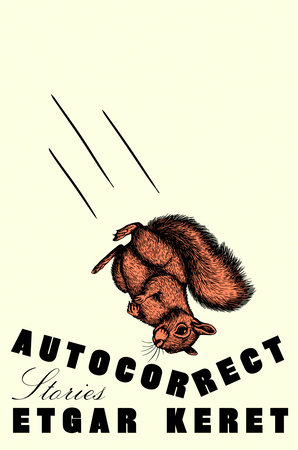
From one of the preeminent literary voices in Israel comes a darkly funny collection of surrealist stories exploring the increasingly complex relationship between humans and technology.

Set in our world, alternate realities, distant futures, and the immortal realm, the stories in Autocorrect traverse the wide range of human experience. With wit and creativity, Keret blends the absurd and the profound, juxtaposing life's smallest details with weighty existential questions. A man names an asteroid after his wife only to find that it's on a collision course with Earth in "For the Woman Who Has Everything." In "Squirrels," a widower's husband reincarnates as a rodent, and "Eating Olives at the End of the World" considers proper social etiquette in the face of destruction.

Keret's collection speaks to the uncertainty and fragility of our time, expertly capturing its misunderstandings and miscommunications. His stories probe society's uncomfortable truths, searching for meaning in our ever-changing world.
© Lielle_Sand
Born in Ramat Gan in 1967, Etgar Keret is a leading voice in Israeli literature and film. His books have been pub­lished in over four dozen lan­guages and his writing has appeared in The New York Times, Le Monde, and The New Yorker, among others. His awards include the Cannes Film Festival’s Caméra d’Or (2007), the Charles Bronfman Prize (2016), and the pres­tigious Sapir Prize (2018). Over a hundred short films and several feature films have been based on his stories. Keret teaches creative writing at Ben-Gurion University of the Negev. Since 2021, he has been publishing the weekly newsletter Alphabet Soup on Substack. View titles by Etgar Keret
Praise for Autocorrect:

“Universal and timeless.” – The New York Times

“The stories in Keret’s new collection respond to personal and global events in a way that is both comic and deeply felt.” – The New Yorker

“Bright and crisp, straightforward, but underneath they teem with wildness and possibility…A shiny Keret conceit is always in the service of the real, of plumbing the depths to reveal something true about how we relate, about our loneliness, our conflicts, and our longing to connect." – Aimee Bender

“Endlessly inventive…short prose morsels—most only a few pages—that explode like tiny starbursts and embrace a speculative edge.”Booklist

“The 33 pieces in this entertaining collection from Keret lay bare the absurdities, anxieties, and ironies of contemporary existence...Taken together, these vignettes form a vibrant tapestry of surprising depth.” – Publishers Weekly

“A bemusing clutch of comic vignettes alert to contemporary anxieties...in its strongest moments, what resonates most aren’t Keret’s high-concept predicaments, but the determination of characters to preserve their humanity despite them. Wry, affectionate, tart storytelling with Keret’s trademark comic kick.” – Kirkus Reviews, starred review

About

From one of the preeminent literary voices in Israel comes a darkly funny collection of surrealist stories exploring the increasingly complex relationship between humans and technology.

Set in our world, alternate realities, distant futures, and the immortal realm, the stories in Autocorrect traverse the wide range of human experience. With wit and creativity, Keret blends the absurd and the profound, juxtaposing life's smallest details with weighty existential questions. A man names an asteroid after his wife only to find that it's on a collision course with Earth in "For the Woman Who Has Everything." In "Squirrels," a widower's husband reincarnates as a rodent, and "Eating Olives at the End of the World" considers proper social etiquette in the face of destruction.

Keret's collection speaks to the uncertainty and fragility of our time, expertly capturing its misunderstandings and miscommunications. His stories probe society's uncomfortable truths, searching for meaning in our ever-changing world.

Author

© Lielle_Sand
Born in Ramat Gan in 1967, Etgar Keret is a leading voice in Israeli literature and film. His books have been pub­lished in over four dozen lan­guages and his writing has appeared in The New York Times, Le Monde, and The New Yorker, among others. His awards include the Cannes Film Festival’s Caméra d’Or (2007), the Charles Bronfman Prize (2016), and the pres­tigious Sapir Prize (2018). Over a hundred short films and several feature films have been based on his stories. Keret teaches creative writing at Ben-Gurion University of the Negev. Since 2021, he has been publishing the weekly newsletter Alphabet Soup on Substack. View titles by Etgar Keret

Praise

Praise for Autocorrect:

“Universal and timeless.” – The New York Times

“The stories in Keret’s new collection respond to personal and global events in a way that is both comic and deeply felt.” – The New Yorker

“Bright and crisp, straightforward, but underneath they teem with wildness and possibility…A shiny Keret conceit is always in the service of the real, of plumbing the depths to reveal something true about how we relate, about our loneliness, our conflicts, and our longing to connect." – Aimee Bender

“Endlessly inventive…short prose morsels—most only a few pages—that explode like tiny starbursts and embrace a speculative edge.”Booklist

“The 33 pieces in this entertaining collection from Keret lay bare the absurdities, anxieties, and ironies of contemporary existence...Taken together, these vignettes form a vibrant tapestry of surprising depth.” – Publishers Weekly

“A bemusing clutch of comic vignettes alert to contemporary anxieties...in its strongest moments, what resonates most aren’t Keret’s high-concept predicaments, but the determination of characters to preserve their humanity despite them. Wry, affectionate, tart storytelling with Keret’s trademark comic kick.” – Kirkus Reviews, starred review