Download high-resolution image Look inside
Listen to a clip from the audiobook
audio play button
0:00
0:00

Fear and Fury

The Reagan Eighties, the Bernie Goetz Shootings, and the Rebirth of White Rage

Look inside
Listen to a clip from the audiobook
audio play button
0:00
0:00
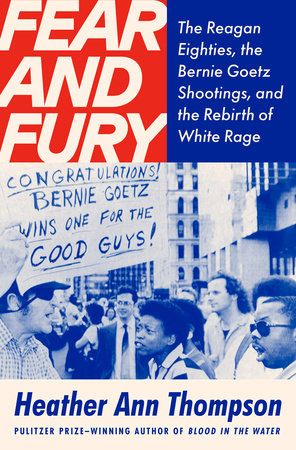
A NEW YORK TIMES BEST BOOK OF THE YEAR SO FARA NEW YORK TIMES BOOK REVIEW EDITORS' CHOICE • In this masterful, groundbreaking work, Pulitzer Prize-winning author Heather Ann Thompson shines surprising new light on an infamous 1984 New York subway shooting that would unveil simmering racial resentments and would lead, in unexpected ways, to a fractured future and a new era of rage and violence.

"A gripping and powerful account of one of the 20th century's most important criminal cases." --James Foreman Jr., Pulitzer Prize-winning author of Locking Up Our Own


On December 22, 1984, in a graffiti-covered New York City subway car, passengers looked on in horror as a white loner named Bernhard Goetz shot four Black teens,  Darrell Cabey, Barry Allen, Troy Canty, and James Ramseur, at point-blank range. He then disappeared into a dark tunnel. After an intense manhunt, and his eventual surrender in New Hampshire, the man the tabloid media had dubbed the “Death Wish Vigilante” would become a celebrity and a hero to countless ordinary Americans who had been frustrated with the economic fallout of the Reagan 80s. Overnight, Goetz’s young victims would become villains.

Out of this dramatic moment would emerge an angry nation, in which Rupert Murdoch's New York Post and later Fox News Network stoked the fear and the fury of a stunning number of Americans. 

Drawing from never-before-seen archival materials, legal files, and more, Heather Ann Thompson narrates the Bernie Goetz Subway shootings and their decades-long reverberations, while deftly recovering the lives of the boys whom too many decided didn't matter. Fear and Fury is the remarkable account and a searing indictment of a crucial turning point in American history.
1

Dreams Dashed

In 1980, Darrell Eugene Cabey was fourteen years old. He lived in the South Bronx, a neighborhood in New York City that, to presidential candidate Ronald Reagan, represented everything that was wrong with America.

Reagan chose the South Bronx as a campaign stop for exactly this reason. His motorcade arrived on Charlotte Street one scorching day in August, and cameras clicked away as he stood in front of a building on which political street artist John Fekner had scrawled the word “DECAY” in huge orange letters. Another crumbling façade could be seen nearby, where Fekner had painted “BROKEN PROMISES” in an equally loud message of censure and despair. Somberly gazing over the dilapidated lot on which he stood, Reagan told the assembled crowd of reporters and curious residents, in a not-so-subtle rebuke, that “he hadn’t ‘seen anything like this since London after the Blitz.’ ”

But this was also the place that Darrell Cabey, known as “Bean” by his family, felt most loved and supported. The Cabey family lived in a small apartment on the twenty-first floor of the Daniel Webster Homes, nestled in the Morrisania neighborhood of the South Bronx. Darrell’s mom, Shirley, worked hard to make it feel warm and welcoming. She insisted that he and his brothers help keep the place tidy and she made sure that they had decent meals and treated each other with respect. This was where Darrell and his siblings listened to baseball on the radio and played video games in one of the two bedrooms. Darrell’s best friend, Lydell, also lived in this building, and those two always found ways to have fun together, too.

Still, no one who lived where Darrell did, or in any of the many concrete complexes that pierced the sky in this South Bronx neighborhood, would have disagreed with Ronald Reagan’s assessment that this part of the city was in bad shape. The apartments were airless and dingy. They were poorly insulated, so that residents sweltered in the summer, and shivered in the winter, kids sometimes having to wear hats and coats inside to stay warm. In the icy winter of 1981, a resident was found literally frozen to death in one of the South Bronx’s public housing blocks.

Many of the buildings had also fallen into dangerous disrepair. The elevators clanged and shook ominously and would sometimes stop between floors, leaving residents panicked and uncertain that a maintenance worker would actually be available to respond to the emergency call button they had frantically pushed. From time to time, these lifts stopped working altogether, forcing residents like Shirley Cabey to trudge up seemingly endless flights of stairs with kids on their hips and grocery bags slipping from their hands. Meanwhile, the stairwells themselves were filled with trash, and light fixtures would flicker worryingly, if they hadn’t burned out entirely.

The basketball courts and playgrounds just outside the dismal confines of these dwellings could be equally dispiriting. Thanks to cracks and holes in the asphalt, it was easy to trip and fall just trying to dribble the ball or to shred one’s skin sliding into a makeshift base.

This, however, had not always been the case.

In the 1920s, the Bronx had been a jewel in the crown of the five boroughs of New York City. The only borough that isn’t on an island, in that early decade it boasted beautiful filigreed buildings, lush parks, and spectacular public works with majestic fountains that glittered when lit up at night. Not even Manhattan had anything akin to the Bronx’s Grand Boulevard and Concourse, a four-mile stretch of road that was “modeled on the Champs-Élysées of Paris” and featured two roadways—one for automobiles, and a shared one for pedestrians and horse-drawn carriages.

The Bronx drew visitors from the other boroughs and from across the globe, offering exuberant gatherings at Yankee Stadium, exotic animals from all around the world at the Bronx Zoo, and vibrant flowers and foliage in the Bronx Botanical Garden. The borough also boasted two well-respected universities, Fordham and New York University, making it a destination for scholars, too.

The “South Bronx” was the rather vague designation bestowed on the southwestern area of the borough, which was more or less “bounded on the north by Fordham Road, on the west, by the Harlem River, and on the south and east by the East and Bronx Rivers.” It covered approximately three thousand acres of land—a bit over 10 percent of the borough. This part of the Bronx had always been less grand than the more touristy areas, and became even less so when, between 1948 and 1972, it endured the noise, dust, and ugly machinery required to build the Cross Bronx Expressway. This highway bisected the neighborhood and subjected it to inordinate amounts of congestion and pollution and was the first major U.S. highway to run straight through an urban area. It also ran through much of the public housing located there, displacing between forty and sixty thousand residents.

While these housing projects would later be associated with blight and decay, they were once beacons of social aspiration. By the 1950s, the New York City Housing Authority had built five large projects consisting of ninety-six buildings, all intended to provide safe and sturdy housing for primarily white families after World War II. These dwellings, along with access to low-interest housing loans from the federal government and to college classes from the G.I. Bill, made it feasible for a generation of young white families to move up and out of these subsidized units, just as they were supposed to.

When the neighborhood started facing increased grassroots and legal pressures to integrate during the 1960s, the Federal Housing Authority and a federally subsidized highway system made it possible for white residents of the South Bronx to escape to alluring suburban enclaves where they could own their own homes. White flight escalated between 1960 and 1980, and the South Bronx, and many other NYC neighborhoods, underwent a dramatic demographic change as Black and Brown families then moved into these areas.

By the close of the 1970s, Puerto Rican and Black residents predominated in the South Bronx, with an ever-growing Dominican population as well. Over the course of the next decade, a full 39 percent of the people in this part of the Bronx would also be living below the poverty line. The area would, meanwhile, quite literally become a dumping ground for the rest of the city. In time, the majority of New York’s commercial waste transfer stations—where trash trucks dumped their loads for compacting—as well as dozens of privately owned salvage yards and recycling centers would be located there.

White fllght had proven devastating to the South Bronx, but the damage it wrought had not been inevitable. Had city hall merely continued the same steady infusion of public dollars and businesses offered the same opportunities for stable employment they had offered the original inhabitants of this area, the fallout from this exodus could have been prevented. But they did not. When a major fiscal crisis then gripped the nation in the mid-1970s, the South Bronx would only continue to be stripped and starved of what remaining resources it had.

This devastating economic crisis was also rooted in ill-fated economic and political choices. A series of oil price shocks in 1973 and more in 1979, as well as stagnating global economic growth accompanied by high inflation—a phenomenon dubbed “stagflation”—had dealt a devastating blow globally. Also important was rising resistance to some of the United States’ more extractive policies on the global stage, along with pressures for better and more equal pay at home. Businesses felt their profits being squeezed, and in response, they pulled back on many of their investment plans and slashed jobs.

In urban centers such as New York City, the consequences of this were particularly dire. Thanks to declining tax revenues and the deepening fiscal crisis more generally, NYC was $11 billion in debt by 1975 and unable to meet its obligations to its creditors. To avoid outright bankruptcy, the city had to rely on both state and federal intervention and severely cut back on its spending. Accordingly, it would lay off 38,000 workers, cancel various resident benefits such as free tuition at city colleges, and much more.

For families in the South Bronx, the loss of city jobs as well as this eradication of an educational path out of poverty mattered. In the late 1960s, for example, before the City University of New York (CUNY) system ended free tuition, it had educated a disproportionately high number of first-generation, working-class Black and Puerto Rican students. Indeed, when it had decided to guarantee every NYC high school graduate a spot in the system without cost in 1969, the percentage of Black and Puerto Rican students nearly tripled in just a few years. By 1976, more than 50 percent of incoming freshmen were Black and Brown. Reversing this policy thereafter hit these New Yorkers very hard.

Meanwhile, unscrupulous landlords had also begun preying upon the poor residents of places like the South Bronx, with very little oversight from city hall. Landlords’ disregard for the needs of their low-income tenants led to serious problems. By the late 1970s, the majority of housing in the South Bronx did not meet even the most basic health and safety regulations. More alarmingly, homes there began igniting in a stunning number of deadly blazes—averaging nearly twelve thousand fires a year.

As historian Bench Ansfield has pointed out, the 1970s “arson epidemic” that engulfed the South Bronx was too often the result of landlords looking to cash in on insurance payouts. As a result of these fires, neglect, and rising rates of poverty, the South Bronx eventually lost a full one-fifth of its housing stock to demolition or abandonment. By the end of the 1970s, city-owned high-rise projects loomed above charred fields with no other dwelling for blocks, like “residential islands on empty landscapes.”

This devastation was not simply spatial or abstract; it was felt directly by the neighborhood’s residents. Usurious private landlords raised rents and evicted tenants whenever it suited them. Successfully fighting such evictions in court was daunting. As one social worker put it, “Often it was hard to figure out who the landlord was or how to reach him.” But fight it the poor still did. They did so via myriad tenant-centered organizations and, as historian Elizabeth Hinton shows, also through open acts of rebellion. Meanwhile, the number of South Bronx residents evicted from public housing would also grow each year of the recession, and they too would resist such displacement.

In fact, people from the South Bronx regularly spoke out against the civic indifference and abuses they now faced. As historian LaShawn Harris has chronicled, they time and again mobilized to demand that their needs be met with the same level of commitment that white residents of this same neighborhood had enjoyed in years past. In one such moment, Harris points out, almost three hundred Bronx families “staged an eight-month rent strike, demanding repairs for windows, washers and dryers, stairwells and hallways, and water-damaged apartments.”

Notably, the Cabeys had not always lived in public housing. In the early years of Darrell’s life, the family had lived in the downstairs of a house in Far Rockaway, Queens. Shirley and her husband, Ronald, had moved there in 1965. Though Ronald worked long hours as a truck driver, his earnings made it possible for Shirley to stay home with Darrell and his four brothers. They could go to the beach when it was nice out, and even when it wasn’t, she was always encouraging the kids to play outside in their own front or back yards. Their dog, Flocko, loved to run around on the lawn and sometimes, to his family’s consternation, even managed to escape for a brief frolic in one of the lush grassy fields nearby.

This family wasn’t flush, but they felt financially stable and independent. They owned two cars and loved taking family vacations. Those adventures were especially treasured by the Cabey kids, because their dad was so often away from home. When Ronald’s boss retired, he had taken the bold step of going into business for himself, which meant that he was driving his truck longer and later each day. The kids hated having to go to bed before they heard him coming in the front door.

But one night, Ronald Cabey did not come home. That evening in 1973, he stopped at a diner to get something to eat. He chose a seat in a vinyl booth, right next to a window, so that he could keep an eye on his truck. Suddenly, he noticed a stranger hoisting himself behind the wheel.

Ron panicked. His family’s entire economic security depended on this vehicle. He ran outside, where the thief was already tearing out of the parking space. Somehow, Ronald managed to jump onto the truck’s running board and tried to grab the man inside in order to throw him out of the vehicle. The driver had a gun, but even this did not dissuade Ron.

To the horror of onlookers, however, as the thief turned onto a busy street, he violently wrenched the wheel in an attempt to shake Ron off. At that exact moment, another car was turning into the restaurant’s driveway. With a sickening screech, the two vehicles collided, crushing Ronald Cabey between them. He fell to the pavement and died at the scene, as the stolen truck sped away.

Shirley Cabey was devastated. Without her husband’s income, she decided to move her family into public housing in the South Bronx, where they would also be closer to her mother. Shirley was only twenty-six years old, a widow with children who were grieving terribly. Darrell was just seven years old when he lost his dad, his dog, and the only home he had ever known. He took his father’s death particularly hard, and Shirley tried to get him counseling. She eventually managed to get Darrell to see someone over at Bronx-Lebanon Hospital, but she wasn’t sure how helpful it was for her son.

By 1980, the five Cabey brothers and their mother were squeezed into a two-bedroom apartment in the sprawling Claremont Village projects, which included the Daniel Webster Homes. Subsidized housing was a godsend, costing Shirley Cabey only $126.25 a month. And the good news too was that she would eventually land a new state job, working as a food service handler at the Manhattan State Psychiatric Center on Wards Island. She prayed that she would make it past the probationary period customary for all new employees, and that the position would become permanent. Since her husband’s death, Shirley also received a monthly Social Security check of $472, which was a great relief as well. The Cabeys were in better shape than most families, and yet the money coming in was still far less than they needed.
© Lisa Spindler Studio
HEATHER ANN THOMPSON is a historian and the author of Blood in the Water: The Attica Prison Uprising of 1971 and Its Legacy, which won the Pulitzer Prize and the Bancroft Prize. She is also the author of Whose Detroit?: Politics, Labor, and Race in a Modern American City. Thompson has written about the criminal justice system for myriad publications, including The New York Times, The Washington Post, Time, Rolling Stone, The Atlantic, and The New Yorker. She has served on the National Academy of Sciences blue ribbon panel that studied the causes and consequences of mass incarceration in the United States, co-runs the Carceral State Project at the University of Michigan, and has been the recipient of numerous honors including a Guggenheim Fellowship, a Whiting Creative Nonfiction Grant, and a Racial Justice Fellowship from the Carr-Ryan Center for Human Rights at Harvard University. Thompson has also served as a historical consultant for film and television, including on the Oscar-nominated feature documentary Attica. View titles by Heather Ann Thompson
A New York Times Best Book of the Year So Far
A New York Times Book Review Editors' Choice

A Most Anticipated Book from The New York Times, The Washington Post, TIME Magazine, Vulture, Barnes & Noble, Literary Hub, Ms. Magazine, Kirkus, Library Journal, Publishers Weekly, BookPage, KMUW, The Stacks, The Sydney Morning Herald, and Reality Blurred

"A timely, brilliantly documented re-examination of the 1980s and the lingering hostility to the Civil Rights movement. Fear and Fury thoughtfully explores the demands of racial equality and carefully details America's often-violent resistance to racial justice."
—Bryan Stevenson, #1 New York Times bestselling author of Just Mercy

"This book is like a secret decoder ring for all those trying to understand the politics of white rage today. In Fear and Fury, Pulitzer Prize–winning historian Heather Ann Thompson delivers a breathtaking and unflinching account of how the Reagan era—and one violent encounter on a New York subway—reignited a national politics of white fear. Moving from the South Bronx to the corridors of power, Thompson exposes how racial anxiety, economic abandonment, and media hysteria fused to justify oppression and criminalize the most vulnerable. This history reminds us that only by reckoning with the roots of fear and fury can we ever hope to build a democracy that truly honors the dignity and humanity of us all."
—Michelle Alexander, New York Times bestselling author of The New Jim Crow

"[Thompson] writes expansively about the Goetz case as both a reflection of a city torn apart by neoliberal neglect and a harbinger of what she calls 'the rebirth of white rage'. . . . Vibrant, powerful and moving."
—Jennifer Szalai, The New York Times

"[Thompson] vividly revisit[s] the 1984 subway shooting that gripped the country. . . . [and] effectively link[s] the shooting to more recent incidents involving a deadly cocktail of racial stereotypes, the overzealous use of force—if not outright vigilantism—countenanced in the name of self-defense and broadening gun rights."
The Washington Post

“Embraced by the media after he shot four Black teenagers on the New York City subway, Bernie Goetz was the vigilante poster boy of the 1980s, a folk hero to millions. . . . Heather Ann Thompson, the Pulitzer Prize-winning author of Blood in the Water, spins this narrative on its head, centering Goetz’s victims while illuminating the rise of tabloid journalism and early stirrings of disinformation culture.”
TIME Magazine


“Written with heart and precision, Fear and Fury captures New York at its breaking point and traces how a city’s panic became a nation’s policy. It’s an extraordinary act of witness and understanding, alive on every page with urgency and truth.”
—Gilbert King, Pulitzer Prize-winning author of Devil in the Grove

“Heather Ann Thompson’s Fear and Fury provides . . . [a] detailed reconstruction [of the Goetz shootings]—very much in the vein of her excellent, indignant history of the Attica prison uprising. . . . She treats the Goetz episode as the first whitecap on the surge of racial rage that rose with the Reagan era and has carried into our own.”
The New Yorker


"Powerful. . . . [Thompson] has painted a sharply accurate contextual picture of 1980s America and shown readers how to see that decade as the seed bed for our current national difficulties."
The Boston Globe

"Riveting . . . [Thompson] examines the Goetz case with a keen eye on today, drawing direct and haunting connections between the 'white rage' that revealed itself after the 1984 shootings and the abhorrent increase in violence against people of Color today."
Harper's Bazaar

"[Thompson's new book] explores fear, how it has become one of the most powerful forces in American life, powerful enough to excuse violence, shape policy and decide whose lives matter. . . . [She] argues the [Goetz] case marked a political turning point when white racial fear was sanctioned by law and leveraged by elites who learned how useful fear could be."
—NPR

"Required reading."
Ms. Magazine

"Thompson's deeply researched account [of the Bernie Goetz case] becomes a through line to the present: the event that, against a backdrop of growing inequality and racial resentment in the early 1980s, first gave legal cover to white vigilantism, creating a template increasingly embraced on the right today."
The New York Times

"Powerful. . . . Thompson explores the [Goetz shootings'] roots in the [1980s'] stark racial and economic divisions and argues that the incident has had a pernicious effect on our contemporary political culture. . . . As a historian, Thompson is interested in the long shadow of these events of four decades ago. . . . Most significantly, Thompson posits that the shootings 'unleashed and normalized a new era of racialized rage.' She sees the influence of the Goetz case in the spread of what are often called 'stand your ground' state laws and in the actions of George Zimmerman, Kyle Rittenhouse, and Daniel Pennyall, in her words, 'ordinary men' who '[meted] out extralegal punishment' and were subsequently acquitted of most or all of the charges against them. . . . Thompson suggests that taken to their extremes, fear and fury can threaten democracy itself."
Christian Science Monitor

“Heather Ann Thompson’s Fear and Fury brings to life Bernhard Goetz’s shooting of four Black teenagers on a New York subway in 1984, a moment that exposed the ugly reality of America’s racial divide. With vivid prose and meticulous research, Thompson shows that we have yet to truly overcome the malign effects of racial animus.”
—Annette Gordon-Reed, Pulitzer Prize-winning author of The Hemingses of Monticello and On Juneteenth, and Carl M. Loeb University Professor at Harvard University

“A magnum opus that balances sensitive storytelling and fully realized characters with illuminating history—required reading for anyone interested in understanding the centrality of violence in American society.”
—Kathleen Belew, author of Bring the War Home: The White Power Movement and Paramilitary America

“Heather Ann Thompson has once again produced a defining work of American history with Fear and Fury. She provides not only a sweeping and indispensable account of Bernhard Goetz’s horrific actions but also excavates the larger backdrop of cultural and political forces that weaponized white rage during the 1980s and beyond. Readers will be moved by the care and dignity Thompson brings to the stories of Barry Allen, Darrell Cabey, Troy Canty, and James Ramseur—the four Black teenagers whose lives were forever changed during that fateful subway ride—forcing a reckoning with the human cost of vigilante violence. Fear and Fury is a monumental achievement that exposes the roots of the nation’s current crisis and serves as an urgent message to resist the manufactured fear that threatens the resilience of democracy itself.”
—Elizabeth Hinton, author of America on Fire

"A gripping and powerful account of one of the 20th century’s most important criminal cases."
James Forman Jr., Pulitzer Prize-winning author of Locking Up Our Own and J. Skelly Wright Professor of Law at Yale Law School

"Groundbreaking. . . . Vivid. . . . [Thompson has] a perceptive grasp on the role of culture, particularly tabloid media, in playing on the fears of many and influencing public opinion.”
Against the Current

"Heather Ann Thompson revisits the [Goetz] case. . . . A granular examination of the shooting, the trial, and the civil case brought by Cabey, this work also explains the incident’s enduring impact on American society. Thompson traces a path from then to now, a period when right-wing news outlets peddle a constant narrative that New York is again a lawless city on the brink of destruction. . . . A worthwhile read."
Irish Examiner

“A comprehensive account of a vicious outburst that shook New York four decades ago. . . . [Thompson] elucidates how the incident still has a malign influence. . . . and excels when exploring the broader trends that led to the shooting and the 'throughline' connecting Goetz to 'the America of President Donald Trump'. . . . [Thompson’s] skill for historical dot-connecting makes this a worthy, informative book.”
Kirkus Reviews

“Thompson names Ronald Reagan’s cuts to the social safety net as the original sin of the 1980s. She charts the rise of Rupert Murdoch’s media empire, which capitalized on racial resentments and economic anxieties of fear­ful, angry white New Yorkers who were disenchanted with liberal solutions to social prob­lems. . . . But the heart of Fear and Fury is twin courtroom dramas: the criminal trial of Goetz for the shootings and a civil trial seek­ing financial damages for one of his victims. . . . In Thompson’s capable hands, the Goetz saga, and its relation­ship to the present day, gets the messy resolution it deserves.”
—BookPage, starred review

"Insightful. . . . A searing critique of white America's racial resentments."
—Publishers Weekly

"A true story of injustice—in which Goetz got off unscathed while the teens paid for the rest of their lives—against a background of economic inequality accelerated by Republican economic and social policies, racial animosity and vigilante adulation fanned by Murdoch’s divisive media empire, and the NRA’s burgeoning political muscle. . . . Insightful. . . . Convincing."
—Booklist

About

A NEW YORK TIMES BEST BOOK OF THE YEAR SO FARA NEW YORK TIMES BOOK REVIEW EDITORS' CHOICE • In this masterful, groundbreaking work, Pulitzer Prize-winning author Heather Ann Thompson shines surprising new light on an infamous 1984 New York subway shooting that would unveil simmering racial resentments and would lead, in unexpected ways, to a fractured future and a new era of rage and violence.

"A gripping and powerful account of one of the 20th century's most important criminal cases." --James Foreman Jr., Pulitzer Prize-winning author of Locking Up Our Own


On December 22, 1984, in a graffiti-covered New York City subway car, passengers looked on in horror as a white loner named Bernhard Goetz shot four Black teens,  Darrell Cabey, Barry Allen, Troy Canty, and James Ramseur, at point-blank range. He then disappeared into a dark tunnel. After an intense manhunt, and his eventual surrender in New Hampshire, the man the tabloid media had dubbed the “Death Wish Vigilante” would become a celebrity and a hero to countless ordinary Americans who had been frustrated with the economic fallout of the Reagan 80s. Overnight, Goetz’s young victims would become villains.

Out of this dramatic moment would emerge an angry nation, in which Rupert Murdoch's New York Post and later Fox News Network stoked the fear and the fury of a stunning number of Americans. 

Drawing from never-before-seen archival materials, legal files, and more, Heather Ann Thompson narrates the Bernie Goetz Subway shootings and their decades-long reverberations, while deftly recovering the lives of the boys whom too many decided didn't matter. Fear and Fury is the remarkable account and a searing indictment of a crucial turning point in American history.

Excerpt

1

Dreams Dashed

In 1980, Darrell Eugene Cabey was fourteen years old. He lived in the South Bronx, a neighborhood in New York City that, to presidential candidate Ronald Reagan, represented everything that was wrong with America.

Reagan chose the South Bronx as a campaign stop for exactly this reason. His motorcade arrived on Charlotte Street one scorching day in August, and cameras clicked away as he stood in front of a building on which political street artist John Fekner had scrawled the word “DECAY” in huge orange letters. Another crumbling façade could be seen nearby, where Fekner had painted “BROKEN PROMISES” in an equally loud message of censure and despair. Somberly gazing over the dilapidated lot on which he stood, Reagan told the assembled crowd of reporters and curious residents, in a not-so-subtle rebuke, that “he hadn’t ‘seen anything like this since London after the Blitz.’ ”

But this was also the place that Darrell Cabey, known as “Bean” by his family, felt most loved and supported. The Cabey family lived in a small apartment on the twenty-first floor of the Daniel Webster Homes, nestled in the Morrisania neighborhood of the South Bronx. Darrell’s mom, Shirley, worked hard to make it feel warm and welcoming. She insisted that he and his brothers help keep the place tidy and she made sure that they had decent meals and treated each other with respect. This was where Darrell and his siblings listened to baseball on the radio and played video games in one of the two bedrooms. Darrell’s best friend, Lydell, also lived in this building, and those two always found ways to have fun together, too.

Still, no one who lived where Darrell did, or in any of the many concrete complexes that pierced the sky in this South Bronx neighborhood, would have disagreed with Ronald Reagan’s assessment that this part of the city was in bad shape. The apartments were airless and dingy. They were poorly insulated, so that residents sweltered in the summer, and shivered in the winter, kids sometimes having to wear hats and coats inside to stay warm. In the icy winter of 1981, a resident was found literally frozen to death in one of the South Bronx’s public housing blocks.

Many of the buildings had also fallen into dangerous disrepair. The elevators clanged and shook ominously and would sometimes stop between floors, leaving residents panicked and uncertain that a maintenance worker would actually be available to respond to the emergency call button they had frantically pushed. From time to time, these lifts stopped working altogether, forcing residents like Shirley Cabey to trudge up seemingly endless flights of stairs with kids on their hips and grocery bags slipping from their hands. Meanwhile, the stairwells themselves were filled with trash, and light fixtures would flicker worryingly, if they hadn’t burned out entirely.

The basketball courts and playgrounds just outside the dismal confines of these dwellings could be equally dispiriting. Thanks to cracks and holes in the asphalt, it was easy to trip and fall just trying to dribble the ball or to shred one’s skin sliding into a makeshift base.

This, however, had not always been the case.

In the 1920s, the Bronx had been a jewel in the crown of the five boroughs of New York City. The only borough that isn’t on an island, in that early decade it boasted beautiful filigreed buildings, lush parks, and spectacular public works with majestic fountains that glittered when lit up at night. Not even Manhattan had anything akin to the Bronx’s Grand Boulevard and Concourse, a four-mile stretch of road that was “modeled on the Champs-Élysées of Paris” and featured two roadways—one for automobiles, and a shared one for pedestrians and horse-drawn carriages.

The Bronx drew visitors from the other boroughs and from across the globe, offering exuberant gatherings at Yankee Stadium, exotic animals from all around the world at the Bronx Zoo, and vibrant flowers and foliage in the Bronx Botanical Garden. The borough also boasted two well-respected universities, Fordham and New York University, making it a destination for scholars, too.

The “South Bronx” was the rather vague designation bestowed on the southwestern area of the borough, which was more or less “bounded on the north by Fordham Road, on the west, by the Harlem River, and on the south and east by the East and Bronx Rivers.” It covered approximately three thousand acres of land—a bit over 10 percent of the borough. This part of the Bronx had always been less grand than the more touristy areas, and became even less so when, between 1948 and 1972, it endured the noise, dust, and ugly machinery required to build the Cross Bronx Expressway. This highway bisected the neighborhood and subjected it to inordinate amounts of congestion and pollution and was the first major U.S. highway to run straight through an urban area. It also ran through much of the public housing located there, displacing between forty and sixty thousand residents.

While these housing projects would later be associated with blight and decay, they were once beacons of social aspiration. By the 1950s, the New York City Housing Authority had built five large projects consisting of ninety-six buildings, all intended to provide safe and sturdy housing for primarily white families after World War II. These dwellings, along with access to low-interest housing loans from the federal government and to college classes from the G.I. Bill, made it feasible for a generation of young white families to move up and out of these subsidized units, just as they were supposed to.

When the neighborhood started facing increased grassroots and legal pressures to integrate during the 1960s, the Federal Housing Authority and a federally subsidized highway system made it possible for white residents of the South Bronx to escape to alluring suburban enclaves where they could own their own homes. White flight escalated between 1960 and 1980, and the South Bronx, and many other NYC neighborhoods, underwent a dramatic demographic change as Black and Brown families then moved into these areas.

By the close of the 1970s, Puerto Rican and Black residents predominated in the South Bronx, with an ever-growing Dominican population as well. Over the course of the next decade, a full 39 percent of the people in this part of the Bronx would also be living below the poverty line. The area would, meanwhile, quite literally become a dumping ground for the rest of the city. In time, the majority of New York’s commercial waste transfer stations—where trash trucks dumped their loads for compacting—as well as dozens of privately owned salvage yards and recycling centers would be located there.

White fllght had proven devastating to the South Bronx, but the damage it wrought had not been inevitable. Had city hall merely continued the same steady infusion of public dollars and businesses offered the same opportunities for stable employment they had offered the original inhabitants of this area, the fallout from this exodus could have been prevented. But they did not. When a major fiscal crisis then gripped the nation in the mid-1970s, the South Bronx would only continue to be stripped and starved of what remaining resources it had.

This devastating economic crisis was also rooted in ill-fated economic and political choices. A series of oil price shocks in 1973 and more in 1979, as well as stagnating global economic growth accompanied by high inflation—a phenomenon dubbed “stagflation”—had dealt a devastating blow globally. Also important was rising resistance to some of the United States’ more extractive policies on the global stage, along with pressures for better and more equal pay at home. Businesses felt their profits being squeezed, and in response, they pulled back on many of their investment plans and slashed jobs.

In urban centers such as New York City, the consequences of this were particularly dire. Thanks to declining tax revenues and the deepening fiscal crisis more generally, NYC was $11 billion in debt by 1975 and unable to meet its obligations to its creditors. To avoid outright bankruptcy, the city had to rely on both state and federal intervention and severely cut back on its spending. Accordingly, it would lay off 38,000 workers, cancel various resident benefits such as free tuition at city colleges, and much more.

For families in the South Bronx, the loss of city jobs as well as this eradication of an educational path out of poverty mattered. In the late 1960s, for example, before the City University of New York (CUNY) system ended free tuition, it had educated a disproportionately high number of first-generation, working-class Black and Puerto Rican students. Indeed, when it had decided to guarantee every NYC high school graduate a spot in the system without cost in 1969, the percentage of Black and Puerto Rican students nearly tripled in just a few years. By 1976, more than 50 percent of incoming freshmen were Black and Brown. Reversing this policy thereafter hit these New Yorkers very hard.

Meanwhile, unscrupulous landlords had also begun preying upon the poor residents of places like the South Bronx, with very little oversight from city hall. Landlords’ disregard for the needs of their low-income tenants led to serious problems. By the late 1970s, the majority of housing in the South Bronx did not meet even the most basic health and safety regulations. More alarmingly, homes there began igniting in a stunning number of deadly blazes—averaging nearly twelve thousand fires a year.

As historian Bench Ansfield has pointed out, the 1970s “arson epidemic” that engulfed the South Bronx was too often the result of landlords looking to cash in on insurance payouts. As a result of these fires, neglect, and rising rates of poverty, the South Bronx eventually lost a full one-fifth of its housing stock to demolition or abandonment. By the end of the 1970s, city-owned high-rise projects loomed above charred fields with no other dwelling for blocks, like “residential islands on empty landscapes.”

This devastation was not simply spatial or abstract; it was felt directly by the neighborhood’s residents. Usurious private landlords raised rents and evicted tenants whenever it suited them. Successfully fighting such evictions in court was daunting. As one social worker put it, “Often it was hard to figure out who the landlord was or how to reach him.” But fight it the poor still did. They did so via myriad tenant-centered organizations and, as historian Elizabeth Hinton shows, also through open acts of rebellion. Meanwhile, the number of South Bronx residents evicted from public housing would also grow each year of the recession, and they too would resist such displacement.

In fact, people from the South Bronx regularly spoke out against the civic indifference and abuses they now faced. As historian LaShawn Harris has chronicled, they time and again mobilized to demand that their needs be met with the same level of commitment that white residents of this same neighborhood had enjoyed in years past. In one such moment, Harris points out, almost three hundred Bronx families “staged an eight-month rent strike, demanding repairs for windows, washers and dryers, stairwells and hallways, and water-damaged apartments.”

Notably, the Cabeys had not always lived in public housing. In the early years of Darrell’s life, the family had lived in the downstairs of a house in Far Rockaway, Queens. Shirley and her husband, Ronald, had moved there in 1965. Though Ronald worked long hours as a truck driver, his earnings made it possible for Shirley to stay home with Darrell and his four brothers. They could go to the beach when it was nice out, and even when it wasn’t, she was always encouraging the kids to play outside in their own front or back yards. Their dog, Flocko, loved to run around on the lawn and sometimes, to his family’s consternation, even managed to escape for a brief frolic in one of the lush grassy fields nearby.

This family wasn’t flush, but they felt financially stable and independent. They owned two cars and loved taking family vacations. Those adventures were especially treasured by the Cabey kids, because their dad was so often away from home. When Ronald’s boss retired, he had taken the bold step of going into business for himself, which meant that he was driving his truck longer and later each day. The kids hated having to go to bed before they heard him coming in the front door.

But one night, Ronald Cabey did not come home. That evening in 1973, he stopped at a diner to get something to eat. He chose a seat in a vinyl booth, right next to a window, so that he could keep an eye on his truck. Suddenly, he noticed a stranger hoisting himself behind the wheel.

Ron panicked. His family’s entire economic security depended on this vehicle. He ran outside, where the thief was already tearing out of the parking space. Somehow, Ronald managed to jump onto the truck’s running board and tried to grab the man inside in order to throw him out of the vehicle. The driver had a gun, but even this did not dissuade Ron.

To the horror of onlookers, however, as the thief turned onto a busy street, he violently wrenched the wheel in an attempt to shake Ron off. At that exact moment, another car was turning into the restaurant’s driveway. With a sickening screech, the two vehicles collided, crushing Ronald Cabey between them. He fell to the pavement and died at the scene, as the stolen truck sped away.

Shirley Cabey was devastated. Without her husband’s income, she decided to move her family into public housing in the South Bronx, where they would also be closer to her mother. Shirley was only twenty-six years old, a widow with children who were grieving terribly. Darrell was just seven years old when he lost his dad, his dog, and the only home he had ever known. He took his father’s death particularly hard, and Shirley tried to get him counseling. She eventually managed to get Darrell to see someone over at Bronx-Lebanon Hospital, but she wasn’t sure how helpful it was for her son.

By 1980, the five Cabey brothers and their mother were squeezed into a two-bedroom apartment in the sprawling Claremont Village projects, which included the Daniel Webster Homes. Subsidized housing was a godsend, costing Shirley Cabey only $126.25 a month. And the good news too was that she would eventually land a new state job, working as a food service handler at the Manhattan State Psychiatric Center on Wards Island. She prayed that she would make it past the probationary period customary for all new employees, and that the position would become permanent. Since her husband’s death, Shirley also received a monthly Social Security check of $472, which was a great relief as well. The Cabeys were in better shape than most families, and yet the money coming in was still far less than they needed.

Author

© Lisa Spindler Studio
HEATHER ANN THOMPSON is a historian and the author of Blood in the Water: The Attica Prison Uprising of 1971 and Its Legacy, which won the Pulitzer Prize and the Bancroft Prize. She is also the author of Whose Detroit?: Politics, Labor, and Race in a Modern American City. Thompson has written about the criminal justice system for myriad publications, including The New York Times, The Washington Post, Time, Rolling Stone, The Atlantic, and The New Yorker. She has served on the National Academy of Sciences blue ribbon panel that studied the causes and consequences of mass incarceration in the United States, co-runs the Carceral State Project at the University of Michigan, and has been the recipient of numerous honors including a Guggenheim Fellowship, a Whiting Creative Nonfiction Grant, and a Racial Justice Fellowship from the Carr-Ryan Center for Human Rights at Harvard University. Thompson has also served as a historical consultant for film and television, including on the Oscar-nominated feature documentary Attica. View titles by Heather Ann Thompson

Praise

A New York Times Best Book of the Year So Far
A New York Times Book Review Editors' Choice

A Most Anticipated Book from The New York Times, The Washington Post, TIME Magazine, Vulture, Barnes & Noble, Literary Hub, Ms. Magazine, Kirkus, Library Journal, Publishers Weekly, BookPage, KMUW, The Stacks, The Sydney Morning Herald, and Reality Blurred

"A timely, brilliantly documented re-examination of the 1980s and the lingering hostility to the Civil Rights movement. Fear and Fury thoughtfully explores the demands of racial equality and carefully details America's often-violent resistance to racial justice."
—Bryan Stevenson, #1 New York Times bestselling author of Just Mercy

"This book is like a secret decoder ring for all those trying to understand the politics of white rage today. In Fear and Fury, Pulitzer Prize–winning historian Heather Ann Thompson delivers a breathtaking and unflinching account of how the Reagan era—and one violent encounter on a New York subway—reignited a national politics of white fear. Moving from the South Bronx to the corridors of power, Thompson exposes how racial anxiety, economic abandonment, and media hysteria fused to justify oppression and criminalize the most vulnerable. This history reminds us that only by reckoning with the roots of fear and fury can we ever hope to build a democracy that truly honors the dignity and humanity of us all."
—Michelle Alexander, New York Times bestselling author of The New Jim Crow

"[Thompson] writes expansively about the Goetz case as both a reflection of a city torn apart by neoliberal neglect and a harbinger of what she calls 'the rebirth of white rage'. . . . Vibrant, powerful and moving."
—Jennifer Szalai, The New York Times

"[Thompson] vividly revisit[s] the 1984 subway shooting that gripped the country. . . . [and] effectively link[s] the shooting to more recent incidents involving a deadly cocktail of racial stereotypes, the overzealous use of force—if not outright vigilantism—countenanced in the name of self-defense and broadening gun rights."
The Washington Post

“Embraced by the media after he shot four Black teenagers on the New York City subway, Bernie Goetz was the vigilante poster boy of the 1980s, a folk hero to millions. . . . Heather Ann Thompson, the Pulitzer Prize-winning author of Blood in the Water, spins this narrative on its head, centering Goetz’s victims while illuminating the rise of tabloid journalism and early stirrings of disinformation culture.”
TIME Magazine


“Written with heart and precision, Fear and Fury captures New York at its breaking point and traces how a city’s panic became a nation’s policy. It’s an extraordinary act of witness and understanding, alive on every page with urgency and truth.”
—Gilbert King, Pulitzer Prize-winning author of Devil in the Grove

“Heather Ann Thompson’s Fear and Fury provides . . . [a] detailed reconstruction [of the Goetz shootings]—very much in the vein of her excellent, indignant history of the Attica prison uprising. . . . She treats the Goetz episode as the first whitecap on the surge of racial rage that rose with the Reagan era and has carried into our own.”
The New Yorker


"Powerful. . . . [Thompson] has painted a sharply accurate contextual picture of 1980s America and shown readers how to see that decade as the seed bed for our current national difficulties."
The Boston Globe

"Riveting . . . [Thompson] examines the Goetz case with a keen eye on today, drawing direct and haunting connections between the 'white rage' that revealed itself after the 1984 shootings and the abhorrent increase in violence against people of Color today."
Harper's Bazaar

"[Thompson's new book] explores fear, how it has become one of the most powerful forces in American life, powerful enough to excuse violence, shape policy and decide whose lives matter. . . . [She] argues the [Goetz] case marked a political turning point when white racial fear was sanctioned by law and leveraged by elites who learned how useful fear could be."
—NPR

"Required reading."
Ms. Magazine

"Thompson's deeply researched account [of the Bernie Goetz case] becomes a through line to the present: the event that, against a backdrop of growing inequality and racial resentment in the early 1980s, first gave legal cover to white vigilantism, creating a template increasingly embraced on the right today."
The New York Times

"Powerful. . . . Thompson explores the [Goetz shootings'] roots in the [1980s'] stark racial and economic divisions and argues that the incident has had a pernicious effect on our contemporary political culture. . . . As a historian, Thompson is interested in the long shadow of these events of four decades ago. . . . Most significantly, Thompson posits that the shootings 'unleashed and normalized a new era of racialized rage.' She sees the influence of the Goetz case in the spread of what are often called 'stand your ground' state laws and in the actions of George Zimmerman, Kyle Rittenhouse, and Daniel Pennyall, in her words, 'ordinary men' who '[meted] out extralegal punishment' and were subsequently acquitted of most or all of the charges against them. . . . Thompson suggests that taken to their extremes, fear and fury can threaten democracy itself."
Christian Science Monitor

“Heather Ann Thompson’s Fear and Fury brings to life Bernhard Goetz’s shooting of four Black teenagers on a New York subway in 1984, a moment that exposed the ugly reality of America’s racial divide. With vivid prose and meticulous research, Thompson shows that we have yet to truly overcome the malign effects of racial animus.”
—Annette Gordon-Reed, Pulitzer Prize-winning author of The Hemingses of Monticello and On Juneteenth, and Carl M. Loeb University Professor at Harvard University

“A magnum opus that balances sensitive storytelling and fully realized characters with illuminating history—required reading for anyone interested in understanding the centrality of violence in American society.”
—Kathleen Belew, author of Bring the War Home: The White Power Movement and Paramilitary America

“Heather Ann Thompson has once again produced a defining work of American history with Fear and Fury. She provides not only a sweeping and indispensable account of Bernhard Goetz’s horrific actions but also excavates the larger backdrop of cultural and political forces that weaponized white rage during the 1980s and beyond. Readers will be moved by the care and dignity Thompson brings to the stories of Barry Allen, Darrell Cabey, Troy Canty, and James Ramseur—the four Black teenagers whose lives were forever changed during that fateful subway ride—forcing a reckoning with the human cost of vigilante violence. Fear and Fury is a monumental achievement that exposes the roots of the nation’s current crisis and serves as an urgent message to resist the manufactured fear that threatens the resilience of democracy itself.”
—Elizabeth Hinton, author of America on Fire

"A gripping and powerful account of one of the 20th century’s most important criminal cases."
James Forman Jr., Pulitzer Prize-winning author of Locking Up Our Own and J. Skelly Wright Professor of Law at Yale Law School

"Groundbreaking. . . . Vivid. . . . [Thompson has] a perceptive grasp on the role of culture, particularly tabloid media, in playing on the fears of many and influencing public opinion.”
Against the Current

"Heather Ann Thompson revisits the [Goetz] case. . . . A granular examination of the shooting, the trial, and the civil case brought by Cabey, this work also explains the incident’s enduring impact on American society. Thompson traces a path from then to now, a period when right-wing news outlets peddle a constant narrative that New York is again a lawless city on the brink of destruction. . . . A worthwhile read."
Irish Examiner

“A comprehensive account of a vicious outburst that shook New York four decades ago. . . . [Thompson] elucidates how the incident still has a malign influence. . . . and excels when exploring the broader trends that led to the shooting and the 'throughline' connecting Goetz to 'the America of President Donald Trump'. . . . [Thompson’s] skill for historical dot-connecting makes this a worthy, informative book.”
Kirkus Reviews

“Thompson names Ronald Reagan’s cuts to the social safety net as the original sin of the 1980s. She charts the rise of Rupert Murdoch’s media empire, which capitalized on racial resentments and economic anxieties of fear­ful, angry white New Yorkers who were disenchanted with liberal solutions to social prob­lems. . . . But the heart of Fear and Fury is twin courtroom dramas: the criminal trial of Goetz for the shootings and a civil trial seek­ing financial damages for one of his victims. . . . In Thompson’s capable hands, the Goetz saga, and its relation­ship to the present day, gets the messy resolution it deserves.”
—BookPage, starred review

"Insightful. . . . A searing critique of white America's racial resentments."
—Publishers Weekly

"A true story of injustice—in which Goetz got off unscathed while the teens paid for the rest of their lives—against a background of economic inequality accelerated by Republican economic and social policies, racial animosity and vigilante adulation fanned by Murdoch’s divisive media empire, and the NRA’s burgeoning political muscle. . . . Insightful. . . . Convincing."
—Booklist

Books for LGBTQIA+ Pride Month

In June we celebrate Lesbian, Gay, Bisexual, Transgender, Queer, Intersex, and Asexual + (LGBTQIA+) Pride Month, which honors the 1969 Stonewall riots in Manhattan. Pride Month is a time to both celebrate the accomplishments of those in the LGBTQ+ community and recognize the ongoing struggles faced by many across the world who wish to live

Read more