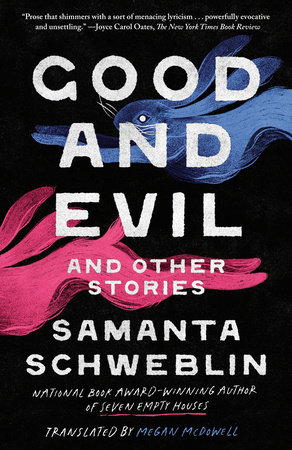
Download high-resolution image Look inside
Listen to a clip from the audiobook
audio play button
0:00
0:00

Good and Evil and Other Stories

Translated by Megan McDowell
Look inside
Listen to a clip from the audiobook
audio play button
0:00
0:00
INTERNATIONAL BESTELLER • A haunting, unforgettable collection of tales by Samanta Schweblin, winner of the 2022 National Book Award for Translated Literature and three-time Booker Prize finalist.

“Nobody understands the balance of light and darkness of the human mind as well as Samanta Schweblin. She is a master of the edge, of the contour, the suggestion. The most brilliant writer of short stories writing today, she now delivers her most haunting, fierce and provocative book.”—Valeria Luiselli, author of Lost Children Archive

"Schweblin creates characters whose lifelines reach some of the most extraordinary questions ever articulated in our literature." —Karen Russell, author of The Antidote and Swamplandia!

“In Samanta Schweblin’s hands a single story becomes a theory of just about everything. You can hear all the atoms of the universe bouncing around. Remarkably taut, clear, precise, and yet capable of capturing the extent of our human messiness, these stories are perfect for the times we dwell inside.” —Colum McCann, author of Let the Great World Spin


The characters of Good and Evil find themselves at a point of no return, dazzled by the glare of impending tragedy. Vulnerable and profoundly human, they become trapped in the instant in which the uncanny has lurched into their lives. Some are transformed, some are isolated, others waver between guilt or tenderness. All of them are driven by uncertainty.

Schweblin’s prose uses tension and truth to construct a literary universe in which the monsters of everyday life come so close to us that we can almost feel their breath. Her writing provokes awe and disquiet, a state of alarm that at the same time transports us to a hypnotic world as recognizable as it is strange.
Welcome to the Club

I jump into the water from the end of the pier and sink down, holding my nose. After the initial impact I open my eyes, surrendering to the fall as it grows softer, and to the new colors all around me, denser and more iridescent. I descend, holding my breath.

Maybe a minute passes. Finally, slowly, my feet touch the mossy ground, like I’m an astronaut landing on the moon. I let go of my nose and lower my arms, and my body tenses up. A contraction comes from my lungs, a spasm, and I wait a little longer. I touch the rocks tied to my waist; the knot can always be untied. Perhaps to keep from changing my mind, I inhale. I fill my chest with water and a new, hard cold hits my ribs. I want this to happen painlessly. A dozen bubbles escape from my mouth and nose and rise upward. Another spasm suddenly wracks me and I’m afraid of what might happen now. I let out my remaining air. I’m struck by the liquid feeling where there was always air before, but above all I’m struck by how lucid I feel. How calm. I look at my hands, larger and whiter than they were above-­water, and wonder how long it will take to lose consciousness. Algae, schools of silvery eyes, plankton floating like glitter. My body feels loose, and there’s an extraordinary sensation from the contact with warm currents, cool ones, warm again. In the distance, the lake floor grows murky. How much time has passed? Three minutes, five—­it’s something I no longer know how to calculate. I was sure this would happen faster.

I touch the rocks, feeling for the knot. I’m not changing my mind; at this point, what’s done is done. It’s curiosity. I untie the rope and the rocks fall away. Their impact causes an earthquake near my feet, which slowly lift off the ground. I stay there, sort of floating, unsure what to do. And it’s then, at that moment, when I remember thinking, What if this is it? To float and wonder for the rest of eternity: the first real fear I had that day. To be unable to move forward or backward, ever again, in any direction.

I curl up, kick against the ground to push upward. What was it that went wrong? I’m trying to understand. For a moment ascending seems easy, but after a few feet my body stops, comfortable in its levitation. It takes a while to return, to finally reach the more crystalline warmth of the surface. Will I breathe again when I emerge from the water? I wonder if anyone is looking for me, and I fear a scene. My arms take a few strokes, my head finally leaves the water, and I feel the relief of cold air on my wet face.

The rocky shore is as empty as ever, and I paddle over to the log ladder and climb up onto the pier. I retch, leaning over the deck, expecting to throw up all the water, but nothing happens. The hot wood immediately absorbs the drops falling from my chin. I try to stand but my body is weak and lax, so I wait a moment and try again. Across the garden, the sun bounces off the house’s windows and stings my eyes. I wring out my hair, try to do the same with the front of my shirt, the cuffs of my pants, and walk to the start end of the pier. My sandals are still in the grass, right where I left them. I slip them on and struggle up the embankment to cross the garden uphill.

I remember how I reach the house. I look at myself in the back door, my wet clothes stuck to my body, my hand approaching to slide open the glass that squeaked on the runner, the frame that crosses in front of my eyes and carries off my reflection, and past it the living room, the dining room table with the remains of breakfast still uncleared. I lean against the doorway and, with a final effort, cross the threshold.

Inside, everything is calm. The hydrangeas I cut in the morning are undisturbed in the two kitchen vases. I pick up the letters I’d left propped against the vases, one I wrote for him and one for the girls. I’m not sure whether picking up those letters is a good decision. I’m not even sure if taking them from this table means taking them from the same table where I left them a while ago. I’m not sure of anything, not then and not now, but the clock is already showing twelve twenty, so I go up to the bedroom, put the letters in the nightstand drawer, take off my wet clothes and put on dry ones, and go back down to make lunch.

They pull up honking the horn and the girls roll into the house like a whirlwind. They’re carrying a big cage with a rabbit in it.

“We have to take care of it until Thursday,” my husband says. “One week per family.”

I’m beating eggs. It takes an enormous effort, but I’m trembling and I trust the action will hide my state. The girls wrap their arms around my waist, and I have to lift the bowl higher so I can see their faces.

“His name is Blimp.”

“Yeah! Blimp.”

Their voices echo in my head. The older one presses her nose into my stomach and inhales deeply.

“Mommy, you smell bad.”

The younger one copies her.

“You do! Like dirty mud.”

“All right,” I tell them, “let’s eat.”

I remember how afraid I am to stop beating the eggs. But I stop and nothing happens, no one looks at me. My older daughter pushes the cage against the wall and frees the rabbit. Her father hurries to close the sliding glass door. When he comes back he summons us with three claps of his hands.

“Starting now, we keep all the doors closed,” he says.

I start the fifth omelet in the skillet and serve the ones that are ready. My husband knows he’s in charge of the one that’s still on the burner because he’s the only one who eats two. So we sit down at the table, and the girls’ silence as they take the first bites helps me finally feel calm, at least for a few seconds.

Everything is in order, I tell myself. Easy now.

I sit watching the rabbit as, without any real caution or circumspection, it crosses the dining room to its dish of water on the floor. If Blimp is an expert traveler in new lands, I am this woman anchored always in the same place. Blimp comes over and sniffs at my feet. His nose tickles, and just to be on the safe side I grab on to the edge of the table.

“His name’s Blimp because he’s fat.”

“Nuh-­uh, that’s not why.”

“Yeah it is, the teacher said so.”

The girls sword fight with their forks for a moment and then go on eating. My husband gets up for the last omelet, and on the way there he’s already making a phone call.

Everything is in order, I tell myself, and the pleasure from the tickling surprises me.

“Mommy, are you happy?”

With her silverware held aloft, my youngest waits eagerly for my answer. Suddenly she jumps down from her chair and runs around the table without ever lowering her knife and fork.

“Blimpy! Blimpy! Mommy’s happy!”

“But eating would be too much to ask, huh?” he says when he comes back with his second omelet, noticing the untouched food on my plate.

My oldest watches and listens. The worst part is whatever it is that she’s learning from us.

Lunch ends and my family disappears up the stairs. I like this house because of its porous ability to absorb us all into its rooms. In the living room, the cage has been left open and empty, and I’m comforted by the thought of the girls playing with Blimp, entertained in my absence. It’s like hearing the washing machine or the microwave—­I relax because, even if I can’t take action myself, something practical is still getting done.

I go back to the sliding glass door and gaze out at the garden. Everything that’s happening seems possible, but how can it be possible? How can it be that what happened, happened, and I still feel so fine, and even my hair is drying? I breathe, take my purse from the coatrack, and go out the front door. Once again, his car is parked diagonally in the driveway; it’s like a barricade. We don’t argue about that anymore. I’ve learned to slide my legs between the fender and the wall almost without getting my clothes dirty. When he is home, “going out” is like “overcoming,” like “vanquishing” the doorway; if I want to get through it I have to really be determined.

The next-­door neighbor is pulling up in his truck. This is the day I understand what it is he really does. But for now I just think he’s coming back from hunting, like all the days when he wears his cap with the visor forward. He has a pair of buck horns hanging over the porch door, and though he’s not a military man, he dresses like one.

Three years ago he was on the front page of the local paper for a harassment case brought by a woman who used to work in Toni’s café. After that article, we never saw her again. And then the thing with the barbed wire happened. We tried to talk to him the day he put it up, explaining several times that the girls could get hurt if they played too close to it. He said that was why it was barbed, that it was the only way parents would be sure to keep their children away.

“The wire is for the parents,” he said.

I remember how, during the course of this day, there are many things I try not to think about. At first, the neighbor is on that list.

Outside, in the shade of the trees, the heat is less stifling. On the corner I ring Daniela’s doorbell and try to fix my appearance a little. I comb my fingers through my hair and find a piece of still-­wet algae tangled in the ends. It stretches out like gum when I tug at it. I drop it on the ground and wipe my hands on my pants, then ring the bell again. No one answers. When I get tired of waiting, I go down to the square.

The neighborhood still seems just as exaggeratedly big and moneyed as the first day we arrived, several years ago now. A couple of blocks down is the café. Inside, two tables are occupied and Toni is washing dishes in the kitchen. I see him through the little window and he winks at me. I poke my head in and ask about Daniela, but he doesn’t know where she is, so I sit down for a minute at the counter. A while back, Toni and I had sex a few times, on the kitchen floor, in the changing room, and in the employees bathroom. And then one day Toni said, “Okay, that’ll do it, right?” He said it wearily, as if he’d been scrubbing at a stain for a long time and still couldn’t get it out, and now he was finally giving up.

A woman comes over, picks up a sugar dispenser, and, before returning to her table, smiles at me. I touch my hair to be sure there is no more algae in it. I find a little strip, maybe a leftover bit of the other piece, but I don’t think anyone has noticed. I’m relieved to see that no one detects anything strange, and it makes me want to stand up and stretch my limbs, do something other than sit here waiting.
© Alejandra López
Samanta Schweblin is the author of the novel Fever Dream, a finalist for the International Booker Prize, and the novel Little Eyes and story collection A Mouthful of Birds, longlisted for the same prize. Chosen by Granta as one of the twenty-two best writers in Spanish under the age of thirty-five, she has won numerous prestigious awards around the world. Her books have been translated into thirty-five languages, and her work has appeared in English in The New Yorker and Harper’s Magazine. Originally from Buenos Aires, Schweblin lives in Berlin.

Megan McDowell is the recipient of a 2020 Award in Literature from the American Academy of Arts and Letters and has been short- or longlisted four times for the International Booker Prize. She lives in Santiago, Chile. View titles by Samanta Schweblin
“Samanta Schweblin is one of the most exciting writers in the world.” —George Saunders, author of Lincoln in the Bardo

“Beautifully translated by Megan McDowell, in prose that shimmers with a sort of menacing lyricism, the stories of Good and Evil are powerfully evocative and unsettling. They seem to hover, indeed like fever dreams, between the reassuring familiarities of domestic life and the stark, unpredictable, visionary flights of the unconscious.” —Joyce Carol Oates, New York Times Book Review

“No one writes like Samanta Schweblin. Her narratives are sui generis—wonderfully unpredictable and invitingly strange.” —Lorrie Moore, author of I Am Homeless if This Is Not My Home

“Time and again in her masterful new collection, Schweblin creates characters whose lifelines reach some of the most extraordinary questions ever articulated in our literature.” —Karen Russell, author of The Antidote and Swamplandia!

“In Samatha Schweblin’s hands a single story becomes a theory of just about everything. You can hear all the atoms of the universe bouncing around. Remarkably taut, clear, precise, and yet capable of capturing the extent of our human messiness, these stories are perfect for the times we dwell inside.” —Colum McCann, author of Let the Great World Spin

“Nobody understands the balance of light and darkness of the human mind as well as Samanta Schweblin. She is a master of the edge, of the contour, the suggestion. The most brilliant writer of short stories writing today, she now delivers her most haunting, fierce and provocative book.” —Valeria Luiselli, author of Lost Children Archive

“Samanta Schweblin combines the urgent propulsion that characterizes all great storytelling with precise, if uncanny, descriptions of human feelings that often go unnamed, those ambiguous zones of human reality where awe, dread, and desire mingle.” —Siri Hustvedt, author of Memories of the Future

“Samanta Schweblin has a rare ability to write stories that are more than just stories: they are bits of obsessions, fragments of nightmares, desires like parasites that colonize us, because Samanta knows. She understands the delicate and monstrous music that is shaped from our shadows, from the ghosts we carry within us. That is why to read her is to remember; to read her is to witness, in bewilderment, a miracle made of disturbance and light.” —Agustina Bazterrica, author of Tender is the Flesh

“The atmosphere in these stories, crafted with striking clarity, foreshadows that at some point, everything will go awry, and the effects of that twist will haunt the protagonists forever. These are not ghost stories. They are something far worse and far better: they are stories about human beings.” —Leila Guerriero, author of La Llamada

“Stellar—extreme, uncanny and beautifully controlled.” —Anne Enright, author of The Gathering

“Reading Samanta Schweblin is a thoroughly immersive experience. These beautifully crafted and eerily unsettling stories completely hypnotised me. This is the sort of storytelling which resonates in the head, the heart and all mysterious parts in between. I wish I could write like this.” —Jan Carson, author of The Fire Starters

“These stories understand the secret moments and strange connections that resonate through a person's life—and they explore these intimacies with a razor sharp edge. Samantha Schweblin is at the top of her game.” —Heather Parry, author of Orpheus Builds a Girl

“Schweblin’s prose, translated with exquisite precision by her regular translator Megan McDowell, avoids all the stylistic traps of the generically mystical. There is no gauziness, no obfuscatory veil. Schweblin’s aim is neither to mystify nor to distort. Instead, she looks at the world directly, piercing its deceptive surface, allowing the reader to do the same. . . . Such directness and clarity of language opens a unique emotional terrain where fear and compassion conjoin.” —Sam Byers, Guardian

“Schweblin once again proves herself to be more of the most unsettling and incisive voices in fiction.” —Frank Wynne, Irish Times

“We have the impression of a writer absolutely and entirely in control, as Schweblin’s meticulous clarity is never compromised by the horror of her subjects. But if we trust her to take us to the bottom, almost always she will reward us with a glimmer. . . . Here are six strong doses of the unheimlich, from a remarkable writer. Schweblin is descended from David Lynch and indeed Kafka, but her voice remains entirely her own.” —Francesca Segal, Financial Times

“Samanta Schweblin is among the top names in the flourishing world of South American horror, and the stories in Good and Evil again proves why her writing continues to haunt us. Nestled perfectly between realistic human tragedy and surrealism, her writing consistently lays bare the interior motivations and fears that threaten to lead us toward monstrosity. At its core, Good and Evil is a collection about aging and what we owe to ourselves and our youth; another triumph from Schweblin.” —Chicago Review of Books

“The Argentinian author’s new collection has six stories on the edge of the diabolical. . . . Spooky and propulsive and perfect for readers of Bora Chung or Mariana Enríquez.” —Our Culture Magazine

“Each entry is more luminous and shocking than the last. This establishes Schweblin as a master storyteller.” —Publishers Weekly (starred review)

“Schweblin and veteran translator McDowell trace the slim barrier between perception and reality with masterful narration, piercing dialogue, stealthy wit, and psychological precision. … Outrageously original and deeply felt stories with an indelible effect.” —Kirkus (starred review)

“[A] doyenne of speculative fiction depicts characters and situations that straddle pleasure and the uncanny, a 21st-century Twilight Zone.” —Boston Globe

“[Schweblin's] worlds tend to be inescapably off—disconcertingly akimbo and bathed in unplaceable menace. Best not to let your guard down.” —NPR

“[A] haunting, surreal collection. . . . A stunning read that will work its way into your heart and make a home there.” People

“Samanta Schweblin knows how to spook. . . . In just six stories, Schweblin demonstrates a mastery of evocative narration and chilling insinuation.”The Harvard Crimson

“Strange and powerful” Wall Street Journal

About

INTERNATIONAL BESTELLER • A haunting, unforgettable collection of tales by Samanta Schweblin, winner of the 2022 National Book Award for Translated Literature and three-time Booker Prize finalist.

“Nobody understands the balance of light and darkness of the human mind as well as Samanta Schweblin. She is a master of the edge, of the contour, the suggestion. The most brilliant writer of short stories writing today, she now delivers her most haunting, fierce and provocative book.”—Valeria Luiselli, author of Lost Children Archive

"Schweblin creates characters whose lifelines reach some of the most extraordinary questions ever articulated in our literature." —Karen Russell, author of The Antidote and Swamplandia!

“In Samanta Schweblin’s hands a single story becomes a theory of just about everything. You can hear all the atoms of the universe bouncing around. Remarkably taut, clear, precise, and yet capable of capturing the extent of our human messiness, these stories are perfect for the times we dwell inside.” —Colum McCann, author of Let the Great World Spin


The characters of Good and Evil find themselves at a point of no return, dazzled by the glare of impending tragedy. Vulnerable and profoundly human, they become trapped in the instant in which the uncanny has lurched into their lives. Some are transformed, some are isolated, others waver between guilt or tenderness. All of them are driven by uncertainty.

Schweblin’s prose uses tension and truth to construct a literary universe in which the monsters of everyday life come so close to us that we can almost feel their breath. Her writing provokes awe and disquiet, a state of alarm that at the same time transports us to a hypnotic world as recognizable as it is strange.

Excerpt

Welcome to the Club

I jump into the water from the end of the pier and sink down, holding my nose. After the initial impact I open my eyes, surrendering to the fall as it grows softer, and to the new colors all around me, denser and more iridescent. I descend, holding my breath.

Maybe a minute passes. Finally, slowly, my feet touch the mossy ground, like I’m an astronaut landing on the moon. I let go of my nose and lower my arms, and my body tenses up. A contraction comes from my lungs, a spasm, and I wait a little longer. I touch the rocks tied to my waist; the knot can always be untied. Perhaps to keep from changing my mind, I inhale. I fill my chest with water and a new, hard cold hits my ribs. I want this to happen painlessly. A dozen bubbles escape from my mouth and nose and rise upward. Another spasm suddenly wracks me and I’m afraid of what might happen now. I let out my remaining air. I’m struck by the liquid feeling where there was always air before, but above all I’m struck by how lucid I feel. How calm. I look at my hands, larger and whiter than they were above-­water, and wonder how long it will take to lose consciousness. Algae, schools of silvery eyes, plankton floating like glitter. My body feels loose, and there’s an extraordinary sensation from the contact with warm currents, cool ones, warm again. In the distance, the lake floor grows murky. How much time has passed? Three minutes, five—­it’s something I no longer know how to calculate. I was sure this would happen faster.

I touch the rocks, feeling for the knot. I’m not changing my mind; at this point, what’s done is done. It’s curiosity. I untie the rope and the rocks fall away. Their impact causes an earthquake near my feet, which slowly lift off the ground. I stay there, sort of floating, unsure what to do. And it’s then, at that moment, when I remember thinking, What if this is it? To float and wonder for the rest of eternity: the first real fear I had that day. To be unable to move forward or backward, ever again, in any direction.

I curl up, kick against the ground to push upward. What was it that went wrong? I’m trying to understand. For a moment ascending seems easy, but after a few feet my body stops, comfortable in its levitation. It takes a while to return, to finally reach the more crystalline warmth of the surface. Will I breathe again when I emerge from the water? I wonder if anyone is looking for me, and I fear a scene. My arms take a few strokes, my head finally leaves the water, and I feel the relief of cold air on my wet face.

The rocky shore is as empty as ever, and I paddle over to the log ladder and climb up onto the pier. I retch, leaning over the deck, expecting to throw up all the water, but nothing happens. The hot wood immediately absorbs the drops falling from my chin. I try to stand but my body is weak and lax, so I wait a moment and try again. Across the garden, the sun bounces off the house’s windows and stings my eyes. I wring out my hair, try to do the same with the front of my shirt, the cuffs of my pants, and walk to the start end of the pier. My sandals are still in the grass, right where I left them. I slip them on and struggle up the embankment to cross the garden uphill.

I remember how I reach the house. I look at myself in the back door, my wet clothes stuck to my body, my hand approaching to slide open the glass that squeaked on the runner, the frame that crosses in front of my eyes and carries off my reflection, and past it the living room, the dining room table with the remains of breakfast still uncleared. I lean against the doorway and, with a final effort, cross the threshold.

Inside, everything is calm. The hydrangeas I cut in the morning are undisturbed in the two kitchen vases. I pick up the letters I’d left propped against the vases, one I wrote for him and one for the girls. I’m not sure whether picking up those letters is a good decision. I’m not even sure if taking them from this table means taking them from the same table where I left them a while ago. I’m not sure of anything, not then and not now, but the clock is already showing twelve twenty, so I go up to the bedroom, put the letters in the nightstand drawer, take off my wet clothes and put on dry ones, and go back down to make lunch.

They pull up honking the horn and the girls roll into the house like a whirlwind. They’re carrying a big cage with a rabbit in it.

“We have to take care of it until Thursday,” my husband says. “One week per family.”

I’m beating eggs. It takes an enormous effort, but I’m trembling and I trust the action will hide my state. The girls wrap their arms around my waist, and I have to lift the bowl higher so I can see their faces.

“His name is Blimp.”

“Yeah! Blimp.”

Their voices echo in my head. The older one presses her nose into my stomach and inhales deeply.

“Mommy, you smell bad.”

The younger one copies her.

“You do! Like dirty mud.”

“All right,” I tell them, “let’s eat.”

I remember how afraid I am to stop beating the eggs. But I stop and nothing happens, no one looks at me. My older daughter pushes the cage against the wall and frees the rabbit. Her father hurries to close the sliding glass door. When he comes back he summons us with three claps of his hands.

“Starting now, we keep all the doors closed,” he says.

I start the fifth omelet in the skillet and serve the ones that are ready. My husband knows he’s in charge of the one that’s still on the burner because he’s the only one who eats two. So we sit down at the table, and the girls’ silence as they take the first bites helps me finally feel calm, at least for a few seconds.

Everything is in order, I tell myself. Easy now.

I sit watching the rabbit as, without any real caution or circumspection, it crosses the dining room to its dish of water on the floor. If Blimp is an expert traveler in new lands, I am this woman anchored always in the same place. Blimp comes over and sniffs at my feet. His nose tickles, and just to be on the safe side I grab on to the edge of the table.

“His name’s Blimp because he’s fat.”

“Nuh-­uh, that’s not why.”

“Yeah it is, the teacher said so.”

The girls sword fight with their forks for a moment and then go on eating. My husband gets up for the last omelet, and on the way there he’s already making a phone call.

Everything is in order, I tell myself, and the pleasure from the tickling surprises me.

“Mommy, are you happy?”

With her silverware held aloft, my youngest waits eagerly for my answer. Suddenly she jumps down from her chair and runs around the table without ever lowering her knife and fork.

“Blimpy! Blimpy! Mommy’s happy!”

“But eating would be too much to ask, huh?” he says when he comes back with his second omelet, noticing the untouched food on my plate.

My oldest watches and listens. The worst part is whatever it is that she’s learning from us.

Lunch ends and my family disappears up the stairs. I like this house because of its porous ability to absorb us all into its rooms. In the living room, the cage has been left open and empty, and I’m comforted by the thought of the girls playing with Blimp, entertained in my absence. It’s like hearing the washing machine or the microwave—­I relax because, even if I can’t take action myself, something practical is still getting done.

I go back to the sliding glass door and gaze out at the garden. Everything that’s happening seems possible, but how can it be possible? How can it be that what happened, happened, and I still feel so fine, and even my hair is drying? I breathe, take my purse from the coatrack, and go out the front door. Once again, his car is parked diagonally in the driveway; it’s like a barricade. We don’t argue about that anymore. I’ve learned to slide my legs between the fender and the wall almost without getting my clothes dirty. When he is home, “going out” is like “overcoming,” like “vanquishing” the doorway; if I want to get through it I have to really be determined.

The next-­door neighbor is pulling up in his truck. This is the day I understand what it is he really does. But for now I just think he’s coming back from hunting, like all the days when he wears his cap with the visor forward. He has a pair of buck horns hanging over the porch door, and though he’s not a military man, he dresses like one.

Three years ago he was on the front page of the local paper for a harassment case brought by a woman who used to work in Toni’s café. After that article, we never saw her again. And then the thing with the barbed wire happened. We tried to talk to him the day he put it up, explaining several times that the girls could get hurt if they played too close to it. He said that was why it was barbed, that it was the only way parents would be sure to keep their children away.

“The wire is for the parents,” he said.

I remember how, during the course of this day, there are many things I try not to think about. At first, the neighbor is on that list.

Outside, in the shade of the trees, the heat is less stifling. On the corner I ring Daniela’s doorbell and try to fix my appearance a little. I comb my fingers through my hair and find a piece of still-­wet algae tangled in the ends. It stretches out like gum when I tug at it. I drop it on the ground and wipe my hands on my pants, then ring the bell again. No one answers. When I get tired of waiting, I go down to the square.

The neighborhood still seems just as exaggeratedly big and moneyed as the first day we arrived, several years ago now. A couple of blocks down is the café. Inside, two tables are occupied and Toni is washing dishes in the kitchen. I see him through the little window and he winks at me. I poke my head in and ask about Daniela, but he doesn’t know where she is, so I sit down for a minute at the counter. A while back, Toni and I had sex a few times, on the kitchen floor, in the changing room, and in the employees bathroom. And then one day Toni said, “Okay, that’ll do it, right?” He said it wearily, as if he’d been scrubbing at a stain for a long time and still couldn’t get it out, and now he was finally giving up.

A woman comes over, picks up a sugar dispenser, and, before returning to her table, smiles at me. I touch my hair to be sure there is no more algae in it. I find a little strip, maybe a leftover bit of the other piece, but I don’t think anyone has noticed. I’m relieved to see that no one detects anything strange, and it makes me want to stand up and stretch my limbs, do something other than sit here waiting.

Author

© Alejandra López
Samanta Schweblin is the author of the novel Fever Dream, a finalist for the International Booker Prize, and the novel Little Eyes and story collection A Mouthful of Birds, longlisted for the same prize. Chosen by Granta as one of the twenty-two best writers in Spanish under the age of thirty-five, she has won numerous prestigious awards around the world. Her books have been translated into thirty-five languages, and her work has appeared in English in The New Yorker and Harper’s Magazine. Originally from Buenos Aires, Schweblin lives in Berlin.

Megan McDowell is the recipient of a 2020 Award in Literature from the American Academy of Arts and Letters and has been short- or longlisted four times for the International Booker Prize. She lives in Santiago, Chile. View titles by Samanta Schweblin

Praise

“Samanta Schweblin is one of the most exciting writers in the world.” —George Saunders, author of Lincoln in the Bardo

“Beautifully translated by Megan McDowell, in prose that shimmers with a sort of menacing lyricism, the stories of Good and Evil are powerfully evocative and unsettling. They seem to hover, indeed like fever dreams, between the reassuring familiarities of domestic life and the stark, unpredictable, visionary flights of the unconscious.” —Joyce Carol Oates, New York Times Book Review

“No one writes like Samanta Schweblin. Her narratives are sui generis—wonderfully unpredictable and invitingly strange.” —Lorrie Moore, author of I Am Homeless if This Is Not My Home

“Time and again in her masterful new collection, Schweblin creates characters whose lifelines reach some of the most extraordinary questions ever articulated in our literature.” —Karen Russell, author of The Antidote and Swamplandia!

“In Samatha Schweblin’s hands a single story becomes a theory of just about everything. You can hear all the atoms of the universe bouncing around. Remarkably taut, clear, precise, and yet capable of capturing the extent of our human messiness, these stories are perfect for the times we dwell inside.” —Colum McCann, author of Let the Great World Spin

“Nobody understands the balance of light and darkness of the human mind as well as Samanta Schweblin. She is a master of the edge, of the contour, the suggestion. The most brilliant writer of short stories writing today, she now delivers her most haunting, fierce and provocative book.” —Valeria Luiselli, author of Lost Children Archive

“Samanta Schweblin combines the urgent propulsion that characterizes all great storytelling with precise, if uncanny, descriptions of human feelings that often go unnamed, those ambiguous zones of human reality where awe, dread, and desire mingle.” —Siri Hustvedt, author of Memories of the Future

“Samanta Schweblin has a rare ability to write stories that are more than just stories: they are bits of obsessions, fragments of nightmares, desires like parasites that colonize us, because Samanta knows. She understands the delicate and monstrous music that is shaped from our shadows, from the ghosts we carry within us. That is why to read her is to remember; to read her is to witness, in bewilderment, a miracle made of disturbance and light.” —Agustina Bazterrica, author of Tender is the Flesh

“The atmosphere in these stories, crafted with striking clarity, foreshadows that at some point, everything will go awry, and the effects of that twist will haunt the protagonists forever. These are not ghost stories. They are something far worse and far better: they are stories about human beings.” —Leila Guerriero, author of La Llamada

“Stellar—extreme, uncanny and beautifully controlled.” —Anne Enright, author of The Gathering

“Reading Samanta Schweblin is a thoroughly immersive experience. These beautifully crafted and eerily unsettling stories completely hypnotised me. This is the sort of storytelling which resonates in the head, the heart and all mysterious parts in between. I wish I could write like this.” —Jan Carson, author of The Fire Starters

“These stories understand the secret moments and strange connections that resonate through a person's life—and they explore these intimacies with a razor sharp edge. Samantha Schweblin is at the top of her game.” —Heather Parry, author of Orpheus Builds a Girl

“Schweblin’s prose, translated with exquisite precision by her regular translator Megan McDowell, avoids all the stylistic traps of the generically mystical. There is no gauziness, no obfuscatory veil. Schweblin’s aim is neither to mystify nor to distort. Instead, she looks at the world directly, piercing its deceptive surface, allowing the reader to do the same. . . . Such directness and clarity of language opens a unique emotional terrain where fear and compassion conjoin.” —Sam Byers, Guardian

“Schweblin once again proves herself to be more of the most unsettling and incisive voices in fiction.” —Frank Wynne, Irish Times

“We have the impression of a writer absolutely and entirely in control, as Schweblin’s meticulous clarity is never compromised by the horror of her subjects. But if we trust her to take us to the bottom, almost always she will reward us with a glimmer. . . . Here are six strong doses of the unheimlich, from a remarkable writer. Schweblin is descended from David Lynch and indeed Kafka, but her voice remains entirely her own.” —Francesca Segal, Financial Times

“Samanta Schweblin is among the top names in the flourishing world of South American horror, and the stories in Good and Evil again proves why her writing continues to haunt us. Nestled perfectly between realistic human tragedy and surrealism, her writing consistently lays bare the interior motivations and fears that threaten to lead us toward monstrosity. At its core, Good and Evil is a collection about aging and what we owe to ourselves and our youth; another triumph from Schweblin.” —Chicago Review of Books

“The Argentinian author’s new collection has six stories on the edge of the diabolical. . . . Spooky and propulsive and perfect for readers of Bora Chung or Mariana Enríquez.” —Our Culture Magazine

“Each entry is more luminous and shocking than the last. This establishes Schweblin as a master storyteller.” —Publishers Weekly (starred review)

“Schweblin and veteran translator McDowell trace the slim barrier between perception and reality with masterful narration, piercing dialogue, stealthy wit, and psychological precision. … Outrageously original and deeply felt stories with an indelible effect.” —Kirkus (starred review)

“[A] doyenne of speculative fiction depicts characters and situations that straddle pleasure and the uncanny, a 21st-century Twilight Zone.” —Boston Globe

“[Schweblin's] worlds tend to be inescapably off—disconcertingly akimbo and bathed in unplaceable menace. Best not to let your guard down.” —NPR

“[A] haunting, surreal collection. . . . A stunning read that will work its way into your heart and make a home there.” People

“Samanta Schweblin knows how to spook. . . . In just six stories, Schweblin demonstrates a mastery of evocative narration and chilling insinuation.”The Harvard Crimson

“Strange and powerful” Wall Street Journal

FROM THE PAGE: Read an excerpt from Samanta Schweblin’s Good and Evil and Other Stories

Good and Evil and Other Stories is a haunting, unforgettable collection of tales by Samanta Schweblin, winner of the 2022 National Book Award for Translated Literature and three-time Booker Prize finalist.   Welcome to the Club I jump into the water from the end of the pier and sink down, holding my nose. After the

Read more