Download high-resolution image Look inside
Listen to a clip from the audiobook
audio play button
0:00
0:00

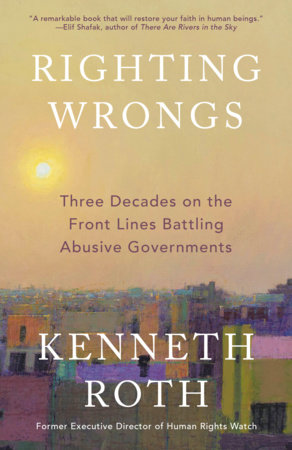
Righting Wrongs

Three Decades on the Front Lines Battling Abusive Governments

Look inside
Listen to a clip from the audiobook
audio play button
0:00
0:00
From the long-time head of Human Rights Watch, the fascinating and inspiring story of taking on the biggest villains and toughest autocrats around the world

“A remarkable book that will restore your faith in human beings. . . . One of the most important books of the year, if not of the next decade.” —Elif Shafak, author of There Are Rivers in the Sky


In three decades under the leadership of Kenneth Roth, Human Rights Watch grew to a staff of more than 500, conducting investigations in 100 countries to uncover abuses—and pressuring offending governments to stop them. Roth has grappled with the worst of humanity, taken on the biggest villains of our time, and persuaded leaders from around the globe to stand up to their repressive counterparts. 

The son of a Jew who fled Nazi Germany just before the war began, Roth grew up knowing full well how inhumane governments could be. He has traveled the world to meet cruelty and injustice on its home turf: he arrived in Rwanda shortly after the Genocide; scrutinized the impact of Saddam’s invasion of Kuwait; investigated and condemned Israel’s mistreatment of Palestinians. He directed efforts to curtail the Chinese government’s persecution of Uyghur Muslims, to bring Myanmar’s officials to justice after the ethnic cleansing of Rohingya Muslims, to halt Russian war crimes in Ukraine, even to reign in the U.S. government. Roth’s many innovations and strategies included the deployment of a concept as old as mankind—the powerful tool of “shaming”—and here he illustrates its surprising effectiveness against evildoers.  

This is a story of wins, losses, and ongoing battles in the ceaseless fight to rend the moral arc from the hands of injustice and bend it toward good.
1

Idlib, Syria

I think it’s important to start by saying that even in the most dire situations, it is possible to make a difference. And when the stakes are life and death, even a small difference can be tremendously important. One of the biggest challenges we faced during my time at Human Rights Watch was trying to stop the slaughter of civilians in Syria. The enormity of the problem required initiative and persistence to build enough pressure to have an impact.

After brutal repression of peaceful anti-government protests in early 2011 yielded an armed conflict, Syria became synonymous with mass atrocities. The carnage was so awful that it was a central focus of Human Rights Watch and a personal preoccupation for me. Despite the magnitude of the challenge, we helped to curtail this unspeakable cruelty.

Throughout the fighting, the Syrian government ripped up the rule book—international humanitarian law—that is designed to spare civilians the hazards of war. Instead, it targeted civilians. It dropped barrel bombs on them (oil drums filled with explosives and shrapnel to maximize damage), deployed chemical weapons against them, starved them, and forcibly disappeared, tortured, and executed them. It was an appalling, deliberate effort to defeat an insurgency by using war crimes and atrocities.

To better understand the horrors unfolding, I periodically visited Gaziantep, the Turkish city known as a sister of Syria’s Aleppo. During my visits, Gaziantep was the hub for humanitarian operations in rebel-held northwestern Syria. I spoke with refugee families, orphans, humanitarian workers, and especially doctors, who were impressively trying to provide health care in very dangerous circumstances. I became deeply concerned about their plight and the fate of the people they were trying to serve.

The doctors vividly described the dreadful conditions of life under the Syrian government. One anesthesiologist who had been serving in the military told me of having been forced to sedate sixty-three people in detention when the United Nations–Arab League special envoy, Lakhdar Brahimi, visited Idlib in 2012. The purpose was to silence them and make it easier to hide from Brahimi their shackles and wounds from torture and medical neglect. He found the experience so unbearable that he fled to opposition territory. An internist with whom I stayed in Gaziantep described working late at night after his regular job in Aleppo to see patients in secret clinics, who feared arrest if they appeared at a government-run facility. He also fled. Three of his students were arrested and killed for having worked with him. I couldn’t help but be appalled by these stories and determined to do my part to try to ease this suffering.

Even though international humanitarian law protected the hospitals in opposition areas where these doctors worked, they were a favorite target of Syrian forces and their Russian allies. One vascular surgeon described desperately trying to stop the bleeding of patients after their hospital had been bombed. The doctors moved some hospitals underground to hide and protect them, but those, too, were attacked. When the UN Office for the Coordination of Humanitarian Affairs (OCHA) persuaded reluctant doctors and humanitarian organizations to provide the coordinates of their hidden hospitals, naively hoping that it might deter the attacks, the Syrian and Russian militaries targeted them more precisely. Nearly one thousand medical workers—doctors, nurses, ambulance drivers—were killed.

Despite the support of troops sent by Iran and its allied Lebanese militia, Hezbollah, the government of Syrian president Bashar al-Assad had lost large swaths of the country to rebel forces and was stuck in a military stalemate. That changed in September 2015, when President Vladimir Putin sent the Russian military. Government forces gradually retook much of the country, including the rebel-held enclaves of eastern Aleppo in 2016 and Eastern Ghouta in 2018. Alas, the Russian military only intensified Assad’s war-crime strategy.

Syria’s Idlib province, in the northwestern part of the country, and a few surrounding bits of territory became the last area still controlled by armed forces opposing the government. By 2020, three million civilians lived in Idlib, roughly half having been forcibly displaced from elsewhere in Syria. Many of the displaced had lived in areas under siege by the Syrian army. When these areas fell, they were given the choice of living under Assad’s ruthless rule or boarding his notorious green buses to be shipped to Idlib. Many chose Idlib. At least one million civilians were crowded into camps, described as “sites of last resort,” along the border with Turkey. As the number of Syrian refugees in Turkey mounted toward 3.5 million, the Turkish government gradually closed its border.

The civilians in Idlib were subject to regular bombardment by Syrian and Russian planes and helicopters. Those bombers deliberately targeted schools, markets, and apartment buildings, as well as hospitals, as Human Rights Watch’s investigation and reporting showed. Pursuing the classic, if criminal, counterinsurgency strategy of draining the sea to catch the fish, the attackers’ aim was to chase civilians from Idlib to make it easier for Syrian troops to recapture the territory from the rebel forces living among them.

During one of my visits to Gaziantep, a Syrian doctor from a hospital in Idlib told me, referring to the United Nations secretary-general through the end of 2016, “We’re tired of always hearing Ban Ki-moon say that he is ‘concerned’ or ‘shocked’ ” by the bombing of civilians in Syria. I fully understood his frustration, but the fault hardly lay with Ban. Russia’s and China’s vetoes had paralyzed the UN Security Council, and no nation offered much beyond occasional expressions of outrage.

Human Rights Watch began as we always did—we investigated, documented, and reported on these war crimes. The first point of such reporting is to shame the perpetrators. Because most governments claim to uphold human rights, we can tarnish their reputations—and generate pressure for change—by spotlighting their abusive conduct.

The difficulty in the case of Syria was that Assad, already willing to do whatever it took to cling to power in what he saw as a life-and-death struggle, had little reputation left to lose. He sometimes tried to cover up his atrocities, but they were often meticulously recorded and publicized—by opposition Syrian videographers who posted their work on YouTube, a commission of inquiry established by the UN Human Rights Council (the world’s top multilateral body on human rights), as well as Human Rights Watch and allied organizations. Showing that he was bombing civilians in Idlib, as he had bombed civilians in many other parts of Syria, was not going to be enough to end his war crimes.

Putin was another story. Now that Putin has committed similar atrocities in Ukraine to avoid a defeat that would jeopardize his rule, he has moved closer to Assad’s realm of shamelessness. But at the time, Putin tried to maintain an aura of respectability. He did not want to be seen as a war criminal. That gave us leverage, as I outlined in July 2018 in an article in the New York Review of Books. Knowing that the Syrian military needed Russian support and that the Russian government was susceptible to pressure, we decided to focus on Putin.

We knew that shameful publicity alone would not be enough. We would need to combine it, as we so often did, with pressure from sympathetic governments. We focused on Germany and France, as the two most important members of the European Union, and Turkey, because of its significant interest in northern Syria and its respectful relations with Russia. I also spoke with an official from Iran, a key political and military ally of Assad. Behind each of these efforts were years of outreach and relationship building.

Turkey was a difficult interlocutor because Human Rights Watch regularly reported on and criticized the increasingly autocratic rule of President Recep Tayyip Erdogan. We had also reported for years on the violent abuses of his predecessors. Yet some officials maintained a degree of independence and were receptive to speaking with Human Rights Watch and hearing us out on Syria.

We had numerous sober, businesslike meetings over the years with senior Turkish officials. Sometimes the meetings paralleled my visits to Gaziantep, which reinforced for me the enormous stakes. I was often accompanied by Emma Sinclair-Webb, Human Rights Watch’s researcher for Turkey—a Brit who spoke beautiful Turkish and knew the country extraordinarily well. One deputy prime minister took copious notes as we spoke in Ankara in January 2016, as if he did not want to forget a single word. The same month, I met with Turkey’s then prime minister, Ahmet Davutoğlu, after a late-night dinner at the World Economic Forum in Davos, Switzerland. In September 2018, Emma and I saw the deputy foreign minister in Ankara. In October 2019, I held a long and remarkably candid conversation with a senior Turkish security official at a Munich Security Conference meeting in Doha, Qatar.

After the flight of more than one million refugees to Europe in 2015, most crossing by raft or small boat from Turkey to nearby Greek islands, the European Union paid the Turkish government 6 billion euros to stop further refugees from leaving. Turkish officials told me that if the loss of civilian life in Syria became too high, it would again allow Syrians to flee, but that was not the same as stopping the slaughter.

In Ankara in September 2018, I met with a large group of Western ambassadors over dinner at the Norwegian ambassador’s residence, urging them to convey to their contacts in the Turkish government my concerns about the need to protect civilians in Idlib. I was encouraged by their interest but appalled at their lack of any apparent strategy. I outlined how pressure on Putin could make a difference.

I pursued talks with the Iranian government because it was a key military backer of Assad. It also used Syrian territory to resupply Hezbollah, its ally against Israel in southern Lebanon. Both Hezbollah troops and Shia militia organized by the Iranian government provided important on-the-ground support to Syrian government troops throughout the armed conflict. I worried that they might contribute to a bloodbath in Idlib.

At the time, I met periodically with Iran’s then foreign minister, Javad Zarif. He had studied in the United States, spoke perfect colloquial English, and was open to meeting with human-rights groups. I routinely joined representatives from several colleague organizations such as Amnesty International, the International Crisis Group, and Crisis Action to speak with him on the sidelines of various international gatherings—the Munich Security Conference, the World Economic Forum, and the United Nations General Assembly. He was always an honest interlocutor with me. I was surprised in Davos in January 2014 when he turned to me and said, “I teach human rights. And I tell my students that it’s a mistake to think that Human Rights Watch reports only on Iran. It also reports on Guantánamo and Israel.” In February 2019 at the Munich Security Conference, we discussed Idlib. He assured me that, because of the threat to civilian life, Iranian forces would not take part in any offensive there. He also said that he had just visited Lebanon to meet with the leader of Hezbollah, and it would not take part either.

As I said, a key part of our strategy was to enlist European Union leaders to pressure Putin. German chancellor Angela Merkel and French president Emmanuel Macron were the two most influential, and I met periodically with both. Human Rights Watch maintained offices in Berlin and Paris, where the primary job of our “advocacy” staff was to influence German and French foreign policy on human rights. (We maintained offices in other key capitals as well.) Most of their work was done with other officials, but on occasion I was called in to meet the chancellor or the president. When possible, I was joined by Wenzel Michalski, our Berlin-based Germany director, or Bénédicte Jeannerod, then our Paris-based France director.

Merkel and Macron were the sort of leaders with whom I enjoyed meeting. They both led powerful countries whose intervention on human rights mattered. Both expressed sympathy, although I knew their other national interests would often take priority over human rights. Both had the self-confidence to engage in a frank and open conversation—not a set-piece talking-point exchange that accomplishes little.

In an early October 2018 meeting at Merkel’s office in the modern German Chancellery in Berlin, I asked her to intervene personally with Putin. I spoke of the horrible humanitarian toll of the Syrian and Russian attacks on civilians in Idlib and explained the potential for another refugee crisis in Europe should the killing become so severe that Turkey would be forced to reopen its borders with Syria. I stressed that she and Macron had leverage over Putin because he valued his relations with them.

In September 2018, Bénédicte and I made similar points with a senior French Foreign Ministry official, and Bénédicte repeated them later that month in a meeting with Macron and then foreign minister Jean-Yves Le Drian. The German and French governments obviously knew what was happening in Idlib; our job was to move the problem higher on their agenda for action. We continued to press the point in direct meetings with government officials and in the media.

Slowly, the pressure on Putin increased, although as so often happens, the process was not linear. In September 2018, Erdogan warned in a meeting with Putin and Iran’s then president, Hassan Rouhani, that an all-out assault on Idlib would result in a “bloodbath,” yet Putin refused to agree to a ceasefire. However, a few days later, in a meeting with Erdogan, Putin did agree at least to create a demilitarized buffer zone between opposing forces in Idlib.

In October 2018, several weeks after my meeting with Merkel, she, Macron, and Erdogan met with Putin. Macron, supported by Merkel and Erdogan, pressed the Russian government to exercise “very clear pressure” on Damascus for a “stable and lasting ceasefire in Idlib.” But even the buffer-zone agreement was never fully implemented, and by May 2019, Syrian and Russian forces were bombing civilians intensively.

On February 20, 2020, while at a European Union summit in Brussels, Merkel and Macron called Putin to press him to stop bombing civilians and civilian structures in Idlib. A few days later, what was said to be a Syrian airstrike killed at least thirty-six Turkish soldiers in northwestern Syria. The Turkish military quickly targeted Syrian troops in retaliation. That reminded Putin and Assad that Turkey was a potent military force willing to act if things got out of hand.

The combined pressure finally worked. On March 5, 2020, after six hours of negotiations in Moscow, Erdogan and Putin agreed to a ceasefire. That largely stopped major attacks on civilians in Idlib. Only in 2023 did that begin somewhat to break down, especially after an October drone attack on a Syrian military graduation ceremony by unknown assailants killed at least eighty. But for at least three years, if not longer, millions of people in Idlib were able to carry on their lives without constant fear of sudden death from the skies.
© Leigh Vogel / Getty Images
KENNETH ROTH is the former executive director of Human Rights Watch. He has extensively investigated human rights abuses around the world, focusing especially on the world’s most dire situations, the pursuit of international justice, the major powers’ foreign policies, the work of the UN, and the global contexts between democracy and autocracy. He has written for The New York Times, The Washington Post, The New York Review of Books, and other major publications. He spends his time between New York and Geneva. View titles by Kenneth Roth
“In Righting Wrongs [Roth] distils his hard-earned insights. . . . The world needs more watchdogs like Mr Roth: principled yet worldly, insanely hard-working and resolutely non-tribal. . . . [Roth] tells human stories . . . that shock the listener into fury. It is stories, more than theories, that help humans comprehend tyranny.” The Economist

Righting Wrongs is more than a memoir; it is both a history of modern human rights battles and a practical guide to advocacy. Roth writes with the same precision that defined his leadership: unsparing but not cynical, deeply informed yet accessible. For anyone working in the field—or for those simply trying to understand how power can be challenged—this is required reading.” —Janine di Giovanni, Middle East Eye

“In his important book published earlier this year, Righting Wrongs, Kenneth Roth, the long-time director of Human Rights Watch, persuasively argues that exposing atrocities and advocating for justice is not merely a moral imperative but a crucial, oftentimes the only, means of holding power accountable on the global stage.” —Joelle M. Abi-Rached, Boston Review

“This book represents a lifetime devoted to the fight for essential rights—a testament to the thoughts and experiences of a truly courageous individual. A wise, deeply insightful analysis that also serves as a practical guide for action, this book is vibrant, passionate, and alive with purpose.”—Ai Weiwei, artist, documentarian, and activist

“A remarkable book that will restore your faith in human beings. Brimming with wisdom, passion, resilience, and courage, Righting Wrongs gives us a powerful antidote to autocracy, an antidote to apathy. One of the most important books of the year, if not of the next decade.” —Elif Shafak, author of There Are Rivers in the Sky

“There is no one better equipped than Ken Roth to explain the creative forms of political pressure that can be generated to force governments to better respect rights. This inside account will inspire and open doors for other courageous visionaries to make change.”—Anthony Romero, executive director, American Civil Liberties Union

“A penetrating, inspiring, and challenging account of what it takes to fight to uphold human rights in an increasingly fractured and dangerous world. Roth does not shy away from detailing the gritty, tough tactics and hard work needed to fight for change, and also shows why it is essential to take a neutral and consistent approach to upholding human rights, not just in the Global South but the West as well.”—Gillian Tett, columnist and editorial board member, Financial Times, and provost, Kings College, Cambridge

“A master class on human rights advocacy from America’s most distinguished human rights leader.”—Michael Ignatieff, professor, Central European University, Vienna

“Memoir, history and horror, a personal journey captivatingly woven around a world, its challenges and hopes.” —Philippe Sands, author of East West Street and professor, University College London

“In an expansive behind-the-scenes memoir, Roth now shares his singular insights on how governments can be encouraged to end human rights abuses. In an era when such crimes against humanity are increasing in scope and severity, Roth’s candor and clarity provide inspirational wisdom and practical advice for rights advocates everywhere.”Booklist

“As the director of Human Rights Watch for three decades, Roth put public opinion to work in the service of his cause. Given the never-ending assault on human rights, a valuable call to fight back.”Kirkus Reviews

About

From the long-time head of Human Rights Watch, the fascinating and inspiring story of taking on the biggest villains and toughest autocrats around the world

“A remarkable book that will restore your faith in human beings. . . . One of the most important books of the year, if not of the next decade.” —Elif Shafak, author of There Are Rivers in the Sky


In three decades under the leadership of Kenneth Roth, Human Rights Watch grew to a staff of more than 500, conducting investigations in 100 countries to uncover abuses—and pressuring offending governments to stop them. Roth has grappled with the worst of humanity, taken on the biggest villains of our time, and persuaded leaders from around the globe to stand up to their repressive counterparts. 

The son of a Jew who fled Nazi Germany just before the war began, Roth grew up knowing full well how inhumane governments could be. He has traveled the world to meet cruelty and injustice on its home turf: he arrived in Rwanda shortly after the Genocide; scrutinized the impact of Saddam’s invasion of Kuwait; investigated and condemned Israel’s mistreatment of Palestinians. He directed efforts to curtail the Chinese government’s persecution of Uyghur Muslims, to bring Myanmar’s officials to justice after the ethnic cleansing of Rohingya Muslims, to halt Russian war crimes in Ukraine, even to reign in the U.S. government. Roth’s many innovations and strategies included the deployment of a concept as old as mankind—the powerful tool of “shaming”—and here he illustrates its surprising effectiveness against evildoers.  

This is a story of wins, losses, and ongoing battles in the ceaseless fight to rend the moral arc from the hands of injustice and bend it toward good.

Excerpt

1

Idlib, Syria

I think it’s important to start by saying that even in the most dire situations, it is possible to make a difference. And when the stakes are life and death, even a small difference can be tremendously important. One of the biggest challenges we faced during my time at Human Rights Watch was trying to stop the slaughter of civilians in Syria. The enormity of the problem required initiative and persistence to build enough pressure to have an impact.

After brutal repression of peaceful anti-government protests in early 2011 yielded an armed conflict, Syria became synonymous with mass atrocities. The carnage was so awful that it was a central focus of Human Rights Watch and a personal preoccupation for me. Despite the magnitude of the challenge, we helped to curtail this unspeakable cruelty.

Throughout the fighting, the Syrian government ripped up the rule book—international humanitarian law—that is designed to spare civilians the hazards of war. Instead, it targeted civilians. It dropped barrel bombs on them (oil drums filled with explosives and shrapnel to maximize damage), deployed chemical weapons against them, starved them, and forcibly disappeared, tortured, and executed them. It was an appalling, deliberate effort to defeat an insurgency by using war crimes and atrocities.

To better understand the horrors unfolding, I periodically visited Gaziantep, the Turkish city known as a sister of Syria’s Aleppo. During my visits, Gaziantep was the hub for humanitarian operations in rebel-held northwestern Syria. I spoke with refugee families, orphans, humanitarian workers, and especially doctors, who were impressively trying to provide health care in very dangerous circumstances. I became deeply concerned about their plight and the fate of the people they were trying to serve.

The doctors vividly described the dreadful conditions of life under the Syrian government. One anesthesiologist who had been serving in the military told me of having been forced to sedate sixty-three people in detention when the United Nations–Arab League special envoy, Lakhdar Brahimi, visited Idlib in 2012. The purpose was to silence them and make it easier to hide from Brahimi their shackles and wounds from torture and medical neglect. He found the experience so unbearable that he fled to opposition territory. An internist with whom I stayed in Gaziantep described working late at night after his regular job in Aleppo to see patients in secret clinics, who feared arrest if they appeared at a government-run facility. He also fled. Three of his students were arrested and killed for having worked with him. I couldn’t help but be appalled by these stories and determined to do my part to try to ease this suffering.

Even though international humanitarian law protected the hospitals in opposition areas where these doctors worked, they were a favorite target of Syrian forces and their Russian allies. One vascular surgeon described desperately trying to stop the bleeding of patients after their hospital had been bombed. The doctors moved some hospitals underground to hide and protect them, but those, too, were attacked. When the UN Office for the Coordination of Humanitarian Affairs (OCHA) persuaded reluctant doctors and humanitarian organizations to provide the coordinates of their hidden hospitals, naively hoping that it might deter the attacks, the Syrian and Russian militaries targeted them more precisely. Nearly one thousand medical workers—doctors, nurses, ambulance drivers—were killed.

Despite the support of troops sent by Iran and its allied Lebanese militia, Hezbollah, the government of Syrian president Bashar al-Assad had lost large swaths of the country to rebel forces and was stuck in a military stalemate. That changed in September 2015, when President Vladimir Putin sent the Russian military. Government forces gradually retook much of the country, including the rebel-held enclaves of eastern Aleppo in 2016 and Eastern Ghouta in 2018. Alas, the Russian military only intensified Assad’s war-crime strategy.

Syria’s Idlib province, in the northwestern part of the country, and a few surrounding bits of territory became the last area still controlled by armed forces opposing the government. By 2020, three million civilians lived in Idlib, roughly half having been forcibly displaced from elsewhere in Syria. Many of the displaced had lived in areas under siege by the Syrian army. When these areas fell, they were given the choice of living under Assad’s ruthless rule or boarding his notorious green buses to be shipped to Idlib. Many chose Idlib. At least one million civilians were crowded into camps, described as “sites of last resort,” along the border with Turkey. As the number of Syrian refugees in Turkey mounted toward 3.5 million, the Turkish government gradually closed its border.

The civilians in Idlib were subject to regular bombardment by Syrian and Russian planes and helicopters. Those bombers deliberately targeted schools, markets, and apartment buildings, as well as hospitals, as Human Rights Watch’s investigation and reporting showed. Pursuing the classic, if criminal, counterinsurgency strategy of draining the sea to catch the fish, the attackers’ aim was to chase civilians from Idlib to make it easier for Syrian troops to recapture the territory from the rebel forces living among them.

During one of my visits to Gaziantep, a Syrian doctor from a hospital in Idlib told me, referring to the United Nations secretary-general through the end of 2016, “We’re tired of always hearing Ban Ki-moon say that he is ‘concerned’ or ‘shocked’ ” by the bombing of civilians in Syria. I fully understood his frustration, but the fault hardly lay with Ban. Russia’s and China’s vetoes had paralyzed the UN Security Council, and no nation offered much beyond occasional expressions of outrage.

Human Rights Watch began as we always did—we investigated, documented, and reported on these war crimes. The first point of such reporting is to shame the perpetrators. Because most governments claim to uphold human rights, we can tarnish their reputations—and generate pressure for change—by spotlighting their abusive conduct.

The difficulty in the case of Syria was that Assad, already willing to do whatever it took to cling to power in what he saw as a life-and-death struggle, had little reputation left to lose. He sometimes tried to cover up his atrocities, but they were often meticulously recorded and publicized—by opposition Syrian videographers who posted their work on YouTube, a commission of inquiry established by the UN Human Rights Council (the world’s top multilateral body on human rights), as well as Human Rights Watch and allied organizations. Showing that he was bombing civilians in Idlib, as he had bombed civilians in many other parts of Syria, was not going to be enough to end his war crimes.

Putin was another story. Now that Putin has committed similar atrocities in Ukraine to avoid a defeat that would jeopardize his rule, he has moved closer to Assad’s realm of shamelessness. But at the time, Putin tried to maintain an aura of respectability. He did not want to be seen as a war criminal. That gave us leverage, as I outlined in July 2018 in an article in the New York Review of Books. Knowing that the Syrian military needed Russian support and that the Russian government was susceptible to pressure, we decided to focus on Putin.

We knew that shameful publicity alone would not be enough. We would need to combine it, as we so often did, with pressure from sympathetic governments. We focused on Germany and France, as the two most important members of the European Union, and Turkey, because of its significant interest in northern Syria and its respectful relations with Russia. I also spoke with an official from Iran, a key political and military ally of Assad. Behind each of these efforts were years of outreach and relationship building.

Turkey was a difficult interlocutor because Human Rights Watch regularly reported on and criticized the increasingly autocratic rule of President Recep Tayyip Erdogan. We had also reported for years on the violent abuses of his predecessors. Yet some officials maintained a degree of independence and were receptive to speaking with Human Rights Watch and hearing us out on Syria.

We had numerous sober, businesslike meetings over the years with senior Turkish officials. Sometimes the meetings paralleled my visits to Gaziantep, which reinforced for me the enormous stakes. I was often accompanied by Emma Sinclair-Webb, Human Rights Watch’s researcher for Turkey—a Brit who spoke beautiful Turkish and knew the country extraordinarily well. One deputy prime minister took copious notes as we spoke in Ankara in January 2016, as if he did not want to forget a single word. The same month, I met with Turkey’s then prime minister, Ahmet Davutoğlu, after a late-night dinner at the World Economic Forum in Davos, Switzerland. In September 2018, Emma and I saw the deputy foreign minister in Ankara. In October 2019, I held a long and remarkably candid conversation with a senior Turkish security official at a Munich Security Conference meeting in Doha, Qatar.

After the flight of more than one million refugees to Europe in 2015, most crossing by raft or small boat from Turkey to nearby Greek islands, the European Union paid the Turkish government 6 billion euros to stop further refugees from leaving. Turkish officials told me that if the loss of civilian life in Syria became too high, it would again allow Syrians to flee, but that was not the same as stopping the slaughter.

In Ankara in September 2018, I met with a large group of Western ambassadors over dinner at the Norwegian ambassador’s residence, urging them to convey to their contacts in the Turkish government my concerns about the need to protect civilians in Idlib. I was encouraged by their interest but appalled at their lack of any apparent strategy. I outlined how pressure on Putin could make a difference.

I pursued talks with the Iranian government because it was a key military backer of Assad. It also used Syrian territory to resupply Hezbollah, its ally against Israel in southern Lebanon. Both Hezbollah troops and Shia militia organized by the Iranian government provided important on-the-ground support to Syrian government troops throughout the armed conflict. I worried that they might contribute to a bloodbath in Idlib.

At the time, I met periodically with Iran’s then foreign minister, Javad Zarif. He had studied in the United States, spoke perfect colloquial English, and was open to meeting with human-rights groups. I routinely joined representatives from several colleague organizations such as Amnesty International, the International Crisis Group, and Crisis Action to speak with him on the sidelines of various international gatherings—the Munich Security Conference, the World Economic Forum, and the United Nations General Assembly. He was always an honest interlocutor with me. I was surprised in Davos in January 2014 when he turned to me and said, “I teach human rights. And I tell my students that it’s a mistake to think that Human Rights Watch reports only on Iran. It also reports on Guantánamo and Israel.” In February 2019 at the Munich Security Conference, we discussed Idlib. He assured me that, because of the threat to civilian life, Iranian forces would not take part in any offensive there. He also said that he had just visited Lebanon to meet with the leader of Hezbollah, and it would not take part either.

As I said, a key part of our strategy was to enlist European Union leaders to pressure Putin. German chancellor Angela Merkel and French president Emmanuel Macron were the two most influential, and I met periodically with both. Human Rights Watch maintained offices in Berlin and Paris, where the primary job of our “advocacy” staff was to influence German and French foreign policy on human rights. (We maintained offices in other key capitals as well.) Most of their work was done with other officials, but on occasion I was called in to meet the chancellor or the president. When possible, I was joined by Wenzel Michalski, our Berlin-based Germany director, or Bénédicte Jeannerod, then our Paris-based France director.

Merkel and Macron were the sort of leaders with whom I enjoyed meeting. They both led powerful countries whose intervention on human rights mattered. Both expressed sympathy, although I knew their other national interests would often take priority over human rights. Both had the self-confidence to engage in a frank and open conversation—not a set-piece talking-point exchange that accomplishes little.

In an early October 2018 meeting at Merkel’s office in the modern German Chancellery in Berlin, I asked her to intervene personally with Putin. I spoke of the horrible humanitarian toll of the Syrian and Russian attacks on civilians in Idlib and explained the potential for another refugee crisis in Europe should the killing become so severe that Turkey would be forced to reopen its borders with Syria. I stressed that she and Macron had leverage over Putin because he valued his relations with them.

In September 2018, Bénédicte and I made similar points with a senior French Foreign Ministry official, and Bénédicte repeated them later that month in a meeting with Macron and then foreign minister Jean-Yves Le Drian. The German and French governments obviously knew what was happening in Idlib; our job was to move the problem higher on their agenda for action. We continued to press the point in direct meetings with government officials and in the media.

Slowly, the pressure on Putin increased, although as so often happens, the process was not linear. In September 2018, Erdogan warned in a meeting with Putin and Iran’s then president, Hassan Rouhani, that an all-out assault on Idlib would result in a “bloodbath,” yet Putin refused to agree to a ceasefire. However, a few days later, in a meeting with Erdogan, Putin did agree at least to create a demilitarized buffer zone between opposing forces in Idlib.

In October 2018, several weeks after my meeting with Merkel, she, Macron, and Erdogan met with Putin. Macron, supported by Merkel and Erdogan, pressed the Russian government to exercise “very clear pressure” on Damascus for a “stable and lasting ceasefire in Idlib.” But even the buffer-zone agreement was never fully implemented, and by May 2019, Syrian and Russian forces were bombing civilians intensively.

On February 20, 2020, while at a European Union summit in Brussels, Merkel and Macron called Putin to press him to stop bombing civilians and civilian structures in Idlib. A few days later, what was said to be a Syrian airstrike killed at least thirty-six Turkish soldiers in northwestern Syria. The Turkish military quickly targeted Syrian troops in retaliation. That reminded Putin and Assad that Turkey was a potent military force willing to act if things got out of hand.

The combined pressure finally worked. On March 5, 2020, after six hours of negotiations in Moscow, Erdogan and Putin agreed to a ceasefire. That largely stopped major attacks on civilians in Idlib. Only in 2023 did that begin somewhat to break down, especially after an October drone attack on a Syrian military graduation ceremony by unknown assailants killed at least eighty. But for at least three years, if not longer, millions of people in Idlib were able to carry on their lives without constant fear of sudden death from the skies.

Author

© Leigh Vogel / Getty Images
KENNETH ROTH is the former executive director of Human Rights Watch. He has extensively investigated human rights abuses around the world, focusing especially on the world’s most dire situations, the pursuit of international justice, the major powers’ foreign policies, the work of the UN, and the global contexts between democracy and autocracy. He has written for The New York Times, The Washington Post, The New York Review of Books, and other major publications. He spends his time between New York and Geneva. View titles by Kenneth Roth

Praise

“In Righting Wrongs [Roth] distils his hard-earned insights. . . . The world needs more watchdogs like Mr Roth: principled yet worldly, insanely hard-working and resolutely non-tribal. . . . [Roth] tells human stories . . . that shock the listener into fury. It is stories, more than theories, that help humans comprehend tyranny.” The Economist

Righting Wrongs is more than a memoir; it is both a history of modern human rights battles and a practical guide to advocacy. Roth writes with the same precision that defined his leadership: unsparing but not cynical, deeply informed yet accessible. For anyone working in the field—or for those simply trying to understand how power can be challenged—this is required reading.” —Janine di Giovanni, Middle East Eye

“In his important book published earlier this year, Righting Wrongs, Kenneth Roth, the long-time director of Human Rights Watch, persuasively argues that exposing atrocities and advocating for justice is not merely a moral imperative but a crucial, oftentimes the only, means of holding power accountable on the global stage.” —Joelle M. Abi-Rached, Boston Review

“This book represents a lifetime devoted to the fight for essential rights—a testament to the thoughts and experiences of a truly courageous individual. A wise, deeply insightful analysis that also serves as a practical guide for action, this book is vibrant, passionate, and alive with purpose.”—Ai Weiwei, artist, documentarian, and activist

“A remarkable book that will restore your faith in human beings. Brimming with wisdom, passion, resilience, and courage, Righting Wrongs gives us a powerful antidote to autocracy, an antidote to apathy. One of the most important books of the year, if not of the next decade.” —Elif Shafak, author of There Are Rivers in the Sky

“There is no one better equipped than Ken Roth to explain the creative forms of political pressure that can be generated to force governments to better respect rights. This inside account will inspire and open doors for other courageous visionaries to make change.”—Anthony Romero, executive director, American Civil Liberties Union

“A penetrating, inspiring, and challenging account of what it takes to fight to uphold human rights in an increasingly fractured and dangerous world. Roth does not shy away from detailing the gritty, tough tactics and hard work needed to fight for change, and also shows why it is essential to take a neutral and consistent approach to upholding human rights, not just in the Global South but the West as well.”—Gillian Tett, columnist and editorial board member, Financial Times, and provost, Kings College, Cambridge

“A master class on human rights advocacy from America’s most distinguished human rights leader.”—Michael Ignatieff, professor, Central European University, Vienna

“Memoir, history and horror, a personal journey captivatingly woven around a world, its challenges and hopes.” —Philippe Sands, author of East West Street and professor, University College London

“In an expansive behind-the-scenes memoir, Roth now shares his singular insights on how governments can be encouraged to end human rights abuses. In an era when such crimes against humanity are increasing in scope and severity, Roth’s candor and clarity provide inspirational wisdom and practical advice for rights advocates everywhere.”Booklist

“As the director of Human Rights Watch for three decades, Roth put public opinion to work in the service of his cause. Given the never-ending assault on human rights, a valuable call to fight back.”Kirkus Reviews