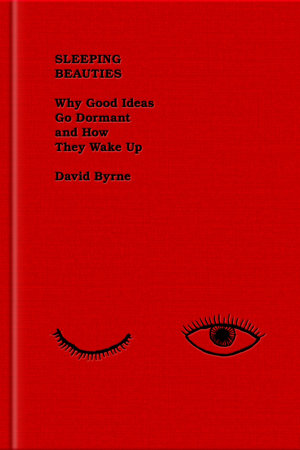
Sleeping Beauties

Why Good Ideas Go Dormant and How They Wake Up

Hardcover
$36.00 US
On sale Oct 06, 2026 | 400 Pages | 9780593655276

See Additional Formats
From incomparable creative force David Byrne, a brilliant and inspiring reckoning with how breakthroughs across the arts and sciences get forgotten, and how they get rediscovered

It’s nice to believe in a meritocracy of ideas—genius is always recognized, innovation always seized upon and rewarded. In fact, so many of the people we now acknowledge as the world’s great creators initially got little traction for their work. It faded out, and only later—often much later—did it somehow came roaring back to life.

Discoveries as diverse as dark matter, lichen, and continental drift . . . technologies from solar panels to the steam engine . . . artists from Bach to Bruegel, Vermeer to Melville . . . all, David Byrne shows us, were sleeping beauties. Why did they fall asleep? How did they wake back up? Ranging across centuries and the full scope of human endeavor, Byrne arrives at important conclusions that serve as a lens for bringing to light new seeds for our future breakthroughs.

Sleeping Beauties is a master class in how not to be blind to the next great thing. Several times throughout history, the shock of the new landed like a blow on vested interests and entrenched views, putting innovation on hold. Suppression emerged from pushback, the absence of key supporters, or simply a lack of complementary economic conditions.

But more important even than why ideas go dormant is why they reawaken. Again and again, Byrne shows, someone from a different discipline breaks into the silo. Frequently it’s someone open to metaphorical thinking, to the counterintuitive. Hierarchies and taxonomies have their place, but they can reward insiders and punish outsiders. Oftentimes, it is the winds of change that blow away the sand that has buried momentous ideas.

Sleeping Beauties is humbling but it is also remarkably hopeful. These stories add up to a compass that leads us to the courage to try new things and the wisdom to embrace them. In a time that can seem all too dark, it’s a powerful source of freely available light, delightful in itself and fit for all our human endeavors.
Introduction
Tom Zee the revenant

Part 1
Advocates and Champions
Vermeer!
Johann Sebastian Bach
Antoni Gaudi
Radio Astronomy
William Faulkner
Beauford Delaney

Part 2
Technological Innovation
The Atom
The Heliocentric solar system
Concrete!!
The hybrid nature of Lichen
Continental Drift
Dark Matter and black holes
The symbiotic origin of cellular life—Lynn Margulis

Part 3
Accidents
Caspar David Friedrich
Antiseptics and handwashing
Genetics Gregor Mendel
Viroids

Part 4
Economics
Solar Panels

Part 5
Catastrophes
Vincente Lusitano
Water Management in South India
Hyman Minsky
War and conflict as a spur to rediscovery
Inoculation
War makes adoption necessary
The Submarine
Bruegel
The Great Gatsby

Part 6
Cultural Changes
The use of Perspective in art and architecture
Sandro Botticelli
Caravaggio
Goya
Herman Melville—Moby Dick
Kropotkin
Franz Kafka
Janet Sobel

Conclusion
Things We Believe

© Todo Mundo
David Byrne, cofounder of the musical group Talking Heads, has also released several solo albums in addition to collaborating with such noted artists as Twyla Tharp, Robert Wilson, and Brian Eno. His art includes photography and installation works and has been published in five books, including Bicycle Diaries and How Music Works. His score for 1987’s The Last Emperor received an Academy Award, a Golden Globe Award, and a Grammy Award for Byrne and his cocomposers. His 2019 Broadway production American Utopia received a Special Tony Award while his 2023 immersive musical Here Lies Love received four Tony Award nominations including one for Best Original Score View titles by David Byrne

About

From incomparable creative force David Byrne, a brilliant and inspiring reckoning with how breakthroughs across the arts and sciences get forgotten, and how they get rediscovered

It’s nice to believe in a meritocracy of ideas—genius is always recognized, innovation always seized upon and rewarded. In fact, so many of the people we now acknowledge as the world’s great creators initially got little traction for their work. It faded out, and only later—often much later—did it somehow came roaring back to life.

Discoveries as diverse as dark matter, lichen, and continental drift . . . technologies from solar panels to the steam engine . . . artists from Bach to Bruegel, Vermeer to Melville . . . all, David Byrne shows us, were sleeping beauties. Why did they fall asleep? How did they wake back up? Ranging across centuries and the full scope of human endeavor, Byrne arrives at important conclusions that serve as a lens for bringing to light new seeds for our future breakthroughs.

Sleeping Beauties is a master class in how not to be blind to the next great thing. Several times throughout history, the shock of the new landed like a blow on vested interests and entrenched views, putting innovation on hold. Suppression emerged from pushback, the absence of key supporters, or simply a lack of complementary economic conditions.

But more important even than why ideas go dormant is why they reawaken. Again and again, Byrne shows, someone from a different discipline breaks into the silo. Frequently it’s someone open to metaphorical thinking, to the counterintuitive. Hierarchies and taxonomies have their place, but they can reward insiders and punish outsiders. Oftentimes, it is the winds of change that blow away the sand that has buried momentous ideas.

Sleeping Beauties is humbling but it is also remarkably hopeful. These stories add up to a compass that leads us to the courage to try new things and the wisdom to embrace them. In a time that can seem all too dark, it’s a powerful source of freely available light, delightful in itself and fit for all our human endeavors.

Table of Contents

Introduction
Tom Zee the revenant

Part 1
Advocates and Champions
Vermeer!
Johann Sebastian Bach
Antoni Gaudi
Radio Astronomy
William Faulkner
Beauford Delaney

Part 2
Technological Innovation
The Atom
The Heliocentric solar system
Concrete!!
The hybrid nature of Lichen
Continental Drift
Dark Matter and black holes
The symbiotic origin of cellular life—Lynn Margulis

Part 3
Accidents
Caspar David Friedrich
Antiseptics and handwashing
Genetics Gregor Mendel
Viroids

Part 4
Economics
Solar Panels

Part 5
Catastrophes
Vincente Lusitano
Water Management in South India
Hyman Minsky
War and conflict as a spur to rediscovery
Inoculation
War makes adoption necessary
The Submarine
Bruegel
The Great Gatsby

Part 6
Cultural Changes
The use of Perspective in art and architecture
Sandro Botticelli
Caravaggio
Goya
Herman Melville—Moby Dick
Kropotkin
Franz Kafka
Janet Sobel

Conclusion
Things We Believe

Author

© Todo Mundo
David Byrne, cofounder of the musical group Talking Heads, has also released several solo albums in addition to collaborating with such noted artists as Twyla Tharp, Robert Wilson, and Brian Eno. His art includes photography and installation works and has been published in five books, including Bicycle Diaries and How Music Works. His score for 1987’s The Last Emperor received an Academy Award, a Golden Globe Award, and a Grammy Award for Byrne and his cocomposers. His 2019 Broadway production American Utopia received a Special Tony Award while his 2023 immersive musical Here Lies Love received four Tony Award nominations including one for Best Original Score View titles by David Byrne

Books for Asian American, Native Hawaiian, and Pacific Islander Heritage Month

Each May, we honor the stories, histories, and cultures of Asian Americans, Native Hawaiians, and Pacific Islanders. Below is a selection of acclaimed fiction and nonfiction books by AANHPI creators to share with your students this month and throughout the year. Find our full collection of titles for Higher Education here.

Read more