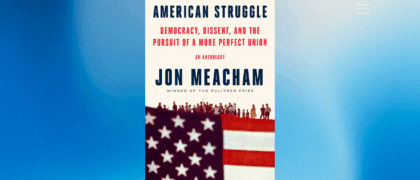
The #1 New York Times bestselling author of The Soul of America unites centuries of essential American voices to understand our national debates and divisions from 1619 to the present, with his signature commentary on the consequential speeches, letters, and essays that led us to this moment.

“Jon Meacham has done it again. If there is a soul in American history, it emerges—indeed, explodes—from these pages.”—David W. Blight, Pulitzer Prize–winning author of Frederick Douglass: Prophet of Freedom

In a polarized era, history can become a subject of political contention. Many see America as perfect; many others argue that the national experiment is fundamentally flawed. The truth, Meacham shows, likely lies between these extremes. America has had shining hours, and also dark ones.

In American Struggle, Jon Meacham illuminates the nation’s complicated past. This rich and diverse collection covers a wide spectrum of history, from 1619 to the twenty-first century, with primary-source documents that take us back to critical moments in which Americans fought over the meaning and the direction of the national experiment. From the founders to Lincoln to Obama, from Andrew Jackson to Theodore Roosevelt to Ronald Reagan, from Seneca Falls to the March on Washington, this chorus—sometimes discordant and always fascinating—tells the story of the country and of its people. As clashes over liberty and slavery, inclusion and exclusion, play out, these voices, brilliantly framed by Meacham’s singular commentary, remind us that contentious citizenship and fair-minded observations are essential to bringing about the more perfect union envisioned in the Preamble to the Constitution, which Frederick Douglass called a “glorious liberty document.”

Conflict is nothing new in our democracy; rather, as Meacham and these texts show, tensions are inherent, stubborn, and perennial. And American Struggle teaches us anew that to know what has come before, to watch as long-running disputes rise and fall, is to be armed against despair.
It was the boldest of claims. “The cause of America,” Thomas Paine would write in the winter of 1776, “is in a great measure the cause of all mankind. . . . Ye that dare oppose, not only the tyranny, but the tyrant, stand forth! Every spot of the old world is overrun with oppression. . . . O! receive the fugitive, and prepare in time an asylum for mankind.” The words came from Paine’s influential pamphlet Common Sense, a case for the burgeoning American Revolution so vivid and so transporting that the commander of the Continental Army, George Washington, ordered that it be read aloud to all of his troops. Though a noted religious skeptic—Paine would later turn his formidable pen to attacking traditional Christian faith in his sulfurous The Age of Reason—he framed the American bid for independence from Great Britain in moral terms, arguing that the colonists’ fight against King George III and the onus of hereditary authority was a battle between good and evil. In this Paine was speaking in a familiar vernacular of the time. “We are engaged in a most important contest; not for power but freedom,” the Reverend Samuel Stillman preached in Boston in 1779. “We mean not to change our masters, but to secure to ourselves, and to generations, yet unborn, the perpetual enjoyment of civil and religious liberty, in their fullest extent.” Or, as John Dickinson, the author of Letters from a Farmer in Pennsylvania, wrote in The Liberty Song:

By uniting we stand, by dividing we fall;

In so RIGHTEOUS a Cause let us hope to succeed,

For Heaven approves of each generous Deed.

For Heaven approves: No understanding of American history is possible without a grasp of the sense of covenant and of mission that prevailed in British North America from the founding of Virginia and of the Massachusetts Bay Colony in the seventeenth century. As John Winthrop preached in a 1630 sermon, linking the New World to Jesus’s Sermon on the Mount, America was to be “as a city upon a hill” whose temporal fortunes would wax or wane according to the virtues of the people, an understanding underscored in the Mayflower Compact drafted by dissenters arriving in Massachusetts in 1620. The continent was seen to be a special place in a providential universe—a universe that was not random but rather the conscious creation of the Lord God and an object of ongoing divine concern and judgment.

The colonists’ emphasis on Scripture informed their view of their own political rights. If God had made all people equal, they held, then individuals were sacred and no man could arbitrarily rule over another. Unless, of course, the individuals were Black, or Native American, or women. Abigail Adams, for one, made the case for the male American authorities to “Remember the Ladies” in the months before the Declaration. The ideal of innate human equality was deeply felt but strictly limited; much of the unfolding national drama would be about bringing that ideal, which had been present in the American experience from the beginning, closer to a reality for all.

The selections that follow illustrate how liberty and enslavement coexisted from at least 1619. That was the year a roughly democratic general assembly met in Jamestown—and the first enslaved Black people were brought to Virginia. The case for emancipation was in (limited) circulation. Perhaps the first moral protest against slavery was published in 1688 by Quakers in Germantown, Pennsylvania. “There is a saying, that we should do to all men like as we will be done ourselves; making no difference of what generation, descent, or colour they are,” read the Germantown document. “To bring men hither [to America], or to rob and sell them against their will, we stand against.”

Such is evidence of the gap between the loftiness of John Winthrop’s 1630 sermon and the world of human enslavement described in 1700 by Samuel Sewall in his antislavery tract The Selling of Joseph. In her poem “On Being Brought from Africa to America,” published in 1773, Phillis Wheatley, who had been transported to Massachusetts in 1761 and sold into enslavement, summoned readers to see Black people as fellow creatures of God.

The tensions between the colonies and London in British North America in the middle of the eighteenth century rose around 1765 with the passage of the Stamp Act, which imposed wide-ranging taxes. Over the next decade revolutionary sentiment grew in proportion to London’s attempts to exert a measure of control over colonial affairs. The conflict entered a new, violent phase with a clash at Lexington and Concord in April 1775. To the south, in Virginia, the royal governor Lord Dunmore’s November 1775 proclamation offering freedom to any enslaved person who joined the British cause helped unify white opinion against London and prompted the colony’s assembly to threaten death to anyone who answered Dunmore’s call.

In memory, of course, the American Revolution appears inevitable. Perhaps as many as a fifth of American colonists, however, remained loyal to Britain, which means the national experiment was forged amid division. The Thomas Paine view—that in America, as he put it, “the law is king”—prevailed. And the revolution went forward.

* * *

“All the Burgesses Took Their Places”

The First Assembly of Virginia, Journal of the House of Burgesses—July 30, 1619

A brief account of the opening moments of the first representative assembly to meet in British North America.

The most convenient place we could finde to sitt in was the Quire of the Churche, Where Sir George Yeardley the Governour being sett downe in his accustomed place, those of the Counsel of Estate sate next him on both handes excepte onely the Secretary then appointed Speaker, who sate right before him; John Twine clerke of the General Assembly being placed nexte the Speaker and Thomas Pierse the Sergeant standing at the barre, to be ready for any service the Assembly should command him. But for as muche as mens affaires doe little prosper where Gods service is neglected; all the Burgesses took their places in the Quire, till a Prayer was said by Mr Bucke, the Minister, that it would please God to guide us & sanctifie all our proceedings to his owne glory, and the good of his Plantation, Prayer being ended, to the intente that as wee had begun at God Almighty soe wee might proceed with awful and due respecte towards his Lieutenant, our most gratious & dread Soveraigne, all the Burgesses were intreated to retyre themselves into the body of the Churche; which being done, before they were fully admitted, they were called in order & by name, & so every man (none staggering at it) tooke the oathe of Supremacy, & then entered the Assembly.

“20. and Odd Negroes”

Letter of John Rolfe on the Coming of Slavery to Jamestown, Virginia—1619/1620

The English explorer and tobacco farmer John Rolfe (1585–1622), who had arrived in Virginia a decade earlier, describes the arrival of what are thought to be the first enslaved Black people in British North America.

About the latter end of August, a Dutch man of Warr of the burden of a 160 tunnes arrived at Point-Comfort, the Comandors name Capt Jope, his Pilott for the West Indies one Mr Marmaduke an Englishman. They mett with the Treasurer in the West Indyes, and determined to hold consort shipp hetherward, but in their passage lost one the other. He brought not any thing but 20. and odd Negroes, which the Governor and Cape Marchant bought for victualls (whereof he was in greate need as he pretended) at the best and easyest rates they could. He hadd a lardge and ample Commyssion from his Excellency to range and to take purchase in the West Indyes.

* * *

“A Civil Body Politick”

The Mayflower Compact—1620

The first governing covenant of the Plymouth Colony was signed by Puritan men of the Mayflower as they arrived in the New World. Plymouth would become part of the Massachusetts Bay Colony in the last decade of the seventeenth century.

IN THE NAME OF GOD, AMEN. We, whose names are underwritten, the Loyal Subjects of our dread Sovereign Lord King James, by the Grace of God, of Great Britain, France, and Ireland, King, Defender of the Faith, &c. Having undertaken for the Glory of God, and Advancement of the Christian Faith, and the Honour of our King and Country, a Voyage to plant the first Colony in the northern Parts of Virginia; Do by these Presents, solemnly and mutually, in the Presence of God and one another, covenant and combine ourselves together into a civil Body Politick, for our better Ordering and Preservation, and Furtherance of the Ends aforesaid: And by Virtue hereof do enact, constitute, and frame, such just and equal Laws, Ordinances, Acts, Constitutions, and Officers, from time to time, as shall be thought most meet and convenient for the general Good of the Colony; unto which we promise all due Submission and Obedience.
© Heidi Ross
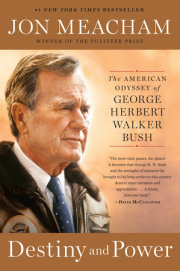
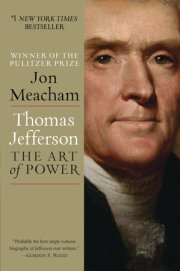
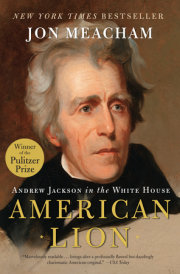
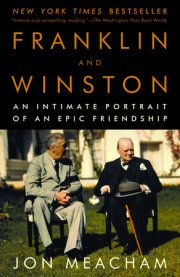
Jon Meacham is a Pulitzer Prize–winning biographer. The author of the New York Times bestsellers And There Was Light: Abraham Lincoln and the American Struggle; Thomas Jefferson: The Art of Power; American Lion: Andrew Jackson in the White House; Franklin and Winston: An Intimate Portrait of an Epic Friendship; Destiny and Power: The American Odyssey of George Herbert Walker Bush; and His Truth Is Marching On: John Lewis and the Power of Hope, he holds the Carolyn T. and Robert M. Rogers Chair at Vanderbilt University and is a fellow of the Society of American Historians. View titles by Jon Meacham
“Jon Meacham has done it again. This collection of pivotal American documents is all about the contrasts that flow from American pluralism over time, but it is even more about poignancies and conflicts which rise over and over in our history. Here are Hamilton and Jefferson, Calhoun and David Walker; Andrew Jackson and the Seneca Falls Declaration; Frederick Douglass and Andrew Johnson. FDR timelessly takes on "fear" and Huey Long "rich people." Democracy marches in many tongues here but so does authoritarianism, American-style. If there is a soul in American history, it emerges—indeed, explodes—from these pages.”—David W. Blight, Yale University, author of the Pulitzer Prize-winning Frederick Douglass: Prophet of Freedom

“Jon Meacham is our era’s preeminent historian of America’s values. In this anthology of brilliant essays and important documents, he weaves a narrative of how our democracy has progressed, in fits and starts, in pursuit of a more perfect union. It serves as a guide for the struggle we still face to preserve our freedoms. This is the one book everyone should read to celebrate our 250th birthday.”—Walter Isaacson, Professor of History, Tulane University, and New York Times bestselling author of Benjamin Franklin, Steve Jobs, and Einstein

“With American Struggle, Jon Meacham gives us exactly what we need as we approach the 250th anniversary of the country’s founding. The documents presented remind us, in this very difficult time, of the country’s sometimes fraught journey toward creating a more perfect union. This volume is inspiring, just at the moment and in the way we need it most.”—Annette Gordon-Reed, Carl M. Loeb University Professor, Harvard University, and Pulitzer Prize-winning author of The Hemingses of Monticello: An American Family

“A panoramic collection of historical writing, illuminating America’s evolving democracy and the dissent that drives it. Broad in scope yet vivid . . . [Meacham] curates a sweeping chronicle of American democracy’s promises and betrayals. . . . By presenting the raw materials of U.S. history with context and moral clarity, Meacham helps readers understand the past and orient themselves in the ongoing fight for a ‘more perfect Union.’ Evocative and impeccably curated—reframing America’s past to inform a more democratic and vigilant future.”—Kirkus Reviews

About

The #1 New York Times bestselling author of The Soul of America unites centuries of essential American voices to understand our national debates and divisions from 1619 to the present, with his signature commentary on the consequential speeches, letters, and essays that led us to this moment.

“Jon Meacham has done it again. If there is a soul in American history, it emerges—indeed, explodes—from these pages.”—David W. Blight, Pulitzer Prize–winning author of Frederick Douglass: Prophet of Freedom

In a polarized era, history can become a subject of political contention. Many see America as perfect; many others argue that the national experiment is fundamentally flawed. The truth, Meacham shows, likely lies between these extremes. America has had shining hours, and also dark ones.

In American Struggle, Jon Meacham illuminates the nation’s complicated past. This rich and diverse collection covers a wide spectrum of history, from 1619 to the twenty-first century, with primary-source documents that take us back to critical moments in which Americans fought over the meaning and the direction of the national experiment. From the founders to Lincoln to Obama, from Andrew Jackson to Theodore Roosevelt to Ronald Reagan, from Seneca Falls to the March on Washington, this chorus—sometimes discordant and always fascinating—tells the story of the country and of its people. As clashes over liberty and slavery, inclusion and exclusion, play out, these voices, brilliantly framed by Meacham’s singular commentary, remind us that contentious citizenship and fair-minded observations are essential to bringing about the more perfect union envisioned in the Preamble to the Constitution, which Frederick Douglass called a “glorious liberty document.”

Conflict is nothing new in our democracy; rather, as Meacham and these texts show, tensions are inherent, stubborn, and perennial. And American Struggle teaches us anew that to know what has come before, to watch as long-running disputes rise and fall, is to be armed against despair.

Excerpt

It was the boldest of claims. “The cause of America,” Thomas Paine would write in the winter of 1776, “is in a great measure the cause of all mankind. . . . Ye that dare oppose, not only the tyranny, but the tyrant, stand forth! Every spot of the old world is overrun with oppression. . . . O! receive the fugitive, and prepare in time an asylum for mankind.” The words came from Paine’s influential pamphlet Common Sense, a case for the burgeoning American Revolution so vivid and so transporting that the commander of the Continental Army, George Washington, ordered that it be read aloud to all of his troops. Though a noted religious skeptic—Paine would later turn his formidable pen to attacking traditional Christian faith in his sulfurous The Age of Reason—he framed the American bid for independence from Great Britain in moral terms, arguing that the colonists’ fight against King George III and the onus of hereditary authority was a battle between good and evil. In this Paine was speaking in a familiar vernacular of the time. “We are engaged in a most important contest; not for power but freedom,” the Reverend Samuel Stillman preached in Boston in 1779. “We mean not to change our masters, but to secure to ourselves, and to generations, yet unborn, the perpetual enjoyment of civil and religious liberty, in their fullest extent.” Or, as John Dickinson, the author of Letters from a Farmer in Pennsylvania, wrote in The Liberty Song:

By uniting we stand, by dividing we fall;

In so RIGHTEOUS a Cause let us hope to succeed,

For Heaven approves of each generous Deed.

For Heaven approves: No understanding of American history is possible without a grasp of the sense of covenant and of mission that prevailed in British North America from the founding of Virginia and of the Massachusetts Bay Colony in the seventeenth century. As John Winthrop preached in a 1630 sermon, linking the New World to Jesus’s Sermon on the Mount, America was to be “as a city upon a hill” whose temporal fortunes would wax or wane according to the virtues of the people, an understanding underscored in the Mayflower Compact drafted by dissenters arriving in Massachusetts in 1620. The continent was seen to be a special place in a providential universe—a universe that was not random but rather the conscious creation of the Lord God and an object of ongoing divine concern and judgment.

The colonists’ emphasis on Scripture informed their view of their own political rights. If God had made all people equal, they held, then individuals were sacred and no man could arbitrarily rule over another. Unless, of course, the individuals were Black, or Native American, or women. Abigail Adams, for one, made the case for the male American authorities to “Remember the Ladies” in the months before the Declaration. The ideal of innate human equality was deeply felt but strictly limited; much of the unfolding national drama would be about bringing that ideal, which had been present in the American experience from the beginning, closer to a reality for all.

The selections that follow illustrate how liberty and enslavement coexisted from at least 1619. That was the year a roughly democratic general assembly met in Jamestown—and the first enslaved Black people were brought to Virginia. The case for emancipation was in (limited) circulation. Perhaps the first moral protest against slavery was published in 1688 by Quakers in Germantown, Pennsylvania. “There is a saying, that we should do to all men like as we will be done ourselves; making no difference of what generation, descent, or colour they are,” read the Germantown document. “To bring men hither [to America], or to rob and sell them against their will, we stand against.”

Such is evidence of the gap between the loftiness of John Winthrop’s 1630 sermon and the world of human enslavement described in 1700 by Samuel Sewall in his antislavery tract The Selling of Joseph. In her poem “On Being Brought from Africa to America,” published in 1773, Phillis Wheatley, who had been transported to Massachusetts in 1761 and sold into enslavement, summoned readers to see Black people as fellow creatures of God.

The tensions between the colonies and London in British North America in the middle of the eighteenth century rose around 1765 with the passage of the Stamp Act, which imposed wide-ranging taxes. Over the next decade revolutionary sentiment grew in proportion to London’s attempts to exert a measure of control over colonial affairs. The conflict entered a new, violent phase with a clash at Lexington and Concord in April 1775. To the south, in Virginia, the royal governor Lord Dunmore’s November 1775 proclamation offering freedom to any enslaved person who joined the British cause helped unify white opinion against London and prompted the colony’s assembly to threaten death to anyone who answered Dunmore’s call.

In memory, of course, the American Revolution appears inevitable. Perhaps as many as a fifth of American colonists, however, remained loyal to Britain, which means the national experiment was forged amid division. The Thomas Paine view—that in America, as he put it, “the law is king”—prevailed. And the revolution went forward.

* * *

“All the Burgesses Took Their Places”

The First Assembly of Virginia, Journal of the House of Burgesses—July 30, 1619

A brief account of the opening moments of the first representative assembly to meet in British North America.

The most convenient place we could finde to sitt in was the Quire of the Churche, Where Sir George Yeardley the Governour being sett downe in his accustomed place, those of the Counsel of Estate sate next him on both handes excepte onely the Secretary then appointed Speaker, who sate right before him; John Twine clerke of the General Assembly being placed nexte the Speaker and Thomas Pierse the Sergeant standing at the barre, to be ready for any service the Assembly should command him. But for as muche as mens affaires doe little prosper where Gods service is neglected; all the Burgesses took their places in the Quire, till a Prayer was said by Mr Bucke, the Minister, that it would please God to guide us & sanctifie all our proceedings to his owne glory, and the good of his Plantation, Prayer being ended, to the intente that as wee had begun at God Almighty soe wee might proceed with awful and due respecte towards his Lieutenant, our most gratious & dread Soveraigne, all the Burgesses were intreated to retyre themselves into the body of the Churche; which being done, before they were fully admitted, they were called in order & by name, & so every man (none staggering at it) tooke the oathe of Supremacy, & then entered the Assembly.

“20. and Odd Negroes”

Letter of John Rolfe on the Coming of Slavery to Jamestown, Virginia—1619/1620

The English explorer and tobacco farmer John Rolfe (1585–1622), who had arrived in Virginia a decade earlier, describes the arrival of what are thought to be the first enslaved Black people in British North America.

About the latter end of August, a Dutch man of Warr of the burden of a 160 tunnes arrived at Point-Comfort, the Comandors name Capt Jope, his Pilott for the West Indies one Mr Marmaduke an Englishman. They mett with the Treasurer in the West Indyes, and determined to hold consort shipp hetherward, but in their passage lost one the other. He brought not any thing but 20. and odd Negroes, which the Governor and Cape Marchant bought for victualls (whereof he was in greate need as he pretended) at the best and easyest rates they could. He hadd a lardge and ample Commyssion from his Excellency to range and to take purchase in the West Indyes.

* * *

“A Civil Body Politick”

The Mayflower Compact—1620

The first governing covenant of the Plymouth Colony was signed by Puritan men of the Mayflower as they arrived in the New World. Plymouth would become part of the Massachusetts Bay Colony in the last decade of the seventeenth century.

IN THE NAME OF GOD, AMEN. We, whose names are underwritten, the Loyal Subjects of our dread Sovereign Lord King James, by the Grace of God, of Great Britain, France, and Ireland, King, Defender of the Faith, &c. Having undertaken for the Glory of God, and Advancement of the Christian Faith, and the Honour of our King and Country, a Voyage to plant the first Colony in the northern Parts of Virginia; Do by these Presents, solemnly and mutually, in the Presence of God and one another, covenant and combine ourselves together into a civil Body Politick, for our better Ordering and Preservation, and Furtherance of the Ends aforesaid: And by Virtue hereof do enact, constitute, and frame, such just and equal Laws, Ordinances, Acts, Constitutions, and Officers, from time to time, as shall be thought most meet and convenient for the general Good of the Colony; unto which we promise all due Submission and Obedience.

Author

© Heidi Ross
Jon Meacham is a Pulitzer Prize–winning biographer. The author of the New York Times bestsellers And There Was Light: Abraham Lincoln and the American Struggle; Thomas Jefferson: The Art of Power; American Lion: Andrew Jackson in the White House; Franklin and Winston: An Intimate Portrait of an Epic Friendship; Destiny and Power: The American Odyssey of George Herbert Walker Bush; and His Truth Is Marching On: John Lewis and the Power of Hope, he holds the Carolyn T. and Robert M. Rogers Chair at Vanderbilt University and is a fellow of the Society of American Historians. View titles by Jon Meacham

Praise

“Jon Meacham has done it again. This collection of pivotal American documents is all about the contrasts that flow from American pluralism over time, but it is even more about poignancies and conflicts which rise over and over in our history. Here are Hamilton and Jefferson, Calhoun and David Walker; Andrew Jackson and the Seneca Falls Declaration; Frederick Douglass and Andrew Johnson. FDR timelessly takes on "fear" and Huey Long "rich people." Democracy marches in many tongues here but so does authoritarianism, American-style. If there is a soul in American history, it emerges—indeed, explodes—from these pages.”—David W. Blight, Yale University, author of the Pulitzer Prize-winning Frederick Douglass: Prophet of Freedom

“Jon Meacham is our era’s preeminent historian of America’s values. In this anthology of brilliant essays and important documents, he weaves a narrative of how our democracy has progressed, in fits and starts, in pursuit of a more perfect union. It serves as a guide for the struggle we still face to preserve our freedoms. This is the one book everyone should read to celebrate our 250th birthday.”—Walter Isaacson, Professor of History, Tulane University, and New York Times bestselling author of Benjamin Franklin, Steve Jobs, and Einstein

“With American Struggle, Jon Meacham gives us exactly what we need as we approach the 250th anniversary of the country’s founding. The documents presented remind us, in this very difficult time, of the country’s sometimes fraught journey toward creating a more perfect union. This volume is inspiring, just at the moment and in the way we need it most.”—Annette Gordon-Reed, Carl M. Loeb University Professor, Harvard University, and Pulitzer Prize-winning author of The Hemingses of Monticello: An American Family

“A panoramic collection of historical writing, illuminating America’s evolving democracy and the dissent that drives it. Broad in scope yet vivid . . . [Meacham] curates a sweeping chronicle of American democracy’s promises and betrayals. . . . By presenting the raw materials of U.S. history with context and moral clarity, Meacham helps readers understand the past and orient themselves in the ongoing fight for a ‘more perfect Union.’ Evocative and impeccably curated—reframing America’s past to inform a more democratic and vigilant future.”—Kirkus Reviews