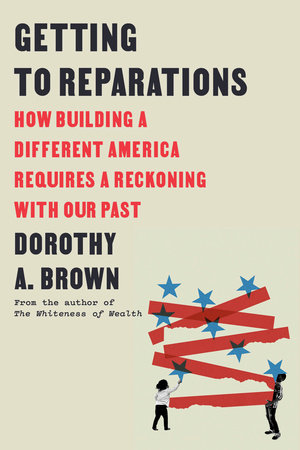
Getting to Reparations

How Building a Different America Requires a Reckoning with Our Past

Author Dorothy A. Brown On Tour
Ebook
On sale Jan 20, 2026 | 272 Pages | 9780593593622

See Additional Formats
A bold manifesto arguing that there is a clear precedent for paying reparations to atone for America’s original sin of slavery, offering a compelling legal strategy to achieve this goal—from the acclaimed author of The Whiteness of Wealth.

The idea of reparations is not a new or original one; it is one that is baked into American history.

When the District of Columbia Emancipation Act of 1862 went into effect, wealthy slaveowners like Margaret Barber were compensated for the loss of their enslaved workers. Barber received $9,000—an equivalent to $250,000 today. When a group of Italian immigrants were lynched in 1892, President Harrison compensated Italy a total of $25,000 for their deaths—an equivalent to almost $766,000 today. The Indian Claims Commission, an arm of the federal government, paid Indigenous Americans $818 million for underhandedly stealing their land in the eighteenth and nineteenth centuries—an equivalent to almost $350 billion today.

Dorothy A. Brown addresses the glaring question: if reparations can be achieved for others, why not for Black Americans? If lynching can be remedied for Italian immigrants, and slaveholders compensated for losses associated with abolition and emancipation, then the government’s failure to provide such remedies to Black communities harmed by similar violence, loss, and destruction is long overdue. The fight for reparations is truly a fight for the soul of America, to produce the country our founding fathers idealized but never achieved.

Getting to Reparations makes a logical and necessary case for reparations for Black Americans. It lays out a path as to how we might achieve this, built on the frameworks used throughout U.S. history by the government to pay restitution. It is now time to do the same for America's Black population.
Our Hidden History

Truth is powerful and it prevails. —Sojourner Truth

White Enslavers’ Payday

The road to emancipation started, in the early 1860s, with an “experiment” in the District of Columbia. Would white enslavers be more supportive of ending slavery if they knew they would receive cash compensation for each enslaved person the law set free?

That idea resulted in the District of Columbia Compensated Emancipation Act, which became law in April 1862 and ended slavery in the District of Columbia. It required cash payments to white enslavers for each enslaved person legally freed. The federal government allocated $1 million for the effort. The final Treasury report referred to these payments as “claimed compensation.”1

One of those enslavers was Margaret Catherine Adlum, who was born on May 29, 1810, in Maryland. Her father, Major John Adlum, served as a corporal in the Revolutionary War and came from a prominent family that aided him in building his fortune as a land surveyor. Her mother, also named Margaret C. Adlum, was Major Adlum’s first cousin and likewise came from a prosperous farming family. The Adlum family wealth came from landowning, surveying work, and human trafficking. The Adlums were enslavers.

Around 1837, Margaret married Cornelius Barber. The following year the newlyweds purchased a seventy-three-acre estate for $3,000 ($96,000 today) in the lush green hills overlooking Georgetown in Washington, DC, and turned it into a working farm they called Northview. In the years that followed, Margaret gave birth to six children. By 1850, with a growing family and a farm to take care of, the Barbers enslaved eleven people to lighten their load, eight of whom Margaret inherited from her parents.

As recorded in the 1850 US Census, “Female, Black, 60 y.o., Born in 1790,” “Male, Black, 25 y.o., Born in 1825,” and “Female, Black, 25 y.o., Born in 1825” were some of the enslaved people who lived and worked at Northview. They weren’t even given the basic dignity of having their names recorded, consistent with standard practice. Collectively, they spent their entire lives serving Margaret, her parents, or other enslavers. They built up the Barbers’ wealth while being stripped of their own. Many had been bought to serve for life and could only dream of becoming free. They tended to their tasks, inside the house and out in the fields, day in and day out. They were never paid wages for their labor, and if they had ever invented anything, they would have been deprived of their intellectual property rights.2

The enslaved people at Northview were silent observers who watched as the Barbers experienced seasons of joy and sorrow, all the while growing wealthier at their expense. They witnessed the tragedy that struck in 1849, when Margaret’s five youngest children died of dysentery, leaving the oldest son, John Adlum Barber, the sole survivor. The couple buried their sadness by throwing themselves headlong into the construction of a new family home.

Over the next four years, an extravagant mansion, designed by renowned local architects, was erected on the highest point of the property. The house boasted two ballrooms, “countless bed and drawing rooms, crystal chandeliers, and enormous mirrors.”3 The candlelit drawing rooms in the big house were in sharp contrast to the slave quarters on the far side of the property, way out past the stables and the corn crib.

In 1853 catastrophe struck the Barber household yet again when Cornelius died at age fifty, one month after making his will. Widowed at the age of forty-four, Margaret and her surviving son, John, now fifteen, were left to manage the farm on their own. As a tribute, Margaret commissioned prominent artist Thomas Sully, famous for his paintings of former presidents including George Washington in The Passage of the Delaware, to paint portraits of her and her late husband. Cornelius’s painting cost her $100 (just under $4,000 today).

While it was customary for husbands to leave their property in a trust for their widow, based on the assumption that a woman would be unable to manage the property, Cornelius left all his property to Margaret outright. Running the estate was a tall order. As Mary Mitchell notes in her book Divided Town, “A woman of less character would have sold her farm and moved into town.”4 By 1860, the farm had grown to include the mansion and carriage house, twenty-nine enslaved people (including many that she inherited upon the death of her husband),5 slave quarters, hay sheds, and hen houses.

For the enslaved people at Northview, little changed other than the type of work they were tasked with. When there was not enough work on the farm to keep them all busy, Margaret rented them out to other merchants and families in the area. She shrewdly hired out ten of the men to slaughterhouses and tanneries and seven of the women to other households as cooks and house servants. This left just over half of the enslaved at home to work the farm and make it as self-sustaining as possible. By renting out the others, she earned an annual income of roughly $1,500 a year (a little over $47,000 today).6 While it is true that some enslavers allowed enslaved workers to keep a small share of the income they earned when hired out, enslavers still kept the lion’s share, further exploiting black Americans.

Cornelius had been right to place his trust in Margaret’s business acumen. According to the 1860 Census, there were 3,185 enslaved people in the District of Columbia; twenty-nine belonged to Margaret, and two years later that number grew to thirty-four, making her the second largest enslaver in the district.

The outbreak of the Civil War in the spring of 1861, however, likely jeopardized Margaret’s balance sheet, as the value of enslaved people plummeted. But there was the other side of the ledger to consider, namely how the enslaved now thought about the future. The promise of emancipation was no longer limited to daydreams: it now seemed not only possible but probable. “All the slaves in the South think they will be freed soon, even those in this neighborhood,” Lieutenant Benjamin F. Fisher of the US Signal Corps at Georgetown declared that fall.7

After the Civil War began, Margaret’s life and those of her enslaved people took a dramatic turn. Five of her men, four of whom she hired out—Mortimer Briscoe, Townley Yates, Rezin Yates, Andrew Yates, and William Cyrass—wasted no time in liberating themselves. More upheaval was soon to follow.

With the start of the war and the secession of eleven Southern states, there emerged for the first time a realistic chance of ending slavery in the District of Columbia. A draft bill was introduced in the nation’s capital in late 1861. The legislation’s most vocal supporters—Henry Wilson, Charles Sumner, and William Fessenden—all had abolitionist backgrounds and supported emancipation because they believed it was morally right. Other proponents argued that emancipation would boost Union morale and powerfully highlight what the war was truly about while also delivering a blow to Southern morale. Once slavery ended in the district, they argued, it was only a matter of time before it was ended throughout the rest of the country. Since the Compensated Emancipation Act required enslavers who requested compensation to take an oath of loyalty, the bill would effectively codify a loyal population in the District of Columbia to help defend against any Southern incursions from neighboring Virginia, which was a slave state and part of the Confederacy. Finally, those in favor of abolition saw the symbolic importance of banishing slavery in the nation’s capital.

Meanwhile, opponents of the bill argued that emancipation would encourage more resistance from the South and embolden the Confederacy to fight harder against the Union. A minority insisted that Congress did not have the power to end slavery in the District of Columbia. Many white Americans expressed fear that the bill would attract large numbers of runaways hoping to secure their freedom. What’s more, detractors believed that the enslaved were unfit for freedom because they were unable to take care of themselves and that they would most likely become dependent on their former enslavers. Emancipation, critics predicted, would lead to a race war. Free blacks would be able to compete with white workers for jobs, thereby harming white livelihoods.
© Alvin Mitchell
Dorothy A. Brown is a professor of law and the Martin D. Ginsburg Chair in Taxation at Georgetown University Law Center. She is also the author of The Whiteness of Wealth. A graduate of Fordham University and Georgetown Law, she received her LLM in taxation from New York University. A nationally recognized scholar in the areas of race, class, and tax policy, she has published dozens of articles, essays, and book chapters on the topic. She has appeared on ABC's The View, CNN, MSNBC, PBS, NPR, The Armchair Expert, New Yorker Radio Hour, and Code Switch, and her opinion pieces have been published in The Atlantic, The New York Times, and The Washington Post. Born and raised in the South Bronx in New York City, Dorothy Brown currently resides in Washington, D.C. View titles by Dorothy A. Brown

Discussion Guide for Getting to Reparations

Provides questions, discussion topics, suggested reading lists, introductions and/or author Q&As, which are intended to enhance reading groups’ experiences.

(Please note: the guide displayed here is the most recently uploaded version; while unlikely, any page citation discrepancies between the guide and book is likely due to pagination differences between a book’s different formats.)

About

A bold manifesto arguing that there is a clear precedent for paying reparations to atone for America’s original sin of slavery, offering a compelling legal strategy to achieve this goal—from the acclaimed author of The Whiteness of Wealth.

The idea of reparations is not a new or original one; it is one that is baked into American history.

When the District of Columbia Emancipation Act of 1862 went into effect, wealthy slaveowners like Margaret Barber were compensated for the loss of their enslaved workers. Barber received $9,000—an equivalent to $250,000 today. When a group of Italian immigrants were lynched in 1892, President Harrison compensated Italy a total of $25,000 for their deaths—an equivalent to almost $766,000 today. The Indian Claims Commission, an arm of the federal government, paid Indigenous Americans $818 million for underhandedly stealing their land in the eighteenth and nineteenth centuries—an equivalent to almost $350 billion today.

Dorothy A. Brown addresses the glaring question: if reparations can be achieved for others, why not for Black Americans? If lynching can be remedied for Italian immigrants, and slaveholders compensated for losses associated with abolition and emancipation, then the government’s failure to provide such remedies to Black communities harmed by similar violence, loss, and destruction is long overdue. The fight for reparations is truly a fight for the soul of America, to produce the country our founding fathers idealized but never achieved.

Getting to Reparations makes a logical and necessary case for reparations for Black Americans. It lays out a path as to how we might achieve this, built on the frameworks used throughout U.S. history by the government to pay restitution. It is now time to do the same for America's Black population.

Excerpt

Our Hidden History

Truth is powerful and it prevails. —Sojourner Truth

White Enslavers’ Payday

The road to emancipation started, in the early 1860s, with an “experiment” in the District of Columbia. Would white enslavers be more supportive of ending slavery if they knew they would receive cash compensation for each enslaved person the law set free?

That idea resulted in the District of Columbia Compensated Emancipation Act, which became law in April 1862 and ended slavery in the District of Columbia. It required cash payments to white enslavers for each enslaved person legally freed. The federal government allocated $1 million for the effort. The final Treasury report referred to these payments as “claimed compensation.”1

One of those enslavers was Margaret Catherine Adlum, who was born on May 29, 1810, in Maryland. Her father, Major John Adlum, served as a corporal in the Revolutionary War and came from a prominent family that aided him in building his fortune as a land surveyor. Her mother, also named Margaret C. Adlum, was Major Adlum’s first cousin and likewise came from a prosperous farming family. The Adlum family wealth came from landowning, surveying work, and human trafficking. The Adlums were enslavers.

Around 1837, Margaret married Cornelius Barber. The following year the newlyweds purchased a seventy-three-acre estate for $3,000 ($96,000 today) in the lush green hills overlooking Georgetown in Washington, DC, and turned it into a working farm they called Northview. In the years that followed, Margaret gave birth to six children. By 1850, with a growing family and a farm to take care of, the Barbers enslaved eleven people to lighten their load, eight of whom Margaret inherited from her parents.

As recorded in the 1850 US Census, “Female, Black, 60 y.o., Born in 1790,” “Male, Black, 25 y.o., Born in 1825,” and “Female, Black, 25 y.o., Born in 1825” were some of the enslaved people who lived and worked at Northview. They weren’t even given the basic dignity of having their names recorded, consistent with standard practice. Collectively, they spent their entire lives serving Margaret, her parents, or other enslavers. They built up the Barbers’ wealth while being stripped of their own. Many had been bought to serve for life and could only dream of becoming free. They tended to their tasks, inside the house and out in the fields, day in and day out. They were never paid wages for their labor, and if they had ever invented anything, they would have been deprived of their intellectual property rights.2

The enslaved people at Northview were silent observers who watched as the Barbers experienced seasons of joy and sorrow, all the while growing wealthier at their expense. They witnessed the tragedy that struck in 1849, when Margaret’s five youngest children died of dysentery, leaving the oldest son, John Adlum Barber, the sole survivor. The couple buried their sadness by throwing themselves headlong into the construction of a new family home.

Over the next four years, an extravagant mansion, designed by renowned local architects, was erected on the highest point of the property. The house boasted two ballrooms, “countless bed and drawing rooms, crystal chandeliers, and enormous mirrors.”3 The candlelit drawing rooms in the big house were in sharp contrast to the slave quarters on the far side of the property, way out past the stables and the corn crib.

In 1853 catastrophe struck the Barber household yet again when Cornelius died at age fifty, one month after making his will. Widowed at the age of forty-four, Margaret and her surviving son, John, now fifteen, were left to manage the farm on their own. As a tribute, Margaret commissioned prominent artist Thomas Sully, famous for his paintings of former presidents including George Washington in The Passage of the Delaware, to paint portraits of her and her late husband. Cornelius’s painting cost her $100 (just under $4,000 today).

While it was customary for husbands to leave their property in a trust for their widow, based on the assumption that a woman would be unable to manage the property, Cornelius left all his property to Margaret outright. Running the estate was a tall order. As Mary Mitchell notes in her book Divided Town, “A woman of less character would have sold her farm and moved into town.”4 By 1860, the farm had grown to include the mansion and carriage house, twenty-nine enslaved people (including many that she inherited upon the death of her husband),5 slave quarters, hay sheds, and hen houses.

For the enslaved people at Northview, little changed other than the type of work they were tasked with. When there was not enough work on the farm to keep them all busy, Margaret rented them out to other merchants and families in the area. She shrewdly hired out ten of the men to slaughterhouses and tanneries and seven of the women to other households as cooks and house servants. This left just over half of the enslaved at home to work the farm and make it as self-sustaining as possible. By renting out the others, she earned an annual income of roughly $1,500 a year (a little over $47,000 today).6 While it is true that some enslavers allowed enslaved workers to keep a small share of the income they earned when hired out, enslavers still kept the lion’s share, further exploiting black Americans.

Cornelius had been right to place his trust in Margaret’s business acumen. According to the 1860 Census, there were 3,185 enslaved people in the District of Columbia; twenty-nine belonged to Margaret, and two years later that number grew to thirty-four, making her the second largest enslaver in the district.

The outbreak of the Civil War in the spring of 1861, however, likely jeopardized Margaret’s balance sheet, as the value of enslaved people plummeted. But there was the other side of the ledger to consider, namely how the enslaved now thought about the future. The promise of emancipation was no longer limited to daydreams: it now seemed not only possible but probable. “All the slaves in the South think they will be freed soon, even those in this neighborhood,” Lieutenant Benjamin F. Fisher of the US Signal Corps at Georgetown declared that fall.7

After the Civil War began, Margaret’s life and those of her enslaved people took a dramatic turn. Five of her men, four of whom she hired out—Mortimer Briscoe, Townley Yates, Rezin Yates, Andrew Yates, and William Cyrass—wasted no time in liberating themselves. More upheaval was soon to follow.

With the start of the war and the secession of eleven Southern states, there emerged for the first time a realistic chance of ending slavery in the District of Columbia. A draft bill was introduced in the nation’s capital in late 1861. The legislation’s most vocal supporters—Henry Wilson, Charles Sumner, and William Fessenden—all had abolitionist backgrounds and supported emancipation because they believed it was morally right. Other proponents argued that emancipation would boost Union morale and powerfully highlight what the war was truly about while also delivering a blow to Southern morale. Once slavery ended in the district, they argued, it was only a matter of time before it was ended throughout the rest of the country. Since the Compensated Emancipation Act required enslavers who requested compensation to take an oath of loyalty, the bill would effectively codify a loyal population in the District of Columbia to help defend against any Southern incursions from neighboring Virginia, which was a slave state and part of the Confederacy. Finally, those in favor of abolition saw the symbolic importance of banishing slavery in the nation’s capital.

Meanwhile, opponents of the bill argued that emancipation would encourage more resistance from the South and embolden the Confederacy to fight harder against the Union. A minority insisted that Congress did not have the power to end slavery in the District of Columbia. Many white Americans expressed fear that the bill would attract large numbers of runaways hoping to secure their freedom. What’s more, detractors believed that the enslaved were unfit for freedom because they were unable to take care of themselves and that they would most likely become dependent on their former enslavers. Emancipation, critics predicted, would lead to a race war. Free blacks would be able to compete with white workers for jobs, thereby harming white livelihoods.

Author

© Alvin Mitchell
Dorothy A. Brown is a professor of law and the Martin D. Ginsburg Chair in Taxation at Georgetown University Law Center. She is also the author of The Whiteness of Wealth. A graduate of Fordham University and Georgetown Law, she received her LLM in taxation from New York University. A nationally recognized scholar in the areas of race, class, and tax policy, she has published dozens of articles, essays, and book chapters on the topic. She has appeared on ABC's The View, CNN, MSNBC, PBS, NPR, The Armchair Expert, New Yorker Radio Hour, and Code Switch, and her opinion pieces have been published in The Atlantic, The New York Times, and The Washington Post. Born and raised in the South Bronx in New York City, Dorothy Brown currently resides in Washington, D.C. View titles by Dorothy A. Brown

Guides

Discussion Guide for Getting to Reparations

Provides questions, discussion topics, suggested reading lists, introductions and/or author Q&As, which are intended to enhance reading groups’ experiences.

(Please note: the guide displayed here is the most recently uploaded version; while unlikely, any page citation discrepancies between the guide and book is likely due to pagination differences between a book’s different formats.)