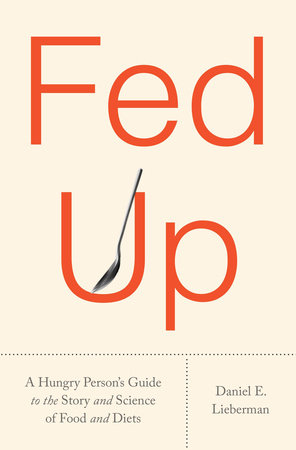
Fed Up

What Evolution Reveals About Food, Diet, Health, and Eating Well

Ebook
On sale Aug 11, 2026 | 416 Pages | 9780593538005

See Additional Formats
As we face today’s excess of confusing and often contradictory advice on diet and wellness, Daniel E. Lieberman—bestselling author of The Story of the Human Body and Exercised, and founding chair of the Department of Human Evolutionary Biology at Harvard University—gives us a brilliant, no-nonsense book, at once fresh, entertaining, informative, and compassionate, to help us answer a question we never evolved to ask but now must consider several times a day: what should we eat, and why?

Contrary to widespread claims, Lieberman argues, there can be no simple, definitive answer. Using lines of evidence from evolutionary biology, physiology, anthropology, anatomy, medical science, and history, Lieberman examines, with brio and wit, the history and health effects of food from before the invention of cooking up to today’s industrially produced diets. He shows how we evolved to eat almost anything, and by evaluating and trying many of these diets (raw food, Paleo, Mediterranean, Blue Zone, intermittent fasting, Atkins, DASH), he helps you understand why none is definitive, and some are better than others.

Lieberman explores the costs and benefits of cheap, energy-rich, tempting, and often unhealthy ultra-processed foods; the tangled roots of weight gain; how diet influences obesity, heart disease, and cancer; and the claims of benefits offered by high- and low-fat diets, meal replacements, intermittent fasting, carnivorism, vegetarianism, and veganism—while showing how over centuries most cultures evolved ingenious ways to grow and cook healthy, delicious food.

This fascinating and entertaining science-based book on nutrition, digestion, and health will teach you how to be well fed instead of fed up with dietary hucksterism.

© Antonia Prescott
DANIEL E. LIEBERMANi s a paleoanthropologist at Harvard University, where he is the Edwin M. Lerner II Professor of Biological Sciences and former chair of the Department of Human Evolutionary Biology. He is best known for his research on the evolution of the human body and its relevance to health. View titles by Daniel E. Lieberman
“One of the country’s foremost evolutionary biologists gives us a terrific book that cuts through the noise of fad diets and nutrition advice by turning to the most reliable guide we have: the deep history of the human body. A wise, accessible, and evidence-based framework for eating well in a world that has made eating badly all too easy.”
—Michael Moss, Pulitzer Prize–winning author of Salt Sugar Fat

“Wonderful: wise, witty, and full of unexpected insights.”
—Bill Bryson, bestselling author of The Body

“A game ... exploration of diet fads and the quest for the perfect plate. . . . A book that neatly punctures food myths while encouraging a splendid, healthful diversity at table.”
—Kirkus Reviews

About

As we face today’s excess of confusing and often contradictory advice on diet and wellness, Daniel E. Lieberman—bestselling author of The Story of the Human Body and Exercised, and founding chair of the Department of Human Evolutionary Biology at Harvard University—gives us a brilliant, no-nonsense book, at once fresh, entertaining, informative, and compassionate, to help us answer a question we never evolved to ask but now must consider several times a day: what should we eat, and why?

Contrary to widespread claims, Lieberman argues, there can be no simple, definitive answer. Using lines of evidence from evolutionary biology, physiology, anthropology, anatomy, medical science, and history, Lieberman examines, with brio and wit, the history and health effects of food from before the invention of cooking up to today’s industrially produced diets. He shows how we evolved to eat almost anything, and by evaluating and trying many of these diets (raw food, Paleo, Mediterranean, Blue Zone, intermittent fasting, Atkins, DASH), he helps you understand why none is definitive, and some are better than others.

Lieberman explores the costs and benefits of cheap, energy-rich, tempting, and often unhealthy ultra-processed foods; the tangled roots of weight gain; how diet influences obesity, heart disease, and cancer; and the claims of benefits offered by high- and low-fat diets, meal replacements, intermittent fasting, carnivorism, vegetarianism, and veganism—while showing how over centuries most cultures evolved ingenious ways to grow and cook healthy, delicious food.

This fascinating and entertaining science-based book on nutrition, digestion, and health will teach you how to be well fed instead of fed up with dietary hucksterism.

Author

© Antonia Prescott
DANIEL E. LIEBERMANi s a paleoanthropologist at Harvard University, where he is the Edwin M. Lerner II Professor of Biological Sciences and former chair of the Department of Human Evolutionary Biology. He is best known for his research on the evolution of the human body and its relevance to health. View titles by Daniel E. Lieberman

Praise

“One of the country’s foremost evolutionary biologists gives us a terrific book that cuts through the noise of fad diets and nutrition advice by turning to the most reliable guide we have: the deep history of the human body. A wise, accessible, and evidence-based framework for eating well in a world that has made eating badly all too easy.”
—Michael Moss, Pulitzer Prize–winning author of Salt Sugar Fat

“Wonderful: wise, witty, and full of unexpected insights.”
—Bill Bryson, bestselling author of The Body

“A game ... exploration of diet fads and the quest for the perfect plate. . . . A book that neatly punctures food myths while encouraging a splendid, healthful diversity at table.”
—Kirkus Reviews

Books for Asian American, Native Hawaiian, and Pacific Islander Heritage Month

Each May, we honor the stories, histories, and cultures of Asian Americans, Native Hawaiians, and Pacific Islanders. Below is a selection of acclaimed fiction and nonfiction books by AANHPI creators to share with your students this month and throughout the year. Find our full collection of titles for Higher Education here.

Read more