Download high-resolution image
Listen to a clip from the audiobook
audio play button
0:00
0:00

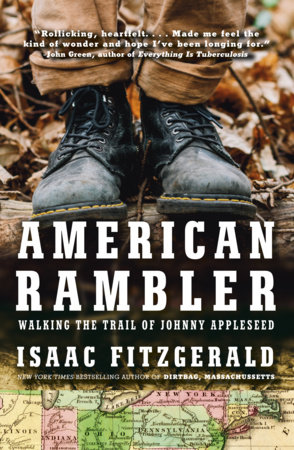
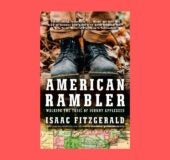
American Rambler

Walking the Trail of Johnny Appleseed

Author Isaac Fitzgerald On Tour
Listen to a clip from the audiobook
audio play button
0:00
0:00
NEW YORK TIMES BESTSELLER • New York Times bestselling author Isaac Fitzgerald sets off into the heart of America, following the path of the legendary Johnny Appleseed on an epic journey that both takes him far from home and brings him closer to it.

“Rollicking, heartfelt. . . . Made me feel the kind of wonder and hope I’ve been longing for.” —John Green, author of Everything Is Tuberculosis


As a child, Isaac Fitzgerald was captivated by Johnny Appleseed, drawn to the legend by family ties, his father’s larger-than-life stories, and a shared restlessness to leave home and discover what lay beyond.

In American Rambler, he sets out on a year-long journey to follow Appleseed’s path, walking (okay, sometimes driving, and at one point, even floating downstream) from Massachusetts to Indiana. On this journey, Fitzgerald turns a childhood fascination into a profound reckoning of loss and grief, ritual and faith, grimy gas station bathrooms and scenic apple picking. He is followed by a mysterious creature, camps in hostile environments, trespasses more than once, and is warmed by the generosity of strangers at every turn.

A moving blend of memoir, history, and travelogue, American Rambler is at once an ode to the American heartland, a meditation on escaping the breakneck pace of modern life, and a clear-eyed look at the myths—often violent, sometimes hopeful, frequently romanticized—at the very core of American identity and history.
1

I’ve been drinking a bit less and praying a lot more than I used to.

Now, that’s not to say I’m drinking less than most people—­I’m not—­nor that a doctor would sign off on my lifestyle as a healthy one—­they wouldn’t—­but self-­betterment has to start somewhere, and for me that means choosing sobriety occasionally. More often than I’m used to, which is to say more often than any sane person living in these modern times would want to.

As for the praying? It’s not that I’m praying some saintly amount, but it’s another habit I’m developing, a healthier one. Like most of my habits, I picked this one up from my parents—­only to abandon it for decades—­taking prayer out on semi-­rare occasions like car accidents, late rent payments, or particularly bad hangovers. But over the past few years I’ve found myself doing it more and more, and not only when I’m in trouble. Sometimes in moments of happiness. Other times, contentment. Every once in a rare while, during a moment of peace, I find myself with my knees in the dirt reciting the Lord’s Prayer.

Which is what I’m doing right now—­though it should be noted that I’m on my knees because I’m hiding behind a bush, and that this is very much one of those vintage “Oh shit, I’m in trouble” prayers, not one of contentment or peace.

On top of all that, yes, I’m sober at the moment, though I’d rather not be, as I’m trying to avoid a railway police officer—­known as a bull—­who is slowly but steadily heading my way, and the stress of the situation is getting to me.

In my mind, I put an emphasis on “And forgive us our trespasses . . .”


The plan was never to walk miles and miles on train tracks during a freezing day in early March—­and it certainly wasn’t to hide from a cop, trying not to get picked up on loitering charges for strolling along a railroad that up until very recently I believed to be abandoned. There was supposed to be a trail.

The Johnny Appleseed Trail of North Central Massachusetts, to be exact.

My interest in Johnny Appleseed, whose real name was John Chapman, was born of another habit I picked up from my parents but have only recently rediscovered: walking.

In a way, prayer and walking have a bit in common. A repetition. A solitude. They’re both ways of getting out of one’s own head—­or at least away from one’s more perilous thoughts, if only for a little while. (Drinking, come to think of it, has a similar effect.)

During the early years of my life, my family lived in Boston. We were poor, and we walked everywhere, rarely taking public transportation. My father biked to work, and my ma’s job at a local cathedral was a short stroll from the Catholic homeless shelter where we lived. My parents were working to get back on their feet after being dealt a few tough hands by life, and then making a few questionable decisions on top of that. One of those decisions was having me.

Our vacations were walks, too, my father taking me into the White Mountains in our beat-­to-­shit, hand-­me-­down, rust-­tinged Toyota truck—­the bed covered in a crumbling plastic shell. We’d backpack for days at a time in New Hampshire and Maine, sleeping in the makeshift camper if a thunderstorm rolled in, my small body curled into my father’s musty chest as water leaked in through the roof.

But if the weather was right, my da and I would spend our nights in the woods, sleeping in a cheap, lightweight tent—­or sometimes, when the temperature was perfect, in our sleeping bags under the stars. Once the sun came up, we would hike. Just the two of us, for miles and miles. My father telling long, elaborate stories to make sure my little legs kept pumping, putting one small foot in front of the other.

“Moonlight gleams off the sword of the red knight as he raises his weapon high above his head, the sharp blade whistling through the air as he brings it down with crushing force upon the green knight’s great helm.”

“Oh no!”

“Oh yes! And do you know what happened next?”

“No! Tell me!”

“Well, if you follow me to that next bend in the trail—­do you see it? That one right up there. If we get past that curve, then I can tell you the fate of our hero, the gallant green knight.”

Dry, dead leaves crunched under my father’s boots as he turned his back to me and hiked ahead. All I could do—­my head spinning, my spirit aching with a desire to know what would happen to the green knight—­was follow him.

Those legends, so often tales woven on the fly in my father’s mind—­using bits of Sir Gawain and the Green Knight, Beowulf, Seven Samurai, stories from the Bible, Lord of the Rings, and always, always, at least a touch of Star Wars—­kept me moving. When the stories of knights eventually dried up, maybe on day two or three of our hikes, I would learn history. None of it accurate. The shot heard round the world, fired by a Minuteman, known famously for being so quick that they could run faster than said bullet that was shot—­

“Which actually traveled around the whole world before it crashed into the chest of an unlucky British soldier, mind you.”

“I don’t think that’s how it went, Da.”

“That’s how it went. Don’t you believe me?”

By the fifth day of hiking, colonial history gave way to stories of how the West was won (violently, which, to be fair to my father, was accurate). Tall tales of Pecos Bill, which then made way for other American legends. John Henry. Paul Bunyan. Johnny Appleseed. Tornadoes were ridden and giant iron pans were greased by lumberjacks wearing blocks of butter as ice skates.

Apple trees got haphazardly planted across the vast expanse of the American frontier.


It’s no wonder that, as far back as I can remember, I’ve been seduced by stories—­legends of all kinds—­but especially tales of people on permanent quests. You know the ones. They loom large. The lone wanderer, or a group of stragglers, rambling toward an endless horizon, either riding an old steed, like Rocinante (Don Quixote’s horse, or Steinbeck’s camper van named in tribute, take your pick), or on foot.

Fiction or nonfiction—­when you’re a child, you don’t know the difference. A book is a book. A story is a story. All you hear is your father’s voice.

It’s a difficult thing to separate legend from story from memory from fact. Especially when you’re young, surrounded by adults doing their best to hide a tough living situation—­eventually my parents and I left the homeless shelter and moved into John Leary House, a halfway house run by the Catholic Worker for unhoused people trying to find a permanent place to live—­with fantasies and self-­made lore in hopes of distracting a child from his surroundings.

To put it one way, I grew up with a sense of magic and wonder.

To put it another, I grew up never really sure what was real and what was myth.

The walking, though. Out there on a trail, following my father and listening to his stories. My feet on the ground.

The walking was real.


Now that I’m older, the things I love about walking, other than fond memories of my father—­hell, maybe I’d go so far as to say the things I love about living—­are freedom and solitude.

The two are inextricably linked in my mind. If you’re walking in a group, there will be discussions of the best way to go, and your body will almost subconsciously start to keep in step with the herd. On your own, though? You set the pace. You map out the journey.

There are so few things one has control over in this life. But out for a walk? Alone? With enough time? You start to feel like the captain of your own ship again.

It’s those little, subtle joys that make walking such a pleasure—­ a lukewarm happiness. Satisfying and steady. Moments of euphoria can be stumbled upon, sure, along with moments of catastrophe (such as getting arrested for trespassing on train tracks by a railway cop). But for the most part, if you keep your pace constant and your feet dry, your contentment will be consistent and light.

Now, are you totally in control? Of course not. We’re not gods. As soon as you walk out your front door—­on a journey either long or short—­you are opening yourself up to the elements, to the spontaneity of life. But on your own you get to choose how you respond. Leave your phone at home? All the better, communication itself is a way others can exert control. When you are alone, walking through the world, your concerns become immediate. Will it rain? Snow? Is there a river that might prove difficult to cross? The issues you face are elemental. How lucky that one can access such a drastic change in reality simply by going outside.

Freedom and solitude.

Escape.

All that said, too much freedom? Too much solitude? Too much escape?

A man does get lonely.


When I was growing up, my ma was always more down to earth than my father. Less of a dreamer would be one way to put it, negative might be a more critical framing—­though it was understandable, raised as she was in the chilly northern hills of Massachusetts by two strict puritanical realists. My mother’s family lived off the land. Grew their own food. Wasted nothing. No wonder she was so charmed by my father’s storytelling—­an Irish Catholic who was raised next to the sea. A religion filled with relics and idols and tales of faith-­fueled magic. Giant stained-­glass windows, so different from the plain white Protestant churches that dotted my ma’s part of the state.

My mother, a teacher, would do her best to counterbalance my father’s tales of fancy. Johnny Appleseed wasn’t a legend, nor was he the mythical pagan god my father made him out to be. He was simply a man: a man named John Chapman. And he grew up just down the road from my ma’s run-­down family farm.

Born right before the American Revolution in Leominster, Province of Massachusetts Bay, on September 26, 1774, John Chapman was a pioneer nurseryman, planting apple trees across the American Midwest during the early nineteenth century. He was deeply religious, leading a simple—­often barefoot—­life, guided by spiritual convictions and a strong respect for nature.

Rather than randomly scattering seeds across the land as the legends suggest, though, Chapman strategically established nurseries—­fencing them in to protect the saplings from animals—­and partnered with local caretakers who would look after the trees, often selling them on Chapman’s behalf long after he had left town. His efforts helped supply apple trees to settlers expanding westward, especially in Western Pennsylvania, Ohio, and Indiana, where Chapman would die in the mid-­1800s not far from Fort Wayne.

“Knowing what’s true is important,” my ma would tell me. Like any child who hears that they have a tenuous (at best) connection to somebody famous, I became obsessed with both the man and the myth. My father filled my head with stories, while my mother brought me dusty encyclopedias full of primary sources, like this tidbit from author and poet Rosella Rice, who met Chapman when she was young:

His personal appearance was as singular as his character. He was a small, “chunked” man, quick and restless in his motions and conversation; his beard, though not long, was unshaven, and his hair was long and dark, and his eye[s] black and sparkling. He lived the roughest life, and often slept in the woods. His clothing was mostly old, being generally given to him in exchange for apple-­trees. He went bare-­footed, and often traveled miles through the snow in that way. . . . [He] wore on his head a tin utensil which answered both as a cap and a mush pot.

Another from historian Paul Aron in his more modern book American Stories adds further nuance to the entertaining but embellished tall tales: “Chapman was actually a successful businessman. He bought many of the parcels of land on which he planted his seeds and ultimately accumulated about twelve hundred acres across three states. . . . He wore pauper’s clothing by choice and not out of necessity.”

As a child who grew up in a homeless shelter, but wasn’t aware yet how that had affected him—­something I maybe still haven’t totally figured out—­who was obsessed with the outdoors thanks to hikes with my father, and also raised religious, Johnny Appleseed became a personal hero.

A patron saint.
© Nader Farzan
ISAAC FITZGERALD is the New York Times bestselling author of Dirtbag, Massachusetts (winner of the New England Book Award). He is also the author of the bestselling children’s book How to Be a Pirate, as well as the co-author of Pen & Ink: Tattoos and the Stories Behind Them and Knives & Ink: Chefs and the Stories Behind Their Tattoos (winner of an IACP Award). He appears frequently on The Today Show, and his writing has appeared in The New York Times, The Atlantic, Esquire, GQ, The Guardian, The Best American Nonrequired Reading, and numerous other publications. He lives with his wife and their two dogs on the North Fork of Long Island. View titles by Isaac Fitzgerald
"Fitzgerald has a gift for intelligent, gimlet-eyed straight shooting, for writing with a bared soul but minimal ego (he does have some ego; he’s a writer after all). In times often defined by cynicism and trolling, he doesn’t seem to have a mean bone in his body. American Rambler isn’t a diagnosis of how America went wrong. It’s a suggestion in practice of how to overcome by putting one foot in front of the other." The Boston Globe

"I'm a huge Johnny Appleseed devotee—so for that (and for many other reasons) I loved this book. It felt like hanging out with a friend. A friend I'd always wished I'd had, but never actually met until these pages. It's not really like any book I've ever read. It meanders and breaks rules—and it works. I'm going for a walk." —Ethan Hawke

"Rollicking, heartfelt. . . . Made me feel the kind of wonder and hope I've been longing for." —John Green, author of Everything Is Tuberculosis

"It takes a wild man to capture this wild land, and Fitzgerald is on the case. This time around, he brings his immeasurable charm and irrepressible humanism to bear on a genuine American legend, with fantastic results.” —Colson Whitehead, author of The Underground Railroad

"An immersive walk through our country's forgotten history. Fitzgerald carves out a trail through his own past as he explores the landscapes and lives that shaped a nation." —Tara Westover, author of Educated

"American Rambler turns its clear-eyed gaze upon the myths that made us and the connections that sustain us. The spirit of Thoreau accompanies Isaac Fitzgerald on this pilgrimage of restlessness and renewal. . . . Adventure, insight, and abandon all tangle in this compelling account of one man’s meander along the paths of perseverance and discovery." —Adam Johnson, author of The Orphan Master's Son

"What a profound pleasure it is to ramble along with Isaac Fitzgerald as he journeys deep into American history and his own searching heart. This absorbing, rollicking, and tender memoir made me laugh and cry, the way good books always do. Fitzgerald’s candid and clear-eyed portrait of a country, a family, and a life built one step at a time is a beautiful and unforgettable read." —Cheryl Strayed, author of Wild

"Part history, part travelogue, part meditative yawp, American Rambler is a quest for Johnny Appleseed that becomes a contemporary, warts-and-all portrait of the land he seeded. Isaac Fitzgerald taps into our need to lean on legends—apocryphal or not—in order to understand and justify the way we live now. This book is an absolute joy to read." —Patrick Ryan, author of Buckeye

"Told with loving tenderness and frank realness, American Rambler is a brilliant walking tour given by a sage party monk through the life of the man behind an American myth. A breath of fresh air that isn’t always all that fresh, but when it isn’t, it’s a little bit intoxicating. Fitzgerald’s voice is rare for its honesty and generosity, for how much you can feel his love in the writing." —Tommy Orange, author of Wandering Stars

"What Fitzgerald learns about himself and the state of the nation is more compelling still, with all their triumphs and tragedies. Blue Highways with hiking boots, and a grand entertainment for travelers real and armchair." —Kirkus Reviews (starred review)

"Throughout, Fitzgerald’s elegant prose, restless curiosity, and deep compassion leap off the page. The result is a stirring, singular entry in the American road trip genre." Publishers Weekly (starred review)

"[Fitzgerald] candidly exposes the tension between myth and reality, revealing how history is often transformed into myths, complete with heroes. . . . American Rambler ultimately becomes less about retracing one legendary man’s footsteps and more about examining the ground beneath them." Booklist

"Fitzgerald is a most excellent tour guide, mix­ing history with anecdote, Chapman’s tangled story with his own somewhat tortured but always fascinating tale." BookPage

About

NEW YORK TIMES BESTSELLER • New York Times bestselling author Isaac Fitzgerald sets off into the heart of America, following the path of the legendary Johnny Appleseed on an epic journey that both takes him far from home and brings him closer to it.

“Rollicking, heartfelt. . . . Made me feel the kind of wonder and hope I’ve been longing for.” —John Green, author of Everything Is Tuberculosis


As a child, Isaac Fitzgerald was captivated by Johnny Appleseed, drawn to the legend by family ties, his father’s larger-than-life stories, and a shared restlessness to leave home and discover what lay beyond.

In American Rambler, he sets out on a year-long journey to follow Appleseed’s path, walking (okay, sometimes driving, and at one point, even floating downstream) from Massachusetts to Indiana. On this journey, Fitzgerald turns a childhood fascination into a profound reckoning of loss and grief, ritual and faith, grimy gas station bathrooms and scenic apple picking. He is followed by a mysterious creature, camps in hostile environments, trespasses more than once, and is warmed by the generosity of strangers at every turn.

A moving blend of memoir, history, and travelogue, American Rambler is at once an ode to the American heartland, a meditation on escaping the breakneck pace of modern life, and a clear-eyed look at the myths—often violent, sometimes hopeful, frequently romanticized—at the very core of American identity and history.

Excerpt

1

I’ve been drinking a bit less and praying a lot more than I used to.

Now, that’s not to say I’m drinking less than most people—­I’m not—­nor that a doctor would sign off on my lifestyle as a healthy one—­they wouldn’t—­but self-­betterment has to start somewhere, and for me that means choosing sobriety occasionally. More often than I’m used to, which is to say more often than any sane person living in these modern times would want to.

As for the praying? It’s not that I’m praying some saintly amount, but it’s another habit I’m developing, a healthier one. Like most of my habits, I picked this one up from my parents—­only to abandon it for decades—­taking prayer out on semi-­rare occasions like car accidents, late rent payments, or particularly bad hangovers. But over the past few years I’ve found myself doing it more and more, and not only when I’m in trouble. Sometimes in moments of happiness. Other times, contentment. Every once in a rare while, during a moment of peace, I find myself with my knees in the dirt reciting the Lord’s Prayer.

Which is what I’m doing right now—­though it should be noted that I’m on my knees because I’m hiding behind a bush, and that this is very much one of those vintage “Oh shit, I’m in trouble” prayers, not one of contentment or peace.

On top of all that, yes, I’m sober at the moment, though I’d rather not be, as I’m trying to avoid a railway police officer—­known as a bull—­who is slowly but steadily heading my way, and the stress of the situation is getting to me.

In my mind, I put an emphasis on “And forgive us our trespasses . . .”


The plan was never to walk miles and miles on train tracks during a freezing day in early March—­and it certainly wasn’t to hide from a cop, trying not to get picked up on loitering charges for strolling along a railroad that up until very recently I believed to be abandoned. There was supposed to be a trail.

The Johnny Appleseed Trail of North Central Massachusetts, to be exact.

My interest in Johnny Appleseed, whose real name was John Chapman, was born of another habit I picked up from my parents but have only recently rediscovered: walking.

In a way, prayer and walking have a bit in common. A repetition. A solitude. They’re both ways of getting out of one’s own head—­or at least away from one’s more perilous thoughts, if only for a little while. (Drinking, come to think of it, has a similar effect.)

During the early years of my life, my family lived in Boston. We were poor, and we walked everywhere, rarely taking public transportation. My father biked to work, and my ma’s job at a local cathedral was a short stroll from the Catholic homeless shelter where we lived. My parents were working to get back on their feet after being dealt a few tough hands by life, and then making a few questionable decisions on top of that. One of those decisions was having me.

Our vacations were walks, too, my father taking me into the White Mountains in our beat-­to-­shit, hand-­me-­down, rust-­tinged Toyota truck—­the bed covered in a crumbling plastic shell. We’d backpack for days at a time in New Hampshire and Maine, sleeping in the makeshift camper if a thunderstorm rolled in, my small body curled into my father’s musty chest as water leaked in through the roof.

But if the weather was right, my da and I would spend our nights in the woods, sleeping in a cheap, lightweight tent—­or sometimes, when the temperature was perfect, in our sleeping bags under the stars. Once the sun came up, we would hike. Just the two of us, for miles and miles. My father telling long, elaborate stories to make sure my little legs kept pumping, putting one small foot in front of the other.

“Moonlight gleams off the sword of the red knight as he raises his weapon high above his head, the sharp blade whistling through the air as he brings it down with crushing force upon the green knight’s great helm.”

“Oh no!”

“Oh yes! And do you know what happened next?”

“No! Tell me!”

“Well, if you follow me to that next bend in the trail—­do you see it? That one right up there. If we get past that curve, then I can tell you the fate of our hero, the gallant green knight.”

Dry, dead leaves crunched under my father’s boots as he turned his back to me and hiked ahead. All I could do—­my head spinning, my spirit aching with a desire to know what would happen to the green knight—­was follow him.

Those legends, so often tales woven on the fly in my father’s mind—­using bits of Sir Gawain and the Green Knight, Beowulf, Seven Samurai, stories from the Bible, Lord of the Rings, and always, always, at least a touch of Star Wars—­kept me moving. When the stories of knights eventually dried up, maybe on day two or three of our hikes, I would learn history. None of it accurate. The shot heard round the world, fired by a Minuteman, known famously for being so quick that they could run faster than said bullet that was shot—­

“Which actually traveled around the whole world before it crashed into the chest of an unlucky British soldier, mind you.”

“I don’t think that’s how it went, Da.”

“That’s how it went. Don’t you believe me?”

By the fifth day of hiking, colonial history gave way to stories of how the West was won (violently, which, to be fair to my father, was accurate). Tall tales of Pecos Bill, which then made way for other American legends. John Henry. Paul Bunyan. Johnny Appleseed. Tornadoes were ridden and giant iron pans were greased by lumberjacks wearing blocks of butter as ice skates.

Apple trees got haphazardly planted across the vast expanse of the American frontier.


It’s no wonder that, as far back as I can remember, I’ve been seduced by stories—­legends of all kinds—­but especially tales of people on permanent quests. You know the ones. They loom large. The lone wanderer, or a group of stragglers, rambling toward an endless horizon, either riding an old steed, like Rocinante (Don Quixote’s horse, or Steinbeck’s camper van named in tribute, take your pick), or on foot.

Fiction or nonfiction—­when you’re a child, you don’t know the difference. A book is a book. A story is a story. All you hear is your father’s voice.

It’s a difficult thing to separate legend from story from memory from fact. Especially when you’re young, surrounded by adults doing their best to hide a tough living situation—­eventually my parents and I left the homeless shelter and moved into John Leary House, a halfway house run by the Catholic Worker for unhoused people trying to find a permanent place to live—­with fantasies and self-­made lore in hopes of distracting a child from his surroundings.

To put it one way, I grew up with a sense of magic and wonder.

To put it another, I grew up never really sure what was real and what was myth.

The walking, though. Out there on a trail, following my father and listening to his stories. My feet on the ground.

The walking was real.


Now that I’m older, the things I love about walking, other than fond memories of my father—­hell, maybe I’d go so far as to say the things I love about living—­are freedom and solitude.

The two are inextricably linked in my mind. If you’re walking in a group, there will be discussions of the best way to go, and your body will almost subconsciously start to keep in step with the herd. On your own, though? You set the pace. You map out the journey.

There are so few things one has control over in this life. But out for a walk? Alone? With enough time? You start to feel like the captain of your own ship again.

It’s those little, subtle joys that make walking such a pleasure—­ a lukewarm happiness. Satisfying and steady. Moments of euphoria can be stumbled upon, sure, along with moments of catastrophe (such as getting arrested for trespassing on train tracks by a railway cop). But for the most part, if you keep your pace constant and your feet dry, your contentment will be consistent and light.

Now, are you totally in control? Of course not. We’re not gods. As soon as you walk out your front door—­on a journey either long or short—­you are opening yourself up to the elements, to the spontaneity of life. But on your own you get to choose how you respond. Leave your phone at home? All the better, communication itself is a way others can exert control. When you are alone, walking through the world, your concerns become immediate. Will it rain? Snow? Is there a river that might prove difficult to cross? The issues you face are elemental. How lucky that one can access such a drastic change in reality simply by going outside.

Freedom and solitude.

Escape.

All that said, too much freedom? Too much solitude? Too much escape?

A man does get lonely.


When I was growing up, my ma was always more down to earth than my father. Less of a dreamer would be one way to put it, negative might be a more critical framing—­though it was understandable, raised as she was in the chilly northern hills of Massachusetts by two strict puritanical realists. My mother’s family lived off the land. Grew their own food. Wasted nothing. No wonder she was so charmed by my father’s storytelling—­an Irish Catholic who was raised next to the sea. A religion filled with relics and idols and tales of faith-­fueled magic. Giant stained-­glass windows, so different from the plain white Protestant churches that dotted my ma’s part of the state.

My mother, a teacher, would do her best to counterbalance my father’s tales of fancy. Johnny Appleseed wasn’t a legend, nor was he the mythical pagan god my father made him out to be. He was simply a man: a man named John Chapman. And he grew up just down the road from my ma’s run-­down family farm.

Born right before the American Revolution in Leominster, Province of Massachusetts Bay, on September 26, 1774, John Chapman was a pioneer nurseryman, planting apple trees across the American Midwest during the early nineteenth century. He was deeply religious, leading a simple—­often barefoot—­life, guided by spiritual convictions and a strong respect for nature.

Rather than randomly scattering seeds across the land as the legends suggest, though, Chapman strategically established nurseries—­fencing them in to protect the saplings from animals—­and partnered with local caretakers who would look after the trees, often selling them on Chapman’s behalf long after he had left town. His efforts helped supply apple trees to settlers expanding westward, especially in Western Pennsylvania, Ohio, and Indiana, where Chapman would die in the mid-­1800s not far from Fort Wayne.

“Knowing what’s true is important,” my ma would tell me. Like any child who hears that they have a tenuous (at best) connection to somebody famous, I became obsessed with both the man and the myth. My father filled my head with stories, while my mother brought me dusty encyclopedias full of primary sources, like this tidbit from author and poet Rosella Rice, who met Chapman when she was young:

His personal appearance was as singular as his character. He was a small, “chunked” man, quick and restless in his motions and conversation; his beard, though not long, was unshaven, and his hair was long and dark, and his eye[s] black and sparkling. He lived the roughest life, and often slept in the woods. His clothing was mostly old, being generally given to him in exchange for apple-­trees. He went bare-­footed, and often traveled miles through the snow in that way. . . . [He] wore on his head a tin utensil which answered both as a cap and a mush pot.

Another from historian Paul Aron in his more modern book American Stories adds further nuance to the entertaining but embellished tall tales: “Chapman was actually a successful businessman. He bought many of the parcels of land on which he planted his seeds and ultimately accumulated about twelve hundred acres across three states. . . . He wore pauper’s clothing by choice and not out of necessity.”

As a child who grew up in a homeless shelter, but wasn’t aware yet how that had affected him—­something I maybe still haven’t totally figured out—­who was obsessed with the outdoors thanks to hikes with my father, and also raised religious, Johnny Appleseed became a personal hero.

A patron saint.

Author

© Nader Farzan
ISAAC FITZGERALD is the New York Times bestselling author of Dirtbag, Massachusetts (winner of the New England Book Award). He is also the author of the bestselling children’s book How to Be a Pirate, as well as the co-author of Pen & Ink: Tattoos and the Stories Behind Them and Knives & Ink: Chefs and the Stories Behind Their Tattoos (winner of an IACP Award). He appears frequently on The Today Show, and his writing has appeared in The New York Times, The Atlantic, Esquire, GQ, The Guardian, The Best American Nonrequired Reading, and numerous other publications. He lives with his wife and their two dogs on the North Fork of Long Island. View titles by Isaac Fitzgerald

Praise

"Fitzgerald has a gift for intelligent, gimlet-eyed straight shooting, for writing with a bared soul but minimal ego (he does have some ego; he’s a writer after all). In times often defined by cynicism and trolling, he doesn’t seem to have a mean bone in his body. American Rambler isn’t a diagnosis of how America went wrong. It’s a suggestion in practice of how to overcome by putting one foot in front of the other." The Boston Globe

"I'm a huge Johnny Appleseed devotee—so for that (and for many other reasons) I loved this book. It felt like hanging out with a friend. A friend I'd always wished I'd had, but never actually met until these pages. It's not really like any book I've ever read. It meanders and breaks rules—and it works. I'm going for a walk." —Ethan Hawke

"Rollicking, heartfelt. . . . Made me feel the kind of wonder and hope I've been longing for." —John Green, author of Everything Is Tuberculosis

"It takes a wild man to capture this wild land, and Fitzgerald is on the case. This time around, he brings his immeasurable charm and irrepressible humanism to bear on a genuine American legend, with fantastic results.” —Colson Whitehead, author of The Underground Railroad

"An immersive walk through our country's forgotten history. Fitzgerald carves out a trail through his own past as he explores the landscapes and lives that shaped a nation." —Tara Westover, author of Educated

"American Rambler turns its clear-eyed gaze upon the myths that made us and the connections that sustain us. The spirit of Thoreau accompanies Isaac Fitzgerald on this pilgrimage of restlessness and renewal. . . . Adventure, insight, and abandon all tangle in this compelling account of one man’s meander along the paths of perseverance and discovery." —Adam Johnson, author of The Orphan Master's Son

"What a profound pleasure it is to ramble along with Isaac Fitzgerald as he journeys deep into American history and his own searching heart. This absorbing, rollicking, and tender memoir made me laugh and cry, the way good books always do. Fitzgerald’s candid and clear-eyed portrait of a country, a family, and a life built one step at a time is a beautiful and unforgettable read." —Cheryl Strayed, author of Wild

"Part history, part travelogue, part meditative yawp, American Rambler is a quest for Johnny Appleseed that becomes a contemporary, warts-and-all portrait of the land he seeded. Isaac Fitzgerald taps into our need to lean on legends—apocryphal or not—in order to understand and justify the way we live now. This book is an absolute joy to read." —Patrick Ryan, author of Buckeye

"Told with loving tenderness and frank realness, American Rambler is a brilliant walking tour given by a sage party monk through the life of the man behind an American myth. A breath of fresh air that isn’t always all that fresh, but when it isn’t, it’s a little bit intoxicating. Fitzgerald’s voice is rare for its honesty and generosity, for how much you can feel his love in the writing." —Tommy Orange, author of Wandering Stars

"What Fitzgerald learns about himself and the state of the nation is more compelling still, with all their triumphs and tragedies. Blue Highways with hiking boots, and a grand entertainment for travelers real and armchair." —Kirkus Reviews (starred review)

"Throughout, Fitzgerald’s elegant prose, restless curiosity, and deep compassion leap off the page. The result is a stirring, singular entry in the American road trip genre." Publishers Weekly (starred review)

"[Fitzgerald] candidly exposes the tension between myth and reality, revealing how history is often transformed into myths, complete with heroes. . . . American Rambler ultimately becomes less about retracing one legendary man’s footsteps and more about examining the ground beneath them." Booklist

"Fitzgerald is a most excellent tour guide, mix­ing history with anecdote, Chapman’s tangled story with his own somewhat tortured but always fascinating tale." BookPage

Books for LGBTQIA+ Pride Month

In June we celebrate Lesbian, Gay, Bisexual, Transgender, Queer, Intersex, and Asexual + (LGBTQIA+) Pride Month, which honors the 1969 Stonewall riots in Manhattan. Pride Month is a time to both celebrate the accomplishments of those in the LGBTQ+ community and recognize the ongoing struggles faced by many across the world who wish to live

Read more