Chapter 1
A Raise Deferred
Stalled Pay and the Road to Renewal
If you're like most working Americans, I have some good news: You probably deserve a raise!
Now, you very well may share this sentiment-after all, most of us believe we're doing a decent job. But here's the kicker: In this case, chances are, you're right. You might wonder how I could possibly know that, since we've likely never met. I've never been to your workplace, and we've never shared a meal or even a coffee. So how can I be so sure?
Well, it has everything to do with my job. I study how people get paid, and why they earn what they earn. My work involves poring over mountains of data, analyzing how companies set wages, and examining the ripple effects of those decisions on employees, customers, and companies themselves. I've researched what happens when businesses compete to attract talent and what unfolds when governments step in to establish pay standards. A few years ago, I even advised the United Kingdom's government on setting its minimum wage policy. These experiences have given me a unique perspective on how companies-your employer included-figure out what to pay.
Here's the truth: Over the past half century, many working- and middle-class Americans have received paychecks smaller than they should be, even as our society has grown more prosperous. In this book, I aim to show you why-and, more importantly, how-we can change the labor market to work better for us all.
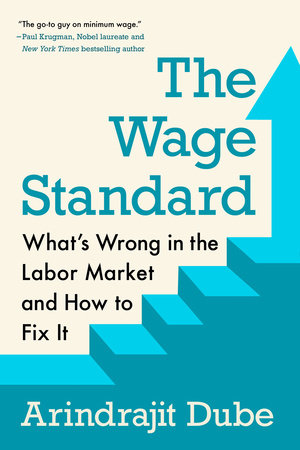
The Wage Standard tells the story of how we got here, the choices that led to this situation, and the steps we can take to give America a raise. Let's start with a thought experiment. Imagine we were time-traveling anthropologists transported back to 1980 to study the American economy. What would seem familiar? What would feel completely different?
Life in 1980 was, in many ways, a world apart from our own. If you wanted to buy a TV, you might head to a department store like Sears, where a 19-inch color RCA television would cost the equivalent of $1,700 today (as in 2023 dollars, after adjusting for inflation). These TVs were clunky and expensive, and they required manual adjustments for a decent picture. On your way home, you might drive to a supermarket called Alpha Beta-yes, that was a real chain-in a car without keyless ignition, built-in navigation, or even airbags, likely getting around sixteen miles per gallon. Inside the store, you'd find few pre-prepared meals, no exotic fruits out of season, and hardly any imported food products.
Fast-forward to today, and the differences are staggering, but the most notable is economic: America has become a far wealthier society than we were forty-five years ago. One way to measure this progress is by looking at how much American workers produce from an hour of work. After accounting for inflation in a manner consistent with how pay is measured, and subtracting the portion of output needed to replenish machinery, buildings, and so on, American workers' overall hourly productivity rose by 73 percent between 1980 and 2019. That statistic alone shows how much wealthier our society has become: We can produce over 1.7x as many goods and services in an hour as we did forty years ago. To put this in perspective, a 73 percent gap in current overall income is roughly the difference between America and countries like Estonia or Poland.
But how have wages grown since 1980? If everyone's wages had risen in step with overall productivity-and if the shares of income going to labor and capital had stayed the same-then real (inflation adjusted) wages could have grown by as much as 73 percent between 1980 and 2019. But is that what actually happened? Or did wages evolve in a way that diverted much of the productivity gains to top earners and business owners rather than to most workers?
During our hypothetical trip back in time, imagine asking the employees at Alpha Beta how much they were making. To find out what their wages looked like-and how they've changed-we can turn to the Current Population Survey (CPS), a monthly federal survey based on household interviews. According to the CPS, the average hourly wage for retail workers in 1980 was about $14.60 in today's dollars. Fast-forward four decades: If we repeated the survey in 2019, just before the pandemic, we'd find that their average pay had risen to only about $17.40, a 19 percent increase in the real (or inflation-adjusted) wage.
In other words, while the broader economy has changed in dramatic, fundamental ways-becoming much richer overall-wages for many workers have remained much more suppressed. Even as economy-wide productivity climbed by 73 percent, the purchasing power of frontline retail workers grew much less-only by around 19 percent. That's a striking-and sobering-gap, reminding us that economic growth alone doesn't guarantee broad-based prosperity.
Measuring Inequalities
Was there something peculiar about retail jobs that could explain why wages at the checkout counter diverged so sharply from overall productivity gains? Not really. In fact, wages for middle- and low-income workers across many industries failed to keep pace with the growth in economy-wide productivity. To get a clearer view, we can again turn to CPS data and examine wage trends across the distribution.
For context, the 10th percentile wage is what 10 percent of workers earn less than, while the 90th percentile wage is what 90 percent of workers earn less than. If economic gains are broadly shared, these percentiles would grow at similar rates. But if gains are concentrated at the top, we will see widening gaps. And keep in mind that a real wage growth of zero means nominal wages rose just enough to match inflation. (The glossary in appendix A goes more deeply into how real wages are constructed.)
Between 1980 and 2019, real wages at the 90th percentile rose by 53 percent-an impressive gain, though still below the growth in overall productivity. But the picture looks far worse for workers at the middle and bottom. Over the same period, median wages rose by just 23 percent, while wages at the 10th percentile grew only 17 percent. These modest gains resemble the sluggish growth seen in retail wages and fall well short of both productivity growth and the pay increases at the top. In short, while top earners surged ahead, workers at the bottom barely kept up with the rising cost of living until very recently. As recently as 2014, real wages at the 10th percentile were still hovering near their 1980 level.
The divergence in wages began in the early 1980s, when pay at the bottom actually fell in real terms. Strikingly, the median hourly wage was virtually stagnant between 1980 and 1997, even as hourly productivity increased by 23 percent during that period. Wages for the middle and lower percentiles only ticked upward during select years, such as the late 1990s and late 2010s, driven by tight labor markets and supportive economic policies-topics we'll explore in this book. Even with those sporadic gains, by 2019, average wages for the bottom 90 percent of earners were just 29 percent higher than in 1980, while productivity had grown by 73 percent. As the economist Lawrence Mishel has pointed out, this disconnect meant that most workers' pay lagged well behind their potential during the post-1980 era.
A big reason behind this gap between median wages and overall productivity is that wages in America have become more unequal over the last half century. While average (mean) wages grew by 42 percent over this period, both the median wage and the 10th percentile wage trailed well behind. This happens because average wage growth is pulled upward by large gains at the top, whereas the median wage reflects what's happening at the middle. A second factor is the declining share of income going to labor, which has fallen, especially since 2000. As wages claim a smaller slice of the economic pie, it boosts the share going to capital owners, further dampening the gains most workers see in their paychecks. All in all, less than 10 percent of salary earners saw their wages keep pace with productivity growth.
You may wonder whether these figures depend on how we measure inflation. In short, yes, different inflation measures can shift the wage numbers somewhat. Yet because I used the same measure to adjust both wages and productivity, the key comparisons still hold, and the overall story remains much the same. The gap between middle- and low-income wages relative to overall productivity persists, as does the disparity between top and bottom wages. No matter which inflation measure you use, it's clear that since 1980, most Americans-particularly those near the bottom-have gained relatively little from the nation's growing prosperity. Many even saw their real wages decline in the 1980s and early 1990s.
Household surveys don't allow us to peer into the upper echelons of earners-like those in the top 1 percent-because of issues like limited sample sizes, confidentiality constraints, and low response rates to surveys from high-income households. To fill that gap, researchers use administrative data (for example, from the Social Security Administration) that covers nearly all U.S. earners. Analyses of these more comprehensive data confirm that the concentration of earnings at the top is even more extreme than household surveys suggest. Real annual earnings for the bottom 90 percent rose by 40 percent between 1980 and 2019, whereas for the top 1 percent they soared, increasing by 169 percent. Looking further up the pay ladder only reinforces how dramatically inequality has climbed since the 1980s.
As its title suggests, The Wage Standard focuses on money that workers earn. For most households-especially those below the top tier-wages also constitute the largest share of their total income. Nevertheless, once we factor in other income sources such as business earnings, investments, and government transfers, additional trends and complexities appear that wage data alone can't show. There is also the role of taxes: In theory, a progressive tax system reduces inequality, but how well it has done so in recent decades is another question.
Using data from both surveys and federal tax records, analysis by the Congressional Budget Office (CBO) reveals that pre-tax income in the United States has become significantly more unequal since 1980. Pre-tax income includes wages, business and capital income, and social insurance benefits like Social Security and unemployment insurance. Between 1980 and 2019, incomes for the bottom fifth of households rose by 45 percent, middle-income households saw a 34 percent increase, and incomes for the top fifth surged by 111 percent. Meanwhile, the top 1 percent experienced a staggering 232 percent increase, clearly showing that the highest earners have pulled far ahead.
What happens when we factor in government programs such as food stamps, welfare, and the Earned Income Tax Credit, and then subtract federal taxes? Since these programs primarily benefit lower-income households and taxes are applied progressively, incomes at the bottom rise more when we take these programs into consideration. Yet even with these adjustments, inequality remains significant and has continued to grow. According to the CBO, between 1980 and 2019, post-tax income for the bottom fifth of households rose by 89 percent, middle-income households saw a 51 percent increase, and the top fifth experienced a 119 percent gain. At the very top, the post-tax income of the top 1 percent climbed by an extraordinary 248 percent, widening the gap between them and the rest of the population.
There is some debate among scholars over the precise increase in household income inequality since 1980. The CBO estimates focus on "fiscal income," which includes wages, business income, capital gains, Social Security, and unemployment benefits, among other sources. However, economists Gerald Auten and David Splinter claim that these official figures miss a substantial amount of hidden income-unreported to the IRS-collected by non-wealthy taxpayers. This leads them to conclude that the rise in inequality has been less dramatic than it appears in official data.
In contrast, Thomas Piketty, Emmanuel Saez, and Gabriel Zucman argue that it's the rich who have increasingly under reported income, especially from pass-through businesses and funds sitting in offshore accounts. They contend that the wealthiest households are responsible for the bulk of unreported income, leading them to estimate a greater rise in inequality than both the CBO and Auten-Splinter.
My own reading of the evidence is closer to Piketty, Saez, and Zucman. But whatever the exact numbers, there is little doubt that U.S. income inequality has risen markedly since 1980. As the Nobel laureate Daron Acemoglu remarked, technical disputes shouldn't obscure the bigger picture: The U.S. economy has been malfunctioning for over four decades. Another laureate, Paul Krugman,famously dubbed this era the "Great Divergence," reflecting the widening chasm between the rich and everyone else.
Here is the bigger point. While early twentieth-century inequality was largely driven by asset ownership and inherited wealth, today's gap is powered by labor income. In their 2003 landmark study, Piketty and Saez put it succinctly: "[T]he working rich have replaced the rentiers at the top of the income distribution." And no one seriously disputes that wage inequality has soared over the past forty-five years.
To understand why incomes at the top-whether for business owners or highly paid executives-have skyrocketed while most American workers' pay have lagged behind productivity growth, we need a closer look at how wages are set. Government programs may have softened some of the blow, but the underlying story remains much the same: The market wages of ordinary Americans have not kept pace with the country's rising prosperity.
Ultimately, wages lie at the heart of the divide between the rich and the rest. This book sets out to examine how pay is determined and why they've diverged so sharply.
Copyright © 2026 by Arindrajit Dube. All rights reserved. No part of this excerpt may be reproduced or reprinted without permission in writing from the publisher.