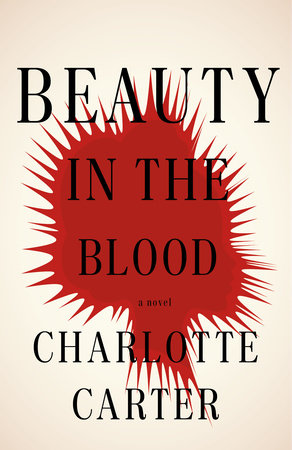
Download high-resolution image
Listen to a clip from the audiobook
audio play button
0:00
0:00

Beauty in the Blood

A Novel

Listen to a clip from the audiobook
audio play button
0:00
0:00
A curse rolls out over centuries, murky and unknowable as swamp waters, shaping and destroying lives.

“Carter delivers. . . . [A] fusion of detective fiction and horror that is impossible to look away from.” —The New York Times Book Review


Sarah Toomey is a successful young black lawyer, lovely but straitlaced– and afraid that she is losing her mind. Since the death of her mother, a force she can neither understand nor control is manipulating her memory and driving her to unexplained acts of violence and destruction. At the same time, Sarah is swept up in a highly charged relationship with a work colleague that portends a danger of its own. As she moves through her privileged life in New York, Sarah comes to learn how her past—her haunted history—is intertwined with America’s.

Yvonne Howard was born into the working class. Now, after years as a prison guard, she has reinvented herself. Her passion for cooking has landed her a position at a trendy soul food restaurant, and she is looking forward to a glamorous career. Then an ex-inmate named Bitty appears, demanding Yvonne’s help investigating her brother’s shocking death. Before long, Bitty too is dead, and Yvonne is pulled back into a world of ugly violence. Smart but unschooled, Yvonne finds herself in the unlikely role of detective: it is she who must unravel the dark and blood-soaked history that not only doomed Bitty and her brother, but also determined beautiful Sarah Toomey’s fate.
Chapter 1

Southeastern Georgia, 1865

In the daytime, they kept low to the ground, watching, not speaking much. It seemed safer to travel that way. So, by night, they were walking black ghosts.

Five of them left the ravaged Clarkson place together. The pitiful livestock had long ago been slaughtered for food. The big house was ransacked, nothing of use left behind. Some of the newly freed slaves stayed among the ruins. Others, destined never to see the day of their freedom, had dropped dead of exhaustion and hunger. As for Master Clarkson and his remaining kin, they’d vanished long ago, riding off in the middle of the night.

This band of five had been on the road for three days now. In their flight, the five of them—­Preacher Jack, Monroe, Henry and his son Abner, and Ruben—­had raided abandoned homes, looking for any food or tools they could lay hands on. They were now living, for the most part, on the berries they picked.

They’d heard all kinds of rumors: Seek out the Union soldiers, they’ll help you, give you something to eat. Keep away from the Union troops, they’re mean, tired of fighting, resentful. Some of them never even seen nobody look like us before—­might shoot you thinking you some kind of animal. And woe be unto you if you come across any deserting Rebs, wounded and half crazy. They’d just as soon kill you as look at you.

Monroe was hungry. He was so hungry, nothing else mattered. So when Brother Jack told him to wait a little while longer before he lit the fire, for the first time ever Monroe disobeyed the older man. Earlier in the day, he had found and skinned a possum, and Monroe meant to have some of it now.

They tore at the charred flesh, sucked at its bones. Hungry as they were, Jack had made them say grace before eating. As a respected elder, the preacher who knew how to read some, the only one of them who had ever been more than ten miles away from his birthplace, he was looked to for guidance, and the other men were trusting in him to lead them on to freedom.

The important thing was to keep moving toward that freedom. Even though they didn’t yet know where that was or how long it would take to get there, they figured they’d recognize it when they saw it. Like Jack had said a hundred times, God wanted them to go into the wilderness. And God would help them find a way out. They were the children of the Israelites.

The preacher was a big man, over six feet, and in his youth, long before Monroe was born, he had brought top dollar at auction. Clarkson, like his father-­in-­law before him, had worked Jack like the horse of a man that he was. Jack had been broken like a horse too. Branded, lashed, and near-­hobbled for trying to run away. But for a long time now, more mule than stallion. He had seen eight of his children sold off. Monroe was his sister’s grandchild.

Jack was old now, and a long way from virile. He still had a voice like thunder, though. And when he talked to the others about God and sin, good and evil, it was not hard to understand why so many believed the word of the Lord was booming out of his throat.

Henry took a careful swig from the water jar and passed it to young Abner. But the boy was asleep. Thirteen-­year-­old Abner had come out of Henry’s wife, by way of Master Clarkson’s son. That made no difference to Henry. Abner was all he had left; his natural son had been sold long ago, and his and Ruth’s little daughter had died of fever before she was six years old.

The fire was out now. Henry shook Abner awake, and the band of men took to the trees.

Chapter 2

Midtown Manhattan, 2000

The March air was wonderful, bracing. Yet it had a milder hint of the coming change of season. Sarah felt good in her coat. She turned into Bergdorf’s and headed for the escalator.

Halfway up, she felt a blow of terror strong enough to buckle her knees. Between the teeth of the moving stairs, something animal was showing its filthy mouth. Whatever it was, it was releasing a dank and suffocating odor.

Against her will, she reached toward the thing, just for an instant, but a horrible sound from somewhere deep inside it made her pull back.

She flew off the escalator and onto solid ground, struggling to keep herself from screaming.

“Are you ill, miss?”

The voice that came out of nowhere belonged to the young white man who caught her as she stumbled backward. That word, ill, hardly conveyed the panicky thumping in her chest. Ill. When a reeking, wet monster had just come after her . . . in Bergdorf’s?

Sarah pointed toward the escalator. The young man followed the movement of her hand with his eyes. “What? There’s nothing there.”

He was right. No monsters anywhere in sight.

“Should I get a doctor?” the stranger asked.

She looked at him, dizzy, confused. But the pounding in her heart and ears had ceased. She inhaled deeply. The foul odor was gone now. Nothing but the flowery scent that wafted up from the main floor.

“I’m all right, thank you.”

The whole thing had to be a carryover from some nightmare. Surely that explained it. She’d had a nightmare about some sort of reptilian monster, repressed it until now, and suddenly the creature from the dream scenario had come slithering into her waking mind. She took another deep breath, and another. There, that was better. Everything was all right now. In fact, she almost felt giddy.

The first thing to catch her eye was a deep purple jacket with a cinched-­in waist. Pretty, in its way, attention-­grabbing. But certainly not at all her style. Yet she couldn’t stop looking at it. And the more she looked, the easier it was to imagine herself wearing it. Sarah saw the red-­haired saleswoman head in her direction.

The new suit would have to be altered. But her two new sheer blouses were wrapped in tissue inside the lilac shopping bag swinging from her wrist.

Her next stop was the cosmetics counter at Bendel’s. The affectless saleswoman applied mascara to Sarah’s eyes while enumerating the merits of the different shades of blush. When she suddenly paused and looked quizzically into her face, Sarah knew exactly why. The woman had just realized Sarah was black. It was the ivory cast to her skin that so often threw white people. Other black people seldom made the mistake. The saleswoman resumed the makeover. Sarah thanked her and then proceeded to buy a full complement of Chanel cosmetics and bath items.

Her final stop was Saks, where she spent eight hundred dollars on a marked-­down pair of Jimmy Choos and then picked up a rust-­colored silk bra, matching bikini panties, and an assortment of Swiss lace camisoles.

Out on the street again, she doubled back toward the apartment, stopping to do more window-­shopping, striding confidently along the avenue.

Sarah had never been much of a drinker. But, standing outside the spacious bar attached to the new hotel on Fifty-­Sixth, she was suddenly aware of a strong desire for alcohol. She pushed in through the heavy glass door, took a quick survey of the room, and headed for a booth. The waiter, a gray-­haired black man with stick-­straight posture, soon appeared at her elbow. He stood there cocking his head in anticipation. Sarah just then realized she had no idea what to order. The waiter never moved.

“I suppose I’ll have something in a martini glass,” she said tentatively.

“But not the martini itself. Is that it?”

“Yes. I think so.” Oh for heaven’s sake, she chastised herself, you’re talking nonsense.

“A Negroni? Cosmopolitan?”

“I don’t— Yes.”

It was after four o’clock by now. The bar was virtually deserted. Sarah luxuriated in the booth, taking off her coat to reveal her favorite sweater, powder blue cashmere with a silk ribbon at the neckline. She took out her compact to tidy her hair and freshen her lipstick, and as she was replacing it in her bag, she noticed the well-­dressed black man two tables away. He was thumbing through a sheaf of papers in his open attaché case. At her glance, he looked up and smiled at her. She returned the smile, and instead of looking away, her standard response to the attentions of a stranger, she held his eyes with her own. Not sixty seconds later, he was standing over her, asking permission to join her at her table. Going against her every instinct, she consented.
© Troy Williams
CHARLOTTE CARTER is the author of an acclaimed mystery series featuring Nanette Hayes, a young Black American jazz musician with a lust for life and a talent for crime-solving, and the Cook County mystery series, set in Chicago during the 1960s. Her short fiction has appeared in a number of American and British anthologies. Charlotte Carter has lived in the American Midwest, North Africa, and France. She currently resides in New York City. View titles by Charlotte Carter
“Carter delivers, though the book is markedly different from her earlier novels. Yes, there’s a mystery to solve … But Carter is after larger narrative game here, linking the violent death to America’s original sin of slavery, and a generations-spanning curse dooming women to act out the worst kind of revenge fantasies. The result is a fusion of detective fiction and horror that is impossible to look away from.”
The New York Times Book Review

“Beauty in the Blood begins in the last year of the Civil War, as blacks flee ruined plantations, murderous Confederates, and treacherous Unionists. It takes us to New York in the year 2000, where successful black women find their lives threatened with a violence that implicates them in America’s harshest racial crimes. None of us is exempt from history’s torments, and none of those torments is simple. This is a riveting and wise novel.”
—Margo Jefferson, Pulitzer Prize winner and author of Negroland and Constructing a Nervous System

About

A curse rolls out over centuries, murky and unknowable as swamp waters, shaping and destroying lives.

“Carter delivers. . . . [A] fusion of detective fiction and horror that is impossible to look away from.” —The New York Times Book Review


Sarah Toomey is a successful young black lawyer, lovely but straitlaced– and afraid that she is losing her mind. Since the death of her mother, a force she can neither understand nor control is manipulating her memory and driving her to unexplained acts of violence and destruction. At the same time, Sarah is swept up in a highly charged relationship with a work colleague that portends a danger of its own. As she moves through her privileged life in New York, Sarah comes to learn how her past—her haunted history—is intertwined with America’s.

Yvonne Howard was born into the working class. Now, after years as a prison guard, she has reinvented herself. Her passion for cooking has landed her a position at a trendy soul food restaurant, and she is looking forward to a glamorous career. Then an ex-inmate named Bitty appears, demanding Yvonne’s help investigating her brother’s shocking death. Before long, Bitty too is dead, and Yvonne is pulled back into a world of ugly violence. Smart but unschooled, Yvonne finds herself in the unlikely role of detective: it is she who must unravel the dark and blood-soaked history that not only doomed Bitty and her brother, but also determined beautiful Sarah Toomey’s fate.

Excerpt

Chapter 1

Southeastern Georgia, 1865

In the daytime, they kept low to the ground, watching, not speaking much. It seemed safer to travel that way. So, by night, they were walking black ghosts.

Five of them left the ravaged Clarkson place together. The pitiful livestock had long ago been slaughtered for food. The big house was ransacked, nothing of use left behind. Some of the newly freed slaves stayed among the ruins. Others, destined never to see the day of their freedom, had dropped dead of exhaustion and hunger. As for Master Clarkson and his remaining kin, they’d vanished long ago, riding off in the middle of the night.

This band of five had been on the road for three days now. In their flight, the five of them—­Preacher Jack, Monroe, Henry and his son Abner, and Ruben—­had raided abandoned homes, looking for any food or tools they could lay hands on. They were now living, for the most part, on the berries they picked.

They’d heard all kinds of rumors: Seek out the Union soldiers, they’ll help you, give you something to eat. Keep away from the Union troops, they’re mean, tired of fighting, resentful. Some of them never even seen nobody look like us before—­might shoot you thinking you some kind of animal. And woe be unto you if you come across any deserting Rebs, wounded and half crazy. They’d just as soon kill you as look at you.

Monroe was hungry. He was so hungry, nothing else mattered. So when Brother Jack told him to wait a little while longer before he lit the fire, for the first time ever Monroe disobeyed the older man. Earlier in the day, he had found and skinned a possum, and Monroe meant to have some of it now.

They tore at the charred flesh, sucked at its bones. Hungry as they were, Jack had made them say grace before eating. As a respected elder, the preacher who knew how to read some, the only one of them who had ever been more than ten miles away from his birthplace, he was looked to for guidance, and the other men were trusting in him to lead them on to freedom.

The important thing was to keep moving toward that freedom. Even though they didn’t yet know where that was or how long it would take to get there, they figured they’d recognize it when they saw it. Like Jack had said a hundred times, God wanted them to go into the wilderness. And God would help them find a way out. They were the children of the Israelites.

The preacher was a big man, over six feet, and in his youth, long before Monroe was born, he had brought top dollar at auction. Clarkson, like his father-­in-­law before him, had worked Jack like the horse of a man that he was. Jack had been broken like a horse too. Branded, lashed, and near-­hobbled for trying to run away. But for a long time now, more mule than stallion. He had seen eight of his children sold off. Monroe was his sister’s grandchild.

Jack was old now, and a long way from virile. He still had a voice like thunder, though. And when he talked to the others about God and sin, good and evil, it was not hard to understand why so many believed the word of the Lord was booming out of his throat.

Henry took a careful swig from the water jar and passed it to young Abner. But the boy was asleep. Thirteen-­year-­old Abner had come out of Henry’s wife, by way of Master Clarkson’s son. That made no difference to Henry. Abner was all he had left; his natural son had been sold long ago, and his and Ruth’s little daughter had died of fever before she was six years old.

The fire was out now. Henry shook Abner awake, and the band of men took to the trees.

Chapter 2

Midtown Manhattan, 2000

The March air was wonderful, bracing. Yet it had a milder hint of the coming change of season. Sarah felt good in her coat. She turned into Bergdorf’s and headed for the escalator.

Halfway up, she felt a blow of terror strong enough to buckle her knees. Between the teeth of the moving stairs, something animal was showing its filthy mouth. Whatever it was, it was releasing a dank and suffocating odor.

Against her will, she reached toward the thing, just for an instant, but a horrible sound from somewhere deep inside it made her pull back.

She flew off the escalator and onto solid ground, struggling to keep herself from screaming.

“Are you ill, miss?”

The voice that came out of nowhere belonged to the young white man who caught her as she stumbled backward. That word, ill, hardly conveyed the panicky thumping in her chest. Ill. When a reeking, wet monster had just come after her . . . in Bergdorf’s?

Sarah pointed toward the escalator. The young man followed the movement of her hand with his eyes. “What? There’s nothing there.”

He was right. No monsters anywhere in sight.

“Should I get a doctor?” the stranger asked.

She looked at him, dizzy, confused. But the pounding in her heart and ears had ceased. She inhaled deeply. The foul odor was gone now. Nothing but the flowery scent that wafted up from the main floor.

“I’m all right, thank you.”

The whole thing had to be a carryover from some nightmare. Surely that explained it. She’d had a nightmare about some sort of reptilian monster, repressed it until now, and suddenly the creature from the dream scenario had come slithering into her waking mind. She took another deep breath, and another. There, that was better. Everything was all right now. In fact, she almost felt giddy.

The first thing to catch her eye was a deep purple jacket with a cinched-­in waist. Pretty, in its way, attention-­grabbing. But certainly not at all her style. Yet she couldn’t stop looking at it. And the more she looked, the easier it was to imagine herself wearing it. Sarah saw the red-­haired saleswoman head in her direction.

The new suit would have to be altered. But her two new sheer blouses were wrapped in tissue inside the lilac shopping bag swinging from her wrist.

Her next stop was the cosmetics counter at Bendel’s. The affectless saleswoman applied mascara to Sarah’s eyes while enumerating the merits of the different shades of blush. When she suddenly paused and looked quizzically into her face, Sarah knew exactly why. The woman had just realized Sarah was black. It was the ivory cast to her skin that so often threw white people. Other black people seldom made the mistake. The saleswoman resumed the makeover. Sarah thanked her and then proceeded to buy a full complement of Chanel cosmetics and bath items.

Her final stop was Saks, where she spent eight hundred dollars on a marked-­down pair of Jimmy Choos and then picked up a rust-­colored silk bra, matching bikini panties, and an assortment of Swiss lace camisoles.

Out on the street again, she doubled back toward the apartment, stopping to do more window-­shopping, striding confidently along the avenue.

Sarah had never been much of a drinker. But, standing outside the spacious bar attached to the new hotel on Fifty-­Sixth, she was suddenly aware of a strong desire for alcohol. She pushed in through the heavy glass door, took a quick survey of the room, and headed for a booth. The waiter, a gray-­haired black man with stick-­straight posture, soon appeared at her elbow. He stood there cocking his head in anticipation. Sarah just then realized she had no idea what to order. The waiter never moved.

“I suppose I’ll have something in a martini glass,” she said tentatively.

“But not the martini itself. Is that it?”

“Yes. I think so.” Oh for heaven’s sake, she chastised herself, you’re talking nonsense.

“A Negroni? Cosmopolitan?”

“I don’t— Yes.”

It was after four o’clock by now. The bar was virtually deserted. Sarah luxuriated in the booth, taking off her coat to reveal her favorite sweater, powder blue cashmere with a silk ribbon at the neckline. She took out her compact to tidy her hair and freshen her lipstick, and as she was replacing it in her bag, she noticed the well-­dressed black man two tables away. He was thumbing through a sheaf of papers in his open attaché case. At her glance, he looked up and smiled at her. She returned the smile, and instead of looking away, her standard response to the attentions of a stranger, she held his eyes with her own. Not sixty seconds later, he was standing over her, asking permission to join her at her table. Going against her every instinct, she consented.

Author

© Troy Williams
CHARLOTTE CARTER is the author of an acclaimed mystery series featuring Nanette Hayes, a young Black American jazz musician with a lust for life and a talent for crime-solving, and the Cook County mystery series, set in Chicago during the 1960s. Her short fiction has appeared in a number of American and British anthologies. Charlotte Carter has lived in the American Midwest, North Africa, and France. She currently resides in New York City. View titles by Charlotte Carter

Praise

“Carter delivers, though the book is markedly different from her earlier novels. Yes, there’s a mystery to solve … But Carter is after larger narrative game here, linking the violent death to America’s original sin of slavery, and a generations-spanning curse dooming women to act out the worst kind of revenge fantasies. The result is a fusion of detective fiction and horror that is impossible to look away from.”
The New York Times Book Review

“Beauty in the Blood begins in the last year of the Civil War, as blacks flee ruined plantations, murderous Confederates, and treacherous Unionists. It takes us to New York in the year 2000, where successful black women find their lives threatened with a violence that implicates them in America’s harshest racial crimes. None of us is exempt from history’s torments, and none of those torments is simple. This is a riveting and wise novel.”
—Margo Jefferson, Pulitzer Prize winner and author of Negroland and Constructing a Nervous System