Download high-resolution image
Listen to a clip from the audiobook
audio play button
0:00
0:00

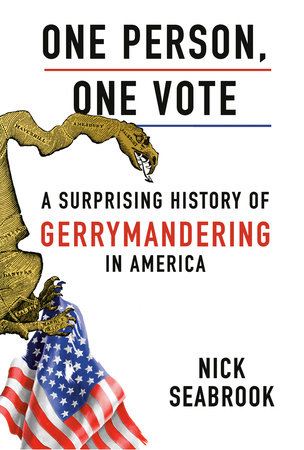
One Person, One Vote

A Surprising History of Gerrymandering in America

Listen to a clip from the audiobook
audio play button
0:00
0:00
A redistricting crisis is upon us. This surprising, compelling book tells the history of how we got to this moment—from the Founding Fathers to today’s high-tech manipulation of election districts—and shows us how to protect our most sacred, hard-fought principle of one person, one vote. Here is THE book on gerrymandering for citizens, politicians, journalists, activists, and voters.

“Seabrook’s lucid account of the origins and evolution of gerrymandering—the deliberate and partisan doctoring of district borders for electoral advantage—makes a potentially dry, wonky subject accessible and engaging for a broad audience.” —The New York Times

Gerrymandering is the manipulation of election districts for partisan and political gain. Instead of voters picking the politicians they want, politicians pick the voters they need to get the election results they’re after. Surprisingly, gerrymandering has been around since before our nation’s founding. And with technology, those drawing the redistricting lines have, now more than ever, been able to microtarget their electoral manipulations with unprecedented levels of precision.

Nick Seabrook, an authority on constitutional and election law and an expert on gerrymandering, has written an illuminating, urgently needed book on how our elections have been rigged through redistricting, beginning with the Founding Fathers, Abraham Lincoln, the Civil War, and Reconstruction, and extending to the twentieth century’s gerrymandering battles at the Supreme Court and today’s high-tech manipulations of election districts.

Seabrook explores the rise of the most partisan gerrymanders in American history, put into place by the Republican Party after the 2010 census, and how the battle has shifted to the states via REDMAP—the GOP’s successful strategy of the last decade to control state governments and rig the results of state legislative and congressional elections.

A vast new redistricting is already here, and as Seabrook makes clear in order to safeguard our republic, action is needed before it is too late.
INTRODUCTION

A Uniquely American Problem

“Redistricting is like an election in reverse! Usually the voters get to pick the politicians. In redistricting, the politicians get to pick the voters!” —Thomas B. Hofeller

The results of Wisconsin’s 2018 election had to be seen to be believed. The state’s controversial governor, Scott Walker, running for a third term in office after surviving a closely contested and high-profile recall effort in 2012, and securing a narrow reelection in 2014, faced off against the Democratic challenger Tony Evers, the state’s superintendent of public instruction. The election was expected to be a close one. The Cook Political Report rated the race as a toss-up, both candidates were consis­tently polling within the margin of error, and prediction models, includ­ing Nate Silver’s FiveThirtyEight, had the contest ranked as one of the closest in the nation. At first blush, very little appears strange about the result. The challenger, Evers, eked out a narrow victory by almost 30,000 votes over the somewhat unpopular incumbent, a margin of slightly more than 1 percent of the nearly 2.7 million ballots that were cast.

Yet peering beneath the surface reveals some disturbing abnormali­ties. Despite losing the popular vote overall, Walker somehow carried sixty-three of Wisconsin’s ninety-nine state assembly districts, and twenty-one of the thirty-three state senate districts. How could a can­didate for governor win almost two-thirds of the districts in a state and still end up on the losing side? The answer to that question lies in what may go down as one of the most egregious instances of gerrymandering in American history. The battle over Wisconsin’s legislative districts would play out in both the statehouse and the media, eventually reaching all the way to Washington, D.C., and a showdown before the nine justices of the U.S. Supreme Court.

What exactly is gerrymandering? The term has a certain elasticity to it that makes pinning down a concise and consistent definition of the underlying concept somewhat tricky. Writing in the early twentieth cen­tury, Elmer Griffith, a University of Chicago PhD student whose treatise “The Rise and Development of the Gerrymander” may be among the most cited doctoral dissertations in history, defined the gerrymander thus: “Districts would not seem, therefore, to be gerrymandered unless they were established especially for election purposes and were formed intentionally in a particular manner for partisan advantage.” As a work­ing definition for the purposes of this book, Griffith’s formulation is a good start, although perhaps a little more restrictive than I would like. Nevertheless, it serves as a decent jumping-off point for the discussion to come, by laying out the three quintessential elements of the practice.

Gerrymandering requires intent. One can point to all manner of examples of unfairness, inequality, and injustice in the electoral process that occurred naturally, by accident of history, or through the aggrega­tion of individual decisions about where to live, whom to vote for, and what rules to follow. These are not gerrymanders. At its heart, gerrymandering involves a concerted effort to make the votes of cer­tain groups of people matter more than the votes of others. It can be directed at an individual politician, at an entire political party, at voters in certain regions, or at those who hold specific political views. It is an effort to place a thumb on the scale of representative democracy, stack­ing the deck before an election has even taken place.

Gerrymandering may not always be partisan, as Griffith’s definition stipulates, but it is always political. Those crafting the gerrymander do so with some concrete political goal in mind. And as is the case in crimi­nal law, it’s often the intent that is the most difficult element to prove. Just as criminal defendants and their attorneys may cook up seemingly innocuous or innocent explanations for their conduct, so too may per­petrators of gerrymandering cloak their actions in subterfuge, obfusca­tion, or deflection. Demonstrating corrupt intent in these instances can be challenging, although sometimes the circumstantial evidence of the gerrymander itself may be sufficient to carry the burden of proof. Other times, the actions of those responsible are documented in an exquisitely detailed paper trail, the conspiracy laid bare for the courts, the media, and the voting public to peruse at their leisure. And like the criminal defendant whose lawyer labors in vain to prevent him from running his mouth, those in the business of gerrymandering have a tendency to want to brag about their exploits. These are the easy cases. To give but one high-profile example: when it comes to the recent gerrymander in Wisconsin, we have the receipts.

Gerrymandering requires manipulation. It is a departure from busi­ness as usual, from the traditional district-drawing principles of com­pactness, of contiguity, of following existing political boundaries, and of preserving the integrity of communities. These manipulations may be subtle, as in the case of a minor modification to a district line that suddenly places an incumbent on the other side, now forced to run for reelection in hostile territory. Or they may be overt, as when an entire state is carved asunder with reckless abandon to serve the whims of the party presently holding power.

The gerrymander is an unnatural creation, a violation of the norms, procedures, and conventions of a functioning democratic system. It can take the form of a minor violation, something akin to a speed­ing ticket on the highway of democracy, or a full-fledged abomination, one that makes a mockery of even the imprimatur of accountability or responsiveness to the will of the people. To gerrymander is to distort, to corrupt, to turn the institutions that should be working on behalf of the people’s interests into perversions that serve only the powerful, the moneyed, or the politically connected. Whenever political machina­tions over gerrymandering are afoot, no matter who wins, it’s always the voter who loses.

Gerrymandering always involves boundaries. They may be district boundaries, county or municipal boundaries, or even the boundaries of the states themselves. But central to the concept of gerrymandering is the drawing or redrawing of lines on a map. Similar results might be achieved by instituting a poll tax, by imposing a restrictive voter identi­fication law, or by systematically purging individuals from the electoral rolls. These are also not gerrymanders. I would further argue, in another minor quibble with Griffith’s earlier definition, that gerrymandering does not require these boundaries to be districts that are established especially for election purposes, or at least not solely for such a use. But they must have predictable electoral effects that can be logically antici­pated by those who are responsible for drawing them.

Just as good fences make good neighbors, gerrymandered districts make for predictable, orderly, well-behaved voters. Nothing pleases politicians more than knowing that their district is safe, that their majority is safe, that no matter which direction the winds of popular sentiment may be blowing, their shelter is well built, sturdy, and pre­pared to weather the storm. But as with Frost’s mended wall, sometimes cracks appear in the veneer of politics as usual. Sometimes voters break through the barriers that are erected against their will and make gaps in the well-laid foundations of properly gerrymandered districts. But these examples are few and far between. While polls show that gerrymandering remains unpopular with the general public across the politi­cal spectrum, the people who do like it also tend to be the ones who make the rules.

I would also argue that gerrymandering, or at least gerrymandering as it is practiced today, is a uniquely American phenomenon. Across the world, virtually every nation that uses districts for its elections has made at least some effort to prevent those in power from manipulating them for partisan gain. To be sure, even the best redistricting practices do not manage to eliminate all traces of electoral unfairness. Nor should they be expected to, because such unfairness is endemic to all district-based electoral systems. But at the very least, these safeguards eliminate the most egregious instances of gerrymandering, of the type that has become a widespread epidemic in contemporary American politics. In the vast majority of U.S. states, however, the political branches of gov­ernment retain the responsibility for drawing the lines, giving rise to the means, the motive, and the opportunity for electoral shenanigans. Which brings us back to Wisconsin.

The effort to gerrymander Wisconsin in 2011 was merely one prong of a broader multistate strategy to maximize Republican representation in state legislatures and the U.S. Congress. Armed with the significant gains made in statehouses across the country during the wave election of 2010, the GOP undertook an unprecedented effort to use control of the redistricting process to entrench those majorities. The scheme was known as REDMAP (short for the Redistricting Majority Project) and was the brainchild of Chris Jankowski, a veteran Republican political strategist and consultant at the Republican State Leadership Commit­tee. Their effort specifically targeted those states, like Wisconsin, that provided fertile ground for gerrymandering, bombarding them with outside money during the 2010 campaign. This was supplemented by millions of additional dollars in so-called dark money, contributed anonymously and in unlimited amounts to social welfare nonprofit groups organized under section 501(c)(4) of the Internal Revenue Code.

The second stage of REDMAP was to utilize sophisticated computer software, such as Maptitude and autoBound, combined with exten­sive and highly granular data on the voting population, to manipulate district boundaries with a level of precision and microtargeting never before seen in American history. What resulted in Wisconsin was a gerrymander so severe that despite winning the popular vote in both 2012 and 2018, Democrats have not controlled more than thirty-nine of the ninety-nine assembly seats (39 percent), or fifteen of the thirty-three senate seats (45 percent), in any of the elections held since. Wisconsin was the centerpiece of the successes that the REDMAP project was able to achieve, and Scott Walker himself went on to become the finance chair and chief fundraiser for the National Republican Redistricting Trust, the organization leading the effort to repeat these successes in the wake of the 2020 census.

Though the slogan of The Washington Post, “Democracy dies in darkness,” refers to the importance of a free press in holding elected representatives accountable, the same can be said for the secretive man­ner in which REDMAP went about implementing its redistricting agenda. The details of the plan would not become fully known until documented in court records years later. On August 26, 2018, Thomas Hofeller, a veteran Republican political strategist and, it turned out, one of the key figures in the REDMAP project, passed away in his Raleigh, North Carolina, home at the age of seventy-five, after a long battle with cancer. Hofeller had been a major player in Republican redistricting efforts going back to the early 1970s, when he worked as a consultant for the California State Assembly, developing one of the very first comput­erized mapping systems for use in the redrawing of district boundaries.

While the Democrats in Sacramento had been able to successfully stymie his early computer-drawn maps, the tools Hofeller developed later proved crucial to Republican efforts in the 1980s and 1990s to crack the decades-long Democratic stranglehold over the “solid South.” They would eventually propel Newt Gingrich and his band of “Contract with America” crusaders to national power in the 1994 midterm election.

And though these earlier political activities had kept Hofeller mostly behind the scenes, developing an almost cultlike following among the somewhat insulated community of hard-core redistricting operatives, it was the Republican successes in the 2010 redistricting cycle that finally catapulted him to national infamy. Hofeller masterminded the success­ful effort to turn the seven-to-six Democratic edge in U.S. House of Representatives seats in his home state of North Carolina into a ten-to-three landslide in favor of the Republicans, earning him plaudits from his fellow partisans and boogeyman-like infamy among his opponents. But it was not until after his death that the full scope of Hofeller’s role in the Republican gerrymandering effort following the 2010 census became apparent.

While going through her father’s effects, Hofeller’s estranged daugh­ter, Stephanie, with whom he had not spoken since 2014, discovered four external hard drives and eighteen thumb drives containing more than seventy-five thousand files, many of them related to his REDMAP consulting activities. These files eventually made their way to attorneys representing Common Cause, a progressive watchdog group that at the time was embroiled in a lawsuit with the State of North Carolina over the gerrymandering of their state legislative districts. The files revealed that Hofeller had been the architect of the second phase of REDMAP and had led the team that was tasked with drawing the maps that would be used in the GOP’s efforts to implement partisan gerrymanders in North Carolina, Pennsylvania, Wisconsin, Michigan, and Ohio. It was a spectacular success. A decade later, the Republican majorities in the legislatures of these REDMAP-focused states have yet to be seriously threatened, let alone reversed.

And it’s not only in state elections where the effects of REDMAP are still being felt. The same Republican state legislatures who redrew their own district boundaries to cement their majorities have, in most cases, also been responsible for drawing the districts for electing members of the U.S. House of Representatives, providing them with a significant advantage in the battle for control of Congress. In 2012, despite receiv­ing in excess of 1.4 million fewer votes than their opponents, Republi­cans controlled 234 of the 435 House seats, 33 more than the Democrats. The journalist David Daley, in his 2016 book, Ratf**ked: Why Your Vote Doesn’t Count, wrote the following: “The outcome of the 2016 and 2018 elections for Congress are no longer in doubt. On the Sunday morning talk shows and cable news panels from now through these elections, we will endure dozens of conversations about ‘who will control the House’ and ‘can Democrats take the House.’ They are all wasting your time. Let’s answer those questions. One: the Republicans. Two: no, it’s settled. There is no need to hold the vote.”

With hindsight, Daley was of course completely wrong about 2018. The Democrats’ Blue Wave, inspired by the insipid approval ratings of the incumbent president, was sufficiently large to crest the Repub­lican Fortress of Gerrymandering, to the tune of a 235–199 majority. Although their popular vote margin of 8.6 percent would certainly have yielded even greater dividends in the absence of REDMAP. But replace “the House” with “the Wisconsin state legislature,” and this argument, though hyperbolic, is not wrong. Ditto Michigan. Ditto Ohio. Ditto Pennsylvania. Ditto North Carolina. This was the effect of what The New York Times labeled “The Great Gerrymander of 2012.”

Gerrymandering may not be new, but the success of REDMAP rep­resents a new phase in the evolution of the phenomenon. No longer shackled by incomplete data, outdated technology, or uncertainty about how districts could perform in the future, line drawers can use today’s software to simulate election results under a wide variety of hypothetical conditions, fine-tuning the gerrymander to remain robust in the face of incumbent retirements, adverse electoral swings, and all manner of other potential hiccups. Historical examples of the practice, and even those from only a decade or two ago, pale in comparison to the effec­tiveness, and the efficiency, of the modern gerrymander.
© Renee Parenteau
NICK SEABROOK is a Professor in the Department of Political Science and Public Administration at the University of North Florida. He is the author of Drawing the Lines: Constraints on Partisan Gerrymandering in U.S. Politics. He lives in Jacksonville, Florida. View titles by Nick Seabrook
A New Yorker Best Book of the Year

“Seabrook’s lucid account of the origins and evolution of gerrymandering—the deliberate and partisan doctoring of district borders for electoral advantage—makes a potentially dry, wonky subject accessible and engaging for a broad audience.” The New York Times
 
“[An] excellent and cogent account of election boundary manipulation proves that political power knows few bounds and explains gerrymandering’s history and effects and ways to combat it . . . A timely and powerful book that should be read by everyone interested in preserving American democracy.” Library Journal (starred)
 
“A sweeping study of gerrymandering, the process of manipulating the boundaries of political districts to ensure an election’s outcome … Seabrook urges readers to pressure their state legislatures to establish independent commissions and other nonpartisan redistricting procedures. Dense yet entertaining, this comprehensive survey is a worthy introduction to a high-stakes political issue.” Publishers Weekly
 
“A study of the practice of shaping electoral districts … Seabrook shows how gerrymandering has been practiced by both major parties in recent years, with procedural road maps now followed by the GOP often laid out by their Democratic predecessors … [a] call to action … valuable reading for voting rights advocates.” Kirkus

About

A redistricting crisis is upon us. This surprising, compelling book tells the history of how we got to this moment—from the Founding Fathers to today’s high-tech manipulation of election districts—and shows us how to protect our most sacred, hard-fought principle of one person, one vote. Here is THE book on gerrymandering for citizens, politicians, journalists, activists, and voters.

“Seabrook’s lucid account of the origins and evolution of gerrymandering—the deliberate and partisan doctoring of district borders for electoral advantage—makes a potentially dry, wonky subject accessible and engaging for a broad audience.” —The New York Times

Gerrymandering is the manipulation of election districts for partisan and political gain. Instead of voters picking the politicians they want, politicians pick the voters they need to get the election results they’re after. Surprisingly, gerrymandering has been around since before our nation’s founding. And with technology, those drawing the redistricting lines have, now more than ever, been able to microtarget their electoral manipulations with unprecedented levels of precision.

Nick Seabrook, an authority on constitutional and election law and an expert on gerrymandering, has written an illuminating, urgently needed book on how our elections have been rigged through redistricting, beginning with the Founding Fathers, Abraham Lincoln, the Civil War, and Reconstruction, and extending to the twentieth century’s gerrymandering battles at the Supreme Court and today’s high-tech manipulations of election districts.

Seabrook explores the rise of the most partisan gerrymanders in American history, put into place by the Republican Party after the 2010 census, and how the battle has shifted to the states via REDMAP—the GOP’s successful strategy of the last decade to control state governments and rig the results of state legislative and congressional elections.

A vast new redistricting is already here, and as Seabrook makes clear in order to safeguard our republic, action is needed before it is too late.

Excerpt

INTRODUCTION

A Uniquely American Problem

“Redistricting is like an election in reverse! Usually the voters get to pick the politicians. In redistricting, the politicians get to pick the voters!” —Thomas B. Hofeller

The results of Wisconsin’s 2018 election had to be seen to be believed. The state’s controversial governor, Scott Walker, running for a third term in office after surviving a closely contested and high-profile recall effort in 2012, and securing a narrow reelection in 2014, faced off against the Democratic challenger Tony Evers, the state’s superintendent of public instruction. The election was expected to be a close one. The Cook Political Report rated the race as a toss-up, both candidates were consis­tently polling within the margin of error, and prediction models, includ­ing Nate Silver’s FiveThirtyEight, had the contest ranked as one of the closest in the nation. At first blush, very little appears strange about the result. The challenger, Evers, eked out a narrow victory by almost 30,000 votes over the somewhat unpopular incumbent, a margin of slightly more than 1 percent of the nearly 2.7 million ballots that were cast.

Yet peering beneath the surface reveals some disturbing abnormali­ties. Despite losing the popular vote overall, Walker somehow carried sixty-three of Wisconsin’s ninety-nine state assembly districts, and twenty-one of the thirty-three state senate districts. How could a can­didate for governor win almost two-thirds of the districts in a state and still end up on the losing side? The answer to that question lies in what may go down as one of the most egregious instances of gerrymandering in American history. The battle over Wisconsin’s legislative districts would play out in both the statehouse and the media, eventually reaching all the way to Washington, D.C., and a showdown before the nine justices of the U.S. Supreme Court.

What exactly is gerrymandering? The term has a certain elasticity to it that makes pinning down a concise and consistent definition of the underlying concept somewhat tricky. Writing in the early twentieth cen­tury, Elmer Griffith, a University of Chicago PhD student whose treatise “The Rise and Development of the Gerrymander” may be among the most cited doctoral dissertations in history, defined the gerrymander thus: “Districts would not seem, therefore, to be gerrymandered unless they were established especially for election purposes and were formed intentionally in a particular manner for partisan advantage.” As a work­ing definition for the purposes of this book, Griffith’s formulation is a good start, although perhaps a little more restrictive than I would like. Nevertheless, it serves as a decent jumping-off point for the discussion to come, by laying out the three quintessential elements of the practice.

Gerrymandering requires intent. One can point to all manner of examples of unfairness, inequality, and injustice in the electoral process that occurred naturally, by accident of history, or through the aggrega­tion of individual decisions about where to live, whom to vote for, and what rules to follow. These are not gerrymanders. At its heart, gerrymandering involves a concerted effort to make the votes of cer­tain groups of people matter more than the votes of others. It can be directed at an individual politician, at an entire political party, at voters in certain regions, or at those who hold specific political views. It is an effort to place a thumb on the scale of representative democracy, stack­ing the deck before an election has even taken place.

Gerrymandering may not always be partisan, as Griffith’s definition stipulates, but it is always political. Those crafting the gerrymander do so with some concrete political goal in mind. And as is the case in crimi­nal law, it’s often the intent that is the most difficult element to prove. Just as criminal defendants and their attorneys may cook up seemingly innocuous or innocent explanations for their conduct, so too may per­petrators of gerrymandering cloak their actions in subterfuge, obfusca­tion, or deflection. Demonstrating corrupt intent in these instances can be challenging, although sometimes the circumstantial evidence of the gerrymander itself may be sufficient to carry the burden of proof. Other times, the actions of those responsible are documented in an exquisitely detailed paper trail, the conspiracy laid bare for the courts, the media, and the voting public to peruse at their leisure. And like the criminal defendant whose lawyer labors in vain to prevent him from running his mouth, those in the business of gerrymandering have a tendency to want to brag about their exploits. These are the easy cases. To give but one high-profile example: when it comes to the recent gerrymander in Wisconsin, we have the receipts.

Gerrymandering requires manipulation. It is a departure from busi­ness as usual, from the traditional district-drawing principles of com­pactness, of contiguity, of following existing political boundaries, and of preserving the integrity of communities. These manipulations may be subtle, as in the case of a minor modification to a district line that suddenly places an incumbent on the other side, now forced to run for reelection in hostile territory. Or they may be overt, as when an entire state is carved asunder with reckless abandon to serve the whims of the party presently holding power.

The gerrymander is an unnatural creation, a violation of the norms, procedures, and conventions of a functioning democratic system. It can take the form of a minor violation, something akin to a speed­ing ticket on the highway of democracy, or a full-fledged abomination, one that makes a mockery of even the imprimatur of accountability or responsiveness to the will of the people. To gerrymander is to distort, to corrupt, to turn the institutions that should be working on behalf of the people’s interests into perversions that serve only the powerful, the moneyed, or the politically connected. Whenever political machina­tions over gerrymandering are afoot, no matter who wins, it’s always the voter who loses.

Gerrymandering always involves boundaries. They may be district boundaries, county or municipal boundaries, or even the boundaries of the states themselves. But central to the concept of gerrymandering is the drawing or redrawing of lines on a map. Similar results might be achieved by instituting a poll tax, by imposing a restrictive voter identi­fication law, or by systematically purging individuals from the electoral rolls. These are also not gerrymanders. I would further argue, in another minor quibble with Griffith’s earlier definition, that gerrymandering does not require these boundaries to be districts that are established especially for election purposes, or at least not solely for such a use. But they must have predictable electoral effects that can be logically antici­pated by those who are responsible for drawing them.

Just as good fences make good neighbors, gerrymandered districts make for predictable, orderly, well-behaved voters. Nothing pleases politicians more than knowing that their district is safe, that their majority is safe, that no matter which direction the winds of popular sentiment may be blowing, their shelter is well built, sturdy, and pre­pared to weather the storm. But as with Frost’s mended wall, sometimes cracks appear in the veneer of politics as usual. Sometimes voters break through the barriers that are erected against their will and make gaps in the well-laid foundations of properly gerrymandered districts. But these examples are few and far between. While polls show that gerrymandering remains unpopular with the general public across the politi­cal spectrum, the people who do like it also tend to be the ones who make the rules.

I would also argue that gerrymandering, or at least gerrymandering as it is practiced today, is a uniquely American phenomenon. Across the world, virtually every nation that uses districts for its elections has made at least some effort to prevent those in power from manipulating them for partisan gain. To be sure, even the best redistricting practices do not manage to eliminate all traces of electoral unfairness. Nor should they be expected to, because such unfairness is endemic to all district-based electoral systems. But at the very least, these safeguards eliminate the most egregious instances of gerrymandering, of the type that has become a widespread epidemic in contemporary American politics. In the vast majority of U.S. states, however, the political branches of gov­ernment retain the responsibility for drawing the lines, giving rise to the means, the motive, and the opportunity for electoral shenanigans. Which brings us back to Wisconsin.

The effort to gerrymander Wisconsin in 2011 was merely one prong of a broader multistate strategy to maximize Republican representation in state legislatures and the U.S. Congress. Armed with the significant gains made in statehouses across the country during the wave election of 2010, the GOP undertook an unprecedented effort to use control of the redistricting process to entrench those majorities. The scheme was known as REDMAP (short for the Redistricting Majority Project) and was the brainchild of Chris Jankowski, a veteran Republican political strategist and consultant at the Republican State Leadership Commit­tee. Their effort specifically targeted those states, like Wisconsin, that provided fertile ground for gerrymandering, bombarding them with outside money during the 2010 campaign. This was supplemented by millions of additional dollars in so-called dark money, contributed anonymously and in unlimited amounts to social welfare nonprofit groups organized under section 501(c)(4) of the Internal Revenue Code.

The second stage of REDMAP was to utilize sophisticated computer software, such as Maptitude and autoBound, combined with exten­sive and highly granular data on the voting population, to manipulate district boundaries with a level of precision and microtargeting never before seen in American history. What resulted in Wisconsin was a gerrymander so severe that despite winning the popular vote in both 2012 and 2018, Democrats have not controlled more than thirty-nine of the ninety-nine assembly seats (39 percent), or fifteen of the thirty-three senate seats (45 percent), in any of the elections held since. Wisconsin was the centerpiece of the successes that the REDMAP project was able to achieve, and Scott Walker himself went on to become the finance chair and chief fundraiser for the National Republican Redistricting Trust, the organization leading the effort to repeat these successes in the wake of the 2020 census.

Though the slogan of The Washington Post, “Democracy dies in darkness,” refers to the importance of a free press in holding elected representatives accountable, the same can be said for the secretive man­ner in which REDMAP went about implementing its redistricting agenda. The details of the plan would not become fully known until documented in court records years later. On August 26, 2018, Thomas Hofeller, a veteran Republican political strategist and, it turned out, one of the key figures in the REDMAP project, passed away in his Raleigh, North Carolina, home at the age of seventy-five, after a long battle with cancer. Hofeller had been a major player in Republican redistricting efforts going back to the early 1970s, when he worked as a consultant for the California State Assembly, developing one of the very first comput­erized mapping systems for use in the redrawing of district boundaries.

While the Democrats in Sacramento had been able to successfully stymie his early computer-drawn maps, the tools Hofeller developed later proved crucial to Republican efforts in the 1980s and 1990s to crack the decades-long Democratic stranglehold over the “solid South.” They would eventually propel Newt Gingrich and his band of “Contract with America” crusaders to national power in the 1994 midterm election.

And though these earlier political activities had kept Hofeller mostly behind the scenes, developing an almost cultlike following among the somewhat insulated community of hard-core redistricting operatives, it was the Republican successes in the 2010 redistricting cycle that finally catapulted him to national infamy. Hofeller masterminded the success­ful effort to turn the seven-to-six Democratic edge in U.S. House of Representatives seats in his home state of North Carolina into a ten-to-three landslide in favor of the Republicans, earning him plaudits from his fellow partisans and boogeyman-like infamy among his opponents. But it was not until after his death that the full scope of Hofeller’s role in the Republican gerrymandering effort following the 2010 census became apparent.

While going through her father’s effects, Hofeller’s estranged daugh­ter, Stephanie, with whom he had not spoken since 2014, discovered four external hard drives and eighteen thumb drives containing more than seventy-five thousand files, many of them related to his REDMAP consulting activities. These files eventually made their way to attorneys representing Common Cause, a progressive watchdog group that at the time was embroiled in a lawsuit with the State of North Carolina over the gerrymandering of their state legislative districts. The files revealed that Hofeller had been the architect of the second phase of REDMAP and had led the team that was tasked with drawing the maps that would be used in the GOP’s efforts to implement partisan gerrymanders in North Carolina, Pennsylvania, Wisconsin, Michigan, and Ohio. It was a spectacular success. A decade later, the Republican majorities in the legislatures of these REDMAP-focused states have yet to be seriously threatened, let alone reversed.

And it’s not only in state elections where the effects of REDMAP are still being felt. The same Republican state legislatures who redrew their own district boundaries to cement their majorities have, in most cases, also been responsible for drawing the districts for electing members of the U.S. House of Representatives, providing them with a significant advantage in the battle for control of Congress. In 2012, despite receiv­ing in excess of 1.4 million fewer votes than their opponents, Republi­cans controlled 234 of the 435 House seats, 33 more than the Democrats. The journalist David Daley, in his 2016 book, Ratf**ked: Why Your Vote Doesn’t Count, wrote the following: “The outcome of the 2016 and 2018 elections for Congress are no longer in doubt. On the Sunday morning talk shows and cable news panels from now through these elections, we will endure dozens of conversations about ‘who will control the House’ and ‘can Democrats take the House.’ They are all wasting your time. Let’s answer those questions. One: the Republicans. Two: no, it’s settled. There is no need to hold the vote.”

With hindsight, Daley was of course completely wrong about 2018. The Democrats’ Blue Wave, inspired by the insipid approval ratings of the incumbent president, was sufficiently large to crest the Repub­lican Fortress of Gerrymandering, to the tune of a 235–199 majority. Although their popular vote margin of 8.6 percent would certainly have yielded even greater dividends in the absence of REDMAP. But replace “the House” with “the Wisconsin state legislature,” and this argument, though hyperbolic, is not wrong. Ditto Michigan. Ditto Ohio. Ditto Pennsylvania. Ditto North Carolina. This was the effect of what The New York Times labeled “The Great Gerrymander of 2012.”

Gerrymandering may not be new, but the success of REDMAP rep­resents a new phase in the evolution of the phenomenon. No longer shackled by incomplete data, outdated technology, or uncertainty about how districts could perform in the future, line drawers can use today’s software to simulate election results under a wide variety of hypothetical conditions, fine-tuning the gerrymander to remain robust in the face of incumbent retirements, adverse electoral swings, and all manner of other potential hiccups. Historical examples of the practice, and even those from only a decade or two ago, pale in comparison to the effec­tiveness, and the efficiency, of the modern gerrymander.

Author

© Renee Parenteau
NICK SEABROOK is a Professor in the Department of Political Science and Public Administration at the University of North Florida. He is the author of Drawing the Lines: Constraints on Partisan Gerrymandering in U.S. Politics. He lives in Jacksonville, Florida. View titles by Nick Seabrook

Praise

A New Yorker Best Book of the Year

“Seabrook’s lucid account of the origins and evolution of gerrymandering—the deliberate and partisan doctoring of district borders for electoral advantage—makes a potentially dry, wonky subject accessible and engaging for a broad audience.” The New York Times
 
“[An] excellent and cogent account of election boundary manipulation proves that political power knows few bounds and explains gerrymandering’s history and effects and ways to combat it . . . A timely and powerful book that should be read by everyone interested in preserving American democracy.” Library Journal (starred)
 
“A sweeping study of gerrymandering, the process of manipulating the boundaries of political districts to ensure an election’s outcome … Seabrook urges readers to pressure their state legislatures to establish independent commissions and other nonpartisan redistricting procedures. Dense yet entertaining, this comprehensive survey is a worthy introduction to a high-stakes political issue.” Publishers Weekly
 
“A study of the practice of shaping electoral districts … Seabrook shows how gerrymandering has been practiced by both major parties in recent years, with procedural road maps now followed by the GOP often laid out by their Democratic predecessors … [a] call to action … valuable reading for voting rights advocates.” Kirkus

Books for LGBTQIA+ Pride Month

In June we celebrate Lesbian, Gay, Bisexual, Transgender, Queer, Intersex, and Asexual + (LGBTQIA+) Pride Month, which honors the 1969 Stonewall riots in Manhattan. Pride Month is a time to both celebrate the accomplishments of those in the LGBTQ+ community and recognize the ongoing struggles faced by many across the world who wish to live

Read more