Download high-resolution image
Listen to a clip from the audiobook
audio play button
0:00
0:00

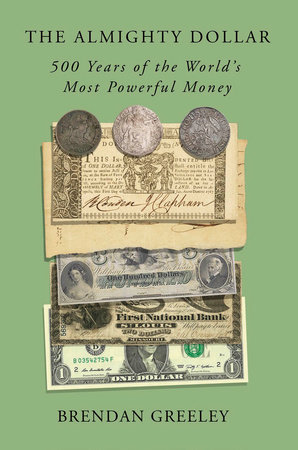
The Almighty Dollar

500 Years of the World's Most Powerful Money

Listen to a clip from the audiobook
audio play button
0:00
0:00
In this ambitious and groundbreaking history of the dollar, financial journalist and economic scholar Brendan Greeley makes a new argument about the origins of our money—and the people and nations who have surrendered to it.

“Brimming with startling details, this is also serious financial history with a conclusion ripe for our unsettled times: Rulers and borders come and go, but the dollar has outlasted our illusions of sovereignty and control.”—Evan Osnos, author of The Haves and Have-Yachts

America’s money is global money—nearly every nation in the world writes international contracts in dollars, and in 2023, central banks around the world held nearly $6.7 trillion in dollar reserves, three times any other currency. Today, the United States’ global hegemony rests largely on its ability to produce unlimited treasury bonds that are sold around the world, dollars that supported America’s explosive growth in the twentieth century and funded its massive wars in the twenty-first. American power and the American dollar have become synonymous.

Yet in this brilliant 500-year history, Brendan Greeley argues that America’s sovereignty over the dollar is an illusion—that the dollar had already empowered and destroyed nations long before it washed up on colonial shores, and that no country or king has or can ever truly control it. Reaching back to the dollar’s birth as the taler in the 15th-century silver mines of St. Joachimsthal, Greeley reveals how the dollar first thrived as a commodity for merchants and bankers—a big, silver coin that was trusted around the world, even as the miners who pulled it from the ground had trouble getting paid in that same silver. Greeley traces a captivatingly complex path across time and place, from the industrial collapse at the heart of Spain’s 17th-century silver empire, to the birth of American paper dollars in colonial Maryland, 19th-century New Orleans bank failures, and the small town of Hawarden, Iowa, which created its own dollars during the Great Depression. At every surprising turn, Greeley upends assumptions about global currencies and draws out the centuries-old tension between how dollars are manufactured and whom they actually serve.

Singular in its breadth, The Almighty Dollar dismantles the myth that America created or has ever truly controlled the dollar. Through meticulous research and vividly rendered stories of merchants, monarchs, and everyday people both past and present, Greeley shows how the dollar became America’s greatest export, spawning a vast financial industry that enriches the wealthy, even as the rest of the country’s industries suffer.
1

A Big Silver Coin from Bohemia

St. Joachimsthal, 1518

The party at the birth of the dollar

On the Feast of Epiphany in January 1518, silver miners in the town of Konradsgrün in the mountains of northern Bohemia threw a party. Things got out of hand. By the end of the night, they had lit their empty beer kegs on fire, hauled them up on their shoulders, and run with them down the street, screaming and singing.

We know exactly where they ran, because at the time Konradsgrün had only one street. Every single one of the town’s three thousand inhabitants had arrived within the previous two years. They lived in about four hundred shacks, perched on a hillside too steep to walk without switchbacks, overlooking a valley narrow enough for a crossbow bolt to reach the other side. The street ran from a chapel, north along the mountain, to a small green—the Grün from the town’s name. At the start of the sixteenth century, the Ore Mountains that divided Bohemia and Saxony were still socked in with virgin forest. In the town’s first few years, bears would sometimes still trot over the green.

It’s possible that the miners set the kegs on fire at the end of the night because they’d run out of beer. At the time, Konradsgrün didn’t yet have a license for its own brewery, and beer had to be hauled in from Schlackenwerth, a town about an hour’s walk away. Schlackenwerth was also the seat of Stephan Schlick, a minor Bohemian nobleman who had claimed the earth around the brand-new mines. The land wasn’t his to claim. He shared the title of count with several other members of his extended family; they all had a claim to the same land. But Stephan Schlick had just brazenly decided he should be lord of the valley, then started acting as if he were.

We do have a good idea of what the party in January 1518 was about. I have found two mentions of the event. One says only that a new captain of the mountain, Heinrich von Könneritz, was “festively installed” on the Feast of Epiphany in 1518. The other describes a christening party, to give the town a new name.

The party marked a temporary victory for the miners in a long fight with Schlick. His title as lord was questionable to begin with, but he was also just bad at it. In the summer of 1517, the miners at Konradsgrün had downed tools over work conditions and threatened to walk out of the valley. Schlick had agreed to a list of demands, among them a requirement to pay the miners with higher-quality silver coins. The miners had also demanded that they give the town a new name of their choosing. The morning after the party, the miners woke up, hungover and likely singed, in a town called St. Joachimsthal—the Valley of Saint Joachim. The silver coins that came out of the valley would become known as joachimsthaler, and then simply thaler or taler.

By the early 1530s, the kingdom of Sweden would begin producing a big silver coin called a jockumsdaler, and the kingdom of Denmark would mint a Jochemdaler, both copies of the same big silver coins that came out of St. Joachimsthal and both named for the town itself, the start of a centuries-long process of copies of copies of copies of the same silver coin. Today the U.S. Mint still makes a coin it calls a silver dollar, with almost the exact same dimensions as the ones that came out of the mint at Joachimsthal. If you were ever given a silver dollar as a child for your birthday, you held in your little palm a direct descendant of that christening party in the mountains in Bohemia in 1518.

The mining town of St. Joachimsthal often shows up in histories of the dollar as the origin of the name itself. Over time the German word taler became, in English, “dollar.” But those histories suggest that what happened at the actual mine in the valley is now irrelevant. They argue that a domestic currency simply became international: Count Schlick had so much silver that the coins of his own realm spread beyond his own borders. But nothing in that sentence about Schlick is really true. Stephan was only one of several Counts Schlick, an ambitious huckster without a clear claim on anything in the valley. In the sixteenth century, St. Joachimsthal was the single most productive silver mine in Europe, but it wasn’t completely out of proportion with the other mines. The big silver joachimsthaler coins that came out of the valley were never meant as local currency. They were far more useful for trade across the Baltic than they were for making payments in a tiny corner of Bohemia.

Stephan Schlick never even wanted to make coins. He just wanted to buy silver cheaply in a place that called him lord, then sell it as silver bars at a profit to bankers in Nuremberg. But his scheme fell apart. By the 1520s, other Bohemian lords and even his own family caught up with Stephan Schlick and forced him to start minting the coins that eventually became the world’s currency. We now think of coins as just money, but in a silver-producing kingdom like Bohemia a mint was also a form of control, a way to count all the silver, stamp it, and tax it. During his short life Schlick was also constantly at the mercy of his miners, who walked out of the mines several times because they couldn’t get paid in the same good silver they were pulling out of the ground. That is, the man who set in motion the money we now call the dollar didn’t even make reliable money for the people who lived in his valley. The joachimsthaler wasn’t Stephan Schlick’s money, or even Bohemia’s money. The dollar was an accident.

The Feast of Epiphany in that one valley in northern Bohemia in 1518—with the flaming beer keg runs from the chapel to the green—marked the beginning of what we today call the dollar. It also marked only a temporary peace in the fight over whose dollar it would be. I have on my desk a copy in silver of one of those first joachimsthaler coins. When I drop it, it doesn’t jingle. It clanks. It has heft. It’s a coin for lords and merchants; it’s not the kind of thing a carpenter would pull out of a pocket to pay for a loaf of bread. That world with its clanking, physical coins is not so different from our own, with its banks and credit cards and storefronts for check cashing. Today some kinds of dollars work for the wealthy, for investors, and for people who ship goods from one continent to another. Some kinds of dollars work for everyone else. Stephan Schlick had a hard time making the right mix of silver bars and big and little coins to make everyone happy: his miners, the investors at his mines, his bankers, and the other lords of Bohemia. That problem never went away. It’s still with us now.

A silver find in the forest

Until 1512, Konradsgrün had been a ruin, a collection of abandoned houses and a forge on the valley floor, with trees growing up through the frames. That year two men walked up from the valley floor, began to dig, and discovered something so overwhelming that they covered their holes back up with slag and immediately left. One of the men was local, from Schlackenwerth—Stephan Schlick’s home county, the place where the beer kegs came from for that party. The other came from a silver-mining town in Saxony, and probably had some understanding of mining law. The two might have been able to establish a legal claim to the mine and sell the silver they’d found, but together they weren’t able to get past any of the basic hurdles of silver prospecting. Silver under the ground doesn’t automatically become silver in your hand. Even in the sixteenth century, someone had to pay for skilled miners and huge machines to dig up ore, refine it into silver on the surface, and sell it into an international market. There’s no silver without investors to pay for silver mining. And what investors wanted determined where the silver went.

In 1515, Stephan Schlick was taking the baths at Karlsbad, about a three-hour walk from the mouth of the valley, when he heard about what the two men had found. By the next spring, he had invited a small group of investors from Saxon mines south for a visit. They met with Schlick at Karlsbad, where he dressed them up as a hunting party and rode with them up the valley floor to check out the slag heap. Schlick’s visitors began production immediately. By the last two quarters of 1516, they were pulling ore out of the ground and refining it into silver.

Joachimsthal is now called Jáchymov, in what is now Czechia. Karlsbad is still a spa town, but also now goes by its Czech name, Karlovy Vary. Both lie in what used to be called the Sudetenland, the part of Czechia that was majority German until the end of World War II; the names all changed after the war, when the Germans were forced to leave. In the summer of 2019, I spent a week in Karlovy Vary in the office of Jan Nedvěd, a historian at the city’s regional museum, reading through a collection of the histories of Joachimsthal, watched by Jan’s two dogs and his poster of the American punk band Fugazi.
© Courtesy of the author
Brendan Greeley has spent twenty years as a journalist, covering economic and monetary policy. He was the US economics editor at the Financial Times and continues to write a regular column there. Before that, he was a staff writer for Bloomberg Businessweek and The Economist, as well as an anchor and correspondent for Bloomberg TV. He has also written for The New York Times, The New York Times Magazine, and The Wall Street Journal Europe, and received a New York Press Club Award for special event reporting. Brendan graduated from Tulane University with honors in German. He is currently completing a PhD in financial history at Princeton University. View titles by Brendan Greeley
“A lucid work of economic history.”Kirkus Reviews

“The history of the dollar is longer and more interesting than people realize. Brendan Greeley, in his The Almighty Dollar, provides the ideal guide to understanding the world's most important currency.”—Tyler Cowen, New York Times bestselling author of The Great Stagnation and Average Is Over

“Greeley has done us all a service with this terrific, erudite, breathtaking story of the Almighty U.S. Dollar, which, I now know thanks to his scholarship, came well before the United States itself! Whizzing from Bohemia of the Middle Ages right up to today’s multitrillion-dollar eurodollar market, Greeley weaves a fascinating narrative, populated by extraordinary innovators, leading us to a revolutionary conclusion that challenges many of the assumptions monetary economists make about how the modern monetary economy actually works. The Almighty Dollar is a must for anyone who wants to understand the dollar in today’s world.”—David McWilliams, #1 international bestselling author of The History of Money: A Story of Humanity

“Despite being a brilliant and surprisingly fun read, in writing a history of the dollar Greeley inadvertently gives us a new history of money. His key insight is that money is not some kind of magical barter-replacement device or a ring of confidence. Rather, it’s a product. Seen this way the history and the future of the dollar stand far less assured than many assume.”—Mark Blyth, author of Inflation: A Guide for Users and Losers

“Greeley’s splendid quest, from Saxon mines to stable coins, makes an epic story vividly accessible. Brimming with startling details, this is also serious financial history with a conclusion ripe for our unsettled times: rulers and borders come and go, but the dollar has outlasted our illusions of sovereignty and control.”—Evan Osnos, New York Times bestselling author of The Haves and Have-Yachts

“Come for the sweeping—and accessible—history of the dollar and the faith people have put in it. Stay for the delightful cameos about the Saxon miners searching for Joachimsthaler, Maryland bills of credit, Hawarden, Iowa scrip, and Andrew Brimmer’s quest to get the Federal Reserve to allocate credit.”—William D. Cohan, New York Times bestselling author of Power Failure and The Last Tycoons

“This is a reporter’s book of detailed, engaging stories and a historian’s book—telling a tale that is stranger, longer, and more rich with significance than any economist’s fable.”—Rebecca Spang, author of Stuff and Money in the Time of the French Revolution

“This is a mesmerizing and fascinating book, breathtakingly researched and spectacularly written, that connects the big story of the dollar—and indeed of other currencies—to the actual experiences of very ordinary people whose lives are transformed, and often wrecked, by money.”—Harold James, author of Seven Crashes and The End of Globalization

“With curiosity, good humor, and a keen eye for human stories, Greeley guides us from centuries-old silver mines to the ongoing machinations of the Federal Reserve Board. Myths about economic sovereignty and objective monetary policy give way to a clear-eyed understanding of a global dollar that has always benefited some at the expense of others.”—Seth Rockman, author of Plantation Goods: A Material History of American Slavery

About

In this ambitious and groundbreaking history of the dollar, financial journalist and economic scholar Brendan Greeley makes a new argument about the origins of our money—and the people and nations who have surrendered to it.

“Brimming with startling details, this is also serious financial history with a conclusion ripe for our unsettled times: Rulers and borders come and go, but the dollar has outlasted our illusions of sovereignty and control.”—Evan Osnos, author of The Haves and Have-Yachts

America’s money is global money—nearly every nation in the world writes international contracts in dollars, and in 2023, central banks around the world held nearly $6.7 trillion in dollar reserves, three times any other currency. Today, the United States’ global hegemony rests largely on its ability to produce unlimited treasury bonds that are sold around the world, dollars that supported America’s explosive growth in the twentieth century and funded its massive wars in the twenty-first. American power and the American dollar have become synonymous.

Yet in this brilliant 500-year history, Brendan Greeley argues that America’s sovereignty over the dollar is an illusion—that the dollar had already empowered and destroyed nations long before it washed up on colonial shores, and that no country or king has or can ever truly control it. Reaching back to the dollar’s birth as the taler in the 15th-century silver mines of St. Joachimsthal, Greeley reveals how the dollar first thrived as a commodity for merchants and bankers—a big, silver coin that was trusted around the world, even as the miners who pulled it from the ground had trouble getting paid in that same silver. Greeley traces a captivatingly complex path across time and place, from the industrial collapse at the heart of Spain’s 17th-century silver empire, to the birth of American paper dollars in colonial Maryland, 19th-century New Orleans bank failures, and the small town of Hawarden, Iowa, which created its own dollars during the Great Depression. At every surprising turn, Greeley upends assumptions about global currencies and draws out the centuries-old tension between how dollars are manufactured and whom they actually serve.

Singular in its breadth, The Almighty Dollar dismantles the myth that America created or has ever truly controlled the dollar. Through meticulous research and vividly rendered stories of merchants, monarchs, and everyday people both past and present, Greeley shows how the dollar became America’s greatest export, spawning a vast financial industry that enriches the wealthy, even as the rest of the country’s industries suffer.

Excerpt

1

A Big Silver Coin from Bohemia

St. Joachimsthal, 1518

The party at the birth of the dollar

On the Feast of Epiphany in January 1518, silver miners in the town of Konradsgrün in the mountains of northern Bohemia threw a party. Things got out of hand. By the end of the night, they had lit their empty beer kegs on fire, hauled them up on their shoulders, and run with them down the street, screaming and singing.

We know exactly where they ran, because at the time Konradsgrün had only one street. Every single one of the town’s three thousand inhabitants had arrived within the previous two years. They lived in about four hundred shacks, perched on a hillside too steep to walk without switchbacks, overlooking a valley narrow enough for a crossbow bolt to reach the other side. The street ran from a chapel, north along the mountain, to a small green—the Grün from the town’s name. At the start of the sixteenth century, the Ore Mountains that divided Bohemia and Saxony were still socked in with virgin forest. In the town’s first few years, bears would sometimes still trot over the green.

It’s possible that the miners set the kegs on fire at the end of the night because they’d run out of beer. At the time, Konradsgrün didn’t yet have a license for its own brewery, and beer had to be hauled in from Schlackenwerth, a town about an hour’s walk away. Schlackenwerth was also the seat of Stephan Schlick, a minor Bohemian nobleman who had claimed the earth around the brand-new mines. The land wasn’t his to claim. He shared the title of count with several other members of his extended family; they all had a claim to the same land. But Stephan Schlick had just brazenly decided he should be lord of the valley, then started acting as if he were.

We do have a good idea of what the party in January 1518 was about. I have found two mentions of the event. One says only that a new captain of the mountain, Heinrich von Könneritz, was “festively installed” on the Feast of Epiphany in 1518. The other describes a christening party, to give the town a new name.

The party marked a temporary victory for the miners in a long fight with Schlick. His title as lord was questionable to begin with, but he was also just bad at it. In the summer of 1517, the miners at Konradsgrün had downed tools over work conditions and threatened to walk out of the valley. Schlick had agreed to a list of demands, among them a requirement to pay the miners with higher-quality silver coins. The miners had also demanded that they give the town a new name of their choosing. The morning after the party, the miners woke up, hungover and likely singed, in a town called St. Joachimsthal—the Valley of Saint Joachim. The silver coins that came out of the valley would become known as joachimsthaler, and then simply thaler or taler.

By the early 1530s, the kingdom of Sweden would begin producing a big silver coin called a jockumsdaler, and the kingdom of Denmark would mint a Jochemdaler, both copies of the same big silver coins that came out of St. Joachimsthal and both named for the town itself, the start of a centuries-long process of copies of copies of copies of the same silver coin. Today the U.S. Mint still makes a coin it calls a silver dollar, with almost the exact same dimensions as the ones that came out of the mint at Joachimsthal. If you were ever given a silver dollar as a child for your birthday, you held in your little palm a direct descendant of that christening party in the mountains in Bohemia in 1518.

The mining town of St. Joachimsthal often shows up in histories of the dollar as the origin of the name itself. Over time the German word taler became, in English, “dollar.” But those histories suggest that what happened at the actual mine in the valley is now irrelevant. They argue that a domestic currency simply became international: Count Schlick had so much silver that the coins of his own realm spread beyond his own borders. But nothing in that sentence about Schlick is really true. Stephan was only one of several Counts Schlick, an ambitious huckster without a clear claim on anything in the valley. In the sixteenth century, St. Joachimsthal was the single most productive silver mine in Europe, but it wasn’t completely out of proportion with the other mines. The big silver joachimsthaler coins that came out of the valley were never meant as local currency. They were far more useful for trade across the Baltic than they were for making payments in a tiny corner of Bohemia.

Stephan Schlick never even wanted to make coins. He just wanted to buy silver cheaply in a place that called him lord, then sell it as silver bars at a profit to bankers in Nuremberg. But his scheme fell apart. By the 1520s, other Bohemian lords and even his own family caught up with Stephan Schlick and forced him to start minting the coins that eventually became the world’s currency. We now think of coins as just money, but in a silver-producing kingdom like Bohemia a mint was also a form of control, a way to count all the silver, stamp it, and tax it. During his short life Schlick was also constantly at the mercy of his miners, who walked out of the mines several times because they couldn’t get paid in the same good silver they were pulling out of the ground. That is, the man who set in motion the money we now call the dollar didn’t even make reliable money for the people who lived in his valley. The joachimsthaler wasn’t Stephan Schlick’s money, or even Bohemia’s money. The dollar was an accident.

The Feast of Epiphany in that one valley in northern Bohemia in 1518—with the flaming beer keg runs from the chapel to the green—marked the beginning of what we today call the dollar. It also marked only a temporary peace in the fight over whose dollar it would be. I have on my desk a copy in silver of one of those first joachimsthaler coins. When I drop it, it doesn’t jingle. It clanks. It has heft. It’s a coin for lords and merchants; it’s not the kind of thing a carpenter would pull out of a pocket to pay for a loaf of bread. That world with its clanking, physical coins is not so different from our own, with its banks and credit cards and storefronts for check cashing. Today some kinds of dollars work for the wealthy, for investors, and for people who ship goods from one continent to another. Some kinds of dollars work for everyone else. Stephan Schlick had a hard time making the right mix of silver bars and big and little coins to make everyone happy: his miners, the investors at his mines, his bankers, and the other lords of Bohemia. That problem never went away. It’s still with us now.

A silver find in the forest

Until 1512, Konradsgrün had been a ruin, a collection of abandoned houses and a forge on the valley floor, with trees growing up through the frames. That year two men walked up from the valley floor, began to dig, and discovered something so overwhelming that they covered their holes back up with slag and immediately left. One of the men was local, from Schlackenwerth—Stephan Schlick’s home county, the place where the beer kegs came from for that party. The other came from a silver-mining town in Saxony, and probably had some understanding of mining law. The two might have been able to establish a legal claim to the mine and sell the silver they’d found, but together they weren’t able to get past any of the basic hurdles of silver prospecting. Silver under the ground doesn’t automatically become silver in your hand. Even in the sixteenth century, someone had to pay for skilled miners and huge machines to dig up ore, refine it into silver on the surface, and sell it into an international market. There’s no silver without investors to pay for silver mining. And what investors wanted determined where the silver went.

In 1515, Stephan Schlick was taking the baths at Karlsbad, about a three-hour walk from the mouth of the valley, when he heard about what the two men had found. By the next spring, he had invited a small group of investors from Saxon mines south for a visit. They met with Schlick at Karlsbad, where he dressed them up as a hunting party and rode with them up the valley floor to check out the slag heap. Schlick’s visitors began production immediately. By the last two quarters of 1516, they were pulling ore out of the ground and refining it into silver.

Joachimsthal is now called Jáchymov, in what is now Czechia. Karlsbad is still a spa town, but also now goes by its Czech name, Karlovy Vary. Both lie in what used to be called the Sudetenland, the part of Czechia that was majority German until the end of World War II; the names all changed after the war, when the Germans were forced to leave. In the summer of 2019, I spent a week in Karlovy Vary in the office of Jan Nedvěd, a historian at the city’s regional museum, reading through a collection of the histories of Joachimsthal, watched by Jan’s two dogs and his poster of the American punk band Fugazi.

Author

© Courtesy of the author
Brendan Greeley has spent twenty years as a journalist, covering economic and monetary policy. He was the US economics editor at the Financial Times and continues to write a regular column there. Before that, he was a staff writer for Bloomberg Businessweek and The Economist, as well as an anchor and correspondent for Bloomberg TV. He has also written for The New York Times, The New York Times Magazine, and The Wall Street Journal Europe, and received a New York Press Club Award for special event reporting. Brendan graduated from Tulane University with honors in German. He is currently completing a PhD in financial history at Princeton University. View titles by Brendan Greeley

Praise

“A lucid work of economic history.”Kirkus Reviews

“The history of the dollar is longer and more interesting than people realize. Brendan Greeley, in his The Almighty Dollar, provides the ideal guide to understanding the world's most important currency.”—Tyler Cowen, New York Times bestselling author of The Great Stagnation and Average Is Over

“Greeley has done us all a service with this terrific, erudite, breathtaking story of the Almighty U.S. Dollar, which, I now know thanks to his scholarship, came well before the United States itself! Whizzing from Bohemia of the Middle Ages right up to today’s multitrillion-dollar eurodollar market, Greeley weaves a fascinating narrative, populated by extraordinary innovators, leading us to a revolutionary conclusion that challenges many of the assumptions monetary economists make about how the modern monetary economy actually works. The Almighty Dollar is a must for anyone who wants to understand the dollar in today’s world.”—David McWilliams, #1 international bestselling author of The History of Money: A Story of Humanity

“Despite being a brilliant and surprisingly fun read, in writing a history of the dollar Greeley inadvertently gives us a new history of money. His key insight is that money is not some kind of magical barter-replacement device or a ring of confidence. Rather, it’s a product. Seen this way the history and the future of the dollar stand far less assured than many assume.”—Mark Blyth, author of Inflation: A Guide for Users and Losers

“Greeley’s splendid quest, from Saxon mines to stable coins, makes an epic story vividly accessible. Brimming with startling details, this is also serious financial history with a conclusion ripe for our unsettled times: rulers and borders come and go, but the dollar has outlasted our illusions of sovereignty and control.”—Evan Osnos, New York Times bestselling author of The Haves and Have-Yachts

“Come for the sweeping—and accessible—history of the dollar and the faith people have put in it. Stay for the delightful cameos about the Saxon miners searching for Joachimsthaler, Maryland bills of credit, Hawarden, Iowa scrip, and Andrew Brimmer’s quest to get the Federal Reserve to allocate credit.”—William D. Cohan, New York Times bestselling author of Power Failure and The Last Tycoons

“This is a reporter’s book of detailed, engaging stories and a historian’s book—telling a tale that is stranger, longer, and more rich with significance than any economist’s fable.”—Rebecca Spang, author of Stuff and Money in the Time of the French Revolution

“This is a mesmerizing and fascinating book, breathtakingly researched and spectacularly written, that connects the big story of the dollar—and indeed of other currencies—to the actual experiences of very ordinary people whose lives are transformed, and often wrecked, by money.”—Harold James, author of Seven Crashes and The End of Globalization

“With curiosity, good humor, and a keen eye for human stories, Greeley guides us from centuries-old silver mines to the ongoing machinations of the Federal Reserve Board. Myths about economic sovereignty and objective monetary policy give way to a clear-eyed understanding of a global dollar that has always benefited some at the expense of others.”—Seth Rockman, author of Plantation Goods: A Material History of American Slavery

Books for LGBTQIA+ Pride Month

In June we celebrate Lesbian, Gay, Bisexual, Transgender, Queer, Intersex, and Asexual + (LGBTQIA+) Pride Month, which honors the 1969 Stonewall riots in Manhattan. Pride Month is a time to both celebrate the accomplishments of those in the LGBTQ+ community and recognize the ongoing struggles faced by many across the world who wish to live

Read more