Download high-resolution image Look inside
Listen to a clip from the audiobook
audio play button
0:00
0:00

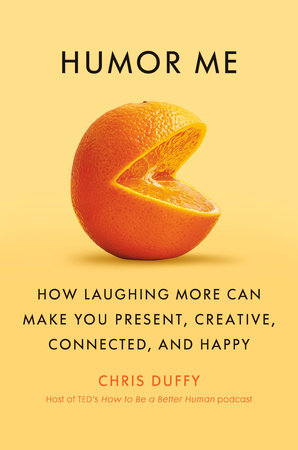
Humor Me

How Laughing More Can Make You Present, Creative, Connected, and Happy

Author Chris Duffy On Tour
Look inside
Listen to a clip from the audiobook
audio play button
0:00
0:00
From a comedian and host of hit TED podcast, How to Be a Better Human, a hilarious and enlightening guide to laughing your way into a fuller life

“Warning: this book may cause repeated smiling. It’s a delightful read about how we can bring more levity into our lives.”
—Adam Grant, author of Hidden Potential and Think Again


In his days as an exhausted fifth grade teacher, Chris Duffy taught the funniest person he’s ever met: eleven-year-old Gary. Gary was the school newspaper’s official food critic, blasting cafeteria pizza for looking like cardboard and opining that the baked beans weren’t “beany” enough. These days, Duffy is a professional comedy writer and the host of a podcast with millions of listeners, but he’s never forgotten the transformative joy of laughing with Gary during a bleak Boston winter. In Humor Me, he shares a road map for how to cultivate and strengthen a sense of humor in a challenging world.

Duffy embarks on a journey that takes him from comedy clubs to emergency rooms to a helicopter full of Navy SEALs and back to his own keyboard to reveal how—and why—a good laugh can bring us closer to the good life. Drawing on personal stories, insights from the social sciences, and the wisdom of comedians, Duffy offers practical strategies, including:
  • How to hone the art of noticing, finding humor in the most unlikely places
  • Why you should take social risks (to build connection through humor!)
  • How to apply the comedy secret that laughs come in threes.

Humor Me promises to deepen your friendships, enhance your creativity, and lighten life’s burdens, and is a genuinely funny read along the way.
1

The First Pillar: Being Present

Noticing That the World Is Filled with Absurdity

Your Brain Is the Background Blur on a Zoom Call

The first step to laughing more is noticing more. As far as I know, no one has mastered the art of laughing at things they have not yet noticed. The good news is that the world is filled with absurdity and weirdness—we’ve just accepted it as “normal.” And as a result, every day is chock-full of opportunities to tickle your sense of humor.

This morning, I saw a man wearing a transparent backpack with a cat inside and pushing a small dog in a stroller. I guess that technically this man was taking his pets on a walk, but he was the only one walking. Both animals looked distinctly bored, while this poor guy was sweating profusely. I could swear that the cat and I shared a moment when we caught each other’s eyes and both of us were thinking, What is this guy accomplishing here?

Noticing small moments and details brings more spontaneous laughter into your life and reveals the world around you to be a more magical, hilarious place. That works only if you’re fully present. Our natural inclination, unfortunately, is to glance past the world without really seeing it.

As a result, a lot of the weird, delightful parts of the world, the opportunities for humor and laughter that surround you, fade into a nondescript blur like one of your coworkers’ Zoom backgrounds (the one definitely hiding his many shelves of Lego spaceships from his coworkers). But we can train our attention and focus to bring the blur back into sharp definition. It’s a skill that you can practice and that can pay big rewards.

We’ve all had moments of crystal-clear awareness and attention. Two experiences we’ve all shared, and during which I bet you’ve noticed your surroundings with real specificity, are your first night in a new home and any time you use someone else’s bathroom.

When you first move to a new house or apartment, you’re attuned to the details. You notice the sounds of the pipes, the creaky spot on the floor, the way one corner seems to have been patched up in a slightly different shade of white paint.

But then, a few days in, that stuff fades out of your attention. That’s just how things are. After moving into a new place, I have a two-week period when I can put art or decorations on a given wall. If I go past that time frame, in my mind it becomes The Blank Wall. I can’t hang up a picture over there, that’s The Blank Wall! That’s just how that wall is. It would look weird to put photos up there.

Alternatively, imagine you’re at a friend’s house, and you’ve asked to use their bathroom. It’s always easier to notice strange, unusual details when you’re outside your own home. When you walk into someone else’s bathroom, you immediately see all the ways they’ve set up that space differently than you. How do they put the toilet paper on the roll? Do they do it correctly (with the paper coming down over the top) or like a degenerate (hanging down loose and wild in the back like some kind of paper mullet)? Do they have a little squatty potty stool? A bidet? Or do they have an old-school, thick plastic cushion on top of the toilet seat as though it’s intended for you to sit comfortably while you wait for a bus? Is there a pile of books and magazines? Are they disturbingly crinkled as though they’ve gotten wet and then air-dried?

This is the kind of stuff you see in someone else’s place but fail to notice in your own. It stands out! It’s weird to you! And it is exactly these kinds of observations that let humor in. That’s the attention and mental frame that creates a fertile soil for laughter to sprout. Humor almost always springs out of noticing what’s off, odd, strange, or delightful—when you pay close attention.

All of which brings me to the first pillar of cultivating a humor mindset: being present. If we’re going to benefit from the joy, creativity, and insight that humor can bring, our goal should be to maintain, as often as possible, this new-bathroom frame of mind.

The Secret Code of Laughter

We’ll get into how to preserve that mindset soon. But first let’s get deeper into what makes something funny when we are present and observing it. Why do we laugh? What does it mean for something to be funny?

Greg Bryant is a cognitive psychologist at UCLA who studies humor and laughter from an evolutionary perspective. There are a number of competing academic theories out there about how humor works. I put my faith in Bryant’s research and papers not just because his framework, encryption theory, makes the most sense to me, but also because he’s the only genuinely funny humor researcher I’ve ever met. You’d be shocked by how many of the people studying laughter seem to think dad jokes are the highest form of the comedic arts. Luckily, that’s not Bryant. He’s got a very dry sense of humor. When I asked him the last time he’d laughed hard, he looked at me stone-faced and said, “1998,” before cracking the faintest hint of a smile. I burst out laughing.

Bryant’s encryption theory suggests that, on a fundamental level, humor is a type of social test. It’s a riddle, a puzzle, intended to see if the listener can figure it out. As Bryant explained it to me, when someone says something funny to you, that’s essentially a secret code. “The only way you can decrypt it is if you have a corresponding piece of information—you have the key. And if you have that key, then you get the joke, and then you signal back to me that you get the joke by spontaneously laughing.”

From an evolutionary standpoint, encryption theory explains why laughter is so important that it exists universally across cultures. (It also explains why people are so sensitive to fake laughter. One of Bryant’s research papers found that across twenty-one cultures, study subjects were able to identify the difference between a fake laugh and a real laugh at rates better than chance.) Knowing whether someone gets your joke, whether they can crack the code on your encrypted message, instantly tells you whether they’re part of your group. It’s an instantaneous, simple, and extremely effective test of whether you’re on the same page. Throughout human evolution, that’s the kind of information that could often make the difference between life and death.

Bryant’s research suggests that this is a natural, unconscious process that underlies all intentional humor. Encryption theory doesn’t explain why it’s funny if you see someone trip and fall. That’s not encryption, because it’s unintentional. (A competing theory of humor, benign violation theory, is much more concerned with examples like this. We’ll talk about it in chapter 2.) But intentional humor works by sending out a code to be broken. There’s something satisfying and cathartic about getting it that triggers our genuine laughter. And, Bryant adds, “it explains why if you have to explain the joke, it’s not funny anymore.” It’s no fun to solve a puzzle if someone hands you the solution.

This is also why being present is so crucial to humor. You’re scanning the environment both for inspiration for riddles that you can set up and for puzzle pieces that will allow you to instantly decrypt the humor that’s sent your way.

Do you need to have read the academic papers? Of course not. I’ve never encountered someone who was laughing hard, deeply and genuinely, and then said, “I didn’t enjoy those laughs because I don’t understand the theoretical framework behind them.” But I do think there’s something very satisfying about understanding the evolutionary motivations behind this strange, joyful exercise that humans do across the globe. Why do we spontaneously make involuntary noises out of our mouths while we’re having fun with friends? Why are some jokes inscrutable while others make us slap our knees? Every laugh is a mystery, a puzzle that we’ve unlocked. The more we pay attention, the more frequently we’ll be able to set up and crack those codes.

Unblurring the Background

So how do you put these pieces together in a way that actually helps you to be present? How do you start seeing the absurdity—recognizing those puzzles and encryptions—in the places that previously blurred by you, unnoticed?

I recommend starting with the times when you are the least present, the most zoned out. For me, like for lots of people, that’s my commute. When I’m on a route that I’ve covered hundreds of times before, I can feel myself switching completely into autopilot, my mind desperate to think about anything but my immediate surroundings.

We all have deep-set automatic routes in our lives, whether going to work, dropping off the kids at school, or driving to the grocery store. These are ripe opportunities for switching into noticing mode. But how?

The first step is simply to recognize what’s happening—that your mind has slipped into blur mode. Since your commute (or other automatic route) is such a common culprit for inattention, treat yours as a chance to work those attending muscles. Take a moment to shake your mind out of the blur and really notice the people, the signs, and the scenery around you. Try to find a single thing you’ve never noticed before.

In her book On Looking, the author Alexandra Horowitz uncovers the “spectacle of the ordinary” by taking the same walk in her Manhattan neighborhood over and over, joined each time by a different expert. An animal researcher shows Horowitz the neighborhood through the eyes of a rat (horrific, would not recommend). A geologist helps her place herself in a vastly bigger timeline. A sound designer shows her the way noises emanate from and bounce off the buildings around her.

We can’t all enlist a bevy of experts to join us for our daily commute, but the principle holds: By engaging our powers of attention and applying different lenses to our minds—attending to that unnameable smell, the especially potholed street, the animal-screeching of a bus’s brakes, the riders or drivers around us, what they’re doing, wearing, watching, reading—even the areas we know best, the places we see every single day, become if not new and exciting, at the very least unusual and surprising.

It was commuting on the New York City subway that first snapped me out of the blur and into focus. I’d taken hundreds of subway rides, trips jammed full of passengers, of sights and sounds, but they all blurred together in my memory, with little to differentiate one from another. Just think about how much time we spend commuting. Those are hours of my life—and probably yours too—that just slipped away, that I essentially sleepwalked through.

What happened when I switched into presence and started scanning for things that would ping my sense of humor?

The first was that I started noticing all kinds of weird stuff. I noticed a man using a dollar bill as a bookmark, which, despite costing only a dollar, struck me as one of the richest things I’d ever seen a person do.

I saw a woman reading a book titled How to Talk So People Will Listen sitting directly across from a man reading a book titled How to Listen with Intention.

I saw a man rest against the pole in the middle of the car so that it perfectly lined up with his visible butt crack, leaving his hands free during the commute.

One time I saw a pigeon fly through the open doors of a subway car, only to be instantly (and extremely nonchalantly) caught by a passenger in their bare hands and tossed right back out the window.

Part of what I’m trying to advocate for here is that you allow for serendipity by not always being so desperate to avoid moments of downtime. Try, even for a few seconds, not to be so terrified of boredom, because so many of us just run from anything that feels like “waiting” or “transitional time” into the loving arms of the phone or the podcast or whatever our distraction of choice may be. I’m arguing that you’ll laugh more if you experiment with cultivating a practice of being in the transitions more and just seeing what’s there from time to time.

If I hadn’t ever switched up my typical routine of checking emails on my phone while walking to the train, I would never have noticed a sign for a Russian mystic who was evidently traveling to the United States on some sort of speaking tour. And that would have been a huge loss because there’s something instantly funny about a person’s job being “Russian mystic.” I mean, is that what he writes on his taxes?

But what really turned it into a moment I’ll never forget is the fact that, upon closer inspection, this Russian mystic looked uncannily like me. I had to take a photo next to the poster (see opposite page), with the help of a fellow commuter. Years later it’s a moment I still remember fondly, a memory that still makes me laugh.

And this was far from an isolated incident. I mean, the mystic doppelgänger has never appeared again. But anyone who has traveled even a short distance with me knows that I’m constantly stopping to take photos or get a closer look at things that make me laugh.

On a recent trip to visit a friend in rural Michigan, I noticed a sign outside a farm that read This horse is not dead! Leave him alone! And the owner! I can’t imagine how much more impoverished my life would be if I had just driven past that farm and failed to see that message. Thankfully, because I didn’t, I can tell you with 100 percent certainty: The horse was not dead.

Life is made of more than just commutes, of course. Your automatic routes are only the gateway to paying greater attention in the rest of your life. Once you start to build the practice of noticing what makes you laugh, you open up a world of possibilities. If you know what tends to delight you, you know which corners of life’s nonsense you’re going to most enjoy hanging out in.
CHRIS DUFFY is a stand-up comedian who has worked as a television writer (Wyatt Cenac's Problem Areas on HBO, National Geographic Explorer) and is currently host of TED’s hit podcast How to Be a Better Human, winner of the 2025 Webby Award for Advice & How-To Podcasts. He has appeared on Good Morning America, ABC News, and NPR. View titles by Chris Duffy

How to Find Laughter Anywhere

About

From a comedian and host of hit TED podcast, How to Be a Better Human, a hilarious and enlightening guide to laughing your way into a fuller life

“Warning: this book may cause repeated smiling. It’s a delightful read about how we can bring more levity into our lives.”
—Adam Grant, author of Hidden Potential and Think Again


In his days as an exhausted fifth grade teacher, Chris Duffy taught the funniest person he’s ever met: eleven-year-old Gary. Gary was the school newspaper’s official food critic, blasting cafeteria pizza for looking like cardboard and opining that the baked beans weren’t “beany” enough. These days, Duffy is a professional comedy writer and the host of a podcast with millions of listeners, but he’s never forgotten the transformative joy of laughing with Gary during a bleak Boston winter. In Humor Me, he shares a road map for how to cultivate and strengthen a sense of humor in a challenging world.

Duffy embarks on a journey that takes him from comedy clubs to emergency rooms to a helicopter full of Navy SEALs and back to his own keyboard to reveal how—and why—a good laugh can bring us closer to the good life. Drawing on personal stories, insights from the social sciences, and the wisdom of comedians, Duffy offers practical strategies, including:
  • How to hone the art of noticing, finding humor in the most unlikely places
  • Why you should take social risks (to build connection through humor!)
  • How to apply the comedy secret that laughs come in threes.

Humor Me promises to deepen your friendships, enhance your creativity, and lighten life’s burdens, and is a genuinely funny read along the way.

Excerpt

1

The First Pillar: Being Present

Noticing That the World Is Filled with Absurdity

Your Brain Is the Background Blur on a Zoom Call

The first step to laughing more is noticing more. As far as I know, no one has mastered the art of laughing at things they have not yet noticed. The good news is that the world is filled with absurdity and weirdness—we’ve just accepted it as “normal.” And as a result, every day is chock-full of opportunities to tickle your sense of humor.

This morning, I saw a man wearing a transparent backpack with a cat inside and pushing a small dog in a stroller. I guess that technically this man was taking his pets on a walk, but he was the only one walking. Both animals looked distinctly bored, while this poor guy was sweating profusely. I could swear that the cat and I shared a moment when we caught each other’s eyes and both of us were thinking, What is this guy accomplishing here?

Noticing small moments and details brings more spontaneous laughter into your life and reveals the world around you to be a more magical, hilarious place. That works only if you’re fully present. Our natural inclination, unfortunately, is to glance past the world without really seeing it.

As a result, a lot of the weird, delightful parts of the world, the opportunities for humor and laughter that surround you, fade into a nondescript blur like one of your coworkers’ Zoom backgrounds (the one definitely hiding his many shelves of Lego spaceships from his coworkers). But we can train our attention and focus to bring the blur back into sharp definition. It’s a skill that you can practice and that can pay big rewards.

We’ve all had moments of crystal-clear awareness and attention. Two experiences we’ve all shared, and during which I bet you’ve noticed your surroundings with real specificity, are your first night in a new home and any time you use someone else’s bathroom.

When you first move to a new house or apartment, you’re attuned to the details. You notice the sounds of the pipes, the creaky spot on the floor, the way one corner seems to have been patched up in a slightly different shade of white paint.

But then, a few days in, that stuff fades out of your attention. That’s just how things are. After moving into a new place, I have a two-week period when I can put art or decorations on a given wall. If I go past that time frame, in my mind it becomes The Blank Wall. I can’t hang up a picture over there, that’s The Blank Wall! That’s just how that wall is. It would look weird to put photos up there.

Alternatively, imagine you’re at a friend’s house, and you’ve asked to use their bathroom. It’s always easier to notice strange, unusual details when you’re outside your own home. When you walk into someone else’s bathroom, you immediately see all the ways they’ve set up that space differently than you. How do they put the toilet paper on the roll? Do they do it correctly (with the paper coming down over the top) or like a degenerate (hanging down loose and wild in the back like some kind of paper mullet)? Do they have a little squatty potty stool? A bidet? Or do they have an old-school, thick plastic cushion on top of the toilet seat as though it’s intended for you to sit comfortably while you wait for a bus? Is there a pile of books and magazines? Are they disturbingly crinkled as though they’ve gotten wet and then air-dried?

This is the kind of stuff you see in someone else’s place but fail to notice in your own. It stands out! It’s weird to you! And it is exactly these kinds of observations that let humor in. That’s the attention and mental frame that creates a fertile soil for laughter to sprout. Humor almost always springs out of noticing what’s off, odd, strange, or delightful—when you pay close attention.

All of which brings me to the first pillar of cultivating a humor mindset: being present. If we’re going to benefit from the joy, creativity, and insight that humor can bring, our goal should be to maintain, as often as possible, this new-bathroom frame of mind.

The Secret Code of Laughter

We’ll get into how to preserve that mindset soon. But first let’s get deeper into what makes something funny when we are present and observing it. Why do we laugh? What does it mean for something to be funny?

Greg Bryant is a cognitive psychologist at UCLA who studies humor and laughter from an evolutionary perspective. There are a number of competing academic theories out there about how humor works. I put my faith in Bryant’s research and papers not just because his framework, encryption theory, makes the most sense to me, but also because he’s the only genuinely funny humor researcher I’ve ever met. You’d be shocked by how many of the people studying laughter seem to think dad jokes are the highest form of the comedic arts. Luckily, that’s not Bryant. He’s got a very dry sense of humor. When I asked him the last time he’d laughed hard, he looked at me stone-faced and said, “1998,” before cracking the faintest hint of a smile. I burst out laughing.

Bryant’s encryption theory suggests that, on a fundamental level, humor is a type of social test. It’s a riddle, a puzzle, intended to see if the listener can figure it out. As Bryant explained it to me, when someone says something funny to you, that’s essentially a secret code. “The only way you can decrypt it is if you have a corresponding piece of information—you have the key. And if you have that key, then you get the joke, and then you signal back to me that you get the joke by spontaneously laughing.”

From an evolutionary standpoint, encryption theory explains why laughter is so important that it exists universally across cultures. (It also explains why people are so sensitive to fake laughter. One of Bryant’s research papers found that across twenty-one cultures, study subjects were able to identify the difference between a fake laugh and a real laugh at rates better than chance.) Knowing whether someone gets your joke, whether they can crack the code on your encrypted message, instantly tells you whether they’re part of your group. It’s an instantaneous, simple, and extremely effective test of whether you’re on the same page. Throughout human evolution, that’s the kind of information that could often make the difference between life and death.

Bryant’s research suggests that this is a natural, unconscious process that underlies all intentional humor. Encryption theory doesn’t explain why it’s funny if you see someone trip and fall. That’s not encryption, because it’s unintentional. (A competing theory of humor, benign violation theory, is much more concerned with examples like this. We’ll talk about it in chapter 2.) But intentional humor works by sending out a code to be broken. There’s something satisfying and cathartic about getting it that triggers our genuine laughter. And, Bryant adds, “it explains why if you have to explain the joke, it’s not funny anymore.” It’s no fun to solve a puzzle if someone hands you the solution.

This is also why being present is so crucial to humor. You’re scanning the environment both for inspiration for riddles that you can set up and for puzzle pieces that will allow you to instantly decrypt the humor that’s sent your way.

Do you need to have read the academic papers? Of course not. I’ve never encountered someone who was laughing hard, deeply and genuinely, and then said, “I didn’t enjoy those laughs because I don’t understand the theoretical framework behind them.” But I do think there’s something very satisfying about understanding the evolutionary motivations behind this strange, joyful exercise that humans do across the globe. Why do we spontaneously make involuntary noises out of our mouths while we’re having fun with friends? Why are some jokes inscrutable while others make us slap our knees? Every laugh is a mystery, a puzzle that we’ve unlocked. The more we pay attention, the more frequently we’ll be able to set up and crack those codes.

Unblurring the Background

So how do you put these pieces together in a way that actually helps you to be present? How do you start seeing the absurdity—recognizing those puzzles and encryptions—in the places that previously blurred by you, unnoticed?

I recommend starting with the times when you are the least present, the most zoned out. For me, like for lots of people, that’s my commute. When I’m on a route that I’ve covered hundreds of times before, I can feel myself switching completely into autopilot, my mind desperate to think about anything but my immediate surroundings.

We all have deep-set automatic routes in our lives, whether going to work, dropping off the kids at school, or driving to the grocery store. These are ripe opportunities for switching into noticing mode. But how?

The first step is simply to recognize what’s happening—that your mind has slipped into blur mode. Since your commute (or other automatic route) is such a common culprit for inattention, treat yours as a chance to work those attending muscles. Take a moment to shake your mind out of the blur and really notice the people, the signs, and the scenery around you. Try to find a single thing you’ve never noticed before.

In her book On Looking, the author Alexandra Horowitz uncovers the “spectacle of the ordinary” by taking the same walk in her Manhattan neighborhood over and over, joined each time by a different expert. An animal researcher shows Horowitz the neighborhood through the eyes of a rat (horrific, would not recommend). A geologist helps her place herself in a vastly bigger timeline. A sound designer shows her the way noises emanate from and bounce off the buildings around her.

We can’t all enlist a bevy of experts to join us for our daily commute, but the principle holds: By engaging our powers of attention and applying different lenses to our minds—attending to that unnameable smell, the especially potholed street, the animal-screeching of a bus’s brakes, the riders or drivers around us, what they’re doing, wearing, watching, reading—even the areas we know best, the places we see every single day, become if not new and exciting, at the very least unusual and surprising.

It was commuting on the New York City subway that first snapped me out of the blur and into focus. I’d taken hundreds of subway rides, trips jammed full of passengers, of sights and sounds, but they all blurred together in my memory, with little to differentiate one from another. Just think about how much time we spend commuting. Those are hours of my life—and probably yours too—that just slipped away, that I essentially sleepwalked through.

What happened when I switched into presence and started scanning for things that would ping my sense of humor?

The first was that I started noticing all kinds of weird stuff. I noticed a man using a dollar bill as a bookmark, which, despite costing only a dollar, struck me as one of the richest things I’d ever seen a person do.

I saw a woman reading a book titled How to Talk So People Will Listen sitting directly across from a man reading a book titled How to Listen with Intention.

I saw a man rest against the pole in the middle of the car so that it perfectly lined up with his visible butt crack, leaving his hands free during the commute.

One time I saw a pigeon fly through the open doors of a subway car, only to be instantly (and extremely nonchalantly) caught by a passenger in their bare hands and tossed right back out the window.

Part of what I’m trying to advocate for here is that you allow for serendipity by not always being so desperate to avoid moments of downtime. Try, even for a few seconds, not to be so terrified of boredom, because so many of us just run from anything that feels like “waiting” or “transitional time” into the loving arms of the phone or the podcast or whatever our distraction of choice may be. I’m arguing that you’ll laugh more if you experiment with cultivating a practice of being in the transitions more and just seeing what’s there from time to time.

If I hadn’t ever switched up my typical routine of checking emails on my phone while walking to the train, I would never have noticed a sign for a Russian mystic who was evidently traveling to the United States on some sort of speaking tour. And that would have been a huge loss because there’s something instantly funny about a person’s job being “Russian mystic.” I mean, is that what he writes on his taxes?

But what really turned it into a moment I’ll never forget is the fact that, upon closer inspection, this Russian mystic looked uncannily like me. I had to take a photo next to the poster (see opposite page), with the help of a fellow commuter. Years later it’s a moment I still remember fondly, a memory that still makes me laugh.

And this was far from an isolated incident. I mean, the mystic doppelgänger has never appeared again. But anyone who has traveled even a short distance with me knows that I’m constantly stopping to take photos or get a closer look at things that make me laugh.

On a recent trip to visit a friend in rural Michigan, I noticed a sign outside a farm that read This horse is not dead! Leave him alone! And the owner! I can’t imagine how much more impoverished my life would be if I had just driven past that farm and failed to see that message. Thankfully, because I didn’t, I can tell you with 100 percent certainty: The horse was not dead.

Life is made of more than just commutes, of course. Your automatic routes are only the gateway to paying greater attention in the rest of your life. Once you start to build the practice of noticing what makes you laugh, you open up a world of possibilities. If you know what tends to delight you, you know which corners of life’s nonsense you’re going to most enjoy hanging out in.

Author

CHRIS DUFFY is a stand-up comedian who has worked as a television writer (Wyatt Cenac's Problem Areas on HBO, National Geographic Explorer) and is currently host of TED’s hit podcast How to Be a Better Human, winner of the 2025 Webby Award for Advice & How-To Podcasts. He has appeared on Good Morning America, ABC News, and NPR. View titles by Chris Duffy

Media

How to Find Laughter Anywhere