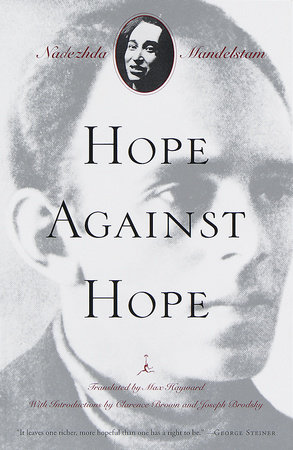
Hope Against Hope

A Memoir

Introduction by Clarence Brown
Translated by Max Hayward
Look inside
Paperback
$27.00 US
On sale Mar 30, 1999 | 480 Pages | 9780375753169

Hope Against Hope  is one of the greatest testaments to the value of literature and imaginative freedom ever written. Praising Nadezhda Mandelstam's classic memoir, Joseph Brodsky wrote that it "amount[s] to a Day of Judgement on earth for her age," adding, "her memoirs are something more than a testimony to her times; they are a view of history in the light of conscience and culture."  Now restored to print, this is perhaps the most powerful account of life in Stalin's Russia ever written.  A harrowing memoir that recounts Mandelstam's last years with her husband, the poet Osip Mandelstam,  it begins with his first arrest in 1934 and ends with his final incarceration in 1938, at the end of the Great Purges.  Marked by a gut-wrenching immediacy, the book brings to life the vibrant Russian intelligentsia of the time--among others, we meet Anna Akhmatova, Boris Pasternak, Maxim Gorky, Ilia Ehrenburg, and Mikhail Bulgakov--as well as some of our century's greatest villains, including Stalin and his inner circle.  At the heart of the story is Osip's decision not to compromise with a ruthless system; he consciously chooses martyrdom by denouncing Stalin in a poem.  As she provides a background to this act of defiance, Mandelstam offers unique insight into the terror state and the psychology of mass complicity, showing how an inner freedom in Stalin's Russia could only be purchased by death.  Translated by Max Hayward--the translator of Dr. Zhivago-- Hope Against Hope is that rare work that combines history and literature in a way that is unforgettable.

"Nothing one can say will either communicate or affect the genius of this book.  To pass judgment on it is almost insolence--even judgment that is merely celebration and homage... It leaves one richer, more hopeful than one has a right to be."
--George Steiner, The New Yorker

"Not merely a superb narrative of travail but also a valuable account of Russian cultural life and an equally valuable series of reflections on the nature of totalitarianism. Beautifully translated by Max Hayward, Hope Against Hope is a classic of its kind."
--Irving Howe  

"So churning in its impact, so tearfully brave and enduring, so horrifying and yet so intelligent that no one of sensibility dare deny himself knowing it."
--Faubion Bowers,  The Village Voice

"Hope Against Hope is at once a love story, an unblinking account of the decimation of a culture, and a luminous inquiry into what it means to be human.... Nadezhda Mandelstam's unswerving, unquestioned commitment to spiritual presence and witness answers a hunger we've almost forgotten we possess, and proves a startling antidote to the trivialization of meaning and relationship so endemic in current American life.... In preserving [Osip's] work, she fought to preserve witness to a people and culture nearly obliterated by the paroxysms of history, and to protect the human voice itself."
--Jayne Anne Phillips, Book Forum

NADEZHDA MANDELSTAM (1899-1980) was a Russian writer and educator, and the wife of the poet Osip Mandelstam, who died in 1938 in a Siberian transit camp of the Soviet gulag. She wrote two memoirs about their life together and the repressive Stalinist regime: Hope Against Hope (1970) and Hope Abandoned (1973), both first published in the West in English. View titles by Nadezhda Mandelstam
"        Nothing one can say will either communicate or affect the genius of this book. To pass judgment on it is almost insolence--even judgment that is merely celebration and homage."
--George Steiner, The New Yorker

"        Surely the most luminous account we have--or are likely to get--of life in the Soviet Union during the purges of the 1930's."
--Olga Carlisle, The New York Times Book Review

"        No work on Russia which I have recently read has given me so sensitive and searing an insight into the hellhouse which Russia became under Stalin as this dedicated and brilliant work on the poet Mandelstam by his devoted wife."
--Harrison E. Salisbury

Of the eighty-one years of her life, Nadezhda Mandelstam spent nineteen as the wife of Russia's greatest poet in this century, Osip Mandelstam, and forty-two as his widow. The rest was childhood and youth."
                So writes Joseph Brodsky in his appreciation of Nadezhda Mandelstam that is reprinted here as an Introduction. Hope Against Hope was first published in English in 1970. It is Nadezhda Mandelstam's memoir of her life with Osip, who was first arrested in 1934 and died in Stalin's Great Purge of 1937-38. Hope Against Hope is a vital eyewitness account of Stalin's Soviet Union and one of the greatest testaments to the value of literature and imaginative freedom ever written. But it is also a profound inspiration--a love story that relates the daily struggle to keep both love and art alive in the most desperate circumstances.

Nadezhda Mandelstam was born in Saratov in 1899. She met Osip Mandelstam in 1919. She is also the author of Hope Abandoned (1974). She died in 1980. Nadezhda means "hope" in Russian.

About

Hope Against Hope  is one of the greatest testaments to the value of literature and imaginative freedom ever written. Praising Nadezhda Mandelstam's classic memoir, Joseph Brodsky wrote that it "amount[s] to a Day of Judgement on earth for her age," adding, "her memoirs are something more than a testimony to her times; they are a view of history in the light of conscience and culture."  Now restored to print, this is perhaps the most powerful account of life in Stalin's Russia ever written.  A harrowing memoir that recounts Mandelstam's last years with her husband, the poet Osip Mandelstam,  it begins with his first arrest in 1934 and ends with his final incarceration in 1938, at the end of the Great Purges.  Marked by a gut-wrenching immediacy, the book brings to life the vibrant Russian intelligentsia of the time--among others, we meet Anna Akhmatova, Boris Pasternak, Maxim Gorky, Ilia Ehrenburg, and Mikhail Bulgakov--as well as some of our century's greatest villains, including Stalin and his inner circle.  At the heart of the story is Osip's decision not to compromise with a ruthless system; he consciously chooses martyrdom by denouncing Stalin in a poem.  As she provides a background to this act of defiance, Mandelstam offers unique insight into the terror state and the psychology of mass complicity, showing how an inner freedom in Stalin's Russia could only be purchased by death.  Translated by Max Hayward--the translator of Dr. Zhivago-- Hope Against Hope is that rare work that combines history and literature in a way that is unforgettable.

"Nothing one can say will either communicate or affect the genius of this book.  To pass judgment on it is almost insolence--even judgment that is merely celebration and homage... It leaves one richer, more hopeful than one has a right to be."
--George Steiner, The New Yorker

"Not merely a superb narrative of travail but also a valuable account of Russian cultural life and an equally valuable series of reflections on the nature of totalitarianism. Beautifully translated by Max Hayward, Hope Against Hope is a classic of its kind."
--Irving Howe  

"So churning in its impact, so tearfully brave and enduring, so horrifying and yet so intelligent that no one of sensibility dare deny himself knowing it."
--Faubion Bowers,  The Village Voice

"Hope Against Hope is at once a love story, an unblinking account of the decimation of a culture, and a luminous inquiry into what it means to be human.... Nadezhda Mandelstam's unswerving, unquestioned commitment to spiritual presence and witness answers a hunger we've almost forgotten we possess, and proves a startling antidote to the trivialization of meaning and relationship so endemic in current American life.... In preserving [Osip's] work, she fought to preserve witness to a people and culture nearly obliterated by the paroxysms of history, and to protect the human voice itself."
--Jayne Anne Phillips, Book Forum

Author

NADEZHDA MANDELSTAM (1899-1980) was a Russian writer and educator, and the wife of the poet Osip Mandelstam, who died in 1938 in a Siberian transit camp of the Soviet gulag. She wrote two memoirs about their life together and the repressive Stalinist regime: Hope Against Hope (1970) and Hope Abandoned (1973), both first published in the West in English. View titles by Nadezhda Mandelstam

Praise

"        Nothing one can say will either communicate or affect the genius of this book. To pass judgment on it is almost insolence--even judgment that is merely celebration and homage."
--George Steiner, The New Yorker

"        Surely the most luminous account we have--or are likely to get--of life in the Soviet Union during the purges of the 1930's."
--Olga Carlisle, The New York Times Book Review

"        No work on Russia which I have recently read has given me so sensitive and searing an insight into the hellhouse which Russia became under Stalin as this dedicated and brilliant work on the poet Mandelstam by his devoted wife."
--Harrison E. Salisbury

Of the eighty-one years of her life, Nadezhda Mandelstam spent nineteen as the wife of Russia's greatest poet in this century, Osip Mandelstam, and forty-two as his widow. The rest was childhood and youth."
                So writes Joseph Brodsky in his appreciation of Nadezhda Mandelstam that is reprinted here as an Introduction. Hope Against Hope was first published in English in 1970. It is Nadezhda Mandelstam's memoir of her life with Osip, who was first arrested in 1934 and died in Stalin's Great Purge of 1937-38. Hope Against Hope is a vital eyewitness account of Stalin's Soviet Union and one of the greatest testaments to the value of literature and imaginative freedom ever written. But it is also a profound inspiration--a love story that relates the daily struggle to keep both love and art alive in the most desperate circumstances.

Nadezhda Mandelstam was born in Saratov in 1899. She met Osip Mandelstam in 1919. She is also the author of Hope Abandoned (1974). She died in 1980. Nadezhda means "hope" in Russian.