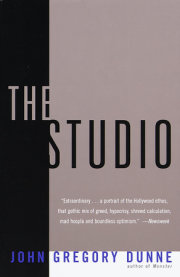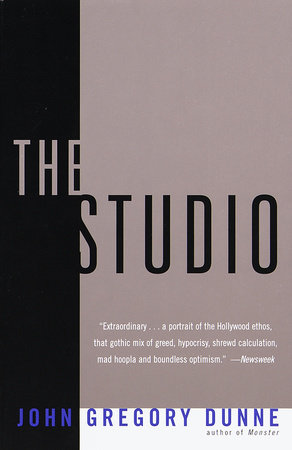

Thirty years ago, John Gregory Dunne was granted unlimited access to the inner workings of Twentieth Century Fox.  For one year he tracked every step of the creation of pictures like Dr. Dolittle, Planet of the Apes, and The Boston Strangler.  The result is a book that, three decades later, is still the most minutely detailed work of its kind.  In the course of researching The Studio, Dunne went everywhere there was to go and spoke with everyone worth talking to in the Fox organization.  He takes readers from bargaining sessions to script conferences, from the soundstage of Funny Girl to a premiere where the guests include a chimp in a white tie and tails, all the while capturing his subject in all its showmanship, savvy, vulgarity, and hype.  It is at once an unblinking critique and a celebration: it reveals the inner workings of the film industry like no other volume.  

"Extraordinary...a portrait of the Hollywood ethos, that gothic mix of greed, hypocrisy, shrewd calculation, mad hoopla, and boundless optimism."--Newsweek

"Reads as racily as a novel...(Dunne) has a novelist's ear for speech and eye for revealing detail...Anyone who has tiptoed along those corridors of power is bound to say that Dunne's impressionism rings true."--Los Angeles Times
© Quintana Roo Dunne
John Gregory Dunne wrote six novels—Vegas; True Confessions; Dutch Shea, Jr.; The Red White and Blue; Playland; and Nothing Lost—and seven works of nonfiction, among which are the memoir-like Harp and two books that look at Hollywood, The Studio and Monster. Born in West Hartford, Connecticut, in 1932, he graduated from Princeton in 1954. He collaborated with his wife, the writer Joan Didion, on many screenplays, including Panic in Needle Park and True Confessions. John Gregory Dunne died in December 2003. View titles by John Gregory Dunne

About

Thirty years ago, John Gregory Dunne was granted unlimited access to the inner workings of Twentieth Century Fox.  For one year he tracked every step of the creation of pictures like Dr. Dolittle, Planet of the Apes, and The Boston Strangler.  The result is a book that, three decades later, is still the most minutely detailed work of its kind.  In the course of researching The Studio, Dunne went everywhere there was to go and spoke with everyone worth talking to in the Fox organization.  He takes readers from bargaining sessions to script conferences, from the soundstage of Funny Girl to a premiere where the guests include a chimp in a white tie and tails, all the while capturing his subject in all its showmanship, savvy, vulgarity, and hype.  It is at once an unblinking critique and a celebration: it reveals the inner workings of the film industry like no other volume.  

"Extraordinary...a portrait of the Hollywood ethos, that gothic mix of greed, hypocrisy, shrewd calculation, mad hoopla, and boundless optimism."--Newsweek

"Reads as racily as a novel...(Dunne) has a novelist's ear for speech and eye for revealing detail...Anyone who has tiptoed along those corridors of power is bound to say that Dunne's impressionism rings true."--Los Angeles Times

Author

© Quintana Roo Dunne
John Gregory Dunne wrote six novels—Vegas; True Confessions; Dutch Shea, Jr.; The Red White and Blue; Playland; and Nothing Lost—and seven works of nonfiction, among which are the memoir-like Harp and two books that look at Hollywood, The Studio and Monster. Born in West Hartford, Connecticut, in 1932, he graduated from Princeton in 1954. He collaborated with his wife, the writer Joan Didion, on many screenplays, including Panic in Needle Park and True Confessions. John Gregory Dunne died in December 2003. View titles by John Gregory Dunne