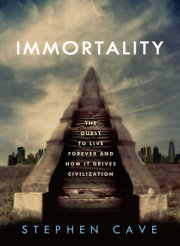
A fascinating work of popular philosophy and history that both enlightens and entertains, Stephen Cave’s Immortality investigates whether it just might be possible to live forever and whether we should want to. But it also makes a powerful argument, which is that it’s our very preoccupation with defying mortality that drives civilization.

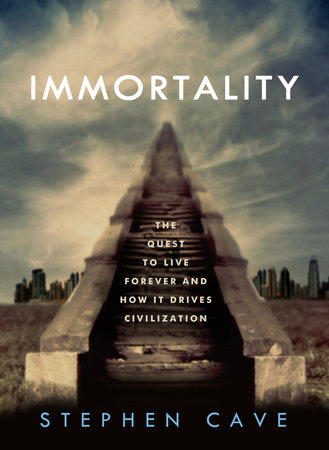
Central to this book is the metaphor of a mountaintop where one can find the Immortals. Since the dawn of humanity, everyone – whether they know it or not – has been trying to climb that mountain. But there are only four paths up its treacherous slope, and there have only ever been four paths. Throughout history, people have wagered everything on their choice of the correct path, and fought wars against those who’ve chosen differently.

While Immortality takes the reader on an eye-opening journey from the beginnings of civilization to the present day, the structure is not chronological. Rather it is path driven. As each path is revealed to us, an historical figure serves as our guide.

In drawing back the curtain on what compels humans to “keep on keeping on,” Cave engages the reader in a number of mind-bending thought experiments. He teases out the implications of each immortality gambit, asking, for example, how long a person would live if they did manage to acquire a perfectly disease-free body. Or what would happen if a super-being tried to round up the atomic constituents of all who’ve died in order to resurrect them. Or what our loved ones would really be doing in heaven if it does exist. Or what part of us actually lives in a work of art, and how long that work of art can survive.

Toward the the book’s end, we’re confronted with a series of brain-rattling questions: What would happen if tomorrow humanity discovered that there is no life but this one? Would people continue to care about their favorite sports team, please their boss, vie for the title of Year’s Best Salesman? Would three-hundred-year projects still get started? If the four paths up the Mount of the Immortals lead nowhere -- if there is no getting up to the summit -- is there still reason to live? And can civilization survive?

Immortality is a deeply satisfying book, as optimistic about the human condition as it is insightful about the true arc of history.

"A riveting read... excellent."
-- Elaine Storkey, BBC Radio 3

"An epic inquiry into the human desire to defy death – and how to overcome it.
Cave traces the histories of each of his four immortality narratives through the world’s great religions, heroes, leaders, thinkers and stories. It’s an epic tale of human folly, featuring a cast of characters including Gilgamesh, Dante, Frankenstein, the King of Qin, Alexander the Great and the Dalai Lama.
Cave, a Berlin-based writer and former diplomat, is an admirably clear elucidator, stripping down arguments to their essences and recounting them without any unnecessary jargon… [he] follows the right path to the right conclusion, rightly stated."
-- The Financial Times

"Stephen Cave's Immortality is a must-read exploration of what spurs human ingenuity.
Every once in a while a book comes along that catches me by surprise and provides me with an entirely new lens through which to view the world. My surprise is even greater when that "aha" moment comes within my own field of expertise. Such is the case with Stephen Cave's book Immortality.
Many will resist Cave's premise, but I think he is right on point. He presents an extremely compelling case - one that has changed my view of the driving force of civilisation as much as Jared Diamond did years ago with his brilliant book Guns, Germs and Steel. I won't tell you Cave's vision of where he thinks it will all end up - I'll leave that mystery for you to discover for yourself. This is a must read."
-- The New Scientist

“In his survey of the subject, Stephen Cave, a British philosopher, argues that man’s various tales of immortality can be boiled down into four basic “narratives”… For the aspiring undying, Mr Cave unfortunately concludes that immortality is a mirage. But his demolition project is fascinating in its own right. … If anything, readers might want more of Mr Cave’s crisp conversational prose.”
-- The Economist
Stephen Cave holds a Ph.D. in philosophy from Cambridge University and, before turning to full-time writing, worked as a diplomat.  He writes regularly for the Financial Times and also contributes to the New York Times. View titles by Stephen Cave
“Informed and metaphysically nuanced…Cave presents his arguments in a brisk, engaging style, and draws effectively upon a wide-ranging stock of religious, philosophical, and scientific sources, both ancient and contemporary.”
--Weekly Standard

“In his survey of the subject, Stephen Cave, a British philosopher, argues that man’s various tales of immortality can be boiled down into four basic “narratives”… For the aspiring undying, Mr Cave unfortunately concludes that immortality is a mirage. But his demolition project is fascinating in its own right…If anything, readers might want more of Mr. Cave’s crisp conversational prose.”
--The Economist

“A must-read exploration of what spurs human ingenuity.  Every once in a while a book comes along that catches me by surprise and provides me with an entirely new lens through which to view the world…Such is the case with Stephen Cave’s book Immortality…Cave presents an extremely compelling case – one that has changed my view of the driving force of civilization as much as Jared Diamond did years ago with his brilliant book Guns, Germs and Steel.”
--S. Jay Olshanksy, New Scientist magazine
 
"Cave explains how the seeking of immortality is the foundation of human achievement, the wellspring of art, religion and civilization...The author is rangy and recondite, searching the byways of elixirs, the surprises of alchemy, the faith in engineering and all the wonder to be found in discussions of life and death...Luminous."
--Kirkus Reviews
 
“A dramatic and frequently surprising story of the pursuit of immortality and its effects on human history.”
--Booklist

“A beautifully clear and entertaining look at life after death. Cave does not shrink from the hard questions. Bold and thought-provoking.”
—Eric Olson, author of The Human Animal and What Are We?
 
Immortality plumbs the depths of the human mind and ties the quest for the infinite prolongation of life into the very nature of civilization itself. Cave reveals remarkable depth and breadth of learning, yet is always a breeze to read. I thoroughly enjoyed his book—it’s a really intriguing study.”
—David Boyd Haycock, author of Mortal Coil and A Crisis of Brilliance
 
I loved this. Cave has set himself an enormous task and accomplished it—in spades. Establishing a four-level subject matter, he has stuck to his guns and never let up. As he left one level and went to the next, I was always a little worried: Would he be able to pull it off? This was especially true as he approached the end. There is a sense in which each level, as he left it smoking in the road, looked easy as he started the next. In fact, the last level, while it is the most difficult, is the best, the most satisfying. I am happy to live in the world Cave describes.”
— Charles Van Doren, author of A History of Knowledge
 
“Cave is smart, lucid, elegant and original. Immortality is an engaging read about our oldest obsession, and how that obsession propels some of our greatest accomplishments.”
—Greg Critser, author of Eternity Soup
 
“In Immortality Stephen Cave tells wonderful stories about one of humanity’s oldest desires and comes to a wise conclusion.”
— Stefan Klein, author of The Science of Happiness and The Secret Pulse of Time
 
“Cave has produced a strikingly original and compelling exploration of the age-old conundrum: Can we live forever, and do we really want to?”
—John Horgan, science journalist and author of The End of War

About

A fascinating work of popular philosophy and history that both enlightens and entertains, Stephen Cave’s Immortality investigates whether it just might be possible to live forever and whether we should want to. But it also makes a powerful argument, which is that it’s our very preoccupation with defying mortality that drives civilization.

Central to this book is the metaphor of a mountaintop where one can find the Immortals. Since the dawn of humanity, everyone – whether they know it or not – has been trying to climb that mountain. But there are only four paths up its treacherous slope, and there have only ever been four paths. Throughout history, people have wagered everything on their choice of the correct path, and fought wars against those who’ve chosen differently.

While Immortality takes the reader on an eye-opening journey from the beginnings of civilization to the present day, the structure is not chronological. Rather it is path driven. As each path is revealed to us, an historical figure serves as our guide.

In drawing back the curtain on what compels humans to “keep on keeping on,” Cave engages the reader in a number of mind-bending thought experiments. He teases out the implications of each immortality gambit, asking, for example, how long a person would live if they did manage to acquire a perfectly disease-free body. Or what would happen if a super-being tried to round up the atomic constituents of all who’ve died in order to resurrect them. Or what our loved ones would really be doing in heaven if it does exist. Or what part of us actually lives in a work of art, and how long that work of art can survive.

Toward the the book’s end, we’re confronted with a series of brain-rattling questions: What would happen if tomorrow humanity discovered that there is no life but this one? Would people continue to care about their favorite sports team, please their boss, vie for the title of Year’s Best Salesman? Would three-hundred-year projects still get started? If the four paths up the Mount of the Immortals lead nowhere -- if there is no getting up to the summit -- is there still reason to live? And can civilization survive?

Immortality is a deeply satisfying book, as optimistic about the human condition as it is insightful about the true arc of history.

"A riveting read... excellent."
-- Elaine Storkey, BBC Radio 3

"An epic inquiry into the human desire to defy death – and how to overcome it.
Cave traces the histories of each of his four immortality narratives through the world’s great religions, heroes, leaders, thinkers and stories. It’s an epic tale of human folly, featuring a cast of characters including Gilgamesh, Dante, Frankenstein, the King of Qin, Alexander the Great and the Dalai Lama.
Cave, a Berlin-based writer and former diplomat, is an admirably clear elucidator, stripping down arguments to their essences and recounting them without any unnecessary jargon… [he] follows the right path to the right conclusion, rightly stated."
-- The Financial Times

"Stephen Cave's Immortality is a must-read exploration of what spurs human ingenuity.
Every once in a while a book comes along that catches me by surprise and provides me with an entirely new lens through which to view the world. My surprise is even greater when that "aha" moment comes within my own field of expertise. Such is the case with Stephen Cave's book Immortality.
Many will resist Cave's premise, but I think he is right on point. He presents an extremely compelling case - one that has changed my view of the driving force of civilisation as much as Jared Diamond did years ago with his brilliant book Guns, Germs and Steel. I won't tell you Cave's vision of where he thinks it will all end up - I'll leave that mystery for you to discover for yourself. This is a must read."
-- The New Scientist

“In his survey of the subject, Stephen Cave, a British philosopher, argues that man’s various tales of immortality can be boiled down into four basic “narratives”… For the aspiring undying, Mr Cave unfortunately concludes that immortality is a mirage. But his demolition project is fascinating in its own right. … If anything, readers might want more of Mr Cave’s crisp conversational prose.”
-- The Economist


Author

Stephen Cave holds a Ph.D. in philosophy from Cambridge University and, before turning to full-time writing, worked as a diplomat.  He writes regularly for the Financial Times and also contributes to the New York Times. View titles by Stephen Cave

Praise

“Informed and metaphysically nuanced…Cave presents his arguments in a brisk, engaging style, and draws effectively upon a wide-ranging stock of religious, philosophical, and scientific sources, both ancient and contemporary.”
--Weekly Standard

“In his survey of the subject, Stephen Cave, a British philosopher, argues that man’s various tales of immortality can be boiled down into four basic “narratives”… For the aspiring undying, Mr Cave unfortunately concludes that immortality is a mirage. But his demolition project is fascinating in its own right…If anything, readers might want more of Mr. Cave’s crisp conversational prose.”
--The Economist

“A must-read exploration of what spurs human ingenuity.  Every once in a while a book comes along that catches me by surprise and provides me with an entirely new lens through which to view the world…Such is the case with Stephen Cave’s book Immortality…Cave presents an extremely compelling case – one that has changed my view of the driving force of civilization as much as Jared Diamond did years ago with his brilliant book Guns, Germs and Steel.”
--S. Jay Olshanksy, New Scientist magazine
 
"Cave explains how the seeking of immortality is the foundation of human achievement, the wellspring of art, religion and civilization...The author is rangy and recondite, searching the byways of elixirs, the surprises of alchemy, the faith in engineering and all the wonder to be found in discussions of life and death...Luminous."
--Kirkus Reviews
 
“A dramatic and frequently surprising story of the pursuit of immortality and its effects on human history.”
--Booklist

“A beautifully clear and entertaining look at life after death. Cave does not shrink from the hard questions. Bold and thought-provoking.”
—Eric Olson, author of The Human Animal and What Are We?
 
Immortality plumbs the depths of the human mind and ties the quest for the infinite prolongation of life into the very nature of civilization itself. Cave reveals remarkable depth and breadth of learning, yet is always a breeze to read. I thoroughly enjoyed his book—it’s a really intriguing study.”
—David Boyd Haycock, author of Mortal Coil and A Crisis of Brilliance
 
I loved this. Cave has set himself an enormous task and accomplished it—in spades. Establishing a four-level subject matter, he has stuck to his guns and never let up. As he left one level and went to the next, I was always a little worried: Would he be able to pull it off? This was especially true as he approached the end. There is a sense in which each level, as he left it smoking in the road, looked easy as he started the next. In fact, the last level, while it is the most difficult, is the best, the most satisfying. I am happy to live in the world Cave describes.”
— Charles Van Doren, author of A History of Knowledge
 
“Cave is smart, lucid, elegant and original. Immortality is an engaging read about our oldest obsession, and how that obsession propels some of our greatest accomplishments.”
—Greg Critser, author of Eternity Soup
 
“In Immortality Stephen Cave tells wonderful stories about one of humanity’s oldest desires and comes to a wise conclusion.”
— Stefan Klein, author of The Science of Happiness and The Secret Pulse of Time
 
“Cave has produced a strikingly original and compelling exploration of the age-old conundrum: Can we live forever, and do we really want to?”
—John Horgan, science journalist and author of The End of War